


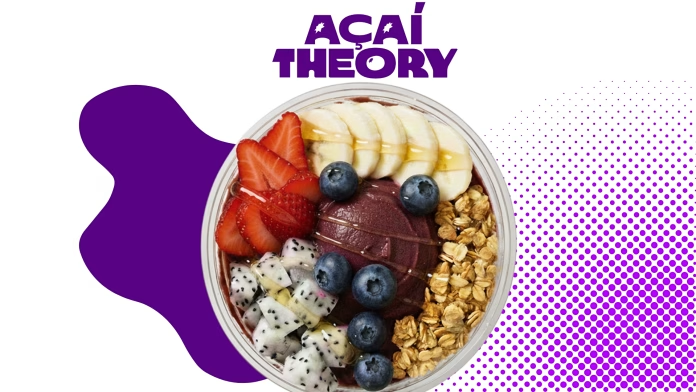
Açaí Theory has secured ₹4 crore in pre-seed funding, led by All In Capital and TDV Partners, signaling rising investor conviction in India’s “healthy indulgence” food category. Founded in 2025 by Rishav Ranjan and Akash Kyal, the Bengaluru-based startup is attempting to carve out a new niche in India’s QSR ecosystem—one that blends nutrition, convenience, and taste rather than forcing a trade-off between them.
The origin story reflects a classic “exposure gap” insight. Ranjan, having experienced the popularity of açaí bowls in Dubai, identified a whitespace in India where nutrient-dense, premium yet convenient food formats were largely missing. Since launching its flagship outlet in Bengaluru in October 2025, the brand has already served 10,000+ bowls, offering early validation that Indian urban consumers are willing to pay for functional, feel-good food—especially when it is positioned as indulgent rather than restrictive.
At the heart of Açaí Theory’s model is its assembly-only QSR format. Unlike traditional kitchens, there is no on-site cooking, which dramatically simplifies operations. Products like açaí bowls, smoothies, and superfood snacks are assembled using pre-prepared bases and toppings, enabling faster service, lower manpower requirements, and tighter quality control. This model is particularly well-suited for scaling, as it reduces variability—a major challenge in food businesses.
To support this, the company plans to set up a central kitchen, which will standardize its proprietary açaí base and toppings. This ensures that every outlet delivers consistent taste and texture, a key factor in building brand trust in the food category. It also allows for better inventory planning and cost efficiencies, especially when dealing with imported ingredients like Brazilian açaí berries.
The funding will primarily be used to expand within Bengaluru, with a target of 8–10 outlets over the next 15–18 months. The company is following a cluster-led expansion strategy, focusing on density within a single city before moving outward—similar to successful QSR and café chains. This approach helps optimize logistics, marketing efficiency, and brand recall.
A notable differentiator is Açaí Theory’s push toward AI-led operations. The brand is integrating technology to forecast demand, manage inventory, and digitize SOPs, effectively making the business “plug-and-play” for future franchising. This is a forward-looking move, as scalability in QSR often hinges on how easily operations can be replicated without compromising quality.
The investor lineup further strengthens the brand’s strategic direction, with participation from leaders like Rinshul Chandra, bringing deep expertise in food delivery and consumer behavior. This aligns with Açaí Theory’s ambition to tap into the growing demand for healthy options on platforms like Zomato and Swiggy, where “healthy” and “protein-rich” searches are seeing rapid growth.
Zooming out, Açaí Theory is riding a broader macro trend: the shift toward “convenient wellness.” Urban consumers—especially in the 18–35 demographic—are increasingly seeking food that supports fitness and lifestyle goals but still feels indulgent. This has led to the rise of categories like smoothie bowls, protein snacks, and clean-label QSR formats globally, and India is now entering that phase.
In essence, Açaí Theory is not just building a food brand—it is building a format innovation in Indian QSR. By combining assembly efficiency, centralized production, and tech-enabled operations, it is positioning itself to scale rapidly in a category that is still largely underpenetrated but primed for growth.