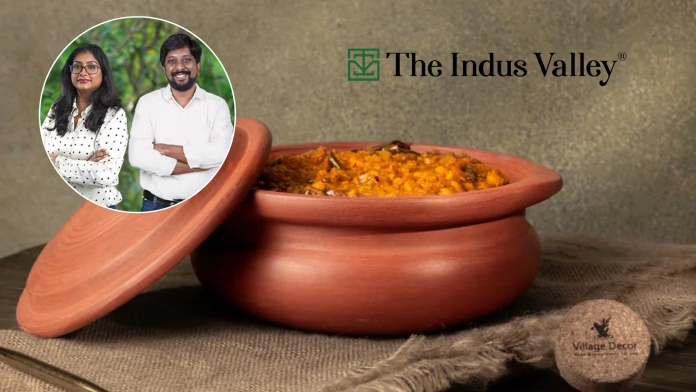
The rise of The Indus Valley is a compelling example of how deeply personal problems can evolve into category-defining businesses. What began in 2016 as a simple kitchen accident—when founders Jagadeesh Kumar and Madhumitha Uday Kumar witnessed a plastic container melt under heat—sparked a larger realization about the hidden risks in everyday cookware. Today, that moment has translated into a ₹200 crore revenue brand that is steadily challenging the dominance of traditional non-stick cookware in Indian households.
At the heart of The Indus Valley’s success lies its sharp identification of an “invisible problem” in Indian kitchens. For decades, convenience-driven choices like non-stick cookware—often coated with PTFE—have been widely adopted. However, concerns around PFOA and PFAS, commonly referred to as “forever chemicals,” have grown, especially as studies suggest these coatings can degrade under high heat or damage, potentially leaching harmful substances into food. Despite this, consumers historically had limited alternatives: either continue using chemical-coated cookware or switch to traditional materials like cast iron, which were often seen as cumbersome and difficult to maintain.
The Indus Valley’s breakthrough came from reimagining these traditional materials rather than replacing them. Instead of creating another synthetic solution, the brand leaned into age-old cookware formats—cast iron, tri-ply stainless steel, and clay—and applied modern engineering to make them more accessible for contemporary consumers. For instance, while traditional cast iron required labor-intensive seasoning, the company introduced pre-seasoned cookware ready for immediate use. It also optimized weight and thickness for compatibility with modern induction cooktops, addressed durability issues through improved casting techniques, and ensured safety through NABL-certified toxin-free materials.
This “modernizing tradition” approach has proven highly effective, aligning with a broader shift in consumer behavior where health-conscious choices are extending beyond food to include cooking tools and kitchen ecosystems. The brand’s growth trajectory reflects this shift. By FY26, The Indus Valley crossed ₹200 crore in revenue, built a customer base of over one million households, and expanded beyond its initial direct-to-consumer roots into major marketplaces like Amazon and Flipkart, along with premium offline retail channels.
Backing this growth is Rukam Capital, which has supported the company through multiple stages of funding, contributing to a total capital raise of around $8 million. Rukam’s investment thesis centers on “founder-problem fit”—a belief that founders who have personally experienced a problem are more likely to build enduring solutions. In this case, the founders’ lived experience translated into a long-term commitment to toxin-free cookware, rather than a short-term pursuit of market trends.
Looking ahead, The Indus Valley is positioning itself for the next phase of growth by expanding beyond core cookware into a broader “holistic kitchen” ecosystem. This includes innovations like smart cookware equipped with temperature sensors to prevent overheating, as well as adjacent categories such as non-toxic storage solutions and organic cleaning products. The company is also exploring international markets, particularly in the US and the Middle East, where demand for premium, health-oriented kitchenware is rising.
In essence, The Indus Valley’s journey underscores a larger transformation in India’s consumer landscape—where functionality alone is no longer enough, and safety, transparency, and authenticity are becoming central to brand value. By bridging traditional wisdom with modern usability, the company is not just selling cookware, but reshaping how Indian consumers think about what goes into—and around—their food.