


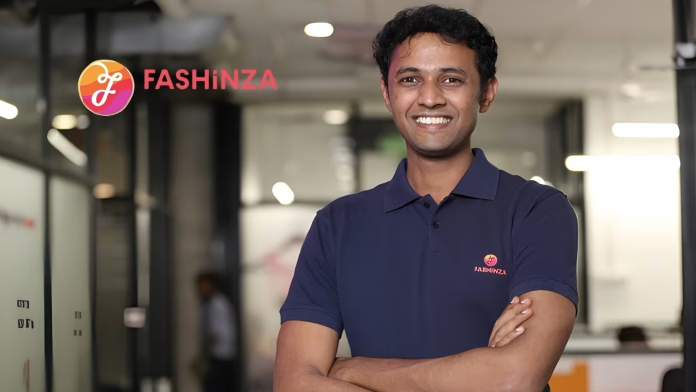
Fashinza, one of India’s most closely watched B2B fashion-tech startups, is entering a major new chapter following the departure of co-founder and CEO Pawan Gupta. The Accel-backed company confirmed that Gupta has officially stepped down from his leadership role to launch a new venture focused entirely on Artificial Intelligence, marking one of the most significant founder transitions in India’s startup ecosystem this year.
The move leaves Abhishek Sharma as the sole remaining original founder and the new CEO of the Gurugram-based supply chain platform. While leadership changes often signal instability in high-growth startups, insiders suggest this transition had been gradually unfolding behind the scenes since late 2025, when Gupta reportedly became non-operational in the business.
Gupta’s exit reflects a broader trend currently reshaping the global startup ecosystem: the migration of top founders and operators toward the AI sector. According to Gupta, the rapid acceleration of generative AI and automation convinced him that the next two decades of technological innovation would be fundamentally shaped by artificial intelligence. The opportunity to build something “AI-native” became too compelling to ignore.
At the same time, Fashinza itself has undergone a dramatic transformation since its early years. Initially positioned as a software-led platform simplifying apparel sourcing and manufacturing, the company has increasingly evolved into a deeply operational business centered around factories, logistics, and physical supply chains. That transition appears to have played a major role in Gupta’s decision to move on.
In many ways, Fashinza’s journey mirrors the evolution of several Indian B2B startups that began as “asset-light marketplaces” before eventually moving deeper into infrastructure ownership. Over the last two years, the company has aggressively expanded its manufacturing footprint, integrating technology directly into production clusters across India, Bangladesh, and China.
The clearest signal of this shift came in April 2026 when Fashinza acquired manufacturing player Qckin, strengthening its push toward vertical integration. The acquisition highlighted the company’s larger ambition of controlling more of the design-to-delivery cycle for global fashion brands seeking faster and more efficient production timelines.
Under Abhishek Sharma’s leadership, Fashinza is now doubling down on what insiders describe as its “FactoryOS” strategy — embedding software, workflow automation, and data systems directly into manufacturing operations rather than functioning purely as a sourcing intermediary.
This operational pivot represents a significant strategic evolution for the company. Instead of simply connecting brands with suppliers, Fashinza is positioning itself as a technology-enabled manufacturing infrastructure platform capable of managing the complexities of global apparel production at scale.
Despite the leadership transition, the company’s financial position remains relatively stable compared to many venture-backed startups navigating today’s funding environment. Fashinza has raised more than $120 million from major investors including Accel, WestBridge Capital, and Prosus, giving it one of the strongest institutional backings in India’s B2B commerce sector.
Financially, the company also appears to be moving closer toward operational sustainability. According to filings referenced in U.S. disclosures, Fashinza reported consolidated revenue of approximately ₹200 crore in FY25 and posted a reported profit of ₹1 crore during the same period — a notable milestone for a business operating in a traditionally margin-heavy manufacturing ecosystem.
The transition also reflects a deeper phenomenon often described in startup circles as the “Founder-Market Fit Lifecycle.” Early-stage founders who thrive during the “zero-to-one” phase of company building are often strongest in product design, software development, and rapid experimentation. However, as companies mature into operationally intensive businesses, the required leadership skill set changes dramatically.
For Fashinza, the challenge is no longer simply building software. It now involves:
- factory operations,
- manufacturing quality control,
- labor management,
- sourcing complexity,
- and global logistics coordination.
That evolution naturally favors operators with deep execution capabilities over product-first founders.
Gupta’s departure therefore appears less like a breakdown and more like a strategic divergence driven by changing company dynamics and personal ambition. By leaving during Fashinza’s operational stabilization phase, he joins a growing wave of second-generation Indian entrepreneurs pivoting into AI after building successful commerce and fintech startups.
Across India’s startup ecosystem, former founders and senior operators from companies like Swiggy, BharatPe, and Udaan are increasingly redirecting their attention toward generative AI infrastructure, workflow automation, and enterprise intelligence tools. Gupta’s move places him directly within that emerging founder cohort.
For Fashinza itself, the road ahead is becoming increasingly clear. The company is no longer positioning itself merely as a “fashion-tech startup.” It is evolving into a manufacturing operating system designed to power global apparel supply chains through a blend of physical infrastructure and embedded technology.
If successful, that shift could fundamentally redefine how Indian manufacturing platforms compete on the global stage — not just through low-cost labor, but through speed, software integration, and production intelligence.