


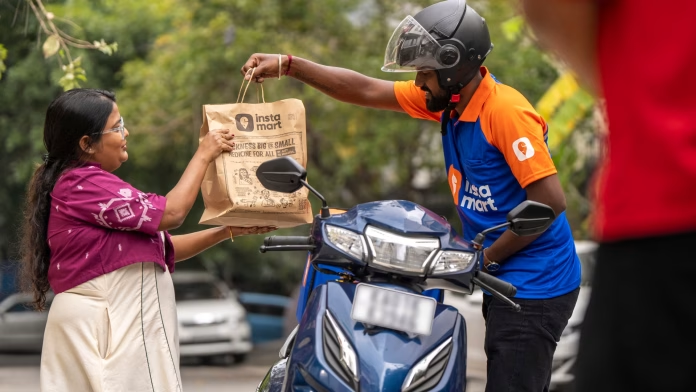
Swiggy delivered a strong operational performance in Q4 FY26, with its quick-commerce arm Instamart continuing to emerge as the company’s biggest growth engine amid India’s intensifying 10-minute delivery battle. Despite aggressive competition from Blinkit and Zepto, Instamart recorded a massive 68.8% year-on-year jump in Gross Order Value (GOV), reaching ₹7,881 crore during the quarter.
The results reinforce Swiggy’s growing dominance in the quick-commerce segment, while also signaling an important shift in investor sentiment around the sector: growth is no longer enough — profitability and operational efficiency are now becoming equally critical.
While Swiggy’s full-year losses widened due to heavy infrastructure investments and expansion costs, the company reported a noticeable narrowing of quarterly losses in Q4 FY26. This has strengthened confidence that the economics of quick commerce are gradually stabilizing after years of cash-intensive expansion.
Instamart’s growth continues to be fueled by rising consumer adoption beyond groceries. What initially began as a convenience-led grocery platform is now rapidly evolving into a broader on-demand retail ecosystem.
Swiggy has aggressively expanded into:
- electronics,
- beauty products,
- personal care,
- home essentials,
- and impulse-driven lifestyle categories.
These newer verticals are helping improve Average Order Value (AOV), which has become a key lever in reducing operational burn.
At the same time, Swiggy is increasingly monetizing the “digital shelf space” within Instamart.
Advertising revenue from D2C brands and FMCG companies has emerged as a significant contributor to margin improvement. Brands are now paying premium placement fees for:
- search visibility,
- homepage discovery,
- and personalized recommendation slots.
This ad-led monetization model is helping offset delivery and fulfillment costs while improving contribution margins at the order level.
Operational efficiency has also improved through increased dark-store density and better logistics optimization.
Swiggy has expanded aggressively into Tier-II cities over the last year, moving beyond its traditional strongholds in Bengaluru, Mumbai, Delhi, and Hyderabad. Higher order density in newer markets is improving fleet utilization and reducing per-order logistics costs.
Internally, Swiggy has also invested heavily in predictive inventory management and supply-chain automation.
The company has reportedly implemented:
- robotics-assisted picking systems,
- smarter inventory forecasting,
- and faster warehouse workflows
across major dark-store hubs to reduce wastage and improve delivery speed consistency.
This operational tightening is becoming increasingly important as investors begin scrutinizing the sustainability of quick-commerce economics more closely.
Swiggy’s FY26 financial story reflects a larger industry reality: India’s quick-commerce market is transitioning from a “growth war” into an “efficiency war.”
Over the last two years, companies across the sector spent aggressively on:
- dark-store expansion,
- customer acquisition,
- discounting,
- and delivery infrastructure.
Swiggy was no exception.
The company’s widening full-year losses were largely driven by what industry observers are calling its “2025 Capex Blitz” — a period marked by heavy investments in:
- dark-store infrastructure,
- logistics expansion,
- and ecosystem integration.
Swiggy also continued scaling adjacent businesses like:
- Dineout,
- SteppinOut,
- and offline lifestyle integrations
as part of its ambition to become a broader “super app” rather than just a food-delivery company.
The company’s delivery fleet has now expanded to over 400,000 active partners, creating one of the largest hyperlocal logistics networks in India.
However, the narrowing quarterly losses in Q4 suggest that the scale benefits of these investments are finally beginning to materialize.
A key driver behind this transition is Swiggy’s increasing focus on retention and customer lifetime value rather than pure user acquisition.
The company’s recent partnership with MoEngage and its growing investment in AI-led personalization indicate a broader strategic pivot toward:
- behavioral engagement,
- ecosystem stickiness,
- and higher-frequency ordering.
In India’s highly competitive quick-commerce market, retaining users profitably is now becoming more valuable than simply adding new users at scale.
For the broader startup ecosystem, Swiggy’s Q4 FY26 performance carries major significance.
The quick-commerce industry has faced increasing skepticism over the last two years due to concerns around:
- unsustainable burn,
- thin margins,
- and excessive discounting.
Swiggy’s improving contribution margins and narrowing quarterly losses now suggest that the operational side of the business is slowly catching up to the scale of consumer demand.
The company’s performance also reinforces a larger behavioral shift in urban India.
Quick commerce is no longer limited to emergency grocery purchases.
It is increasingly becoming an everyday consumption infrastructure layer for:
- food,
- essentials,
- beauty,
- electronics,
- and impulse shopping.
That shift dramatically expands the long-term market opportunity for players like Swiggy Instamart.
The challenge now is execution discipline.
As the sector matures, the winners are unlikely to be determined solely by delivery speed or discounting power.
Instead, leadership will increasingly depend on:
- logistics efficiency,
- inventory intelligence,
- advertising monetization,
- and customer retention economics.
Swiggy’s Q4 FY26 results suggest the company is beginning to align all four.