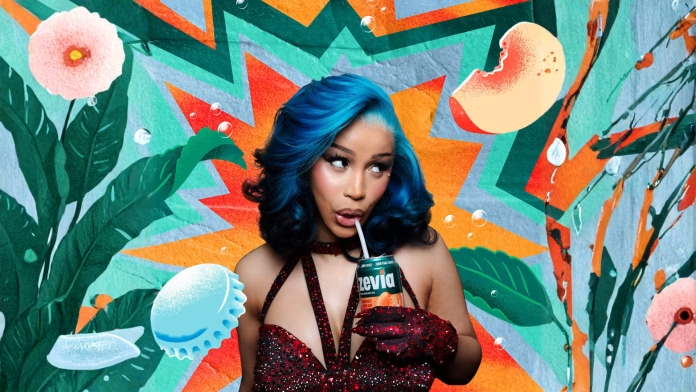
Zevia PBC, the zero-sugar soda company built around naturally sweetened beverages, delivered one of the strongest quarters in its history as the brand continues its transformation from niche wellness product to mainstream beverage contender. Reporting its Q1 2026 earnings on May 6, the company posted record net sales of $46.1 million, marking a 21.2% year-over-year increase and signaling that its multi-year restructuring strategy is finally beginning to compound.
The results represent a major milestone for CEO Amy Taylor, the former Red Bull North America executive who took over the business during a period of operational instability and slowing growth. Since then, Taylor has focused on rebuilding Zevia’s retail presence, simplifying the company’s cost structure, and repositioning the brand as a culturally relevant lifestyle beverage rather than a purely “health-focused” soda alternative.
The strongest signal from the quarter was that Zevia’s growth is now being driven primarily by volume rather than pricing. Net sales growth was fueled by a 20.4% increase in volumes, suggesting that consumer demand for zero-sugar, naturally sweetened soda continues to accelerate despite broader inflationary pressures affecting the beverage industry.
The company also reported a dramatic improvement in profitability metrics. Net losses narrowed to $2.4 million, compared to a loss of $6.4 million during the same period last year. More importantly, adjusted EBITDA turned positive at $0.9 million — marking the company’s first meaningful EBITDA-positive quarter in recent history and reinforcing investor confidence that Zevia’s turnaround strategy is entering a more sustainable phase.
While the top-line momentum was impressive, Zevia still faced margin pressure from rising commodity and logistics costs. Gross margin slipped slightly to 48.4%, down from 50.1% a year earlier, primarily due to higher aluminum pricing and fuel-related expenses. However, management successfully offset much of that pressure through aggressive operational optimization and tighter marketing efficiency.
One of the most important drivers behind the quarter was Zevia’s evolving distribution strategy under Taylor’s leadership. The company has increasingly prioritized high-velocity retail channels capable of rapidly scaling household penetration.
The biggest contributor was the “Club Channel,” particularly a successful national rotation at Costco. The placement significantly expanded Zevia’s consumer reach and introduced the brand to a broader mainstream audience beyond its traditional wellness-focused demographic.
At the same time, Zevia continued strengthening its shelf presence across major grocery and mass retail accounts including Kroger and other large-format chains. E-commerce also remained a strong contributor, with the company reporting double-digit digital growth as Zevia continues to perform strongly within the “Better-for-You” beverage category on Amazon.
However, the quarter’s most visible growth catalyst was undoubtedly the company’s new partnership with rapper and cultural icon Cardi B. The two-year collaboration represents one of the most aggressive marketing pivots in Zevia’s history and reflects the company’s attempt to fundamentally reshape consumer perception around zero-sugar soda.
Historically, Zevia’s branding leaned heavily into “health-conscious” consumers, often attracting shoppers focused on wellness, fitness, or clean-label ingredients. While effective in building early loyalty, that positioning limited the company’s mainstream cultural reach.
The Cardi B partnership changes that narrative entirely.
Within its first week, the campaign reportedly generated over 152 million media impressions, helping Zevia tap into a younger, more culturally engaged consumer base. The collaboration is designed to “age down” the brand and reposition zero-sugar soda as an aspirational lifestyle choice rather than simply a dietary substitute.
Simultaneously, the company is rolling out a broader visual refresh aimed at modernizing packaging and improving shelf standout. The redesign is intended to make Zevia feel more emotionally relevant within the increasingly competitive “modern soda” category, where brands like Olipop and Poppi are aggressively competing for younger consumers through aesthetics, storytelling, and functional positioning.
Industry analysts increasingly view Zevia as part of a much larger structural shift within the global beverage market. Traditional soda consumption patterns are evolving rapidly as consumers seek:
- lower sugar,
- cleaner labels,
- functional ingredients,
- and more transparent formulations.
Stevia-based beverages, once considered niche alternatives, are now becoming increasingly mainstream as shoppers grow more skeptical of artificial sweeteners and high-calorie soft drinks.
What makes Zevia’s current moment especially important is that the company appears to be balancing growth with operational discipline — something many emerging beverage brands struggle to achieve. Selling and marketing expenses dropped significantly as a percentage of net sales, falling from 40% to 31.5%, highlighting the effectiveness of the company’s broader productivity initiatives around warehousing, logistics, and retail execution.
Ultimately, Zevia’s Q1 performance signals that the company may finally be moving beyond its identity as a specialty wellness soda brand. Under Amy Taylor’s leadership, the business is increasingly positioning itself as a legitimate long-term challenger within the mainstream beverage industry — one aiming to build a “third lane” in soda culture alongside legacy giants Coca-Cola and PepsiCo.