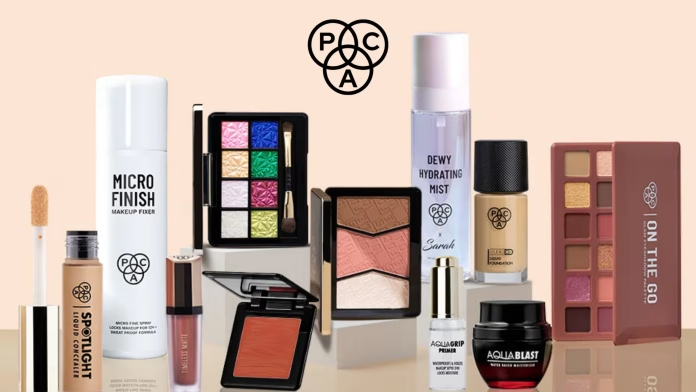
In an industry often dominated by venture-funded growth and aggressive customer acquisition spends, PAC Cosmetics has emerged as a notable outlier, crossing the ₹100 crore revenue milestone in FY26 while remaining fully bootstrapped and profitable. The Mumbai-based brand reported a steady 30 percent year-on-year growth, underscoring a disciplined, product-led scaling strategy that contrasts sharply with the high-burn models commonly seen across the Indian D2C beauty ecosystem.
Founded in 2006 by Bonish Jain, PAC has steadily evolved from a niche, professional-grade makeup brand used primarily by artists into a mass-premium label with strong consumer recall. Unlike many new-age brands that prioritize rapid scale through external funding, PAC has consciously avoided raising private equity, choosing instead to build through internal accruals and reinvested profits. This approach has allowed the company to maintain EBITDA margins in the range of 20 to 25 percent, a benchmark that remains rare in the highly competitive beauty segment.
The brand’s financial performance reflects a focus on sustainable growth rather than short-term scale. With FY26 revenues surpassing ₹100 crore, PAC is projecting a further 20 to 25 percent growth in FY27, indicating continued momentum without compromising profitability. This balance between growth and margin discipline positions the company as a compelling case study in long-term brand building within India’s evolving beauty market.
A key driver of PAC’s success has been its emphasis on product innovation grounded in real-world usability. Under the leadership of Vaishnavi Jain, the brand has shifted toward what it describes as “intuitive makeup,” focusing on products that deliver professional-grade results while being easy to use in everyday conditions. This philosophy has translated into a series of differentiated launches in FY26, including a 4-in-1 magnetic makeup brush designed for portability and minimalism, a high-performance Studio HD liquid concealer tailored for humid climates, and an Aqua Foam primer that emphasizes lightweight, breathable application. These innovations highlight PAC’s ability to bridge the gap between professional artistry and consumer convenience.
From a distribution standpoint, PAC has built a well-balanced omnichannel presence. The company operates on a near 50:50 split between online and offline sales, with digital channels including its own D2C platform and major marketplaces complemented by a strong physical retail footprint spanning over 140 locations. This hybrid approach ensures accessibility while also enabling experiential discovery, which remains critical in the beauty category.
On the supply side, PAC has adopted a globally integrated manufacturing strategy, partnering with more than 60 laboratories across markets such as the United States, South Korea, Germany, and China. This allows the brand to maintain international formulation standards while retaining its identity as an Indian company. The combination of global sourcing and local market understanding has been instrumental in delivering consistent product quality across categories.
Looking ahead, PAC is preparing to extend its footprint beyond India, with regulatory filings underway for entry into markets such as Dubai, Nepal, and Sri Lanka by late 2026. This marks the beginning of its international expansion phase, leveraging its established product credibility and competitive pricing in the ₹600 to ₹1,200 range.
At a strategic level, PAC’s differentiation lies in its “professional-to-personal” positioning. By retaining the performance standards expected by makeup artists—such as high pigment payoff and long wear—while simplifying application for everyday users, the brand has successfully avoided being confined to a niche segment. This dual appeal has enabled it to build a loyal customer base without relying heavily on influencer-driven marketing or discount-led growth.
As competition intensifies with the entry of heavily funded domestic and global players, PAC’s trajectory demonstrates that disciplined execution, strong product-market fit, and community trust can create a durable competitive advantage. Its journey reinforces the idea that in the beauty industry, sustained profitability and brand authenticity can be as powerful as capital in driving long-term success.