


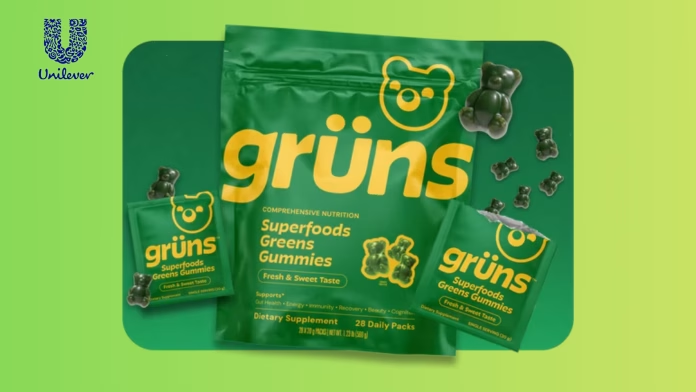
Unilever is undertaking one of the most significant strategic transformations in its history, combining the acquisition of fast-growing supplements brand Grüns with a sweeping exit from its traditional food business. Announced on April 9, 2026, the move signals Unilever’s definitive pivot toward becoming a pureplay Health and Personal Care (HPC) company, aligning its portfolio with higher-growth, higher-margin wellness categories.
At the center of this shift is the acquisition of Grüns, a U.S.-based vitamins, minerals, and supplements (VMS) brand that has scaled at remarkable speed since its launch in 2023. Founded by Chad Janis, the company built its success on reimagining how consumers engage with daily nutrition. Instead of traditional powders or capsules, Grüns introduced a gummy-based “greens” supplement format, combining over 60 functional ingredients—including prebiotics, adaptogens, and whole-food extracts—into a convenient, palatable product.
This innovation has resonated strongly with modern consumers, particularly those seeking ease of use and better taste in wellness routines. In under three years, Grüns has scaled to an annualized revenue run rate exceeding $300 million and expanded from a digital-first brand into major retail chains such as Walmart, Target, and Sprouts. Its rapid growth, combined with a $500 million valuation achieved in 2025, made it an attractive acquisition target for Unilever as it strengthens its foothold in the booming wellness segment.
The Grüns deal is not an isolated move but part of a much larger strategic realignment. Just days earlier, Unilever announced a landmark $44.8 billion transaction to merge its global food business with McCormick & Company. As part of the deal, Unilever will receive $15.7 billion in cash and retain a 65% equity stake in the combined entity. This effectively marks Unilever’s exit from the traditional packaged food category, which includes legacy brands like Knorr and Hellmann’s, and frees up capital and management focus for its core growth areas.
Post-restructuring, Unilever’s portfolio will be streamlined around four key pillars: Beauty & Wellbeing, Personal Care, Home Care, and Prestige Health. Within this framework, Grüns will be integrated into the company’s Wellbeing division, joining other high-growth brands and benefiting from Unilever’s global supply chain and distribution capabilities. The expectation is that Grüns will maintain its brand identity and innovation-led approach while leveraging Unilever’s scale to expand into international markets such as Asia and Australia.
This dual move—acquiring a high-growth wellness brand while divesting a legacy food business—reflects a broader industry trend. Large FMCG companies are increasingly reallocating capital toward categories that offer stronger growth potential and higher consumer engagement, particularly those linked to health, longevity, and self-care. The VMS segment, in particular, has emerged as a ключевой battleground, driven by rising consumer awareness around preventive health and daily supplementation.
From a financial perspective, the strategy also signals a shift toward asset-light, margin-accretive growth. Wellness brands like Grüns typically operate with higher gross margins and stronger direct-to-consumer relationships compared to traditional food businesses. By concentrating on these segments, Unilever aims to improve both profitability and valuation multiples in the long term.
At the same time, the company is not entirely exiting food but rather repositioning its exposure through a minority stake in the combined McCormick entity. This allows Unilever to retain upside potential in the category while reducing operational complexity and capital intensity.
Ultimately, this transformation represents a clear statement of intent. Unilever is moving away from being a broad-based consumer goods conglomerate toward becoming a focused, future-ready wellness and personal care leader. The acquisition of Grüns provides immediate access to a high-growth, culturally relevant brand, while the food divestment unlocks resources to scale similar opportunities globally.
If executed effectively, this pivot could redefine Unilever’s competitive positioning for the next decade—placing it at the forefront of the global shift toward health-driven consumption and lifestyle-oriented brands.