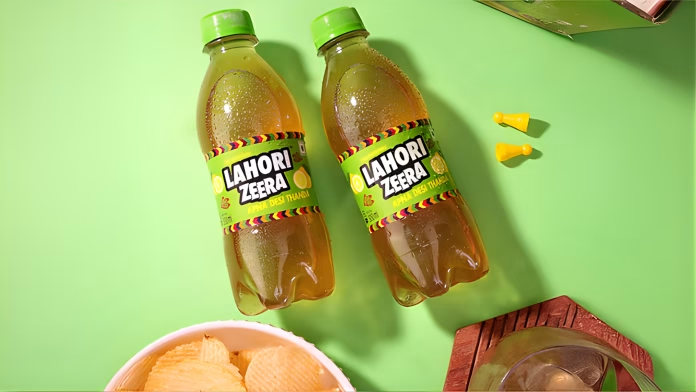
Chandigarh-based beverage brand Lahori Zeera is accelerating its growth strategy with a sharp focus on manufacturing scale and geographic expansion, aiming to reach ₹1,200–1,300 crore in revenue by FY27 after closing FY26 at around ₹770–780 crore. Backed by its parent Archian Foods, the brand is doubling down on capacity creation, which it identifies as the primary constraint to growth rather than demand.
To address this bottleneck, Lahori Zeera is expanding its production footprint through a hybrid model of owned facilities and third-party co-packers. The company is setting up five new bottling units across Bihar, Bengaluru, Muzaffarnagar, Agra, and Bhopal, complementing its existing plants in Lucknow, Mohali, and Vapi. Its Lucknow facility—currently operating at about 70% capacity—is expected to become fully operational in its second phase by next summer, significantly boosting output. Going forward, the brand plans to lean heavily on co-bottling, aligning with industry norms where scale is achieved through distributed manufacturing networks.
Despite these expansions, the company’s distribution backbone remains firmly rooted in general trade, which contributes nearly 97–98% of its volumes and spans 8–10 lakh retail outlets. This GT-led approach has enabled rapid penetration, especially in North India, where the brand already commands double-digit market share across key states like Punjab, Haryana, Delhi, and Himachal Pradesh. However, with supply constraints easing, Lahori Zeera is now opening up newer channels such as modern trade, institutional sales, and quick commerce—expected to contribute 8–9% of revenues in the coming fiscal. Notably, quick commerce is emerging as a high-growth lever, with projections of 3–4x year-on-year expansion.
Geographically, South India represents the next major growth frontier. The upcoming Bengaluru co-packing unit will act as a strategic hub for entering markets like Hyderabad, Bengaluru, and parts of Andhra Pradesh and Telangana. The company plans to replicate its proven playbook—starting with metro cities (population above 10 lakh) before expanding into smaller towns—ensuring both brand visibility and distribution efficiency.
On the product front, Lahori Zeera is broadening its portfolio beyond carbonated beverages. Larger pack sizes, ranging from ₹20 300 ml bottles to 2-litre formats, already contribute 16–17% of revenues, indicating strong consumer acceptance. The company is also preparing to launch a new non-carbonated offering, Lahori Aamras, in spout and PET bottle formats. After an initial general trade pilot in North India, the product will be rolled out across modern trade and quick commerce channels, marking a strategic diversification into adjacent beverage categories.
However, margin pressures remain a concern. Plastic—particularly PET resin—accounts for 40–45% of raw material costs, and recent crude-linked price increases have impacted input economics. While the company has implemented a modest price hike from April 1, it has absorbed part of the cost inflation to maintain competitive pricing in a highly price-sensitive category.
Operationally, the company is investing in technology and workforce expansion to support its scale ambitions. It runs on SAP as its ERP backbone and has deployed IoT systems across manufacturing units for real-time monitoring and efficiency optimization. Its workforce has grown to over 3,500 employees, with 400 new hires added in just the past two months.
Looking ahead, Lahori Zeera has set an ambitious internal target of ₹2,000 crore in revenue and is also exploring international expansion. Plans are underway to establish a co-bottling unit in the UAE to cater to Indian diaspora demand across GCC markets, signaling its intent to evolve from a regional success story into a global ethnic beverage brand.