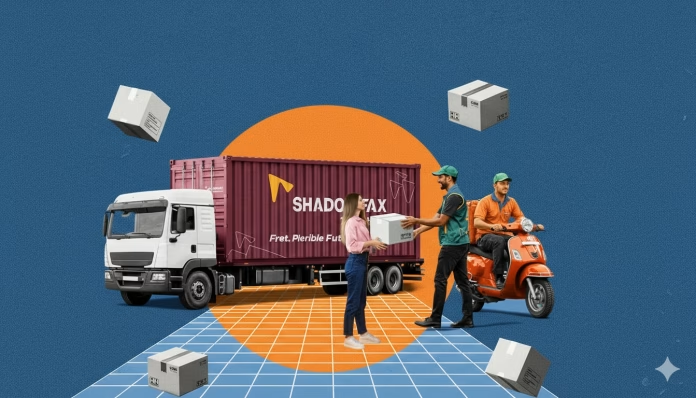
India’s logistics market is undergoing a structural shift. For nearly a decade, scale in ecommerce delivery was built around servicing large marketplaces at high volumes and low margins. Throughput mattered more than experience, and bulk contracts drove growth.
That model is now evolving — and Shadowfax is repositioning itself at the centre of the change.
After years as a marketplace-first logistics partner, the publicly listed company is pivoting toward same-day delivery, D2C brands, hyperlocal commerce and premium shipments. Management has identified quick commerce and direct-to-consumer logistics as the next major growth drivers.
In its latest earnings commentary, the company said Shadowfax Prime — its same-day and next-day fulfilment arm — is now its fastest-growing vertical. Two years ago, D2C volumes were negligible. Today, they account for early-teen market share and continue to expand at triple-digit year-on-year growth rates.
Moving closer to brands and consumers
Shadowfax’s strategy reflects a deliberate downstream shift — moving closer to brands, sellers and end consumers rather than relying primarily on large enterprise marketplace contracts.
D2C, B2C and SME clients offer 20–25% higher yields compared to enterprise marketplace customers. As this mix increases, revenue realisations improve and margins follow. In a sector historically characterised by thin profitability, that shift materially changes the economics.
The company describes the transition as an evolution. Large anchor clients helped build nationwide serviceability and infrastructure. With that foundation in place, Shadowfax is expanding toward smaller sellers and independent brands.
The Shadowfax Prime strategy
The company’s D2C playbook operates across three layers.
At the core is Shadowfax Prime, focused on mass-market D2C brands seeking faster fulfilment. The company is onboarding new clients across more than 100 cities and building self-serve onboarding flows that allow even micro sellers — including social commerce merchants — to begin nationwide shipping within minutes.
Second, the acquisition of CriticalLog has brought over 500 premium D2C brands onto the platform. These include jewellery, luxury apparel and electronics sellers — segments that require specialised handling and tighter operational controls. High-value, time-sensitive shipments have traditionally been underserved, but demand is rising as premium ecommerce expands.
Third, Shadowfax is expanding into volumetric deliveries. The company has built an annualised business of roughly ₹50 crore in large parcels and appliances, despite currently servicing only a fraction of its PIN codes for volumetric shipments. White goods logistics is expected to roll out in FY27, opening another higher-ticket revenue stream.
Same-day as standard
Same-day and next-day delivery are no longer premium features. They are increasingly baseline expectations across categories.
What began with groceries has now expanded to baby products, apparel, gourmet food and specialty retail. Shadowfax sees vertical quick commerce emerging across multiple consumer categories, driving demand for faster logistics infrastructure.
The company currently operates across more than 15,000 postal codes, supported by ongoing investments in sort centres, last-mile networks and gig rider orchestration. As density improves, routing efficiency increases and per-shipment costs decline.
Technology-led operating leverage
Unlike asset-heavy logistics operators, Shadowfax has prioritised a technology-first model. Rather than owning vehicles, the company focuses on gig network orchestration through AI-driven routing and clustering algorithms. The system optimises rider earnings per day rather than per shipment, improving partner productivity and reducing overall delivery costs.
This model creates operating leverage as network density grows. Partner expenses — the company’s largest cost component — have begun declining as a percentage of revenue, and management expects further efficiency gains as scale improves.
IPO flexibility and growth outlook
The IPO has provided capital and flexibility to onboard new marketplace clients and expand quick commerce integrations. Management expects revenue to grow at 25–30% annually over the next few years, driven by D2C growth, hyperlocal quick commerce and volumetric logistics.
Long-term EBITDA margins are guided toward the early teens, with expansion expected as higher-yield segments scale.
A broader industry transition
Shadowfax’s pivot mirrors a larger transformation within India’s startup ecosystem — from scale-driven contracts toward precision-led, margin-accretive growth models. Logistics players are diversifying beyond marketplace dependence, seeking direct relationships with brands and smaller sellers.
From Instagram entrepreneurs shipping their first order to luxury merchants promising same-day fulfilment, the demand for speed is reshaping retail infrastructure.
Shadowfax is positioning itself not merely as a delivery partner, but as a core enabler of India’s instant economy — betting that quick commerce will redefine how goods move across the country in the decade ahead.