India has emerged as a rare bright spot for global consumer goods giants Nestle SA and Reckitt Benckiser, even as both companies grapple with slowing growth and operational turbulence across major international markets.
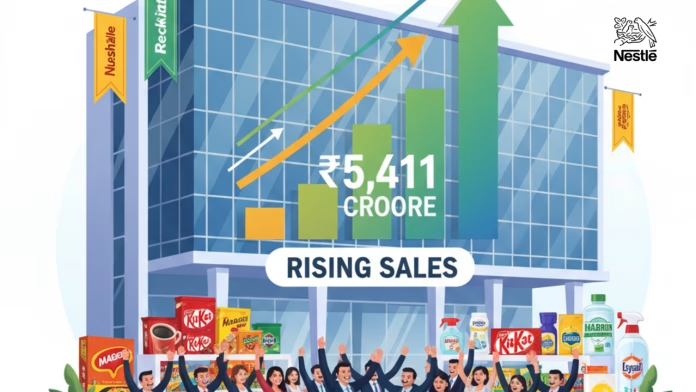
For the first time, Nestle SA spotlighted India in its post-earnings call as a high-performing market with strong growth momentum. The company’s global CFO, Anna Manz, credited continued investment in strategic emerging markets such as India, Malaysia, Indonesia, and Pakistan for offsetting weakness elsewhere. Nestle India, which manufactures popular brands like Maggi and Purina, reported a 10.8 percent year-on-year rise in domestic sales to ₹5,411 crore for the September quarter—its highest-ever quarterly revenue—driven by broad-based volume growth.
Globally, however, Nestle SA faced a challenging nine months, with sales slipping 1.9 percent year-on-year to $82.8 billion. The Swiss food major also underwent major leadership changes, including the exit of its chairman and two chief executives within a year. Newly appointed CEO Philipp Navratil announced plans to cut 16,000 jobs worldwide, calling the move a “hard but necessary decision” to realign operations.
Meanwhile, Reckitt Benckiser also highlighted India as a standout market, despite short-term disruptions caused by recent Goods and Services Tax (GST) adjustments. The company reported strong sell-out performance across its hygiene and health portfolio, including Dettol and Lysol, but noted that revenue growth was temporarily affected by the GST transition. Reckitt’s emerging markets segment grew 15.5 percent during the quarter, led by robust demand in India and China.
CFO Shannon Eisenhardt confirmed that India’s low single-digit growth in the September quarter was a result of GST-related phasing, with expectations of a rebound in the following months. Other FMCG majors such as Hindustan Unilever, Dabur, and Godrej Consumer Products have also flagged similar short-term disruptions linked to the GST overhaul.
India’s sustained consumer demand and expanding retail ecosystem, however, continue to anchor optimism for multinational players betting on emerging markets for future growth.