Home Blog

Start following Kiara Advani’s simple yet powerful morning ritual for glowing skin

Have you ever stopped to marvel at Kiara Advani’s radiant and flawless skin? In the exquisite glamour that is Bollywood, Kiara Advani stands out not just for her acting genius but also for her luminous and healthy skin. Amidst the overwhelming myriad of options surfaced by the beauty industry, this simple yet transformative ritual is not only a fad, but the cornerstone of her radiance.


The secret might be simpler than you think. It’s not a gruelling workout or a 10-step skincare routine; it’s a simple cup of warm water, with a slice of lemon in it. Kiara’s morning habit of indulging in warm water infused with the zest of fresh lemons has become a conscious choice rooted in her approach to holistic well-being. The actress recommends this refreshing elixir not only for its skin-enhancing benefits but also for the multiple benefits it has in improving your overall health and vitality.  

 

Hansa Yogendra, Director of The Yoga Institute in one of her videos on the health benefits of lemons mentioned, “Drinking one glass of lemon water every day in the morning will benefit you for a lifetime”.  Her claim can further be supported by a research published in the Journal of Science and Technology which reveals that “It is a healthy appetiser and helps to treat diseases with digestive aids. Lemon does not disclose any adverse effects, according to literature, but it is used all over the world as a traditional medicine”. Vitamin C, which is abundantly present in lemons, fights toxins and increases collagen production in the body, both of which help in treating acne as well as tightening the skin and reducing fine lines and wrinkles. While lemons are famously known for their Vitamin C component, not many people are aware of their Potassium-rich skin, which is an important mineral for nervous stimulation as well as maintaining blood pressure. Here are a few more benefits of adding lemon water to your everyday diet:- 

  • Immediately soothes muscle cramps
  • Peptin in lemons makes us feel fuller, thereby, helping in weight loss
  • Boosts immunity by stimulating the production of White Blood Cells in the body
  • Removal of kidney stones 
  • The lemon peel when infused in water for 30 minutes, activates its bioactive compounds which boost immunity and prevent our bodies from cellular damage
  • It also helps in the release of digestive enzymes which help in better absorption of nutrients

 

This simple kitchen hack has proudly made its way into the celebrity wellness circuit. Not only Kiara Advani but also Alia Bhatt, Deepika Padukone, Kriti Sanon, and Malaika Arora have this one drink in common at the break of dawn.

Here are 3 ways, you can incorporate the lemon water glow into your morning routine:- 

  1. Warm ginger lemon tea- Boil a glass of water with crushed ginger. When its done, squeeze a lemon into your glass and have it warm. To enjoy it in place of your morning tea, you may add a teaspoon of honey to it.

2. Ginger lemon shot – Take an inch of ginger root, and one squeezed lemon. Add enough water to blend it (3-4 tablespoons) in a blender, and have it as a morning shot.

3. Lemon-infused detox water- Cut up slices of one lemon and add it to your water bottle. Have 1-2 glasses of lemon water in the morning, and keep having the rest throughout the day. 

While lemon water offers a myriad of health benefits, it’s crucial to exercise moderation. One lemon a day is a healthy limit, and people with gastroesophageal reflux disease should be cautious about excessive lemon juice intake. As with any dietary rituals, balance is key to ensuring you enjoy the advantages without overdoing it. 
Cadence’s Retail Blitz: The Hydration Challenger Races Past 6,000 Stores

0

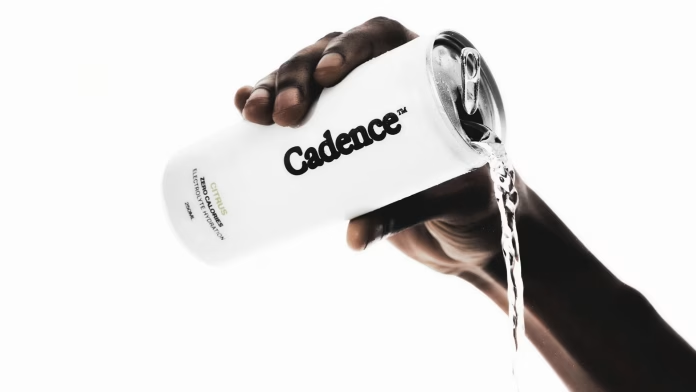
Cadence, the fast-rising hydration startup founded by entrepreneurs Ross MacKay and George Heaton, has officially crossed the 6,000 retail store milestone less than six months after its aggressive retail expansion began. The latest breakthrough came through a nationwide rollout into CVS Pharmacy refrigerators, marking another major step in the brand’s transformation from niche D2C startup to mainstream hydration contender.

The speed of Cadence’s retail growth has positioned it as one of the fastest-scaling players in the “modern hydration” category, a segment currently experiencing explosive momentum as consumers shift away from traditional sugary sports drinks toward cleaner, performance-focused alternatives.

What makes Cadence particularly notable is the caliber of its founding team. Ross MacKay previously built plant-based food disruptor Daring into one of the most recognizable challenger brands in the alternative protein space, while George Heaton is best known as the founder of Represent, the globally influential streetwear label with deep roots in fitness and performance culture.

Together, the duo has combined sports nutrition functionality with premium lifestyle branding — a formula increasingly proving successful across modern consumer categories.

Cadence’s 2026 strategy has centered around what industry observers are calling a “speed-to-shelf” expansion model. Rather than scaling slowly through regional retail tests, the company aggressively pursued simultaneous distribution across mass retail, specialty fitness channels, and convenience-focused pharmacy networks.

The biggest milestone came with the brand’s rollout into CVS Pharmacy, placing Cadence products directly inside high-traffic refrigerated sections across more than 6,000 locations nationwide. The move significantly broadens the brand’s accessibility, especially among consumers making impulse hydration purchases during daily routines rather than specifically shopping within sports nutrition aisles.

Earlier in the year, Cadence also secured major placements inside:

  • Target,
  • Walmart,
  • GNC,
  • and The Vitamin Shoppe.

This multi-channel strategy allows the company to compete across both lifestyle and performance-oriented retail environments simultaneously.

Target and Walmart provide mainstream scale and household visibility, while GNC and Vitamin Shoppe reinforce Cadence’s credibility within serious athletic and supplementation communities. The balancing act is strategic: maintaining “high-performance” authenticity while achieving mass-market accessibility.

The company is now targeting 8,000 retail doors by the end of Q4 2026, a pace that would place it among the fastest-growing hydration brands in recent years.

Product positioning has played a major role in the company’s rapid traction.

Unlike traditional sports drinks built around sugar-heavy replenishment, Cadence emphasizes what it describes as “precision hydration.” Each 355ml can contains:

  • 500mg sodium,
  • 190mg potassium,
  • and 30mg magnesium,

creating a formula designed specifically for endurance athletes, high-intensity training, and extended recovery periods.

The beverages are also entirely sugar-free and calorie-free, relying on Reb M stevia for sweetness instead of artificial sweeteners or syrups.

This formulation aligns closely with the current “performance optimization” movement dominating younger fitness communities. Consumers are increasingly prioritizing hydration products that feel functional without carrying the excessive sugar loads traditionally associated with legacy sports drinks like Gatorade or Powerade.

Equally important to Cadence’s success is its branding.

George Heaton’s design background has heavily influenced the product’s minimalist “premium utility” aesthetic, helping the brand resonate strongly with culturally influential fitness subcultures such as:

  • Hyrox,
  • CrossFit,
  • endurance racing,
  • and performance lifestyle communities.

The packaging intentionally avoids the loud, hyper-aggressive visual identity common in older sports nutrition brands. Instead, Cadence presents itself more like a premium fashion or wellness product — a strategy increasingly common among modern functional beverage startups targeting Gen Z and millennial consumers.

The company has also benefited from strong founder-led storytelling and community-driven growth. Before entering large-scale retail, Cadence built organic awareness among marathon runners, hybrid athletes, and creators within the fitness ecosystem. That early credibility appears to have accelerated retailer interest, creating demand pull rather than relying solely on paid marketing.

High-profile support from investors such as Steven Bartlett has further amplified the brand’s visibility, particularly among digitally native consumers already familiar with founder-led challenger brands.

Industry analysts increasingly view Cadence as part of a larger structural shift within hydration itself.

Hydration is no longer being marketed purely as thirst relief or sports recovery. It is evolving into a daily “performance ritual” tied to:

  • energy,
  • productivity,
  • recovery,
  • focus,
  • and lifestyle identity.

That broader cultural repositioning has opened the door for premium hydration startups to compete directly against legacy beverage giants despite significantly smaller marketing budgets.

The CVS rollout is especially important because it moves Cadence closer to everyday consumption occasions. Rather than existing only in fitness-centric environments, the brand is now entering convenience-driven purchasing behavior — a critical step for any beverage company seeking long-term scale.

Ultimately, Cadence’s rapid rise reflects how modern challenger brands are increasingly built not just on product functionality, but on community, aesthetics, and cultural positioning. In less than a year, the company has evolved from a startup hydration experiment into one of the most closely watched brands in the next generation of performance beverages.

Advertisement

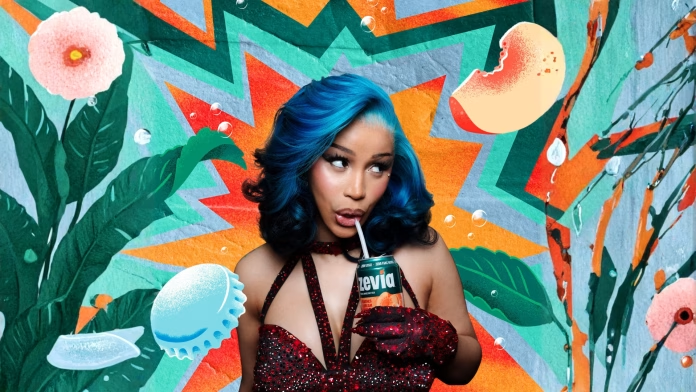
Zevia’s Breakout Quarter: Profitability Momentum Meets the “Cardi B” Era

0

Zevia PBC, the zero-sugar soda company built around naturally sweetened beverages, delivered one of the strongest quarters in its history as the brand continues its transformation from niche wellness product to mainstream beverage contender. Reporting its Q1 2026 earnings on May 6, the company posted record net sales of $46.1 million, marking a 21.2% year-over-year increase and signaling that its multi-year restructuring strategy is finally beginning to compound.

The results represent a major milestone for CEO Amy Taylor, the former Red Bull North America executive who took over the business during a period of operational instability and slowing growth. Since then, Taylor has focused on rebuilding Zevia’s retail presence, simplifying the company’s cost structure, and repositioning the brand as a culturally relevant lifestyle beverage rather than a purely “health-focused” soda alternative.

The strongest signal from the quarter was that Zevia’s growth is now being driven primarily by volume rather than pricing. Net sales growth was fueled by a 20.4% increase in volumes, suggesting that consumer demand for zero-sugar, naturally sweetened soda continues to accelerate despite broader inflationary pressures affecting the beverage industry.

The company also reported a dramatic improvement in profitability metrics. Net losses narrowed to $2.4 million, compared to a loss of $6.4 million during the same period last year. More importantly, adjusted EBITDA turned positive at $0.9 million — marking the company’s first meaningful EBITDA-positive quarter in recent history and reinforcing investor confidence that Zevia’s turnaround strategy is entering a more sustainable phase.

While the top-line momentum was impressive, Zevia still faced margin pressure from rising commodity and logistics costs. Gross margin slipped slightly to 48.4%, down from 50.1% a year earlier, primarily due to higher aluminum pricing and fuel-related expenses. However, management successfully offset much of that pressure through aggressive operational optimization and tighter marketing efficiency.

One of the most important drivers behind the quarter was Zevia’s evolving distribution strategy under Taylor’s leadership. The company has increasingly prioritized high-velocity retail channels capable of rapidly scaling household penetration.

The biggest contributor was the “Club Channel,” particularly a successful national rotation at Costco. The placement significantly expanded Zevia’s consumer reach and introduced the brand to a broader mainstream audience beyond its traditional wellness-focused demographic.

At the same time, Zevia continued strengthening its shelf presence across major grocery and mass retail accounts including Kroger and other large-format chains. E-commerce also remained a strong contributor, with the company reporting double-digit digital growth as Zevia continues to perform strongly within the “Better-for-You” beverage category on Amazon.

However, the quarter’s most visible growth catalyst was undoubtedly the company’s new partnership with rapper and cultural icon Cardi B. The two-year collaboration represents one of the most aggressive marketing pivots in Zevia’s history and reflects the company’s attempt to fundamentally reshape consumer perception around zero-sugar soda.

Historically, Zevia’s branding leaned heavily into “health-conscious” consumers, often attracting shoppers focused on wellness, fitness, or clean-label ingredients. While effective in building early loyalty, that positioning limited the company’s mainstream cultural reach.

The Cardi B partnership changes that narrative entirely.

Within its first week, the campaign reportedly generated over 152 million media impressions, helping Zevia tap into a younger, more culturally engaged consumer base. The collaboration is designed to “age down” the brand and reposition zero-sugar soda as an aspirational lifestyle choice rather than simply a dietary substitute.

Simultaneously, the company is rolling out a broader visual refresh aimed at modernizing packaging and improving shelf standout. The redesign is intended to make Zevia feel more emotionally relevant within the increasingly competitive “modern soda” category, where brands like Olipop and Poppi are aggressively competing for younger consumers through aesthetics, storytelling, and functional positioning.

Industry analysts increasingly view Zevia as part of a much larger structural shift within the global beverage market. Traditional soda consumption patterns are evolving rapidly as consumers seek:

  • lower sugar,
  • cleaner labels,
  • functional ingredients,
  • and more transparent formulations.

Stevia-based beverages, once considered niche alternatives, are now becoming increasingly mainstream as shoppers grow more skeptical of artificial sweeteners and high-calorie soft drinks.

What makes Zevia’s current moment especially important is that the company appears to be balancing growth with operational discipline — something many emerging beverage brands struggle to achieve. Selling and marketing expenses dropped significantly as a percentage of net sales, falling from 40% to 31.5%, highlighting the effectiveness of the company’s broader productivity initiatives around warehousing, logistics, and retail execution.

Ultimately, Zevia’s Q1 performance signals that the company may finally be moving beyond its identity as a specialty wellness soda brand. Under Amy Taylor’s leadership, the business is increasingly positioning itself as a legitimate long-term challenger within the mainstream beverage industry — one aiming to build a “third lane” in soda culture alongside legacy giants Coca-Cola and PepsiCo.

Advertisement

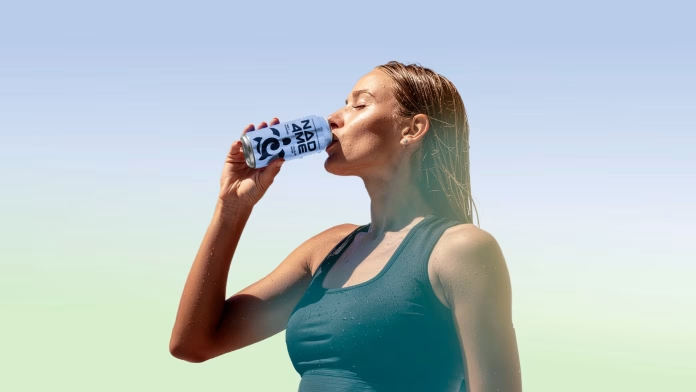
NAD4Me Bets on “Cellular Energy” as Longevity Drinks Enter the Mainstream

0

NAD4Me, a new entrant in the rapidly expanding longevity beverage market, has officially launched its line of caffeine-free cellular energy drinks, bringing one of the wellness industry’s most discussed molecules into a ready-to-drink consumer format. Founded by beverage veteran and food scientist Waldemar Schlemmer, the company is positioning itself at the intersection of functional hydration, preventative health, and modern “bio-optimization” culture.

The launch reflects a major shift currently reshaping the global beverage industry. Consumers are increasingly moving away from traditional stimulant-heavy energy drinks and toward products that promise long-term wellness, metabolic support, and sustained mental clarity. Instead of relying on caffeine spikes and sugar-driven stimulation, NAD4Me is marketing itself as a “cellular restoration” beverage designed to support energy production at the mitochondrial level.

At the center of the brand’s positioning is NAD+ (Nicotinamide Adenine Dinucleotide), a coenzyme widely associated with cellular repair, metabolism, and healthy aging. Over the last few years, NAD+ therapies have gained massive popularity across longevity clinics, wellness influencers, and biohacking communities, often appearing in the form of expensive IV drips or supplement protocols. NAD4Me’s core proposition is simple: turn that premium wellness concept into an accessible, shelf-stable beverage.

The biggest technical challenge for the category has always been stability. NAD+ molecules are notoriously fragile and degrade quickly when exposed to heat, light, or oxidation. According to the company, NAD4Me solves this issue through a proprietary nanocapsulation process that protects the active ingredients and allows the drinks to remain shelf-stable without compromising efficacy.

This technological positioning is central to the brand’s credibility. In a market increasingly crowded with “functional” beverage claims, scientific defensibility has become one of the most valuable differentiators. By emphasizing food science and ingredient stabilization, NAD4Me is attempting to separate itself from trend-driven wellness drinks that rely heavily on branding but lack meaningful formulation depth.

The beverages are also intentionally caffeine-free, a strategic decision that directly challenges the traditional energy drink industry. Instead of “borrowing energy” through stimulants, the company frames its products as supporting the body’s natural energy systems. This message strongly aligns with the growing “sober-curious” and wellness-first consumer movement, particularly among younger professionals seeking focus and productivity without anxiety, crashes, or sleep disruption.

Beyond NAD+, the formulation includes a blend of ingredients commonly associated with cognitive support and metabolic function:

  • L-Tryptophan,
  • Trigonelline,
  • Ergothioneine,
  • Inositol,
  • and Vitamins C, B3, B5, and B12.

Together, the formula is designed to position the beverage somewhere between an energy drink, a nootropic stack, and a recovery supplement.

The company launched with three flagship varieties:

  • Minty Lime Spark,
  • Tropical Wave,
  • and Cellular Water.

Minty Lime Spark targets consumers seeking a sharper, more refreshing sensory profile, while Tropical Wave is positioned as a broader mainstream flavor play aimed at lifestyle-oriented wellness consumers. Cellular Water, meanwhile, takes a minimalist approach focused on hydration and “clean functionality,” avoiding added sugars and artificial sweeteners entirely.

Pricing places NAD4Me firmly within the premium functional beverage category. The products retail at roughly $4 per can, with multi-pack bundles priced around $49.99. While significantly more expensive than traditional energy drinks, the pricing reflects the brand’s attempt to compete with high-end wellness supplements and recovery products rather than mass-market soda.

Industry analysts view NAD4Me as part of a much larger “proactive longevity” movement now entering mainstream consumer markets. The global NAD+ market is projected to surpass $12 billion by 2033, fueled by growing awareness around aging, metabolic health, and preventative wellness. At the same time, the broader functional beverage industry continues to evolve beyond simple hydration into increasingly specialized niches such as cognitive enhancement, stress management, gut health, and recovery optimization.

The timing may also be particularly favorable due to the rise of the “GLP-1 era.” As weight management medications and metabolic health conversations reshape consumer behavior, shoppers are becoming far more ingredient-conscious and increasingly skeptical of traditional high-sugar, high-caffeine beverage formats. Functional stacking — combining multiple wellness benefits into a single daily ritual — is rapidly becoming one of the strongest growth drivers across premium CPG.

For NAD4Me, the long-term opportunity extends far beyond wellness enthusiasts and biohackers. The company is effectively attempting to normalize longevity-focused nutrition as an everyday consumer habit rather than an elite clinical service. If its stabilization technology proves scalable and scientifically credible, the brand could emerge as one of the first serious contenders in the emerging “cellular beverage” category.

Ultimately, NAD4Me’s launch represents more than just another functional drink debut. It signals the continued transformation of the beverage aisle itself — from a category once dominated by sugar and stimulation into one increasingly defined by optimization, recovery, and long-term health performance.

Advertisement

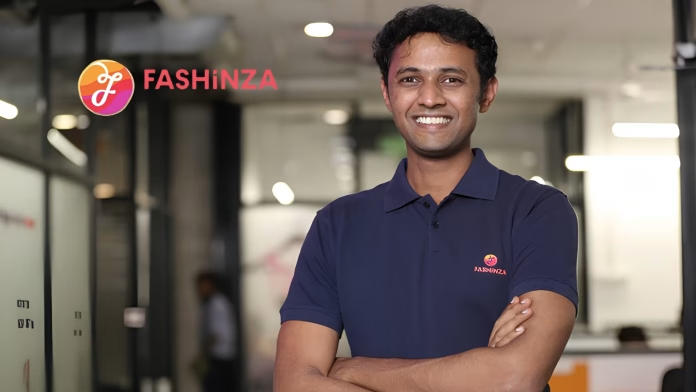
Fashinza Enters Its “FactoryOS” Era as Pawan Gupta Exits for AI

0

Fashinza, one of India’s most closely watched B2B fashion-tech startups, is entering a major new chapter following the departure of co-founder and CEO Pawan Gupta. The Accel-backed company confirmed that Gupta has officially stepped down from his leadership role to launch a new venture focused entirely on Artificial Intelligence, marking one of the most significant founder transitions in India’s startup ecosystem this year.

The move leaves Abhishek Sharma as the sole remaining original founder and the new CEO of the Gurugram-based supply chain platform. While leadership changes often signal instability in high-growth startups, insiders suggest this transition had been gradually unfolding behind the scenes since late 2025, when Gupta reportedly became non-operational in the business.

Gupta’s exit reflects a broader trend currently reshaping the global startup ecosystem: the migration of top founders and operators toward the AI sector. According to Gupta, the rapid acceleration of generative AI and automation convinced him that the next two decades of technological innovation would be fundamentally shaped by artificial intelligence. The opportunity to build something “AI-native” became too compelling to ignore.

At the same time, Fashinza itself has undergone a dramatic transformation since its early years. Initially positioned as a software-led platform simplifying apparel sourcing and manufacturing, the company has increasingly evolved into a deeply operational business centered around factories, logistics, and physical supply chains. That transition appears to have played a major role in Gupta’s decision to move on.

In many ways, Fashinza’s journey mirrors the evolution of several Indian B2B startups that began as “asset-light marketplaces” before eventually moving deeper into infrastructure ownership. Over the last two years, the company has aggressively expanded its manufacturing footprint, integrating technology directly into production clusters across India, Bangladesh, and China.

The clearest signal of this shift came in April 2026 when Fashinza acquired manufacturing player Qckin, strengthening its push toward vertical integration. The acquisition highlighted the company’s larger ambition of controlling more of the design-to-delivery cycle for global fashion brands seeking faster and more efficient production timelines.

Under Abhishek Sharma’s leadership, Fashinza is now doubling down on what insiders describe as its “FactoryOS” strategy — embedding software, workflow automation, and data systems directly into manufacturing operations rather than functioning purely as a sourcing intermediary.

This operational pivot represents a significant strategic evolution for the company. Instead of simply connecting brands with suppliers, Fashinza is positioning itself as a technology-enabled manufacturing infrastructure platform capable of managing the complexities of global apparel production at scale.

Despite the leadership transition, the company’s financial position remains relatively stable compared to many venture-backed startups navigating today’s funding environment. Fashinza has raised more than $120 million from major investors including Accel, WestBridge Capital, and Prosus, giving it one of the strongest institutional backings in India’s B2B commerce sector.

Financially, the company also appears to be moving closer toward operational sustainability. According to filings referenced in U.S. disclosures, Fashinza reported consolidated revenue of approximately ₹200 crore in FY25 and posted a reported profit of ₹1 crore during the same period — a notable milestone for a business operating in a traditionally margin-heavy manufacturing ecosystem.

The transition also reflects a deeper phenomenon often described in startup circles as the “Founder-Market Fit Lifecycle.” Early-stage founders who thrive during the “zero-to-one” phase of company building are often strongest in product design, software development, and rapid experimentation. However, as companies mature into operationally intensive businesses, the required leadership skill set changes dramatically.

For Fashinza, the challenge is no longer simply building software. It now involves:

  • factory operations,
  • manufacturing quality control,
  • labor management,
  • sourcing complexity,
  • and global logistics coordination.

That evolution naturally favors operators with deep execution capabilities over product-first founders.

Gupta’s departure therefore appears less like a breakdown and more like a strategic divergence driven by changing company dynamics and personal ambition. By leaving during Fashinza’s operational stabilization phase, he joins a growing wave of second-generation Indian entrepreneurs pivoting into AI after building successful commerce and fintech startups.

Across India’s startup ecosystem, former founders and senior operators from companies like Swiggy, BharatPe, and Udaan are increasingly redirecting their attention toward generative AI infrastructure, workflow automation, and enterprise intelligence tools. Gupta’s move places him directly within that emerging founder cohort.

For Fashinza itself, the road ahead is becoming increasingly clear. The company is no longer positioning itself merely as a “fashion-tech startup.” It is evolving into a manufacturing operating system designed to power global apparel supply chains through a blend of physical infrastructure and embedded technology.

If successful, that shift could fundamentally redefine how Indian manufacturing platforms compete on the global stage — not just through low-cost labor, but through speed, software integration, and production intelligence.

Advertisement

Vantara Creamery Rolls Into Mumbai: Turning Nostalgia Into a Premium Dessert Experience

0

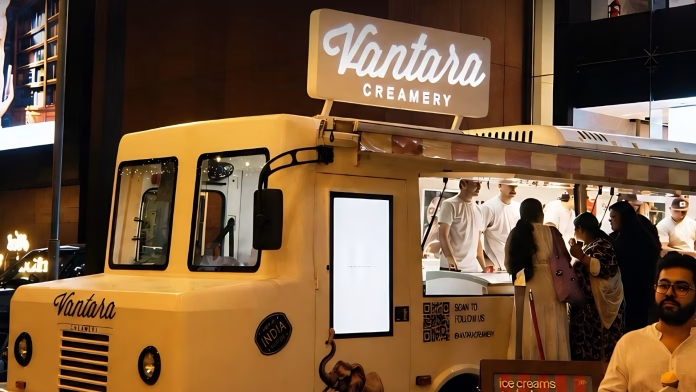
Vantara Creamery, a new-age artisanal dessert brand, has officially entered Mumbai’s premium food landscape with the launch of its experiential “Vantara Truck” at Jio World Drive in Bandra Kurla Complex. Instead of debuting through a traditional retail outlet, the brand has chosen a mobile, event-driven format that blends craft desserts with storytelling, positioning itself at the intersection of nostalgia, luxury, and social-first food culture.

The launch reflects a growing shift in India’s D2C food ecosystem, where consumers are increasingly gravitating toward brands that offer emotional connection and cultural identity alongside premium quality. Vantara is not attempting to compete with mass-market ice cream chains on scale or affordability. Instead, it is targeting urban consumers seeking highly curated, “memory-driven” dessert experiences that feel both familiar and elevated.

At the heart of Vantara’s strategy is what the brand calls “emotionally familiar, yet unexpected” flavor storytelling. Rather than focusing purely on indulgence or novelty, the company is building its identity around Indian memories, regional inspirations, and shared cultural moments. This approach mirrors a broader “Modern Heritage” movement currently reshaping India’s premium consumer brands, where startups are successfully reinterpreting traditional Indian experiences for younger, aspirational audiences.

The decision to launch through an ice cream truck rather than a permanent café is equally strategic. The Vantara Truck creates a sense of discovery and exclusivity that aligns perfectly with modern consumer behavior, particularly among Gen Z and millennials. By turning the launch into a limited-time event rather than a static retail experience, the brand generates urgency, footfall, and strong social media engagement. In the Instagram and TikTok era, the truck itself becomes part of the product narrative.

Operating at Jio World Drive also places the brand directly within one of Mumbai’s most premium lifestyle ecosystems. The location is known for attracting affluent urban consumers, luxury shoppers, and food-forward audiences who actively seek emerging experiential brands. For Vantara, this provides an ideal environment to establish cultural relevance before considering larger retail or quick-commerce expansion.

The residency is being hosted across two weekends:

  • May 9–10
  • May 16–17

with operations beginning daily from 11:00 AM onward.

This “pop-up residency” format follows a playbook increasingly common among premium global food brands. Rather than rushing into large-scale expansion, brands are first building scarcity-driven hype and organic community traction through immersive activations. Companies like Salt & Straw, Van Leeuwen, and various global craft dessert labels have used similar models to establish strong lifestyle positioning before scaling distribution.

Vantara appears to be applying a similar strategy to the Indian market, particularly within the growing “masstige” dessert segment — products that combine mass appeal with prestige branding. Mumbai consumers have rapidly shifted toward gourmet desserts over the past few years, embracing flavors and concepts that move beyond traditional vanilla-and-chocolate formats. Sea salt caramel, indigenous fruit infusions, burnt butter, and craft dairy profiles have become increasingly mainstream within urban premium retail.

This shift has created a significant white space for brands capable of combining artisanal quality with narrative depth. Vantara’s storytelling-first positioning gives it a differentiator beyond flavor alone. The company is effectively selling a mood, memory, and cultural experience rather than just frozen desserts.

The mobile launch format also provides operational flexibility. Unlike traditional cafés that require heavy fixed investments, the truck model allows Vantara to test neighborhoods, consumer response, and flavor demand with lower upfront infrastructure costs. It also creates opportunities for future collaborations, event activations, and citywide “tour-style” expansions that align naturally with social commerce and influencer marketing.

Industry observers see strong potential for Vantara to eventually expand into premium retail, gourmet grocery placements, and quick-commerce partnerships. Platforms like Zepto, Blinkit, and Instamart are increasingly prioritizing high-margin artisanal food brands, especially within desserts and indulgence categories where impulse ordering behavior remains strong. If Vantara successfully converts its launch buzz into repeat customer loyalty, the brand could become highly attractive within the premium quick-commerce ecosystem.

The timing of the launch is particularly favorable. India’s premium food and beverage market is undergoing a broader “experience economy” transition, where consumers are willing to pay significantly more for products that feel personalized, culturally rich, and socially shareable. In this environment, brands are no longer competing solely on taste or convenience. They are competing on emotional resonance and identity creation.

Ultimately, Vantara Creamery’s Mumbai debut represents more than just another artisanal dessert launch. It reflects the evolution of Indian consumer culture itself — one where nostalgia, storytelling, scarcity, and premiumization are increasingly becoming the core ingredients behind the next generation of food brands.

Advertisement

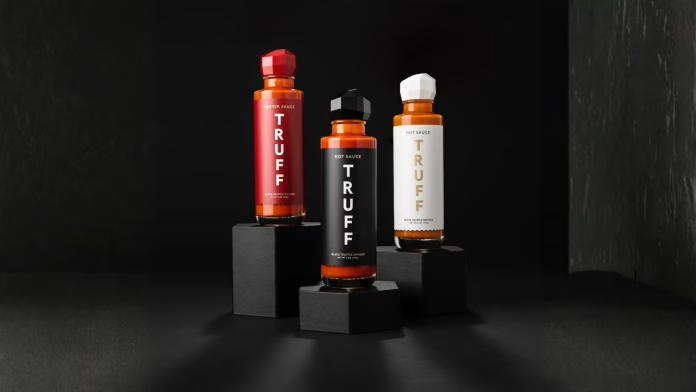
TRUFF x Kith Turn Ronnie’s Pronto Into a Luxury Condiment Playground

0

TRUFF has officially partnered with Kith to launch one of the most culturally aligned food collaborations of 2026, transforming Ronnie’s Pronto in West Hollywood into a live showcase for luxury condiments, lifestyle branding, and experiential dining. The collaboration arrives alongside the opening of Ronnie Fieg’s newest hospitality concept and represents another major step in the growing convergence of fashion, food, and culture-led retail.

At the center of the partnership is a co-branded condiment collection designed to integrate directly into the restaurant experience rather than function as a traditional retail-only launch. Every table at Ronnie’s Pronto now features the custom-labeled TRUFF sauces, allowing customers to engage with the products organically throughout their meal. The strategy turns the dining table itself into a marketing channel while reinforcing Kith’s larger vision of creating immersive consumer ecosystems.

The headline product from the collaboration is the new Lemon Pepper Aioli, a flavor innovation that signals TRUFF’s ambitions beyond its core hot sauce business. The aioli blends citrus-forward flavor, pepper-heavy seasoning, and TRUFF’s premium truffle identity to create a condiment positioned for elevated casual dining. While currently exclusive to Ronnie’s Pronto, the product is expected to receive a wider national launch in the coming weeks.

The Lemon Pepper Aioli is strategically important because it places TRUFF inside one of the fastest-growing flavor categories in American casual dining. Lemon pepper has become deeply embedded in modern food culture through wings, sandwiches, fried chicken, and sports-bar cuisine. By introducing a premium truffle-forward interpretation, TRUFF is repositioning a familiar comfort flavor into the luxury pantry segment while expanding its usable occasions far beyond traditional hot sauce applications.

Alongside the aioli, the collaboration includes limited-edition versions of TRUFF’s flagship White Truffle Hot Sauce and Mild Truffle Hot Sauce. Both feature exclusive Kith co-branding and are available across multiple channels including Ronnie’s Pronto table service, in-store retail, and Kith.com. The omnichannel rollout mirrors the modern “fashion drop” strategy, where exclusivity, collectibility, and digital hype operate simultaneously to drive consumer engagement.

For Kith, the collaboration reinforces Ronnie Fieg’s broader ambition to transform the brand from a fashion retailer into a fully integrated lifestyle platform. Over the past several years, Kith has steadily expanded into hospitality through cafés, cereal bars, desserts, and experiential food concepts. Ronnie’s Pronto now becomes another extension of that ecosystem, where apparel, dining, design, and cultural identity all operate under a single brand philosophy.

The partnership also highlights how food products are increasingly functioning as cultural accessories rather than simple consumables. In 2026, pantry staples are no longer competing only on taste or convenience. Consumers are now evaluating products based on aesthetics, exclusivity, storytelling, and social identity. TRUFF has been one of the clearest leaders in this transformation, turning hot sauce from a commodity product into a status-driven lifestyle item through premium packaging, celebrity adoption, and carefully curated collaborations.

For TRUFF, maintaining cultural relevance has become just as important as expanding retail distribution. While the brand initially gained momentum through luxury grocery placements and influencer-driven visibility, collaborations with culturally dominant brands like Kith help reinforce its positioning among younger, trend-conscious consumers. Instead of competing solely in the condiment aisle, TRUFF is competing for space within lifestyle culture itself.

The collaboration also reflects the broader rise of “experiential condiments” within the premium food industry. Sauces and pantry products are increasingly being used as tools to drive restaurant traffic, generate digital conversation, and build community engagement. By embedding the products directly into Ronnie’s Pronto, both brands are transforming the condiments from secondary meal additions into core components of the overall consumer experience.

The Lemon Pepper Aioli launch could become particularly important for TRUFF’s long-term growth strategy. If successful, the product creates a pathway into larger food-service categories including premium fast casual, sandwich chains, sports venues, and hospitality partnerships. Unlike niche hot sauces that remain limited to specialty audiences, aioli-based products offer significantly broader menu versatility and higher frequency usage.

Ultimately, the TRUFF x Kith partnership demonstrates how modern consumer brands are evolving beyond transactional retail into immersive cultural ecosystems. Ronnie’s Pronto is not simply functioning as a restaurant, and the sauces are not merely condiments. Together, they represent a new model of lifestyle commerce where fashion, food, hospitality, and social identity are increasingly inseparable.

Advertisement

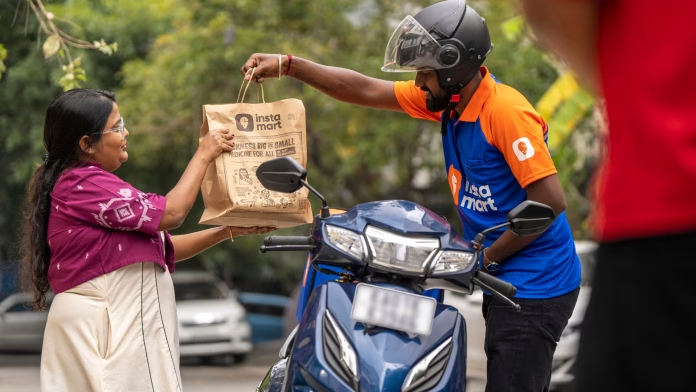
Swiggy Instamart’s Q4 FY26 Signals a Turning Point as Hyper-Growth Meets Improving Profit Discipline

0

Swiggy delivered a strong operational performance in Q4 FY26, with its quick-commerce arm Instamart continuing to emerge as the company’s biggest growth engine amid India’s intensifying 10-minute delivery battle. Despite aggressive competition from Blinkit and Zepto, Instamart recorded a massive 68.8% year-on-year jump in Gross Order Value (GOV), reaching ₹7,881 crore during the quarter.

The results reinforce Swiggy’s growing dominance in the quick-commerce segment, while also signaling an important shift in investor sentiment around the sector: growth is no longer enough — profitability and operational efficiency are now becoming equally critical.

While Swiggy’s full-year losses widened due to heavy infrastructure investments and expansion costs, the company reported a noticeable narrowing of quarterly losses in Q4 FY26. This has strengthened confidence that the economics of quick commerce are gradually stabilizing after years of cash-intensive expansion.

Instamart’s growth continues to be fueled by rising consumer adoption beyond groceries. What initially began as a convenience-led grocery platform is now rapidly evolving into a broader on-demand retail ecosystem.

Swiggy has aggressively expanded into:

  • electronics,
  • beauty products,
  • personal care,
  • home essentials,
  • and impulse-driven lifestyle categories.

These newer verticals are helping improve Average Order Value (AOV), which has become a key lever in reducing operational burn.

At the same time, Swiggy is increasingly monetizing the “digital shelf space” within Instamart.

Advertising revenue from D2C brands and FMCG companies has emerged as a significant contributor to margin improvement. Brands are now paying premium placement fees for:

  • search visibility,
  • homepage discovery,
  • and personalized recommendation slots.

This ad-led monetization model is helping offset delivery and fulfillment costs while improving contribution margins at the order level.

Operational efficiency has also improved through increased dark-store density and better logistics optimization.

Swiggy has expanded aggressively into Tier-II cities over the last year, moving beyond its traditional strongholds in Bengaluru, Mumbai, Delhi, and Hyderabad. Higher order density in newer markets is improving fleet utilization and reducing per-order logistics costs.

Internally, Swiggy has also invested heavily in predictive inventory management and supply-chain automation.

The company has reportedly implemented:

  • robotics-assisted picking systems,
  • smarter inventory forecasting,
  • and faster warehouse workflows

across major dark-store hubs to reduce wastage and improve delivery speed consistency.

This operational tightening is becoming increasingly important as investors begin scrutinizing the sustainability of quick-commerce economics more closely.

Swiggy’s FY26 financial story reflects a larger industry reality: India’s quick-commerce market is transitioning from a “growth war” into an “efficiency war.”

Over the last two years, companies across the sector spent aggressively on:

  • dark-store expansion,
  • customer acquisition,
  • discounting,
  • and delivery infrastructure.

Swiggy was no exception.

The company’s widening full-year losses were largely driven by what industry observers are calling its “2025 Capex Blitz” — a period marked by heavy investments in:

  • dark-store infrastructure,
  • logistics expansion,
  • and ecosystem integration.

Swiggy also continued scaling adjacent businesses like:

  • Dineout,
  • SteppinOut,
  • and offline lifestyle integrations

as part of its ambition to become a broader “super app” rather than just a food-delivery company.

The company’s delivery fleet has now expanded to over 400,000 active partners, creating one of the largest hyperlocal logistics networks in India.

However, the narrowing quarterly losses in Q4 suggest that the scale benefits of these investments are finally beginning to materialize.

A key driver behind this transition is Swiggy’s increasing focus on retention and customer lifetime value rather than pure user acquisition.

The company’s recent partnership with MoEngage and its growing investment in AI-led personalization indicate a broader strategic pivot toward:

  • behavioral engagement,
  • ecosystem stickiness,
  • and higher-frequency ordering.

In India’s highly competitive quick-commerce market, retaining users profitably is now becoming more valuable than simply adding new users at scale.

For the broader startup ecosystem, Swiggy’s Q4 FY26 performance carries major significance.

The quick-commerce industry has faced increasing skepticism over the last two years due to concerns around:

  • unsustainable burn,
  • thin margins,
  • and excessive discounting.

Swiggy’s improving contribution margins and narrowing quarterly losses now suggest that the operational side of the business is slowly catching up to the scale of consumer demand.

The company’s performance also reinforces a larger behavioral shift in urban India.

Quick commerce is no longer limited to emergency grocery purchases.

It is increasingly becoming an everyday consumption infrastructure layer for:

  • food,
  • essentials,
  • beauty,
  • electronics,
  • and impulse shopping.

That shift dramatically expands the long-term market opportunity for players like Swiggy Instamart.

The challenge now is execution discipline.

As the sector matures, the winners are unlikely to be determined solely by delivery speed or discounting power.

Instead, leadership will increasingly depend on:

  • logistics efficiency,
  • inventory intelligence,
  • advertising monetization,
  • and customer retention economics.

Swiggy’s Q4 FY26 results suggest the company is beginning to align all four.

Advertisement

Britannia’s ₹19,000 Crore FY26 Signals a Bigger Shift: From Biscuit Giant to Digital-First Foods Powerhouse

0

Britannia Industries Limited is rapidly transforming from a traditional biscuit-led FMCG company into a diversified, digital-first foods powerhouse. Under the leadership of Managing Director and CEO Rakshit Hargave, the company revealed that e-commerce now contributes nearly 6% of its domestic business, while the share rises to almost 12% within premium and urban-focused categories. The update came alongside Britannia’s strong FY26 performance, where the company crossed ₹19,151 crore in total revenue and reported a consolidated net profit of ₹2,537 crore, up 16.5% year-on-year.

While biscuits continue to remain Britannia’s largest category, the company’s real momentum is increasingly coming from “adjacent categories” such as dairy, croissants, wafers, cakes, brownies, and premium snacking products. These segments now contribute nearly 25% of Britannia’s total revenue, highlighting the company’s long-term ambition to evolve into a broader foods business rather than remain dependent on its biscuit portfolio alone.

Digital commerce has become a major growth engine for these newer categories. According to management, Britannia’s adjacent businesses are growing 2.7 times faster on e-commerce platforms compared to traditional retail channels. Platforms like Blinkit, Zepto, Swiggy Instamart, and Amazon are increasingly driving demand for premium products such as Pure Magic, NutriChoice, Winkin’ Cow beverages, and 5050 Cheese Dips.

The company is also investing heavily in platform-exclusive packs, customized D2C offerings, and impulse-led snacking formats tailored specifically for quick-commerce ecosystems. This “channel-product matching” strategy allows Britannia to use digital platforms for premium experimentation while leveraging its massive offline network to scale mass-market staples across India.

One of the strongest growth contributors during FY26 was Britannia’s dairy and beverages vertical. Led by the Winkin’ Cow brand, the segment has emerged as a significant revenue driver in flavored milk, milkshakes, and cheese categories. Britannia’s dairy business generated approximately ₹5.25 billion in FY25 revenue and continued delivering double-digit growth throughout FY26.

The company’s bakery and snacking expansion is also gaining nationwide traction. Croissants developed through Britannia’s Chipita partnership have become one of the company’s fastest-growing categories, while the wafers business is reportedly growing at nearly 25% annually. Britannia already holds a strong position in the ₹10 billion wafer cream segment, further strengthening its premium snacking portfolio.

Despite strong growth, Britannia faced operational headwinds during FY26. EBITDA margins remained relatively flat at 18.07% due to rising input costs and supply-chain disruptions. Operational expenses reportedly surged by nearly 17.5% during the year, while international disruptions linked to geopolitical tensions in West Asia impacted growth momentum during March 2026.

To improve efficiency and protect margins, Britannia increased its in-house manufacturing share to nearly 65%, reducing reliance on contract manufacturing. This move is expected to improve logistics control, supply-chain resilience, and operational efficiency as the company continues scaling premium categories nationally.

At the same time, Britannia is aggressively pursuing a “masstige” strategy by introducing premium products through low-unit packs priced at ₹5–₹10. This allows the company to seed higher-margin categories into rural and price-sensitive markets while maintaining affordability for mass consumers.

Rakshit Hargave’s leadership style is increasingly visible in Britannia’s evolving strategy. Drawing from his experience across Domino’s and Nivea, Hargave is positioning Britannia not just as a legacy FMCG company, but as a modern omnichannel food platform optimized for digital discovery, quick-commerce velocity, and high-frequency urban consumption.

Britannia’s FY26 performance reflects a larger shift underway across India’s FMCG industry. Growth is no longer being driven purely by scale distribution and mass staples. Increasingly, the next phase of expansion is being powered by premiumization, convenience, digital commerce, and impulse-led snacking behavior.

While e-commerce still contributes a relatively small share of Britannia’s overall revenue, the company’s rapidly growing premium digital mix signals where the future of Indian packaged food consumption is heading. Britannia is no longer competing only for shelf space in kirana stores — it is positioning itself to dominate India’s evolving on-demand snacking economy.

Advertisement

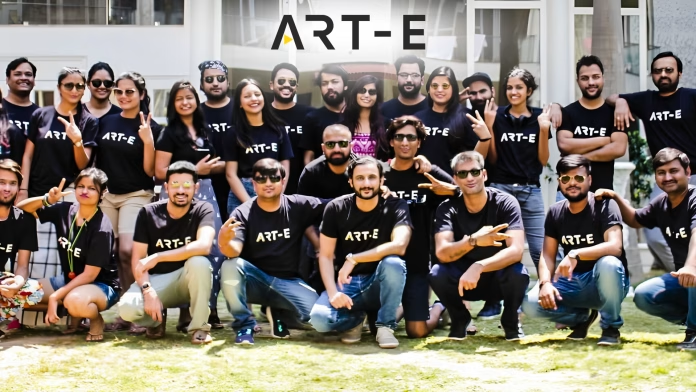
Art-E Mediatech Wins IndiaMART Mandate Again: Doubling Down on B2B Digital Storytelling

Delhi-based Art-E Mediatech has once again secured the full social media mandate for IndiaMART, reinforcing a long-standing partnership between the two companies. The renewed collaboration highlights IndiaMART’s continued focus on strengthening its digital presence and deepening engagement with its vast network of buyers and sellers across the country.

Under the new mandate, Art-E Mediatech will lead end-to-end social media strategy, including content planning, campaign execution, and performance-driven storytelling. The objective is to enhance IndiaMART’s brand communication while making it more relevant and relatable to a digital-first audience—particularly India’s rapidly growing base of MSMEs that rely on online platforms for business discovery and transactions.

This second win is significant. In an industry where brands frequently rotate agencies, IndiaMART’s decision to reappoint Art-E Mediatech signals strong confidence in the agency’s ability to understand and communicate complex B2B narratives. The focus will now be on building integrated campaigns that combine creative storytelling with data-backed insights, ensuring both engagement and measurable outcomes.

From IndiaMART’s perspective, the partnership aligns with its broader mission of driving digital transformation for Indian businesses. As COO Dinesh Gulati emphasized, a strong online presence is no longer optional—it is central to how businesses connect, transact, and scale. The brand’s communication strategy will therefore aim to reflect its scale, trust, and real-world impact on millions of enterprises across India.

For Art-E Mediatech, the mandate strengthens its positioning as a full-stack MarTech partner capable of handling large-scale, performance-oriented accounts. Co-founder Rohit Sakunia highlighted that the agency will leverage its deep understanding of the B2B ecosystem to craft campaigns that are not just creative, but conversion-focused—an essential requirement in a category where ROI often outweighs vanity metrics.

Strategically, this partnership underscores a broader shift in B2B marketing. Platforms like IndiaMART are moving beyond functional messaging (lead generation, listings) toward brand-led storytelling that humanizes businesses and builds long-term trust. As competition intensifies in India’s digital commerce ecosystem, differentiated communication will become a key lever for user acquisition and retention.

With this renewed mandate, both companies are betting on a blend of creativity and performance to redefine how B2B platforms engage with their audiences—turning transactional interactions into sustained digital relationships.

Advertisement

Yu Foods Eyes ₹180 Cr in FY27 — Fuelled by Quick Commerce, Clean Labels, and Zero Cash Burn

0

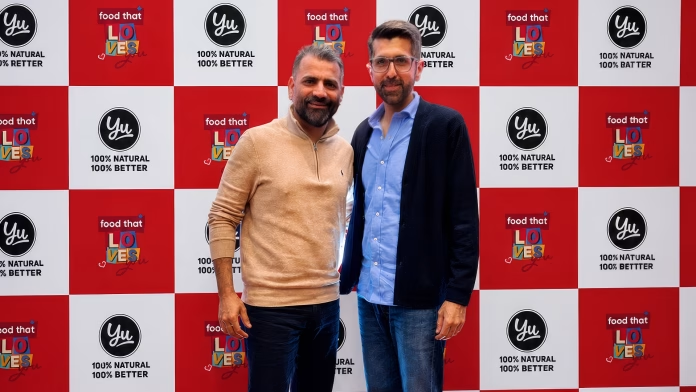
In a market where scale is often pursued through aggressive cash burn, Yu Foods has charted a different trajectory built on channel discipline and operational focus. The brand more than doubled its revenue from ₹35 crore to ₹75 crore in FY26, driven by a decisive pivot away from traditional D2C toward a “Quick Commerce First” model. As it enters FY27, Yu Foods is targeting ₹180 crore in revenue, supported by its emergence as a “core brand” across major delivery platforms and a growing presence in the healthy staples segment. At the heart of Yu’s growth is a consistent product lens: replace, simplify, and clean up what people already consume.

The strategic inflection point came with the company’s decision to deprioritize its owned website, avoiding high customer acquisition and logistics costs associated with low-ticket food products. Instead, Yu Foods concentrated on quick commerce platforms, achieving over 90% penetration across dark store networks. This shift translated into scale efficiencies, with the brand generating significant search demand and transitioning into a “core brand” category. As a result, procurement became system-driven, enabling monthly stock movement of approximately ₹12.5 crore without continuous negotiation. The approach also allowed the company to avoid fragmented general trade channels, preserving a tighter working capital cycle.

Product innovation has complemented distribution strategy. What stands out is Yu’s commitment to redefine indulgent categories with cleaner, natural ingredients and an uncompromising commitment to taste.. A key growth lever has been the expansion into “healthy staples,” particularly through the replacement of refined flour with whole wheat formulations. Noodles and pasta now contribute nearly 25% of total revenue, while the brand has established a leading position in the domestic ramen category on quick commerce platforms. In beverages, its single-ingredient coconut water has emerged as a top-performing SKU, reflecting strong consumer alignment with clean-label offerings.

Financially, the company is approaching an inflection point. With a monthly revenue run rate of ₹10 crore and EBITDA losses narrowed to approximately -3%, Yu Foods is positioned to achieve enterprise-level profitability in FY27. The projected increase in scale, with monthly revenues expected to reach ₹15–16 crore, provides operating leverage that supports a transition to positive EBITDA.

Looking ahead, the FY27 roadmap is centered on portfolio expansion within the “clean label” ecosystem. The company is preparing to enter adjacent categories such as low-sugar sauces, breakfast staples, and ready-mix products, while also evolving its hydration portfolio beyond coconut water into flavored and functional variants. Packaging innovation, including a potential shift toward cans, is being explored as volumes increase.

Offline retail continues to play a selective role in the company’s strategy. Presence in modern trade channels and institutional partnerships allows Yu Foods to maintain predictable throughput without the inefficiencies associated with widespread general trade distribution. This calibrated approach ensures that offline expansion supports, rather than dilutes, overall capital efficiency.

Yu ’ growth trajectory reflects a broader shift in FMCG strategy. Scale is increasingly being built through channel prioritization and product relevance rather than distribution breadth. By aligning itself with high-intent consumption platforms and focusing on functional, everyday categories, the company has repositioned from a challenger brand to an embedded player within the consumer’s purchase journey.

Advertisement