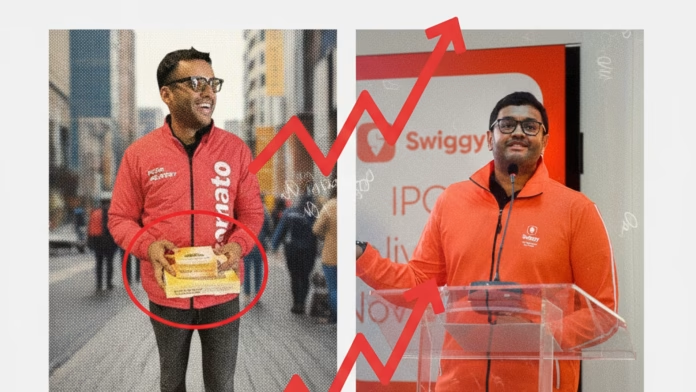
India’s online food delivery sector staged a stronger-than-expected rebound in the October–December quarter, with Zomato and Swiggy both crossing the 20% gross order value (GOV) growth mark after several muted quarters.
Eternal-owned Zomato reported a 21.3% rise in GOV, while Swiggy posted 20.5% growth, outperforming their medium-term guidance band of 18–20%. The acceleration signals a shift in strategy as the duopoly pivots back to expanding its user base, particularly among price-sensitive and low-order-value customers.
Affordability Back in Focus
Both platforms have ramped up efforts to attract budget-conscious consumers and newer segments such as health-focused diners. Swiggy has scaled its “99-store” offering, featuring items priced under ₹99, while Zomato reduced the minimum order value for free delivery under its Gold loyalty programme to ₹99 from ₹199. Affordable menus, curated carts under ₹250, and value-driven campaigns have collectively driven volume growth.
A senior industry executive noted that growth had bottomed out two to three quarters ago, after which the trend reversed. Much of the recovery has been led by customers with average order values between ₹100 and ₹200 — a segment expected to compound over time.
Profit Cushion Enables Expansion
The renewed focus on user acquisition comes as both firms report stronger profitability in food delivery, giving them the margin cushion to step up investments. In the December quarter, Zomato posted ₹531 crore in adjusted EBITDA, up 25% year-on-year, while Swiggy’s food delivery business saw adjusted EBITDA rise 48% to ₹272 crore.
Platform fees — introduced at ₹1 in 2022 and gradually increased to ₹15 — have also contributed to improved margins. Food delivery remains the profit engine for both companies even as they continue to invest heavily in quick commerce.
Between the two, Zomato held a 57.3% market share in the quarter, compared to Swiggy’s 42.7%, with the Gurugram-based firm gaining incremental share over the past few quarters. Monthly transacting users rose 21.5% for both players, reaching 24.9 million for Zomato and 18.1 million for Swiggy.
Quick Delivery Models Under Scrutiny
While affordability has boosted core delivery volumes, the ultra-fast 10-minute delivery model continues to face economic challenges. Swiggy has retained its Bolt service but shut down its café-style vertical Snacc. Zomato exited its quick delivery experiment earlier, and other players have scaled back similar offerings due to high unit costs and inconsistent repeat demand.
Rising Competitive Pressure
The rebound also comes amid growing competitive interest in the space. Mobility platform Rapido is expanding its food delivery service Ownly, while Walmart-owned Flipkart is reportedly evaluating an entry into online food delivery, with a pilot expected in Bengaluru later this year.
India’s online food delivery market, estimated at around $9 billion in FY25, is projected to reach $25 billion by FY30, according to Jefferies. Analysts believe sustained order growth strengthens the incumbents’ ability to invest in pricing and incentives without significantly eroding margins.
At a time when new entrants are preparing to step up competition, the December-quarter rebound suggests that Zomato and Swiggy still command strong network effects and meaningful headroom for user expansion — reinforcing food delivery as a high-stakes, winner-takes-most business.