According to a CRISIL report, the surge in onion and tomato prices resulted in a 10% increase in the cost of vegetarian thalis and a 5% rise in non-vegetarian thalis in November compared to the previous month.
In November 2023, the cost of a vegetarian thali rose by 9% compared to the same period the previous year. Additionally, the prices of pulses, constituting approximately 9% of the total cost of the vegetarian thali, witnessed a year-on-year increase of 21%.
The report indicated that in November, the prices of onions and tomatoes saw a surge of 58% and 35%, respectively, compared to October. This increase was attributed to festive demand and reduced output during the Kharif season due to unpredictable rainfall conditions.
Prices of broiler chicken, constituting approximately half of the cost of a non-vegetarian thali, experienced a 1-3% decrease.
The substantial increase in prices of essential food items such as wheat, rice, pulses, sugar, and onions in India over the recent months poses a significant challenge for the union government, especially as they approach the general elections scheduled for April-May 2024.
Due to irregular and insufficient rainfall, the yearly retail inflation reached a 15-month peak of 7.44% in July. Additionally, food price inflation escalated to 11.5% during the same month, marking its highest level in over three and a half years.
In spite of the government’s measures to control food prices, including the ban on wheat exports, limitations on sugar, onion, and rice exports, pulse imports, and the sale of wheat, rice, and vegetables like onions from its reserves, food inflation, constituting almost half of the total consumer price basket, stood at 6.61% in October.
In October, the retail inflation for pulses surged to 18.79%, primarily driven by significant increases in the prices of tur (40.94%), gram (11.16%), and moong (12.75%). The inflation rate for tur surpassed the 37.3% recorded in September, despite the government’s initiative to boost imports from Africa and Myanmar by eliminating the import duty on tur in March.
The recent hailstorms in Maharashtra over the past few weeks have caused damage to the onion crop in areas like Nashik and Ahmednagar.
The arrivals of onions at mandis, which typically reach their peak at this time of the year, have decreased, leading to an increase in prices.
Unfavorable weather conditions have led to a delay in kharif onion sowing, resulting in reduced coverage and a delayed arrival of the onion crop. As stored rabi onions (harvested in April-May) are depleting and kharif onion arrival is delayed, a tight supply situation has emerged, leading to an increase in prices.
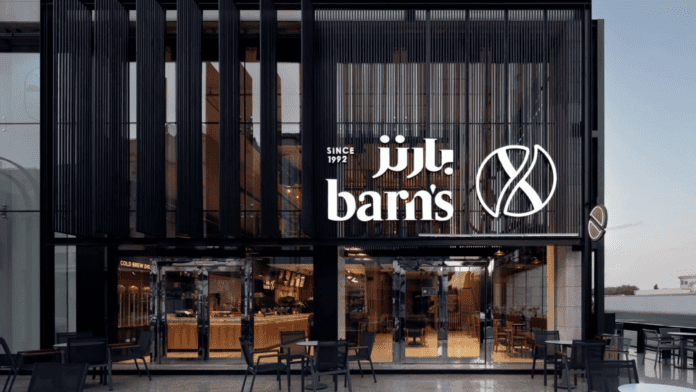
Saudi Arabia-based specialty coffee chain Barn’s is gearing up to enter the public market with plans to launch its initial public offering (IPO) in 2024, according to a report from the World Coffee Portal.
Founded in 1992 by the Al Amjaad Group, the coffee chain based in Jeddah runs a network of over 550 stores throughout Saudi Arabia, making it the largest market in the Middle East region.
Franchises account for over 70% of Barn’s stores in the region.
Al Amjaad Group CEO Mohamed Al Zain was quoted by the World Coffee Portal as saying, “Saudi Arabia’s recognition as the “coffee capital of the Middle East” is a testament to our passion for coffee and our commitment to fostering a vibrant coffee culture.
“We believe that this is just the beginning of our journey, and we look forward to further elevating Saudi Arabia’s standing in the international coffee community,” he said.
During Barn’s annual franchise meeting, Mohamed Al Zain articulated that the proposed IPO would empower the public to transition from loyal customers to becoming investors in the company’s success.
The coffee chain is set to achieve a global presence of 1,000 stores by the close of the 2020s, with the brand’s inaugural overseas expansion anticipated in 2024.
According to the report, the coffee chain will concentrate on extending its footprint in the Middle East and North African (MENA) markets. Additionally, it plans to broaden its presence in the UK, US, and Malaysia.
In July 2024, Barn’s finalized an agreement with Premier Fine Foods to launch stores not only in Malaysia but also in various Southeast Asian regions.
Premier intends to establish 25 Barn’s Coffee outlets in Kuala Lumpur, Malaysia.
Additionally, there are intentions to broaden the coffee chain’s footprint across Southeast Asia by inaugurating 300 stores by the year 2033.
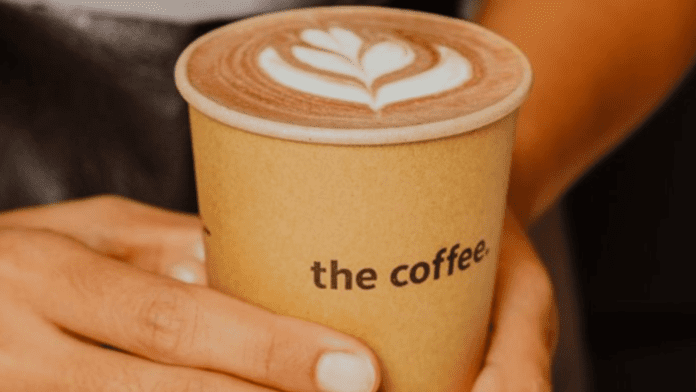
The Coffee, a Brazilian coffee chain, aims to extend its global presence by opening its first stores in the Middle East in 2024, as reported by the World Coffee Portal.
The decision is fueled by a rising demand for coffee in the region, ongoing investments in coffee production, and the identified growth opportunities in that area.
The expansion of The Coffee in the Middle East will kick off with the opening of two franchised stores in Dubai, United Arab Emirates (UAE), in 2024.
It intends to inaugurate its initial establishments in Saudi Arabia and Egypt within the first half of the same year.
Established in 2018, The Coffee concluded a funding round of $7.5 million in January 2023.
By October 2023, the coffee chain secured an extra $10 million to support its venture into the Middle East and to enhance its operations across Europe and South America.
Presently, The Coffee runs 200 establishments in Brazil and has 23 outlets spread across Chile, Colombia, France, Peru, Portugal, and Spain.
Approximately 85% of The Coffee’s revenue is derived from its activities in Brazil, and it aims to reach a total of 320 stores in the country by the end of 2024.
The plan is to establish 1,500 stores outside Brazil, with an additional 12 slated to open before the conclusion of 2023, followed by 35 more in the first half of 2024.
In the Middle East, the UAE holds the position of the second-largest market for branded coffee shops, boasting over 1,400 coffee outlets.
In December 2023, SSP Group revealed the launch of a new Food Park at Abu Dhabi International Airport in the UAE. Additionally, in September, the renowned Indian chef Ranveer Brar inaugurated his inaugural UAE restaurant, KashKan, in Dubai.
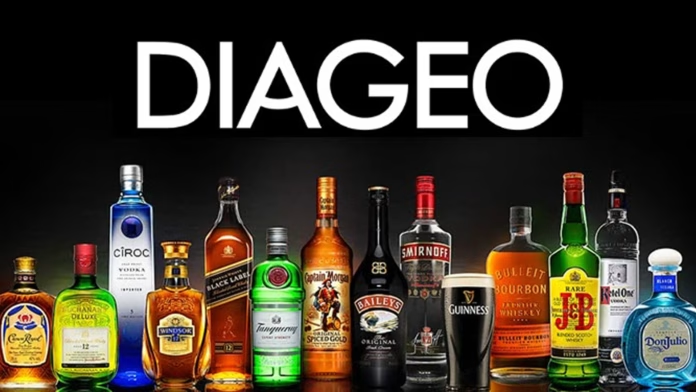
Diageo currently has no intention of selling off any of its beer labels.
Axios disclosed on December 5th that the British beverage behemoth is exploring the sale of a group of beer assets while aiming to keep Guinness, its primary brand in that sector.
Unnamed insiders informed Axios that, with the exception of Guinness, Diageo’s beer labels have a negative impact on the company’s overall profit margins.
Upon reaching out to Diageo for a response to the report, a company spokesperson stated, “We do not provide comments on market speculation.”
For the fiscal year ending on June 30th, the world’s largest spirits company garnered £3.36 billion ($4.23 billion) in beer sales. The total group sales amounted to £23.51 billion, with net sales (excluding excise duties) reaching £17.11 billion.
At the core of Diageo’s beer operations is Guinness, marketed in over 100 countries.
The primary brewery for the company is located at the St James’s Gate site in central Dublin. Diageo possesses breweries in five African nations and the Seychelles. Additionally, the group, in collaboration with partner breweries, is in the process of constructing another brewery in Ireland.
Diageo recorded a 9% growth in net sales from beer for the twelve months ending in June. On an organic basis, net sales also experienced a 9% increase, although volumes saw a decline of 7%.
Guinness witnessed a 17% surge in net sales. On an organic basis, the net sales for Guinness saw a 16% growth, accompanied by a 1% increase in organic volumes.
Earlier this year, Diageo secured regulatory clearance to acquire an additional 14.97% stake in Kenya’s East African Breweries, bringing the Smirnoff maker’s shareholding in the Nairobi-based brewer to 65%.
In July last year, Diageo completed the sale of its Guinness brewing operation in Cameroon to the France-based peer Groupe Castel.
The group issued a profit warning just last month due to challenges affecting its business in Latin America.
The owner of Johnnie Walker anticipates a decrease in organic operating profit during the first half of its 2024 financial year.
Diageo highlighted a significantly diminished performance outlook for its operations in Latin America and the Caribbean. This division constituted 11% of its annual net sales in the previous fiscal year.
In discussions with reporters following the profit warning, Diageo CEO Debra Crew mentioned that the entire spirits industry was experiencing sales pressure in Latin America, as consumers were leaning towards more affordable products. She noted that Diageo had been successful in gaining market share despite these challenges.
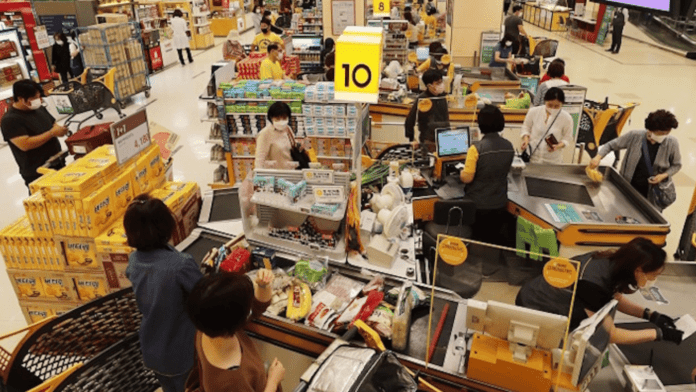
South Korea’s food, cosmetics, and retail enterprises, which heavily depend on domestic sales, are reducing their workforce significantly to endure an extended downturn in domestic spending. This is perceived by some industry observers as potentially marking the most severe sequence of job cuts since the 2008 global financial crisis.
They are grappling with the triple challenge of reduced consumption due to persistent inflation and elevated interest rates, competition from inexpensive Chinese products, and government insistence to control price increases.
The string of workforce reductions in sectors centered on domestic sales may result in a subsequent decline in private spending, posing a risk of Asia’s fourth-largest economy getting caught in a detrimental cycle, caution business experts.
Since the end of last month, Lotte Mart Co. has been receiving voluntary retirement applications from employees with more than 10 years of tenure with the company, as reported by the food and distribution industry on Sunday.
In the year 2021, the supermarket chain permitted 200 employees to opt for voluntary retirement.
Over the past six years, a total of 5,600 employees have left the company through early retirement programs at its affiliate, Lotte Shopping Co.
This year, several other companies oriented toward domestic sales have either initiated workforce reductions through voluntary retirement or are currently in the process of implementing such measures.
Among them are LG H&H Co., formerly known as LG Household & Healthcare; AmorePacific Corp., a renowned cosmetics brand; Lotte Home Shopping Inc.; Maeil Dairies Co.; Paris Croissant Co., a bakery and dessert chain; and 11Street Co., an online shopping platform.
LG H&H and AmorePacific, prominent manufacturers of cosmetics and bath products in the country, experienced a 20-40% decline in operating profit during the first nine months of this year compared to the corresponding period last year. Lotte Home Shopping reported a financial loss during the same period.
The Bank of Korea predicts a modest 1.9% year-on-year increase in private spending for 2023, marking the lowest figure since the 4.8% decline observed in 2020 during the peak of the COVID-19 pandemic.
The Korea Chamber of Commerce & Industry said in its recently published “2024 Consumer Market Outlook Survey” that domestic retail sales are predicted to grow 1.6% on-year, about half the estimated 2.9% in 2023 due to deteriorating consumer sentiment and increased household debt.
“The series of job cuts could place our economy at risk of falling into a vicious circle, pushing consumption further lower, as domestic companies see greater employment effects than other industries,” said Seo Yong-gu, a professor at Sookmyung Women’s University.
E-Mart Inc., South Korea’s leading supermarket chain, has maintained stagnant operating profit margins, hovering around 1% since 2019. To put it differently, the company has been earning only 10 won or less from the sale of 1,000 won worth of goods.
This figure is below Walmart’s 4.4%, the average profit margin over the past five years, and Aeon’s 2.2% in Japan.
FnGuide’s consensus forecast anticipates that in 2023, E-Mart’s operating profit margin will decline further to 0.3%, compared to the previous year’s 0.4%.
“Domestic companies, already in the low-margin business structure, are now being pushed to their limits, hit by a decline in consumption and competition from low-priced Chinese products,” said a retail industry official.
AmorePacific recently implemented voluntary retirement for its door-to-door salesforce following a third-quarter operating profit that significantly fell short of market expectations. It recorded an operating profit of 17.2 billion won in the third quarter, approximately 52% below the consensus forecast of 36.6 billion won.
“It is beyond an earnings shock. It seems to be on the brink of a cliff,” said another industry official.“It is beyond an earnings shock. It seems to be on the brink of a cliff,” said another industry official.
AmorePacific is projected to record its lowest-ever operating profit in history, amounting to 133.3 billion won in 2023.
In June, LG H&H implemented workforce reductions via voluntary retirement, marking the first instance of the beauty and health brand conducting job cuts in the midst of a year.
The projected operating profit for 2023 is anticipated to be less than half of the 1.2 trillion won recorded in 2020.
CJ CHEILJEDANG Corp. and Daesang Corp., the top two food companies in South Korea, are no different. Both firms are expected to announce a decline in operating profit ranging from 12-21% in 2023 compared to the figures from 2022.
This stands in stark contrast to U.S. food manufacturers like Conagra Brands and Kellanova, which have consistently reported double-digit growth in operating profit.
“The increase in raw material prices and labor costs have substantially reduced our profitability,” said a food industry official.
“But we can’t pass on them to customers due to government pressure,” he said, referring to the Korean government’s requests that food companies join the government’s efforts to tame inflation.
On the other hand, duty-free shops, once considered among the primary beneficiaries of China’s relaxation of travel restrictions this year, have suffered a setback due to a lower-than-anticipated number of visitors from China.
From January to September of this year, the average monthly number of Chinese tourists visiting South Korea, as per the Hyundai Research Institute, stood at 144,000.
This figure is notably below the monthly average of 416,000 recorded between 2017 and 2019, a period during which Chinese group tours to Korea were prohibited in response to China’s objection to Seoul’s deployment of terminal high altitude area defense (THAAD) missile systems.
As per the Korea Duty Free Shop Association, sales to foreigners at domestic duty-free stores experienced a sharp decline of 34% in October, falling to $810 million compared to the corresponding period last year.
Despite discouraging domestic sales figures, some industry observers suggest that consumer sentiment appears to have reached its lowest point. This coincides with the recovery in the shipments of semiconductor chips, which constitute the country’s primary export.
Nevertheless, the predominant perspective is that domestic demand is unlikely to recover unless central banks transition away from their current tightening stance.
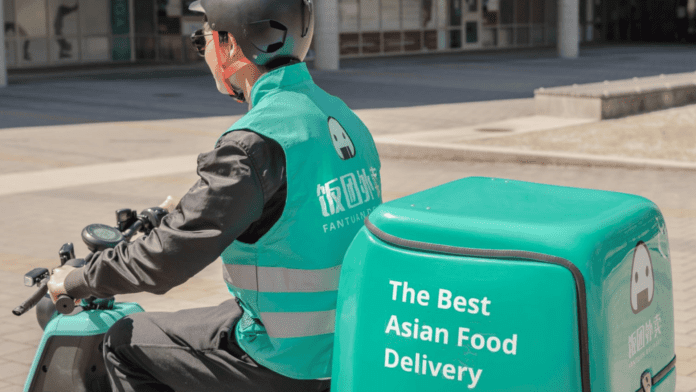
When individuals relocate from China to other countries, one aspect they often long for is the convenience offered by food delivery applications. Over the last nine years, Fantuan, a company based in Vancouver, has dedicated itself to recreating the essence of Chinese food delivery platforms in Western regions. Recently, the company secured additional funding to enhance its mission of delivering genuine Asian cuisine to a global audience.
Fantuan, translating to “rice balls” in Chinese, secured $40 million in a Series C funding round spearheaded by Celtic House Asia, a venture capital firm specializing in investments in first-generation immigrants. GrubMarket, the food supply chain upstart that achieved a valuation exceeding $1 billion in 2021, also played a significant role in leading the funding round.
Additional contributors in the funding round encompass Vision Plus, a venture capital firm founded by Eddie Wu, recently appointed as the chief executive officer at Alibaba, and boutique private equity firm JSD Capital. The company opted not to reveal its valuation following the successful fundraising.
In addition to institutional investors, Fantuan also raised capital from several powerbrokers in China’s retail tech space. This group includes the co-founders of Ele.me, a food delivery pioneer gobbled up by Alibaba in 2018; Bianlifeng, an unmanned convenience store chain; Qunar, a GGV-backed travel booking site acquired by its bigger rival Ctrip; and Dianping, the more powerful Chinese counterpart of Yelp owned by food delivery giant Meituan.
Inspired by the growing prominence of food delivery applications in China, Randy Wu founded Fantuan in 2014 while pursuing an economics degree at Simon Fraser University. Initially managing the business single-handedly, Wu took on multiple roles, even personally delivering food across Vancouver. Eventually, he made the decision to leave college and dedicate himself full-time to what he saw as his opportunity to replicate the success of Chinese models, with Meituan serving as his primary reference point.
Shortly after the establishment of Fantuan, Randy Wu found a partner in Yaofei Feng, whom he had connected with online through their shared interest in playing Dota. Impressed by Wu’s entrepreneurial initiative, Feng decided to take a bold step, leaving his position as a software engineer at Amazon in Seattle and relocating to Vancouver to join the venture.
The founders placed their bets on the increasing demand for top-notch Asian cuisine in Western nations, driven by the migration of millions of Chinese individuals abroad. According to a 2020 report by the International Organization for Migration, the global count of international migrants of Chinese origin had reached approximately 10 million.
“Having food from one’s homeland serves as a form of spiritual solace when living abroad,” expressed Wu. “I distinctly recall my first Chinese meal, three months into my relocation to Saskatchewan, where Chinese cuisine was notably scarce.”
Fantuan aspires to go beyond merely providing delivery services. Drawing inspiration from Meituan’s model, the comprehensive platform for local services in China, the company aims to evolve into the ultimate destination for overseas Chinese, offering a one-stop solution for discovering and accessing various leisure activities.
Its collaboration with GrubMarket mirrors Meituan’s vertical expansion strategy, wherein the food delivery platform facilitates connections between restaurants and ingredient suppliers. By linking farmers with prominent customers such as Whole Foods and Costco, GrubMarket might view Fantuan as a pathway to potentially reach small, local restaurants in the future.
Within two years of its inception, Fantuan emerged as a leading Chinese food delivery platform in Vancouver and attained net profitability. Sustaining profitability for an additional five years, the company embarked on an ambitious expansion into the U.S. amid the challenges of the COVID-19 pandemic. Projections indicate that its annual revenue is expected to approach $100 million this year.
According to Wu, delivering Chinese food poses challenges due to the intricate cooking process, which is often time-consuming. Unlike platforms that cater to various cuisines, concentrating solely on one category results in a lower density of restaurants, consequently leading to extended delivery times. Nonetheless, Wu asserted that Fantuan has successfully maintained an average delivery time of 40 minutes across cities such as Vancouver, Toronto, London, San Francisco, and Sydney.
The availability of drivers impacts delivery times, especially in costly cities like San Francisco, where recruitment efforts may face challenges. Fantuan, preferring Chinese-speaking drivers for effective communication with immigrant restaurant owners, encounters difficulties in securing an adequate number of drivers. Wu noted that drivers are attracted to Fantuan due to the nearly “double” average order value from Chinese restaurants compared to mainstream food delivery platforms, resulting in higher tips.
At present, Wu indicates that Fantuan maintains a user retention rate of approximately 90% after five orders within a 24-month period. Out of its total of two million registered accounts, 1.2 million qualify as “active” users.
Wu asserts that one of Fantuan’s notable strengths lies in its capacity to onboard a diverse array of authentic Chinese and other Asian restaurants. The platform employs the on-the-ground sales approach frequently employed by Chinese tech firms dedicated to digitizing traditional retail. This strategy involves physically visiting customers and establishing in-person relationships.
“Our business development specialists would each manage around 80 restaurants and pay frequent visits to these customers, teaching them tips like how to do marketing and how to pack more efficiently for delivery,” said Wu.
Currently, Fantuan has a global workforce of approximately 500 individuals. Earlier this year, Yinfeng Lu, who previously served as a sales executive at Meituan, joined the company as its Chief Operating Officer.
DP Eurasia N.V. characterized the proposal from Jubilant FoodWorks Limited to acquire the company as ‘unsolicited and opportunistic’.
The statement comes after Jubilant raised its stake in DP Eurasia to 53.52%.
In a stock exchange filing last week, Jubilant proposed acquiring all the issued and outstanding ordinary share capital of DP Eurasia at a market value of up to 85 pence per share.
In response, DP Eurasia’s board expressed profound disappointment that Jubilant chose to pursue this unsolicited and opportunistic approach without initially attempting to negotiate terms that the board could support as being in the best interests of all stakeholders.
In November, the rate of inflation in British groceries decelerated once more. Industry data revealed on Tuesday that the increase in the cost of a typical Christmas dinner is also notably lower than the overall inflation rate.
Consumers, the Bank of England assessing interest rate trends, and lawmakers are closely monitoring the recent decline in food inflation. This scrutiny is particularly relevant in light of Prime Minister Rishi Sunak’s commitment to reducing overall inflation by half this year, especially with a likely national election in 2024.
According to market research firm Kantar, the annual inflation in grocery prices stood at 9.1% for the four weeks ending on November 26, a slight decrease from the 9.7% reported in the previous month. During the same period, grocery sales experienced a year-on-year increase of 6.3%, with 28.4% of the sales occurring through promotional offers, marking the highest figure in over two years.
The researcher reported that the average expense for a frozen turkey Christmas dinner serving four, inclusive of all the accompaniments, Christmas pudding, and sparkling wine, increased by 1.3%, reaching £31.71 ($40.00). However, Brussels sprouts and the pudding were more affordable compared to the previous year.
Kantar noted that prices are experiencing the most rapid increase in markets such as eggs, sugar confectionery, and frozen potato products. This data offers the most current snapshot of grocery inflation in the UK.
The latest official data indicated that annual food inflation stood at 10.1% in October, peaking at over 19% in March, the highest since 1977. Kantar reported that discounters Lidl and Aldi, along with Ocado, Sainsbury’s, and the market leader Tesco, were the top performers in the 12 weeks leading up to November 26.
Kantar observed that Sainsbury’s, the second-largest player, achieved its most substantial market share increase in over a decade, gaining an additional 0.4 percentage points. Kantar predicts that grocery sales in December will surpass 13 billion pounds for the first time, reflecting the ongoing impact of price inflation.
On a different note, data released on Tuesday by the British Retail Consortium revealed that retail sales growth stayed sluggish in November, even with Black Friday deals. The persistent cost-of-living pressure led consumers to restrain spending on non-essential items.
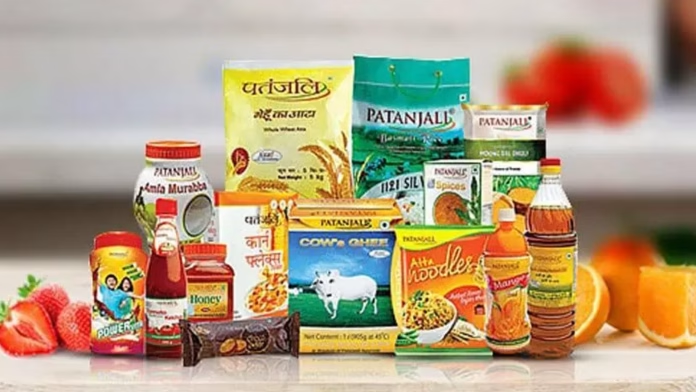
Patanjali Foods is targeting INR 1,000 crore in sales within the masala business, viewing this category as the next frontier for growth.
Baba Ramdev, serving as a non-executive director at Patanjali Foods, expressed the company’s intent to develop the biscuits and edible oil business. This strategic focus aims not only to stimulate growth but also to establish favorable profit margins.
The company has enlisted former cricketer M S Dhoni as the ambassador for its edible oil brand, Mahakosh.
During the investor day, Ramdev refrained from commenting on the merger, demerger, or acquisition plans the company was contemplating.
“While we will enter the nutraceuticals business, we are still discussing the name under which we will launch our product, which also includes Nutrela,” said Ramdev.
According to the investor presentation, the company introduced 22 products and 35 stock-keeping units in the nutraceuticals segment under the Nutrela brand.
He mentioned that the top 10-20 brands of Patanjali Foods would persist in their growth trajectory and further expand in size over the coming years.
Within the food sector, the company has introduced premium offerings, encompassing a range of dry fruits, cereals based on millets, and health-oriented cookies.
The company highlighted in its presentation that it is expanding its outreach through various channels, including modern trade, e-commerce, quick-commerce, and direct-to-consumer. Additionally, it is extending its presence to new geographic areas, particularly in South India.
The company outlined six key areas of focus, which encompass boosting its presence in the food and fast-moving consumer goods sector, swiftly adapting to changing markets through prompt product launches, realigning marketing and branding strategies, expanding distribution through omnichannel channels, driving premiumization across various business segments, and sustaining growth in the oil palm business.
In the first half of this fiscal year, the company foresees 28% of its revenue originating from its food business, marking a significant rise from the 20% reported in FY23. Moreover, its dependence on edible oils has diminished to 72%, down from 80% in the previous fiscal year.
The Leela Palaces, Hotels and Resorts, a prominent luxury hotel brand in India, has recently announced the signing of a management agreement for a 140-room hotel in Ranka, Sikkim. This move signifies the brand’s entry into Northeast India. The project, named Leela Sikkim and owned by the SIBIN Group, is situated approximately 10 kilometers from the capital city on a 17-acre plot with scenic views of Gangtok Hill. Expected to open its doors in December 2026, The Leela Sikkim is nestled in the serene Himalayan backdrop and aims to redefine the hospitality scene in the region with its inspiring design, thoughtful programming, and the brand’s renowned signature services.
Commenting on the announcement, Anuraag Bhatnagar, Chief Executive Officer, The Leela Palaces, Hotels and Resorts stated, “We are delighted to introduce The Leela brand into Northeast India with the project Leela Sikkim. Sikkim remains a pristine destination with the right blend of urbanization, rich cultural heritage and unexplored natural beauty. This expansion is in lockstep with the growing demand from the discerning global leisure traveller to experience meaningful and transformative journeys that are an authentic expression of a region’s natural beauty, heritage, cuisine, and culture.”
Speaking on the occasion Neel Chhetri, Proprietor, Sibin Group stated, “I am excited to partner with The Leela Palaces, Hotels and Resorts to bring this uber luxury brand to Sikkim. We are confident that with this partnership and the investments we are making, the project Leela Sikkim will soon emerge as one of the most sought-after leisure and wellness destinations in the country and will help us to showcase the hidden Himalayan treasure to the world.”
The Leela Sikkim is set to provide guests with a serene and opulent experience, offering a comprehensive array of leisure and wellness facilities and carefully curated services. The resort will boast 35 independent luxury villas, comprising 20 wellness villas, 13 twin villas, and a 6-room double-storey villa, in addition to 88 luxury rooms in a hotel block. Various dining options, including an all-day dining restaurant, a specialty restaurant, a wellness restaurant, and a lounge bar, will be available. Guests can indulge in a state-of-the-art wellness center, a casino, and a variety of both indoor and outdoor activities.
In heralding its entry into the Northeast, The Leela proudly presents Sikkim—an enchanting Himalayan destination for leisure travelers. With a commitment to authenticity, The Leela aims to immerse guests in the genuine culture, art, wellness, flavors, and natural beauty of this undiscovered region, ensuring unforgettable experiences. This strategic expansion underscores the company’s dedication to growing in pivotal leisure and resort destinations throughout the country.
We use cookies to ensure that we give you the best experience on our website. If you continue to use this site we will assume that you are happy with it.