Friday, December 19, 2025
Home Blog Page 42

Palm Oil Flows Into India at 13-Month High as Imports Touch 990,528 Tons in August; Sunflower Oil Gains, Soyoil Slides, Canola Oil Returns After 5 Years

0

India’s palm oil imports soared in August to their highest in more than a year, as refiners rushed to secure supplies ahead of the festive season, lured by palm oil’s price advantage over soyoil. The rise is expected to ease excess stockpiles in Indonesia and Malaysia, the world’s top producers.

According to data released by the Solvent Extractors’ Association of India (SEA) on Monday, palm oil shipments into the country rose nearly 16% month-on-month to 990,528 metric tons, marking the highest level since July 2024.

The surge came at the expense of soyoil, with imports of the soft oil plunging 25% to 367,917 tons, the lowest in four months. Sunflower oil, however, staged a strong rebound, with imports climbing 28.5% to 257,080 tons — a seven-month peak.

In a notable development, India also imported 6,000 tons of canola oil in August, its first significant purchase of the commodity in nearly five years.

Overall edible oil imports rose 4.7% month-on-month to 1.62 million tons, also the highest since July 2024. The SEA noted that refiners have stepped up stocking to meet expected demand spikes during the September–November festive window, when consumption of fried foods and sweets rises sharply.

India, the world’s largest importer of vegetable oils, sources palm oil mainly from Indonesia and Malaysia, while soyoil comes from Argentina and Brazil, and sunflower oil largely from Russia and Ukraine.

Trade sources estimate that palm oil imports will remain above 800,000 tons in September as festive demand peaks. SEA data also showed that India imported 589,283 tons of duty-free edible oils from Nepal between November 2024 and July 2025, under a regional trade pact.

Advertisement

India’s Luggage Market to Hit Rs 267 Billion by 2028: VIP, Samsonite, Safari Race Ahead as Weddings and Travel Fuel 12% CAGR

0

India’s luggage market is on a strong growth trajectory, projected to expand at a compound annual growth rate (CAGR) of 12 percent over the next four years to touch Rs 267 billion by 2028, according to a new report by Motilal Oswal Financial Services.

The sector, which had contracted to Rs 60 billion during the pandemic in 2020, has staged a sharp recovery, clocking a 37 percent CAGR between 2020 and 2023. Analysts link this rebound to a surge in air and rail travel, coupled with an uptick in weddings and destination ceremonies where luggage plays a key role in gifting and trousseau purchases. The wedding-heavy November–December 2024 period alone witnessed more than 4.8 million ceremonies, adding significantly to sales.

Branded players, currently holding 52 percent of the market, are expected to outpace industry growth as consumers shift away from unbranded goods toward more durable, stylish, and premium luggage. Three major companies—VIP, Samsonite, and Safari—already account for about one-third of the total market.

The mass segment, priced under Rs 4,000, dominates with a 60 percent share valued at Rs 102 billion. Safari leads this category with 16 percent, followed by Aristocrat and Kamiliant. The mid-tier, comprising 30 percent of the market, is driven by VIP (21 percent through VIP and Skybags) and American Tourister (17 percent), both targeting value-conscious urban buyers through omnichannel presence and curated ranges.

The premium end, making up around 10 percent, is growing rapidly with Samsonite holding 20 percent and Carlton 8 percent, buoyed by international travel demand. Digital-first direct-to-consumer labels are also gaining traction, especially among younger consumers drawn to minimalist design and influencer-led marketing.

Advertisement

Little Spoon Aims for $150M Revenue in 2025: How Ben Lewis and Angela Vranich Built America’s 1 Kids’ Food Brand Without Retail

0

Little Spoon, the largest direct-to-consumer baby and kids’ food company in the United States, is on track to cross $150 million in net revenue this year, according to company executives. The milestone comes less than a decade after its founding and just a year after turning profitable in 2024.

Launched in 2017 by Ben Lewis and Angela Vranich, Little Spoon carved out a strong position in the crowded food market by targeting a niche often overlooked by big packaged food companies: clean, convenient, and nutritionally balanced meals for children. The company’s portfolio spans baby blends, toddler meals, snacks, and vitamins, with each product designed around rigorous sourcing standards and ingredient transparency.

Industry analysts point out that the brand’s success is striking not only because of its scale, but also because it has achieved nine-figure revenues without entering physical retail. While most packaged food companies rely on grocery distribution to drive volume, Little Spoon has grown entirely through its online subscription model, serving families across the country.

Executives attribute this growth to shifting consumer preferences among millennial and Gen Z parents, who have shown a greater willingness to pay a premium for fresh, minimally processed meals delivered directly to their doors. Since launch, the company has shipped tens of millions of meals and built one of the largest digital communities of parents in the United States.

With profitability secured and revenue scaling at double-digit rates, industry observers suggest Little Spoon could soon explore international expansion or strategic partnerships. For now, its ability to disrupt a traditionally retail-heavy category with a direct-to-consumer model has made it one of the most closely watched food startups in the country.

Advertisement

Gen Z Tips the Glass Differently: 1 in 4 Indians Now Prefers No/Low Alcohol; Startups like Sober & Catwalk Botanicals Join UB, Diageo in Chasing Metro Demand

0

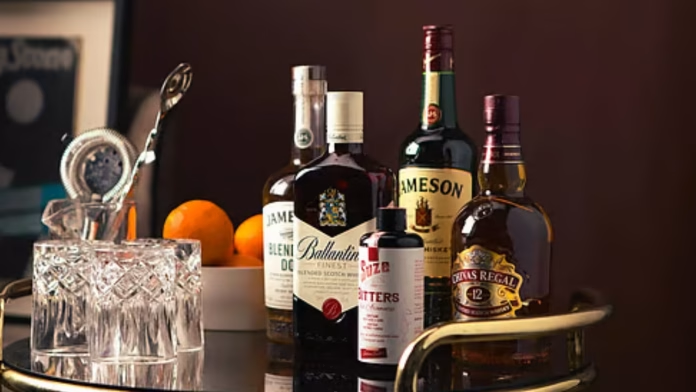
India’s youngest consumers are reshaping the country’s drinking culture, steering demand toward no-alcohol and low-alcohol beverages. A recent NielsenIQ study shows that 24% of Indian consumers now opt for such alternatives, well above the global average of 17%. More than half of this segment is made up of millennials and Gen Z, making India the second-largest market for these drinks in Asia-Pacific after the Philippines.

The trend is most pronounced in metros where bars are moving beyond colas and virgin mojitos to offer sophisticated non-alcoholic cocktails. Industry leaders say this reflects a broader health and moderation shift. Vikram Bahl, chief marketing officer at United Breweries, said urban professionals and young consumers increasingly want inclusivity and balance without giving up the taste of beer. United Breweries’ latest report notes investments in alcohol-free innovation aimed at metro markets.

Diageo India is also tracking the space closely. Its CMO, Ruchira Jaitley, said Gen Z is adopting what she calls “zebra striping,” alternating between alcoholic and non-alcoholic drinks, and leaning toward cocktails and premium categories. Diageo recently bought a 15% stake in V9 Beverages, parent of non-alcoholic spirits brand Sober.

Local startups are riding the wave. Aditya Agarwal, founder of Sober, said non-alcoholic whiskey is the fastest mover, reflecting whiskey’s dominance as India’s most consumed spirit. Catwalk Botanicals’ Ishan Arora estimates the non-alcoholic segment remains a fraction of India’s premium alcohol market, which itself accounts for 8–9% of the country’s $42 billion alcobev industry.

Cultural observers believe the shift is as social as it is health-driven. Santosh Desai noted that younger consumers want the buzz and social ease of alcohol without its risks. Spencer’s Retail vice-chairman Shashwat Goenka added that Gen Z is drinking to stand out, unlike millennials who drank to blend in.

Advertisement

Coffee Island Lands in Pune with European Flair as India’s Café Market Poised to Cross ₹25,000 Crore by 2028

0

Coffee Island, one of Europe’s fastest-growing specialty coffee chains, has officially entered the Indian market with the launch of its first café at Amanora Mall. Positioned at the mall’s East Block on the ground floor, the brand aims to redefine Pune’s café experience by blending European coffee traditions with local sensibilities.

Founded in Greece in 1999, Coffee Island has expanded across Europe with over 500 outlets and is now looking to tap into India’s fast-rising café culture. The Indian café market, currently estimated at over ₹25,000 crore, is growing at double digits annually, fueled by millennials and Gen Z consumers who increasingly view cafés as social and work hubs.

The Pune outlet offers a wide range of specialty brews, global blends, and signature recipes, promising an “immersive coffee journey” that goes beyond the standard café menu. From cappuccinos and Americanos to experimental handcrafted blends, Coffee Island is pitching itself as a destination for both everyday coffee drinkers and connoisseurs seeking artisanal brews.

The brand’s debut also ties in with Amanora Mall’s ongoing repositioning as a lifestyle hub. “Every transformation deserves a place to pause, reflect, and recharge. Coffee Island arrives at the right moment as Amanora evolves beyond shopping into a 360-degree lifestyle destination,” said Surjit Singh Rajpurohit, CEO of Amanora Mall. “Known for its global coffee culture and artisan blends, the café adds an international edge to our mix of fashion, retail, and food.”

Pune, with its large student base and young working professionals, has become a battleground for café chains in recent years, with Starbucks, Third Wave Coffee, and Blue Tokai expanding rapidly. Coffee Island’s entry signals growing competition in India’s premium coffee segment, where international and homegrown players alike are racing to capture a slice of the market.

Advertisement

Behind the Festive Rush: Delivery Platforms Face Rising Fraud as 5 Lakh Zomato and 2.4 Lakh Blinkit Riders Hit the Streets

0

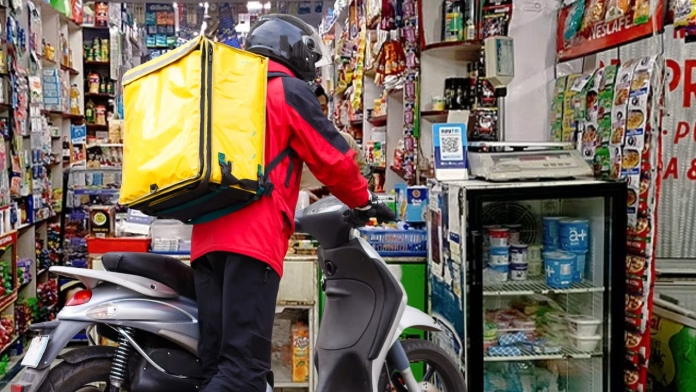
India’s festive season hiring blitz is revealing a troubling undercurrent. While quick-commerce and e-commerce platforms are ramping up gig workforce recruitment by 20-25% compared to last year, incidents of fudged documents, fake addresses, and flawed background verification are on the rise, industry executives said.

Identity verification firm IDfy estimates that nearly 10,000 rider profiles have been blocked so far this season for discrepancies ranging from forged IDs to mismatched addresses. This compares with about 30,000 blocked profiles during last year’s festive surge. “Most of the lapses are related to identity and address proofs,” said Pratik Agarwal, head of IDfy.

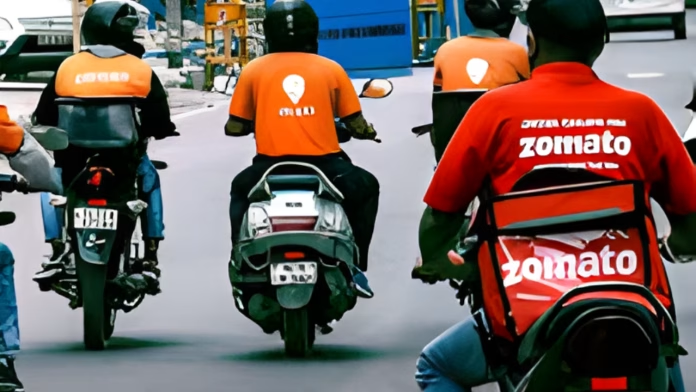
With quick-commerce giants Blinkit and Zomato each managing vast fleets—5.09 lakh and 2.4 lakh delivery partners, respectively, as of Q1 FY26—platforms are now doubling down on checks. “Impersonation is treated as identity theft and leads to permanent termination, along with strict action under our code of conduct,” a spokesperson for Eternal, which oversees verification for both firms, said.

Yet, lapses often surface only after incidents. “Weaknesses in ID checks frequently come to light after a fraud, compliance violation, or customer safety issue,” said Aditya Mishra, chief executive of staffing services firm CIEL HR. “Such gaps, if unchecked, carry reputational and regulatory risks.”

Logistics startups are also tightening their processes. Angad Singh of Zippee said his company has instituted criminal record checks, address verification, and blacklist mechanisms. “Rare misrepresentations lead to immediate termination, and offenders are permanently barred,” he added.

Platforms are responding with continuous monitoring, including regular selfie checks to ensure rider identity matches, executives said. Analysts warn that with quick-commerce hiring expected to peak further during Diwali, safeguarding customer trust will require deeper investment in technology-driven verification and real-time oversight.

Advertisement

ITC Foods Bets on Fresh Packaged Play: Sunfeast Cookies, Aashirvaad Chapatis to Ride ₹3,000-Crore Quick Commerce Wave in FY26

0

ITC Foods is gearing up to expand into fresh packaged foods such as cookies, cakes, and chapatis, in a move designed to tap India’s rapidly growing quick commerce market. The initiative reflects the company’s bid to align with shifting consumer preferences for convenience-led foods with short shelf lives, delivered quickly through hyper-local supply chains.

Hemant Malik, chief executive of ITC’s food division, said the company has extended its flagship Sunfeast and Aashirvaad brands into these categories. “Consumers today are looking for products that combine freshness, quality, and accessibility. The rise of quick commerce has made it possible to reach them faster with foods designed to be consumed within days rather than months,” he told ET.

To deliver on this promise, ITC has built a small-batch production and hyper-local distribution model that enables next-day delivery from oven to doorstep. The system bypasses long-haul logistics and warehouse storage, common hurdles in a country where 75 percent of FMCG sales still flow through local kirana stores.

Industry analysts, however, warn that scaling such a model will require more than quick commerce. Devangshu Dutta, founder of retail advisory Third Eyesight, said products with limited shelf lives “must move fast,” making inventory management on quick commerce platforms a challenge. He added that ITC will eventually need to extend these products into modern and general trade to achieve scale.

For ITC, the push into fresh packaged foods comes on the back of steady growth in its food business, which reported gross sales of ₹18,270 crore in FY25, up 6 percent year-on-year. The company joins peers like Hindustan Unilever, Marico, Adani Wilmar, and Parle, all of whom are creating dedicated portfolios for the fast-moving quick commerce channel, now dominated by Blinkit, Swiggy Instamart, and Zepto.

Advertisement

Boat Signs Hip-Hop Sensation KR$NA as Brand Ambassador, Tapping His 116M+ Streams to Power Youth Campaigns

0

Boat, one of India’s largest audio wearables companies, has announced hip-hop artist KR$NA as its newest brand ambassador, strengthening its push to align with the country’s youth-driven music and cultural movements.

The homegrown consumer electronics brand, which leads India’s hearables market with products such as earbuds, headphones, and smartwatches, said the collaboration is designed to blend music, culture and technology while reinforcing its image as a youth-first label.

KR$NA, who has emerged as one of India’s most influential rap voices, has consistently delivered hits that resonate with urban audiences. His songs “YKWIM” (116 million streams), “I Guess” (61 million), and “Joota Japani” (38 million) have made him a mainstay on music charts. Tracks such as “No Cap” and “Never Enough” have further cemented his reputation for storytelling rooted in everyday realities.

Speaking on the partnership, KR$NA said he identifies with Boat’s approach of letting quality speak for itself. “I’ve always kept things limited and let my music do the talking. Boat has the same authenticity. Both of us draw from culture, and this association will connect across every street and corner of the country,” he said.

Boat confirmed that the campaign will not be restricted to product endorsements. It will feature digital-first content, interactive campaigns, and on-ground activations that aim to build communities around music and self-expression. A company spokesperson added that KR$NA’s story of resilience and creativity mirrors the values Boat wants to champion.

Founded in 2016, Boat has built a stronghold in affordable lifestyle electronics and has frequently used music icons and sporting personalities to expand its brand equity. The addition of KR$NA continues this strategy of embedding itself deeper into India’s evolving pop culture fabric.

Advertisement

Gen Z at the Core: Myntra and Vellvette Lifestyle Roll Out Molten Beauty, Eye 40% Share of India’s Online Beauty Spending by 2030

0

Fashion and lifestyle e-tailer Myntra has joined hands with Vellvette Lifestyle Pvt Ltd, the company behind SUGAR Cosmetics, to roll out Molten Beauty, a new brand that blends skincare with makeup and is sharply targeted at Gen Z buyers.

The collaboration, announced on Friday, positions Molten Beauty at the heart of India’s booming beauty and personal care segment, currently valued at over ₹1.2 lakh crore and growing at a double-digit rate. The brand aims to roll out more than 50 products in its first year, spanning categories such as hybrid foundations, serums with tint, skin-friendly lip oils and lightweight blush balms.

Myntra, which counts 25 million Gen Z users on its platform, said the tie-up reflects a growing appetite among younger shoppers for multi-purpose products that prioritize skin health without compromising on style. “Today’s consumers, particularly Gen Z, are looking for beauty that works as hard as they do. Molten Beauty’s skin-first philosophy is designed to meet that demand,” said Nandita Sinha, CEO of Myntra.

The new label will be retailed exclusively on Myntra’s marketplace, its own brand website, and Myntra’s M-Now quick delivery service, ensuring faster access in top urban markets. Analysts note that quick commerce has become a critical lever in beauty sales, especially for impulse-driven categories such as lip and eye products.

For Vellvette Lifestyle, which has built SUGAR into a ₹500-crore-plus brand, Molten Beauty marks a diversification into the next wave of beauty consumption. Industry watchers say the launch could help the company tap a consumer base younger than SUGAR’s millennial-heavy audience.

With Gen Z expected to account for nearly 40% of India’s online beauty spending by 2030, the partnership signals an aggressive play to capture share early in a fast-evolving market.

Advertisement

Balaji Wafers in ₹40,000-Crore Snack Race: ITC, PepsiCo, TPG, Temasek Compete for 10% Stake as Profits Jump 41% in FY24

0

Regional FMCG companies are shaking up India’s consumer goods market, forcing legacy giants to rethink strategy. One of the biggest names at the center of this shift is Rajkot-based Balaji Wafers, which has attracted fresh takeover interest from ITC, PepsiCo and global private equity firms including TPG and Temasek. According to people familiar with the matter, discussions are underway for a 10 percent stake that could value Balaji at nearly Rs 40,000 crore.

Founded in 1982 by Chandubhai Virani and his brothers Bhikubhai and Kanubhai, Balaji has grown from a small theatre snack supplier to a regional powerhouse. The company operates four factories, keeps advertising spends negligible and competes by pricing products 20–30 percent lower than national rivals. Its strategy has paid off. Annual revenue crossed Rs 5,453.7 crore in FY24, up 11 percent from the previous year, while profit after tax jumped 41 percent to Rs 578.8 crore.

This is not PepsiCo’s first attempt to enter Balaji. In 2013, then-CEO Indra Nooyi explored a larger stake, but the Virani family resisted ceding control. Today, global majors see even a minority partnership as a way to tap into Balaji’s stronghold across western and central India and to strengthen supply chain capabilities.

Balaji’s success mirrors a broader trend. From noodles and tea to spices and soft drinks, smaller regional brands are winning consumers by tailoring products to local preferences and undercutting national labels on price. Quick commerce platforms like Blinkit and e-commerce players such as Amazon and BigBasket have accelerated their reach, while investors are pouring money into upcoming brands like Iscon Balaji, Zoff Spices, and Lahori Zeera.

As demand growth slows in metros, regional challengers are becoming the new battleground for India’s FMCG industry.

Advertisement