Monday, December 22, 2025
Home Blog Page 32

Blue Tribe Foods Targets Health-Conscious Consumers with Launch of Korean Soya Chaap and Spicy Kebab

0

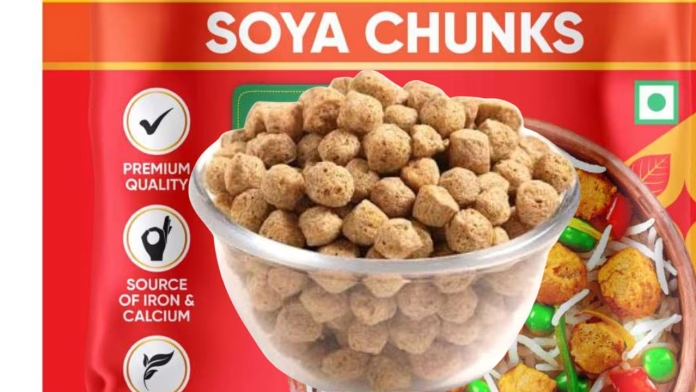
Blue Tribe Foods, one of India’s leading plant-based food companies, has unveiled two new additions to its range — India’s first Korean Soya Chaap and a fiery Spicy Kebab. The launch marks the company’s latest effort to merge global culinary trends with clean-label, sustainable eating options for Indian consumers.

The Korean Soya Chaap, a category-first innovation, brings together the tender texture of traditional North Indian chaap with the bold, umami-rich flavors of Korean cuisine. Crafted without maida or palm oil and containing zero cholesterol, the high-protein product caters to India’s growing base of health-conscious and experimental eaters. The Spicy Kebab, meanwhile, is a ready-to-cook option created for those who enjoy bold flavors without compromising on nutrition.

The new products come at a time when India’s plant-based food market is witnessing rapid expansion. Valued at about USD 98.6 million in 2024, the segment is projected to reach USD 737.9 million by 2033, growing at a compound annual rate of 22.3%. Blue Tribe, founded by entrepreneurs Sandeep Singh and Nikki Arora Singh, has been at the forefront of this shift, aiming to make plant-based eating both accessible and exciting.

“Our goal is to make sustainable eating mainstream in India,” said Nikki Arora Singh, Co-founder of Blue Tribe Foods. “The Korean Soya Chaap and Spicy Kebab reflect how Indian consumers are ready for global flavors that align with health and sustainability. We want to make that choice easy and enjoyable.”

The products are now available across 76 premium offline outlets in cities such as Mumbai, Delhi, Gurgaon, Noida, Ludhiana, and Amritsar, as well as through online platforms including Blinkit, Zepto, and Swiggy Instamart. With this launch, Blue Tribe strengthens its leadership in India’s fast-evolving plant-based food market.

Advertisement

After Two Big Years, Home Interiors Brand Livspace Still Rising with 23% Growth in FY25

0

Bengaluru-based home interiors platform Livspace recorded a 23% rise in revenue for FY25, reaching ₹1,460 crore, marking its second consecutive year of moderate growth after an earlier phase of rapid expansion. The omnichannel home design firm, backed by Ikea’s Ingka Group Investments, had previously logged 85% growth in FY23 and 20% in FY24.

Alongside topline gains, Livspace has made significant progress in cutting losses. Its adjusted EBITDA loss (before ESOPs) narrowed by 47% to ₹131 crore, down from ₹246 crore in the previous fiscal. The company’s gross profit rose 26% to ₹752 crore, while gross margins stood at 51.5%, up from ₹598 crore in FY24.

Livspace said the numbers reflect better traction in both premium and mass-premium residential projects, improved cost discipline, and stronger unit economics. The company attributed the growth to rising demand for organized home renovation and higher-value interior projects.

Looking ahead, Livspace is gearing up for a reverse flip of its domicile to India by the end of 2025, a move that will align its corporate structure with its largest market. The company also continues to prepare for an IPO, which could launch in late 2025 or early 2026, as previously indicated by co-founder and CEO Ramakant Sharma.

To fuel expansion, Livspace plans to increase its retail footprint to 200 stores, deepen its reach across tier-II and tier-III cities, and introduce a private-label range of kitchen appliances, including hobs and chimneys.

Founded in 2015 by Sharma and Anuj Srivastava, Livspace connects homeowners with interior designers and contractors. The platform has raised $450 million to date from investors such as KKR, Bessemer Venture Partners, Jungle Ventures, and others.

Advertisement

Financial Strain Deepens at Bira 91 as Auditor Warns of Uncertain Future and Mounting Liabilities

0

Craft beer maker Bira 91 is facing mounting financial strain, with its auditor warning that the company’s losses and liabilities raise “significant doubt” about its ability to continue operations. The latest audit report by Walker Chandiok & Co, a network firm of Grant Thornton International, has flagged severe liquidity concerns for the parent company, B9 Beverages, after its net worth was fully eroded in FY24.

According to the audit, B9 Beverages ended the fiscal year with a negative cash flow of ₹84 crore and accumulated losses of ₹1,904 crore. Its liabilities exceeded total assets by ₹619.6 crore as of March 31, 2024. The auditor cited exposure to market, credit, and liquidity risks that could further impact the fair value of the company’s financial instruments.

“These events and conditions indicate material uncertainty regarding the group’s ability to continue as a going concern,” the report stated.

Founder and CEO Ankur Jain maintained that such financial pressure is “not unusual” for fast-growing businesses at scale. He said the management remains confident about meeting obligations based on future cash flows and planned capital infusions from investors.

Bira 91, once celebrated for transforming India’s craft beer market, is now confronting multiple challenges, including layoffs and production halts. In September, over 250 employees reportedly wrote to the board, major investors Kirin Holdings and Peak XV Partners, and lender Anicut Capital, demanding a leadership change amid delayed salary and reimbursement payments.

Adding to the company’s troubles, the Ministry of Corporate Affairs directed B9 Beverages to ensure timely compliance with regulations after it sought an extension to hold its FY25 annual general meeting. The Registrar of Companies later granted a three-month extension to file its financials.

Advertisement

Malabar Gold Eyes 30% Sales Growth in FY26, Bets on Tier 2 Cities and Festive Demand

0

Malabar Gold & Diamonds expects strong double-digit growth in the second half of FY26, buoyed by festive spending, rising rural consumption, and a surge in digitally influenced purchases. The company, among India’s largest jewellery retailers, is also gearing up for a potential IPO as it consolidates operations and scales up across new markets.

According to Asher O, Managing Director of India Operations, shoppers are increasingly blending digital research with physical store visits before buying. “Consumers may not complete purchases online, but their decisions are deeply shaped by digital exploration. This behaviour is shaping our retail strategy,” he told ETRetail.

The company currently operates 262 outlets across India and over 150 international stores in 14 countries, including the US, UK, UAE, Australia, and Singapore. Malabar plans to expand its global footprint to over 410 stores by the end of FY26, with more than 35 new stores expected to open in India over the next few months. Tier II and Tier III cities are driving this growth, supported by rising disposable incomes and increasing exposure to global trends through social media.

The jeweller recently inaugurated a new 9,500 sq ft showroom in Delhi’s Vaishali Enclave, replacing its Pitampura outlet. Bollywood actor and brand ambassador Anil Kapoor attended the opening.

On the financial front, Malabar expects its India retail revenue to rise from ₹42,000 crore in FY25 to around ₹54,000–₹55,000 crore in FY26, while global B2C revenue is projected to exceed ₹76,000 crore.

Malabar continues to focus on natural gold and diamond jewellery but remains watchful of the lab-grown diamond trend. The company’s integrated manufacturing and design operations help sustain competitive pricing, while a unified “one-year-one-rate” policy across states strengthens consumer trust.

Advertisement

Organic Food Startup TBOF Raises ₹110 Crore to Expand Manufacturing, Farmer Training, and Exports

0

Two Brothers Organic Farms (TBOF), a leading player in India’s organic and regenerative agriculture sector, has secured ₹110 crore in a Series B funding round led by 360 ONE Asset, with participation from Rainmatter Investments, Narotam Sekhsaria Family Office, and IGNITE Growth LLP. The capital infusion marks a strategic milestone for the company as it looks to scale operations, strengthen its manufacturing footprint, and expand its global presence.

Founded by brothers Ajinkya and Satyajit Hange, TBOF has carved a niche in the clean-label food segment, offering over 100 products that span staples, snacks, and health foods. The brand, which currently reaches 50 international markets, has recorded an annual recurring revenue of ₹200 crore. The new investment is expected to accelerate its path toward a targeted revenue of ₹1,000 crore in the coming years.

“The Series B funding will enable us to scale our manufacturing capabilities, enhance farmer training programs, and deepen our presence in international markets,” said a company spokesperson. By focusing on regenerative agriculture practices, TBOF aims to combine sustainable farming with commercially scalable operations, benefiting both farmers and consumers.

This round follows the company’s ₹58.25 crore Series A funding, reflecting strong investor confidence in TBOF’s growth trajectory and the rising demand for organic and sustainable food products. The company plans to invest in state-of-the-art manufacturing facilities, expand supply chain networks, and introduce new product lines to cater to global taste preferences.

TBOF’s growth story underscores the potential of India’s organic food sector, which is witnessing rising consumer awareness, increased health-conscious spending, and growing export opportunities. With its strong foundation and fresh capital, Two Brothers Organic Farms is poised to scale aggressively while maintaining its commitment to quality, sustainability, and farmer empowerment.

Advertisement

Papa Johns Re-Enters India with Bengaluru Launch, Plans Rapid Nationwide Expansion

0

Papa Johns has made its official comeback in India through a new joint venture, marking its return with the opening of four outlets in Bengaluru. The international pizza chain has set up shop in Indiranagar, Hennur, Electronic City, and Sarjapur Road, positioning the southern metropolis as its launchpad for renewed growth in the country’s competitive quick-service restaurant (QSR) market.

The re-entry is being led by PJP Investments Group, which operates Papa Johns across the UAE, Saudi Arabia, and Jordan. The group’s CEO, Tapan Vaidya, said the brand’s focus on premium ingredients and consistency will be its key differentiator in India. “Our commitment to quality is central to the Papa Johns experience. Every pizza is made from fresh, never-frozen dough prepared daily at a central quality control center to maintain the same taste across all locations,” Vaidya said.

Papa Johns’ return comes at a time when India’s pizza market is estimated to exceed ₹20,000 crore by 2026, fueled by rising urban demand, online food delivery, and experimentation with premium international brands. Competing directly with Domino’s, Pizza Hut, and a growing crop of homegrown players, Papa Johns is betting on its “Better Ingredients. Better Pizza.” positioning to attract Indian consumers.

The brand’s Indian menu includes its global favorites alongside localized offerings designed for regional palates, such as the Ghee Roast Pizza. According to Ravi T., CFO of Papa Johns, the Bengaluru launch “lays a strong foundation for long-term growth” as the company prepares for a broader rollout across major cities.

Industry insiders expect Papa Johns to open additional outlets across Mumbai, Delhi, and Hyderabad in the next phase. With a focus on freshness, flavor innovation, and consistency, the brand aims to reclaim its place among India’s leading pizza chains.

Advertisement

Ajay Devgn Enters India’s Premium Whisky Market with The GlenJourneys Crafted in the Scottish Highlands

0

Bollywood actor and entrepreneur Ajay Devgn has forayed into India’s luxury spirits market with the launch of The GlenJourneys, a premium single malt whisky crafted in the Scottish Highlands and curated for Indian whisky drinkers. Co-founded with premium liquor firm Cartel Bros, the brand aims to build a strong presence in India’s rapidly expanding single malt segment, currently growing at nearly 12% annually.

The first collection under the label, called The Cask Series, features whiskies finished in rum, bourbon, and sherry casks, each designed to offer depth and diversity suited to Indian palates. Priced at around ₹6,409 in Mumbai, the range positions The GlenJourneys within the country’s ultra-premium whisky segment, where consumer demand for authenticity and craftsmanship is surging.

Speaking on the launch, Devgn described The GlenJourneys as a balance between “tradition, innovation, and patience,” emphasizing how each variant embodies the character of the cask and the care taken through maturation.

Following a limited debut at select international duty-free stores, The GlenJourneys is now rolling out across India, beginning with Maharashtra, where it targets sales of 10,000 cases by March 2026. The brand will expand to Haryana, Uttar Pradesh, Goa, and Chandigarh by the end of this year, followed by Delhi and Bengaluru in early 2026.

The lineup also includes The Pioneer Edition, a 21-year-old Highland single malt, limited to just 600 bottles worldwide and priced at approximately ₹50,000. The collector’s edition has already drawn attention among global whisky aficionados for its refinement and exclusivity.

Devgn’s entry into the whisky business reflects a growing wave of celebrity-led ventures in India’s luxury beverage space. With The GlenJourneys, he hopes to bring a distinct, globally benchmarked single malt experience to Indian connoisseurs.

Advertisement

Lay’s Goes Back to Its Roots: PepsiCo Unveils Biggest Redesign in 100 Years to Spotlight Real Potatoes and Family Farms

0

Lay’s, the iconic potato chip label from PepsiCo, has unveiled a striking new global look the most significant change it’s made in almost a century. The refreshed identity puts the spotlight back on where it all begins: the farm. It’s a reminder that every Lay’s chip starts with a real potato, grown and harvested by family farmers.

Interestingly, a recent survey revealed that nearly half of consumers didn’t know Lay’s chips come from real potatoes. This finding pushed the brand to tell its story more clearly through packaging, design, and a renewed focus on simple, natural ingredients.

Alongside the new design, Lay’s is also cleaning up its recipes. By the end of 2025, the company plans to eliminate all artificial flavors and colors from its main U.S. lineup, with its dips following suit the next year. The Baked range will soon be made with olive oil, and the Kettle Cooked Reduced Fat Original Sea Salt chips will switch to avocado oil.

Created by PepsiCo’s Design & Innovation team, the updated packaging features a friendlier sun logo, “Lay’s Rays” that echo natural sunlight, and warm, earthy colors inspired by ingredients found in nature. The goal is to bridge Lay’s heritage with the expectations of today’s consumers — who care about both authenticity and transparency.

“The redesign honors the simple potato  the heart of every Lay’s chip,” said Alexis Porter, VP of Marketing, Global Lay’s. Denise Truelove, SVP of Marketing, PepsiCo Foods US, added that the brand is “bringing more transparency, more options, and the same joy people have always loved.”

Partnering with over 100 family-owned farms across North America, some of Lay’s potatoes go from field to bag in as little as two days. With this transformation, Lay’s isn’t changing what people love about it — just making that love feel a little more real.

Advertisement

India’s Beer Makers Grapple with 13-Crore Can Deficit, Demand Policy Relief

0

India’s beer makers are warning of a severe disruption in supply due to an acute shortage of aluminium cans, urging the government to allow short-term import relaxations to meet rising demand during the peak consumption period.

According to the Brewers Association of India (BAI), the domestic industry faces an annual deficit of nearly 12 to 13 crore aluminium cans in the 500 ml size segment, which accounts for roughly 20% of total beer sales across the country. The shortage, if unresolved, could cost the government an estimated ₹1,300 crore in lost excise revenue this fiscal year.

The supply crunch has been compounded by a mandatory Bureau of Indian Standards (BIS) certification introduced on April 1, 2025, under a new Quality Control Order (QCO). While intended to ensure product quality and safety, the regulation has temporarily restricted imports from non-certified suppliers, leaving domestic manufacturers unable to bridge the gap.

Leading can producers Ball Beverage Packaging India and Can-Pack India have reached full production capacity and are unlikely to scale output for another 6 to 12 months as they expand their facilities. The bottleneck has already begun to affect breweries that rely heavily on canned formats for both retail and export markets.

Industry executives have appealed to the government for a limited relaxation in BIS compliance to allow certified international suppliers to ship cans into India until local capacity stabilizes. They warn that continued shortages could disrupt production, slow category growth, and affect availability during the upcoming festive and tourist seasons—key demand drivers for the sector.

Advertisement

Bira 91’s Ankur Jain Reassures Employees Amid Fundraising Push, Calls Out “Inaccurate” Media Reports

0

Bira 91 founder and CEO Ankur Jain addressed recent media coverage about the company’s fundraising efforts, reaffirming his commitment to employees and the company’s long-term stability. In a note to his team, Jain emphasized that his “singular focus” remains on completing the fundraise and protecting the interests of both Bira 91 and its employees.

He confirmed that the company is in active discussions with investors to secure the capital required to stabilize operations. “While there are still many bridges to cross, we are confident that we will be able to bring these efforts to a positive conclusion,” he said, adding that all stakeholders have been supportive of the company’s goals.

Jain also stressed that employees will be fully prioritized throughout the fundraising process. “No employee’s interest will be sacrificed as we succeed in our efforts,” he stated, highlighting that for over a decade, Bira 91 has ensured timely payroll even at the expense of other critical investments.

Addressing recent negative media reports, Jain called them “inaccurate, unsubstantiated, and driven by cynical objectives,” noting that the company’s focus remains on growth and employee welfare.

He concluded by expressing optimism about Bira 91’s future: “Despite this speed bump, I am optimistic that we will bring back Bira 91 on the growth highway.”

Founded in 2015, Bira 91 has grown into one of India’s leading craft beer brands, known for its youthful identity and innovative products. The upcoming fundraise is expected to mark the company’s next phase of expansion.

Advertisement