BlueStone Shrinks IPO to ₹820 Cr, Takes a ₹300 Cr Hit on Valuation; Accel, Kalaari Trim Exit Plans
Bengaluru-headquartered jewellery brand BlueStone has trimmed the size of its initial public offering, as per an updated red herring prospectus filed with SEBI. The omnichannel retailer now plans to raise ₹820 crore in primary capital, a significant cut from the ₹1,000 crore originally proposed.
The IPO is scheduled to open on August 11, with the company targeting a public market valuation of around ₹7,800 crore. That figure is notably below the ₹8,100 crore valuation it secured in its previous funding round in August 2024.
BlueStone’s offer-for-sale component has also seen a sharp reduction. Investors including Accel, Kalaari Capital, Iron Pillar and Hero Group’s Sunil Kant Munjal will offload 13.9 million shares, compared to 24 million in the earlier draft. IvyCap Ventures, which was earlier listed to sell 3.1 million shares, has opted out of the OFS altogether.
The company, which received SEBI’s nod for the IPO in April, has reported strong topline growth but widening losses. Operating revenue rose 40 percent year-on-year to ₹1,770 crore in FY25. However, net losses grew to ₹222 crore from ₹142 crore in FY24.
Axis Capital, IIFL Capital and Kotak Mahindra are managing the IPO.
In the lead-up to its public issue, BlueStone also saw active secondary market interest. Private wealth firms 360 One and Centrum Wealth facilitated share sales worth ₹300 to ₹350 crore, as per earlier ET reports.
Investor appetite in jewellery-focused startups has picked up pace, particularly after the Tata Group’s full buyout of CaratLane in 2023, valuing the company at ₹17,000 crore. More recently, silver jewellery startup Giva is in talks to raise ₹450 crore in a round led by Creaegis, with backing from Premji Invest and Epiq Capital.
Reliance Retail’s Tira Unveils Puraveda: Over 50 Ayurvedic Beauty Products Hit Market, Backed by Ancient Formulas and Modern Actives
Reliance Retail is strengthening its presence in the beauty market with the launch of Puraveda, a new Ayurvedic beauty brand housed under its omni-channel platform, Tira. With over 50 products rolled out at launch, Puraveda spans skincare, haircare, and body care, blending traditional Indian wellness with modern scientific formulations.
The brand features four ingredient-led ranges: Dhara, focused on deep nourishment using chandan, D-panthenol and lavender; Niyama, designed for mindful self-care with kumkumadi, squalane and vetiver; Sama, centred around calm and balance with gulaab, hibiscus and tocopherol; and Urja, a revitalising line built on mulethi, mogra and BHA.
All products are cruelty-free and combine Ayurvedic hero ingredients with clinically backed actives. According to Tira, the line has been developed to suit daily routines while offering both performance and sensory indulgence, keeping the modern consumer’s preferences in mind.
“Puraveda reflects our approach to conscious beauty—where heritage meets performance,” said Bhakti Modi, Co-founder and CEO of Tira. “We’re not just introducing another Ayurveda brand. We’re curating self-care experiences rooted in tradition but designed for today’s lifestyle.”
Tira, launched by Reliance Retail in 2023, is now one of India’s fastest-growing beauty platforms, delivering to over 98 percent of the country’s pincodes. With Puraveda, the company continues to expand its portfolio of in-house labels, competing directly with incumbents like Hindustan Unilever’s Ayush, Emami’s BoroPlus, and Forest Essentials.
As the Ayurvedic beauty segment sees rising demand from health-conscious and ingredient-aware shoppers, Reliance is betting on scale, accessibility and brand storytelling to create space in a crowded, yet still underpenetrated, category. Puraveda products are now available on the Tira app, website, and select offline stores across India.
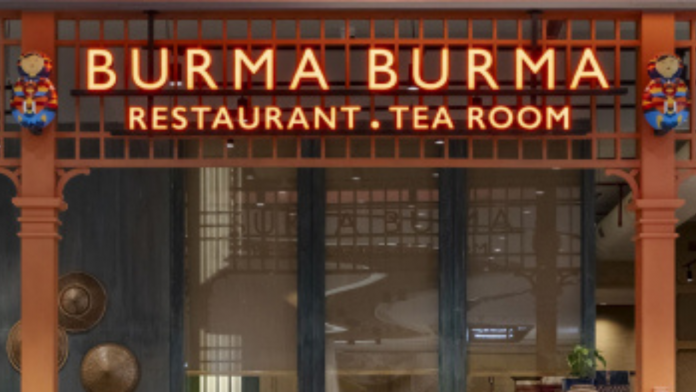
Burma Burma Expands to 18 Outlets Nationwide with Three New Openings in Delhi-NCR, Adds Over 11,500 Sq. Ft of Dining Space
Burma Burma, the country’s leading Burmese restaurant and tea room chain, has expanded its Delhi-NCR presence with three new outlets across Vasant Kunj, Aerocity and Gurugram. The latest launches take the brand’s regional footprint to six locations.
The new restaurants are located at DLF Promenade (Vasant Kunj), Worldmark 3 (Aerocity), and Worldmark 65 (Gurugram). With these additions, the brand now operates 18 restaurants and a delivery kitchen across India, including cities like Mumbai, Bengaluru, Hyderabad, Kolkata and Ahmedabad.
The Aerocity outlet is the largest among the new set, spread across 6,302 sq. ft. with a 110-seater layout. It features a dramatic atrium and a hanging pagoda installation. At DLF Promenade, the 94-seater restaurant draws inspiration from Yangon’s iconic colonial-era Strand Hotel and occupies 2,017 sq. ft. Meanwhile, the Gurugram location spans 3,238 sq. ft., with a dedicated tea bar and private dining space that nods to Mandalay’s cultural landscape.
Each outlet has been designed by Minnie Bhatt, Principal Architect of Mini Bhatt Designs, to reflect distinctive elements of Burmese art, craft and storytelling.
To mark the openings, Burma Burma is serving a limited-edition tea house menu titled From Burma with Tea, available exclusively at the three new locations until September 30. The menu features traditional Burmese pulled teas, iced teas, snacks and shareable bowls. It will roll out nationwide from September 1.
Founded in 2014 by Chirag Chhajer and Ankit Gupta under Hunger Pangs Pvt. Ltd., the brand has consistently championed a modern take on Burmese cuisine. Head Chef Ansab Khan leads the kitchen, serving dishes infused with regional ingredients like laphet, balachaung peppers and kaffir lime.
Burma Burma continues to position itself as a cultural and culinary bridge to Myanmar, using food and design to deepen its brand story with every new restaurant.
Swiggy Sharpens Focus on Office-Goers with DeskEats Launch; 2 Lakh Restaurants, ₹4,961 Cr Revenue, and Counting
Swiggy has launched a new feature called DeskEats, designed to cater specifically to India’s growing base of working professionals. The service is now live across 30 cities and more than 7,000 office zones including tech parks, corporate towers and business centres.
With a menu pool of 7 lakh items from over 2 lakh restaurants, DeskEats is positioned as an everyday lunch-and-snack solution for the time-starved workforce. Users can access the feature by simply typing “office” or “work” on the Swiggy app.
The offering includes curated categories like ‘deadline desserts’, ‘one-handed grabbies’, ‘value combos’, and ‘healthy nibbles’ to suit the range of moods and meal moments in a workday. Swiggy says the intent is to blend convenience with discovery while keeping pace with modern workplace routines.
The rollout comes on the heels of Swiggy’s Corporate Rewards programme, which has seen uptake from 14,000 companies and reached 1.5 lakh employees in just three months.
“DeskEats is our answer to the hustle of the office grind. It’s built around the rhythms of a working day,” said Deepak Maloo, VP, Food Strategy and New Initiatives.
While Swiggy expands on the food front, it’s also diversifying. In June, it launched a lifestyle concierge app called Crew, followed by Pyng, a professional services marketplace. At the same time, the company has sunset its delivery service Swiggy Genie.
Financially, Swiggy’s Q1 FY26 performance was a mixed bag. Net loss widened to ₹1,197 crore, nearly double from last year’s ₹611 crore. However, revenue climbed 54% year-on-year to ₹4,961 crore. Losses from Instamart touched ₹797 crore, triple from last year, though sequential growth was marginal.
The company remains in expansion mode, with DeskEats marking its latest bet on India’s evolving urban appetite.
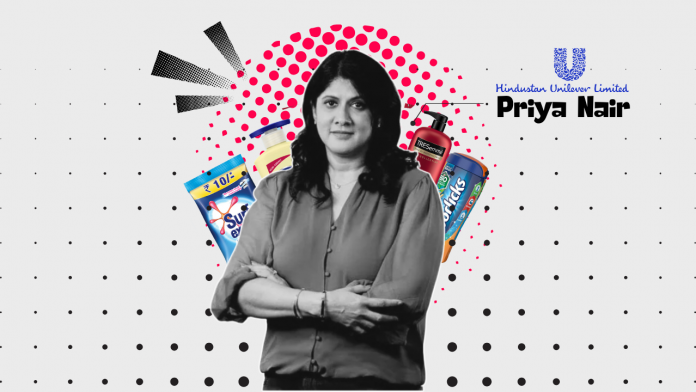
Priya Nair Steps In as HUL CEO, Inherits ₹5.6 Lakh Cr FMCG Giant Struggling to Keep Up with Gen Z, Honasa, and L’Oréal
Priya Nair has stepped into the top job at Hindustan Unilever, taking charge of a consumer behemoth that’s been feeling the heat from all sides. While the FMCG giant recently posted better-than-expected profits, its broader growth story has been underwhelming. Over the last three years, HUL’s stock has crawled up just 4 percent, while the Nifty 50 sprinted ahead with a 42 percent gain.
The bigger concern? HUL is struggling to keep up with a fast-evolving India. Smaller, nimble brands—especially in beauty and personal care—are cutting into its turf. Local challengers like Mamaearth and even global players like L’Oreal are giving the Dove-and-Lakme maker a real fight. Volume growth has been tepid, and consumer behavior in both cities and small towns is shifting rapidly. Urban buyers are trimming their spending or opting for niche, “natural” alternatives, while rural markets remain unpredictable.
Nair’s appointment as CEO, the first woman to lead the company, sparked a stock rally last month after Rohit Jawa’s early exit. Known for her sharp instincts, Nair has previously led HUL’s home care and beauty segments and served as Unilever’s Global Chief Marketing Officer. Industry insiders see her as an assertive leader with a strong grip on what Indian consumers want today.
The road ahead is steep. Analysts say HUL must rethink its product pipeline, pricing strategy, and rural distribution. Nair also has the global board watching closely. Unilever CEO Fernando Fernandez has already committed higher investments in India, calling it a key market alongside the US.
Brokerages including Goldman Sachs and Jefferies have raised their outlooks, betting on Nair’s ability to turn things around. But in an increasingly fragmented market, sustaining relevance could be her toughest challenge yet.
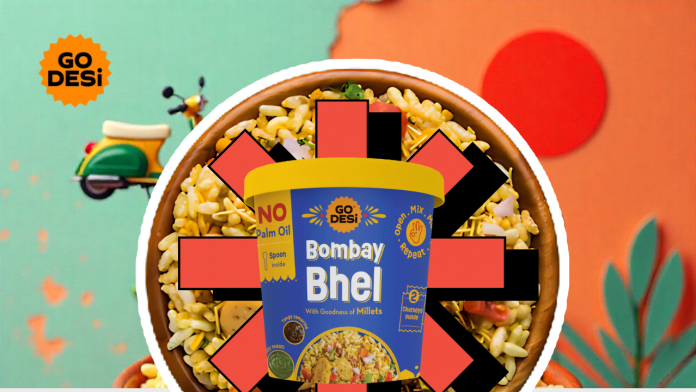
GO DESi’s Bombay Bhel Makes ₹10 Chaat Look Like a ₹1000 Idea—and It’s Flying Off Zepto
Homegrown snacking brand GO DESi has announced the launch of ‘Bombay Bhel’, a ready-to-eat, packaged version of the much-loved Indian street snack. Priced at ₹69, the product is being positioned as a modern, convenient alternative to traditional bhelpuri—complete with tamarind and mint chutneys included inside the pack.
This marks yet another move by GO DESi to tap into India’s regional food nostalgia, repackaging hyperlocal favourites for modern retail shelves. The new product is currently available on platforms like Zepto and the company’s own D2C website.
Founded by Tejas Krishna, GO DESi has built a loyal consumer base by reimagining Indian snack-time staples. From tangy treats like Imli Pops to spicy banana chips, the brand has focused on offering familiar flavours in a cleaner, shelf-stable format. With the launch of Bombay Bhel, it’s now turning its attention to one of the country’s most ubiquitous snacks—and perhaps one of the most commercially overlooked in retail aisles.
The product development and packaging were led in-house, with design inputs from Tejaswee Manapuram, Yashashree RA, Rigzin Angmo and Shreya Agrawal. The team says the goal was simple: retain the chaotic, bold flavours of street-side chaat, while making the format accessible for today’s on-the-go lifestyles.
India’s packaged snacks market, valued at over ₹1 lakh crore, continues to see demand for products that bridge taste nostalgia with convenience. With Bombay Bhel, GO DESi appears to be doubling down on this trend—offering a slice of street-side chaos, without the mess.
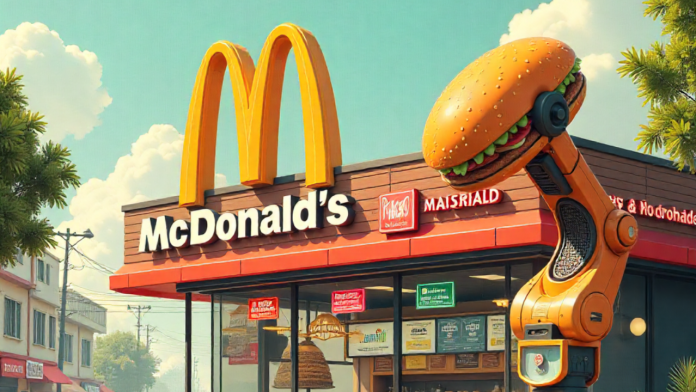
McDonald’s Eyes India in AI-Powered Expansion Drive by 2027
McDonald’s is gearing up for a major push into artificial intelligence, with big plans to expand its digital capabilities and lean on India as a core technology hub over the next few years. By 2027, the global fast-food chain wants to significantly deepen its investment in AI, using it to enhance everything from order accuracy to pricing and sales forecasts.
The company has already started testing AI tools across 400 restaurants to reduce errors during order handoffs. The goal is to roll out these systems to over 40,000 outlets worldwide within the next two years. “We’re still in the early stages, so it’s hard to pin down the exact investment,” said Deshant Kaila, McDonald’s Head of Global Business Services Operations, during a visit to the company’s newly established Hyderabad office.
This expansion into AI isn’t just about making smarter decisions. It’s also about placing the right talent in the right places. And for McDonald’s, India is becoming central to that effort. Hyderabad, where the company recently opened a major global office, is set to become its largest tech base outside the United States. The focus will be on building out the company’s AI capabilities—particularly in areas like data management, platform design, and systems engineering.
Kaila noted that the emphasis will be on investing in tools and technology rather than growing headcount dramatically. The idea is to build a strong, agile foundation in India that can support McDonald’s global AI strategy.
Durga Prakash, the company’s Global Offices Head of Technology, explained how AI is being used behind the scenes to forecast demand, set dynamic prices, and evaluate how well products are performing. McDonald’s is also working on a fully personalized app experience that would work seamlessly across international markets. “The idea is to make tech work smarter for both customers and the business,” Prakash said.
Hyderabad is already shaping up to be a critical part of that vision. Earlier this year, the Telangana state government announced that McDonald’s would be setting up a global capability center in the city. The center is expected to employ around 2,000 people and will play a key role in everything from tech development to operations support.
While India has long been a destination for IT and back-office operations, global firms like McDonald’s are increasingly looking to their Indian centers for more strategic roles. These hubs are no longer just about saving costs—they’re becoming engines of innovation and business transformation.
Alongside its India investment, McDonald’s is also exploring the possibility of opening a global office in Poland, similar to the ones it already has in Hyderabad and Mexico.
As the company continues to evolve beyond burgers and fries into a more tech-forward business, its bets on AI and the talent hubs powering it are likely to shape its next phase of growth.
FSSAI Mandates Allergen Disclosure on Menus and Packaging by August 31
The Food Safety and Standards Authority of India (FSSAI) has issued a new directive requiring all food businesses to prominently declare the top eight allergens on menus, product packaging, and online delivery platforms. The regulation will come into force on August 31, 2025, and applies to restaurants, cloud kitchens, food manufacturers, and e-commerce listings.
Under the new rule, businesses must clearly mention the presence of the following allergens: milk, eggs, peanuts, tree nuts, soy, wheat, fish, and shellfish. The labeling must be easily visible and legible, both in physical formats—such as printed menus and packaging—and digital platforms like Zomato, Swiggy, and grocery delivery apps.
The move is part of FSSAI’s broader effort to improve food safety and protect consumers with dietary sensitivities. Officials say the regulation brings India closer to international food labeling standards and addresses a growing public health concern.
“Consumers have the right to know what’s in their food. This regulation ensures transparency and safety for people with food allergies,” a senior FSSAI official said, requesting anonymity as the circular is yet to be publicly detailed.
Food businesses that fail to comply by the deadline could face penalties, including warnings, fines, or suspension of licenses, according to sources familiar with the matter.
Industry stakeholders are expected to begin updating packaging, digital listings, and staff training in preparation for the rollout. Several large QSR chains and FMCG brands have already begun implementing allergen labels voluntarily, anticipating the regulation.
The FSSAI is expected to release detailed implementation guidelines and provide support to small and medium enterprises in the coming weeks.
Unilever Doubles Down on India and US to Power Next Phase of Growth
Unilever is doubling down on India and the United States, its two biggest markets, in a move aimed at reigniting growth and staying ahead of global headwinds. The company’s CEO, Fernando Fernandez, recently confirmed that these countries will receive a larger share of investment, resources, and strategic attention, as Unilever looks to grow volumes faster than the company average.
India currently makes up around 12% of Unilever’s total global sales, placing it just behind the US in importance. But after a couple of years of slowing momentum—largely because rising prices forced Indian households to cut back—Unilever is ready to hit refresh.
Steering this new phase of growth in India is Priya Nair, who steps in as the new CEO of Hindustan Unilever (HUL), the company’s India arm. Her appointment marks a significant change in leadership, following a brief tenure by her predecessor, Rohit Jawa.
“Momentum is building in India where we have recently appointed a new head of the business, Priya Nair, who takes over after having successfully led our global beauty and wellbeing business,” said Fernandez during the company’s latest earnings call.
He praised Nair’s blend of local and global experience, describing her as someone who deeply understands the Indian market while also having a strong grasp on international consumer trends. “Priya combines a deep understanding of our home and personal care business in India that she successfully ran for many years with the knowledge of international markets that is necessary to keep our portfolio in tune with the significant consumer needs and channel shifts already visible in the market.”
Nair’s leadership comes at a pivotal moment. Globally, Unilever is undergoing a major reset. The sudden exit of former CEO Hein Schumacher earlier this year signaled urgency at the top, and Fernandez—then the CFO—was quickly appointed to drive a turnaround.
Meanwhile, India’s standing within Unilever has only grown stronger. As the Chinese market stumbles, multinational firms have turned their gaze back to India. And Unilever is no exception. The company believes India offers a unique mix of resilience, demand potential, and emerging retail channels that make it a long-term growth engine.
Fernandez is particularly optimistic about recent shifts in the Indian market, especially with the rise of online and rapid delivery platforms. He noted that Unilever is gaining share and expanding its reach through newer, faster channels. “If you actually see the market growth in the last 12 weeks, we see an improvement. There’s also been a lot of work which has happened in terms of the portfolio transformation, where we are actually investing behind the market makers beyond the core portfolio,” said Srinivas Phatak, Unilever’s acting CFO. “When we add up all of this, we’ve started to see a step up in volume.”
Phatak added that e-commerce sales have been growing in double digits and that quick commerce has become a game changer, doubling Unilever’s business in that space over the past year.
Unilever’s approach isn’t just about pushing existing products harder. The company has been putting money into transforming its portfolio—investing in newer categories, future-forward formats, and products that are more aligned with changing lifestyles and consumption patterns in India.
“With the acceleration we’re seeing, we feel quite confident and comfortable with the India growth trajectory; we will expect this to do well,” Phatak said.
As 2025 enters its second half, Unilever appears set on making India not just a major market in terms of numbers, but a strategic hub for innovation and expansion. And with Priya Nair now at the helm, the company is hoping to blend deep local insights with global ambitions—putting India front and center in Unilever’s next chapter.
How Small Brands Are Reshaping India’s FMCG Industry
India’s fast-moving consumer goods (FMCG) space is going through a quiet revolution. For decades, the sector was largely steered by corporate giants like Hindustan Unilever, Nestlé India, ITC, and Tata Consumer Products. Their sheer scale, brand legacy, and distribution networks gave them the upper hand. But now, smaller regional players are rewriting the rules. And what’s interesting? They’re not just surviving—they’re thriving, often outpacing the big names in growth.
These up-and-coming brands are connecting with consumers on a more local and personal level. They’re not trying to win over the entire country at once. Instead, they’re going hyper-local—focusing on a handful of neighbourhoods, a few pin codes, or even a single town. This sharp focus is allowing them to create products that truly resonate with local tastes, traditions, and expectations.
Suresh Narayanan, Nestlé India’s outgoing MD, recently acknowledged this shift. He said that smaller players are actually helping the industry grow by expanding choices for consumers and pushing larger companies to improve and evolve. According to him, the younger generation—especially Gen Z and Gen Alpha—isn’t too concerned about brand legacies. What matters to them is relevance. “Just because their parents consumed a brand doesn’t mean they will too,” he pointed out. “Maggi still has to earn its place on the plate.”
Brands like Balaji Wafers, Rungta Tea, Mario Biscuits, and 1to3 Noodles are great examples. They’re giving stiff competition to well-established names in categories like snacks, noodles, and beverages. Their secret? Deep local knowledge, quick adaptability, and affordable pricing without compromising on quality.
Why Small Brands Are Winning
India’s diversity is a tough challenge for national brands to crack. A product that works in Mumbai might flop in Mangalore. That’s where smaller players have an edge. They know their customers, often quite literally. They understand local ingredients, flavours, festivals, buying habits, and price sensitivities. And unlike large conglomerates, they can launch new products quickly, test them in small markets, tweak them if needed, and scale gradually.
These companies also keep their operations lean. Their supply chains are mostly local, and they don’t spend billions on advertising. This means they can offer products at competitive prices—something that matters in a price-sensitive market like India.
They’re also innovating in ways the big brands can’t. Many small snack and beverage brands are reviving traditional recipes, using regional ingredients, or bringing in fresh formats that reflect local culinary trends. Their products feel more ‘homegrown’ and often strike an emotional chord with consumers.
The rise of quick commerce platforms like Blinkit and Instamart, along with the increasing dominance of e-commerce, has levelled the playing field. Small brands now have direct access to customers without having to fight for shelf space in retail stores dominated by the big guys.
Investor Attention Is Shifting Too
With sluggish growth in metro cities and the big players struggling to maintain pace, investors are increasingly betting on nimble, emerging FMCG businesses. Brands like Moi Soi (noodles and condiments), Iscon Balaji (frozen food), Dermabay (skincare), and Bindu Jeera (beverages) have all attracted funding or interest from private equity firms.
Recent funding rounds for brands like Lahori Zeera and Country Delight (each raising over Rs 200 crore) show how investor appetite is tilting toward regional stories with national potential. These brands are proving that premium doesn’t have to mean elite—it can come from a small town and still find eager buyers.
As Kannan Sitaram from Fireside Ventures put it, “We assumed premium products were only for metros. But that’s no longer true. Smaller cities are ready for better products, and platforms like e-commerce and q-commerce are making them more accessible.”
Big Brands Are Taking Notes—and Action
The dominance of smaller brands has been a wake-up call for the larger players. Some, like Nestlé India, are no longer seeing them as mere competitors. They’re exploring ways to collaborate, learn, and co-create. Nestlé’s accelerator program is one such initiative aimed at working closely with startups and learning from their agility.
Larger FMCG companies are also investing more in digital transformation, D2C models, and product customisation. The idea is simple: stay relevant or risk becoming obsolete. That means faster go-to-market strategies, better engagement with younger consumers, and a sharper focus on local preferences.
Big companies are also pushing for premiumisation in categories where it makes sense—think artisanal chocolates, specialty coffee, nutrition, and pet care. But they’re walking a tightrope. They have to offer premium value while keeping affordability in mind. If they miss that balance, they risk losing more ground to local upstarts.
Narayanan summed it up well when he said that smaller brands are good for the ecosystem. They keep the big players on their toes and prevent stagnation. “Sure, there’s a pricing war,” he admitted. “But we have other strengths to offer. We just have to keep evolving.”
What Lies Ahead
India’s FMCG space is clearly in transition. The days of one-size-fits-all are fading. Instead, brands—big and small—must think small to grow big. Success will come to those who are willing to listen to the consumer, act fast, experiment fearlessly, and stay grounded in regional insights.
In this new normal, the story isn’t about David versus Goliath. It’s about collaboration, adaptation, and co-existence. And for the Indian consumer, it’s the best of both worlds.
We use cookies to ensure that we give you the best experience on our website. If you continue to use this site we will assume that you are happy with it.