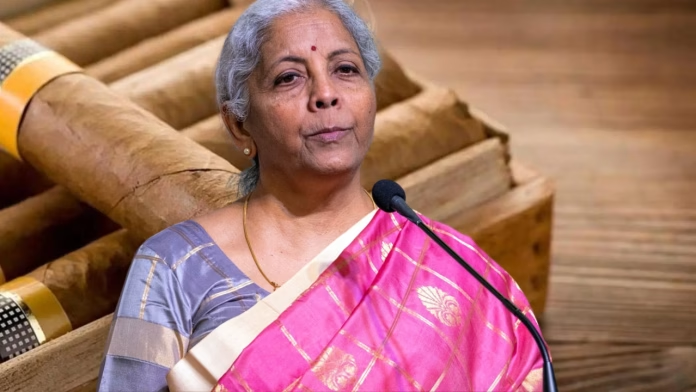
The Union government has moved to ensure that taxes on tobacco products do not fall after recent changes to the GST framework, with Finance Minister Nirmala Sitharaman telling Parliament that the proposed excise duty on cigarettes and other tobacco items is simply a continuation of the tax structure that existed before GST. Speaking during a debate on the Central Excise Amendment Bill in the Lok Sabha, she emphasised that the measure is not an additional levy and that states will receive their share of the revenue as part of the divisible pool.
The move comes as the GST compensation cess, currently applied to all tobacco products, prepares to sunset. The cess was introduced in 2017 for a five-year period to help states adjust to the new tax regime and later extended to 2026 so the Centre could repay a loan of 2.69 lakh crore that was taken during the pandemic years. Officials expect that loan to be fully settled within the next few weeks, after which the cess will end and the revised excise structure will take effect.
Under the Bill, the government proposes excise duty ranging from 2,700 to 11,000 rupees per thousand sticks of cigarettes depending on size and category. It also lays out a duty of 60 to 70 per cent per kilogram on tobacco used in various products and a full 100 per cent per kilogram on chewing tobacco. Sitharaman noted that cigarette affordability in India has remained largely unchanged over the past decade, citing a World Health Organisation finding that stagnant prices undermine public health goals.
India’s total tax incidence on cigarettes currently sits at around 53 per cent of the retail price. This is well below the WHO benchmark of 75 per cent and lower than rates in markets such as the United Kingdom and Australia, where total tax routinely crosses 80 to 85 per cent. The minister added that the aim is to prevent tobacco products from becoming cheaper once the cess ends, while continuing efforts to help farmers move away from tobacco cultivation.