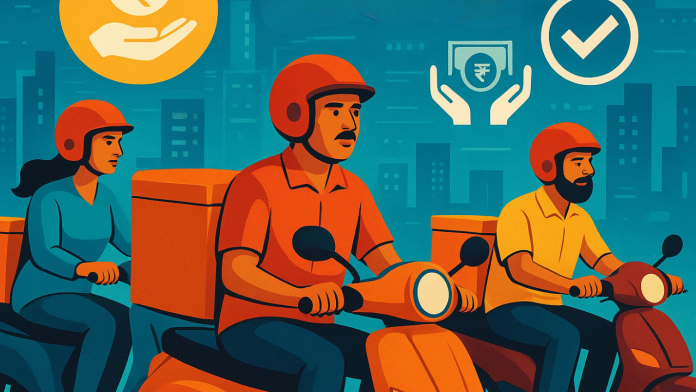
India has taken a significant step toward formalising the gig economy by mandating online platforms to contribute to worker welfare. Under the newly implemented Labour Codes, companies such as Zomato, Swiggy, Zepto, and Uber are now required to allocate up to 2 percent of their annual turnover, capped at 5 percent of payments made to gig workers, to a centralised Social Security Fund. This is the first time Indian law has formally defined aggregators, gig workers, and platform workers.
The Social Security Fund will finance a range of welfare schemes, including health and life insurance, provident fund support, maternity benefits, and emergency assistance. Authorities aim to ensure that workers who frequently migrate across states can access benefits seamlessly. To achieve this, each gig and platform worker will receive an Aadhaar-linked Universal Account Number, or UAN. The UAN will provide portability, facilitate verification, and streamline disbursement of benefits across India’s rapidly growing digital labour market.
The Labour Codes also extend traditional employment benefits to unorganised sector workers, including employee state insurance where applicable. Digital compliance systems are being introduced to speed up processing, reduce bureaucracy, and improve transparency. Additionally, a portion of funds generated from penalties under labour regulations will flow into the Social Security Fund, reinforcing its financial base.
Industry stakeholders have largely welcomed the initiative. An Uber spokesperson noted that the company looks forward to collaborating with the government for smooth implementation. Analysts say the move could provide long-term stability to India’s gig economy, which has faced criticism for a lack of social safety nets despite rapid expansion.
With millions of delivery and service workers relying on platforms for income, the government’s directive represents a crucial attempt to balance flexibility with security. As implementation progresses, the focus will shift to ensuring compliance by platforms and accessibility for workers, potentially creating a more structured and resilient gig economy across India.