Home Blog

Start following Kiara Advani’s simple yet powerful morning ritual for glowing skin

Have you ever stopped to marvel at Kiara Advani’s radiant and flawless skin? In the exquisite glamour that is Bollywood, Kiara Advani stands out not just for her acting genius but also for her luminous and healthy skin. Amidst the overwhelming myriad of options surfaced by the beauty industry, this simple yet transformative ritual is not only a fad, but the cornerstone of her radiance.


The secret might be simpler than you think. It’s not a gruelling workout or a 10-step skincare routine; it’s a simple cup of warm water, with a slice of lemon in it. Kiara’s morning habit of indulging in warm water infused with the zest of fresh lemons has become a conscious choice rooted in her approach to holistic well-being. The actress recommends this refreshing elixir not only for its skin-enhancing benefits but also for the multiple benefits it has in improving your overall health and vitality.  

 

Hansa Yogendra, Director of The Yoga Institute in one of her videos on the health benefits of lemons mentioned, “Drinking one glass of lemon water every day in the morning will benefit you for a lifetime”.  Her claim can further be supported by a research published in the Journal of Science and Technology which reveals that “It is a healthy appetiser and helps to treat diseases with digestive aids. Lemon does not disclose any adverse effects, according to literature, but it is used all over the world as a traditional medicine”. Vitamin C, which is abundantly present in lemons, fights toxins and increases collagen production in the body, both of which help in treating acne as well as tightening the skin and reducing fine lines and wrinkles. While lemons are famously known for their Vitamin C component, not many people are aware of their Potassium-rich skin, which is an important mineral for nervous stimulation as well as maintaining blood pressure. Here are a few more benefits of adding lemon water to your everyday diet:- 

  • Immediately soothes muscle cramps
  • Peptin in lemons makes us feel fuller, thereby, helping in weight loss
  • Boosts immunity by stimulating the production of White Blood Cells in the body
  • Removal of kidney stones 
  • The lemon peel when infused in water for 30 minutes, activates its bioactive compounds which boost immunity and prevent our bodies from cellular damage
  • It also helps in the release of digestive enzymes which help in better absorption of nutrients

 

This simple kitchen hack has proudly made its way into the celebrity wellness circuit. Not only Kiara Advani but also Alia Bhatt, Deepika Padukone, Kriti Sanon, and Malaika Arora have this one drink in common at the break of dawn.

Here are 3 ways, you can incorporate the lemon water glow into your morning routine:- 

  1. Warm ginger lemon tea- Boil a glass of water with crushed ginger. When its done, squeeze a lemon into your glass and have it warm. To enjoy it in place of your morning tea, you may add a teaspoon of honey to it.

2. Ginger lemon shot – Take an inch of ginger root, and one squeezed lemon. Add enough water to blend it (3-4 tablespoons) in a blender, and have it as a morning shot.

3. Lemon-infused detox water- Cut up slices of one lemon and add it to your water bottle. Have 1-2 glasses of lemon water in the morning, and keep having the rest throughout the day. 

While lemon water offers a myriad of health benefits, it’s crucial to exercise moderation. One lemon a day is a healthy limit, and people with gastroesophageal reflux disease should be cautious about excessive lemon juice intake. As with any dietary rituals, balance is key to ensuring you enjoy the advantages without overdoing it. 
TRUFF x Kith Turn Ronnie’s Pronto Into a Luxury Condiment Playground

0

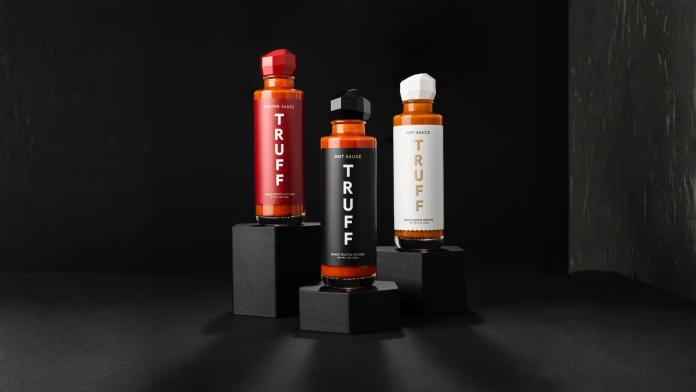
TRUFF has officially partnered with Kith to launch one of the most culturally aligned food collaborations of 2026, transforming Ronnie’s Pronto in West Hollywood into a live showcase for luxury condiments, lifestyle branding, and experiential dining. The collaboration arrives alongside the opening of Ronnie Fieg’s newest hospitality concept and represents another major step in the growing convergence of fashion, food, and culture-led retail.

At the center of the partnership is a co-branded condiment collection designed to integrate directly into the restaurant experience rather than function as a traditional retail-only launch. Every table at Ronnie’s Pronto now features the custom-labeled TRUFF sauces, allowing customers to engage with the products organically throughout their meal. The strategy turns the dining table itself into a marketing channel while reinforcing Kith’s larger vision of creating immersive consumer ecosystems.

The headline product from the collaboration is the new Lemon Pepper Aioli, a flavor innovation that signals TRUFF’s ambitions beyond its core hot sauce business. The aioli blends citrus-forward flavor, pepper-heavy seasoning, and TRUFF’s premium truffle identity to create a condiment positioned for elevated casual dining. While currently exclusive to Ronnie’s Pronto, the product is expected to receive a wider national launch in the coming weeks.

The Lemon Pepper Aioli is strategically important because it places TRUFF inside one of the fastest-growing flavor categories in American casual dining. Lemon pepper has become deeply embedded in modern food culture through wings, sandwiches, fried chicken, and sports-bar cuisine. By introducing a premium truffle-forward interpretation, TRUFF is repositioning a familiar comfort flavor into the luxury pantry segment while expanding its usable occasions far beyond traditional hot sauce applications.

Alongside the aioli, the collaboration includes limited-edition versions of TRUFF’s flagship White Truffle Hot Sauce and Mild Truffle Hot Sauce. Both feature exclusive Kith co-branding and are available across multiple channels including Ronnie’s Pronto table service, in-store retail, and Kith.com. The omnichannel rollout mirrors the modern “fashion drop” strategy, where exclusivity, collectibility, and digital hype operate simultaneously to drive consumer engagement.

For Kith, the collaboration reinforces Ronnie Fieg’s broader ambition to transform the brand from a fashion retailer into a fully integrated lifestyle platform. Over the past several years, Kith has steadily expanded into hospitality through cafés, cereal bars, desserts, and experiential food concepts. Ronnie’s Pronto now becomes another extension of that ecosystem, where apparel, dining, design, and cultural identity all operate under a single brand philosophy.

The partnership also highlights how food products are increasingly functioning as cultural accessories rather than simple consumables. In 2026, pantry staples are no longer competing only on taste or convenience. Consumers are now evaluating products based on aesthetics, exclusivity, storytelling, and social identity. TRUFF has been one of the clearest leaders in this transformation, turning hot sauce from a commodity product into a status-driven lifestyle item through premium packaging, celebrity adoption, and carefully curated collaborations.

For TRUFF, maintaining cultural relevance has become just as important as expanding retail distribution. While the brand initially gained momentum through luxury grocery placements and influencer-driven visibility, collaborations with culturally dominant brands like Kith help reinforce its positioning among younger, trend-conscious consumers. Instead of competing solely in the condiment aisle, TRUFF is competing for space within lifestyle culture itself.

The collaboration also reflects the broader rise of “experiential condiments” within the premium food industry. Sauces and pantry products are increasingly being used as tools to drive restaurant traffic, generate digital conversation, and build community engagement. By embedding the products directly into Ronnie’s Pronto, both brands are transforming the condiments from secondary meal additions into core components of the overall consumer experience.

The Lemon Pepper Aioli launch could become particularly important for TRUFF’s long-term growth strategy. If successful, the product creates a pathway into larger food-service categories including premium fast casual, sandwich chains, sports venues, and hospitality partnerships. Unlike niche hot sauces that remain limited to specialty audiences, aioli-based products offer significantly broader menu versatility and higher frequency usage.

Ultimately, the TRUFF x Kith partnership demonstrates how modern consumer brands are evolving beyond transactional retail into immersive cultural ecosystems. Ronnie’s Pronto is not simply functioning as a restaurant, and the sauces are not merely condiments. Together, they represent a new model of lifestyle commerce where fashion, food, hospitality, and social identity are increasingly inseparable.

Advertisement

Swiggy Instamart’s Q4 FY26 Signals a Turning Point as Hyper-Growth Meets Improving Profit Discipline

0

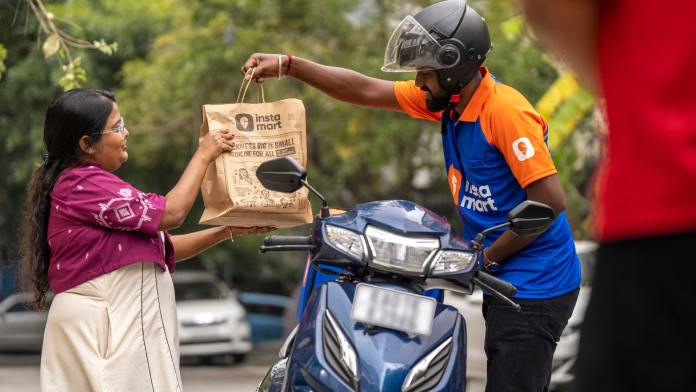
Swiggy delivered a strong operational performance in Q4 FY26, with its quick-commerce arm Instamart continuing to emerge as the company’s biggest growth engine amid India’s intensifying 10-minute delivery battle. Despite aggressive competition from Blinkit and Zepto, Instamart recorded a massive 68.8% year-on-year jump in Gross Order Value (GOV), reaching ₹7,881 crore during the quarter.

The results reinforce Swiggy’s growing dominance in the quick-commerce segment, while also signaling an important shift in investor sentiment around the sector: growth is no longer enough — profitability and operational efficiency are now becoming equally critical.

While Swiggy’s full-year losses widened due to heavy infrastructure investments and expansion costs, the company reported a noticeable narrowing of quarterly losses in Q4 FY26. This has strengthened confidence that the economics of quick commerce are gradually stabilizing after years of cash-intensive expansion.

Instamart’s growth continues to be fueled by rising consumer adoption beyond groceries. What initially began as a convenience-led grocery platform is now rapidly evolving into a broader on-demand retail ecosystem.

Swiggy has aggressively expanded into:

  • electronics,
  • beauty products,
  • personal care,
  • home essentials,
  • and impulse-driven lifestyle categories.

These newer verticals are helping improve Average Order Value (AOV), which has become a key lever in reducing operational burn.

At the same time, Swiggy is increasingly monetizing the “digital shelf space” within Instamart.

Advertising revenue from D2C brands and FMCG companies has emerged as a significant contributor to margin improvement. Brands are now paying premium placement fees for:

  • search visibility,
  • homepage discovery,
  • and personalized recommendation slots.

This ad-led monetization model is helping offset delivery and fulfillment costs while improving contribution margins at the order level.

Operational efficiency has also improved through increased dark-store density and better logistics optimization.

Swiggy has expanded aggressively into Tier-II cities over the last year, moving beyond its traditional strongholds in Bengaluru, Mumbai, Delhi, and Hyderabad. Higher order density in newer markets is improving fleet utilization and reducing per-order logistics costs.

Internally, Swiggy has also invested heavily in predictive inventory management and supply-chain automation.

The company has reportedly implemented:

  • robotics-assisted picking systems,
  • smarter inventory forecasting,
  • and faster warehouse workflows

across major dark-store hubs to reduce wastage and improve delivery speed consistency.

This operational tightening is becoming increasingly important as investors begin scrutinizing the sustainability of quick-commerce economics more closely.

Swiggy’s FY26 financial story reflects a larger industry reality: India’s quick-commerce market is transitioning from a “growth war” into an “efficiency war.”

Over the last two years, companies across the sector spent aggressively on:

  • dark-store expansion,
  • customer acquisition,
  • discounting,
  • and delivery infrastructure.

Swiggy was no exception.

The company’s widening full-year losses were largely driven by what industry observers are calling its “2025 Capex Blitz” — a period marked by heavy investments in:

  • dark-store infrastructure,
  • logistics expansion,
  • and ecosystem integration.

Swiggy also continued scaling adjacent businesses like:

  • Dineout,
  • SteppinOut,
  • and offline lifestyle integrations

as part of its ambition to become a broader “super app” rather than just a food-delivery company.

The company’s delivery fleet has now expanded to over 400,000 active partners, creating one of the largest hyperlocal logistics networks in India.

However, the narrowing quarterly losses in Q4 suggest that the scale benefits of these investments are finally beginning to materialize.

A key driver behind this transition is Swiggy’s increasing focus on retention and customer lifetime value rather than pure user acquisition.

The company’s recent partnership with MoEngage and its growing investment in AI-led personalization indicate a broader strategic pivot toward:

  • behavioral engagement,
  • ecosystem stickiness,
  • and higher-frequency ordering.

In India’s highly competitive quick-commerce market, retaining users profitably is now becoming more valuable than simply adding new users at scale.

For the broader startup ecosystem, Swiggy’s Q4 FY26 performance carries major significance.

The quick-commerce industry has faced increasing skepticism over the last two years due to concerns around:

  • unsustainable burn,
  • thin margins,
  • and excessive discounting.

Swiggy’s improving contribution margins and narrowing quarterly losses now suggest that the operational side of the business is slowly catching up to the scale of consumer demand.

The company’s performance also reinforces a larger behavioral shift in urban India.

Quick commerce is no longer limited to emergency grocery purchases.

It is increasingly becoming an everyday consumption infrastructure layer for:

  • food,
  • essentials,
  • beauty,
  • electronics,
  • and impulse shopping.

That shift dramatically expands the long-term market opportunity for players like Swiggy Instamart.

The challenge now is execution discipline.

As the sector matures, the winners are unlikely to be determined solely by delivery speed or discounting power.

Instead, leadership will increasingly depend on:

  • logistics efficiency,
  • inventory intelligence,
  • advertising monetization,
  • and customer retention economics.

Swiggy’s Q4 FY26 results suggest the company is beginning to align all four.

Advertisement

Britannia’s ₹19,000 Crore FY26 Signals a Bigger Shift: From Biscuit Giant to Digital-First Foods Powerhouse

0

Britannia Industries Limited is rapidly transforming from a traditional biscuit-led FMCG company into a diversified, digital-first foods powerhouse. Under the leadership of Managing Director and CEO Rakshit Hargave, the company revealed that e-commerce now contributes nearly 6% of its domestic business, while the share rises to almost 12% within premium and urban-focused categories. The update came alongside Britannia’s strong FY26 performance, where the company crossed ₹19,151 crore in total revenue and reported a consolidated net profit of ₹2,537 crore, up 16.5% year-on-year.

While biscuits continue to remain Britannia’s largest category, the company’s real momentum is increasingly coming from “adjacent categories” such as dairy, croissants, wafers, cakes, brownies, and premium snacking products. These segments now contribute nearly 25% of Britannia’s total revenue, highlighting the company’s long-term ambition to evolve into a broader foods business rather than remain dependent on its biscuit portfolio alone.

Digital commerce has become a major growth engine for these newer categories. According to management, Britannia’s adjacent businesses are growing 2.7 times faster on e-commerce platforms compared to traditional retail channels. Platforms like Blinkit, Zepto, Swiggy Instamart, and Amazon are increasingly driving demand for premium products such as Pure Magic, NutriChoice, Winkin’ Cow beverages, and 5050 Cheese Dips.

The company is also investing heavily in platform-exclusive packs, customized D2C offerings, and impulse-led snacking formats tailored specifically for quick-commerce ecosystems. This “channel-product matching” strategy allows Britannia to use digital platforms for premium experimentation while leveraging its massive offline network to scale mass-market staples across India.

One of the strongest growth contributors during FY26 was Britannia’s dairy and beverages vertical. Led by the Winkin’ Cow brand, the segment has emerged as a significant revenue driver in flavored milk, milkshakes, and cheese categories. Britannia’s dairy business generated approximately ₹5.25 billion in FY25 revenue and continued delivering double-digit growth throughout FY26.

The company’s bakery and snacking expansion is also gaining nationwide traction. Croissants developed through Britannia’s Chipita partnership have become one of the company’s fastest-growing categories, while the wafers business is reportedly growing at nearly 25% annually. Britannia already holds a strong position in the ₹10 billion wafer cream segment, further strengthening its premium snacking portfolio.

Despite strong growth, Britannia faced operational headwinds during FY26. EBITDA margins remained relatively flat at 18.07% due to rising input costs and supply-chain disruptions. Operational expenses reportedly surged by nearly 17.5% during the year, while international disruptions linked to geopolitical tensions in West Asia impacted growth momentum during March 2026.

To improve efficiency and protect margins, Britannia increased its in-house manufacturing share to nearly 65%, reducing reliance on contract manufacturing. This move is expected to improve logistics control, supply-chain resilience, and operational efficiency as the company continues scaling premium categories nationally.

At the same time, Britannia is aggressively pursuing a “masstige” strategy by introducing premium products through low-unit packs priced at ₹5–₹10. This allows the company to seed higher-margin categories into rural and price-sensitive markets while maintaining affordability for mass consumers.

Rakshit Hargave’s leadership style is increasingly visible in Britannia’s evolving strategy. Drawing from his experience across Domino’s and Nivea, Hargave is positioning Britannia not just as a legacy FMCG company, but as a modern omnichannel food platform optimized for digital discovery, quick-commerce velocity, and high-frequency urban consumption.

Britannia’s FY26 performance reflects a larger shift underway across India’s FMCG industry. Growth is no longer being driven purely by scale distribution and mass staples. Increasingly, the next phase of expansion is being powered by premiumization, convenience, digital commerce, and impulse-led snacking behavior.

While e-commerce still contributes a relatively small share of Britannia’s overall revenue, the company’s rapidly growing premium digital mix signals where the future of Indian packaged food consumption is heading. Britannia is no longer competing only for shelf space in kirana stores — it is positioning itself to dominate India’s evolving on-demand snacking economy.

Advertisement

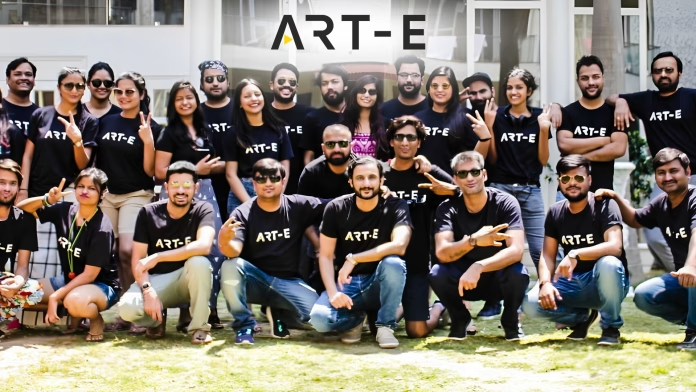
Art-E Mediatech Wins IndiaMART Mandate Again: Doubling Down on B2B Digital Storytelling

Delhi-based Art-E Mediatech has once again secured the full social media mandate for IndiaMART, reinforcing a long-standing partnership between the two companies. The renewed collaboration highlights IndiaMART’s continued focus on strengthening its digital presence and deepening engagement with its vast network of buyers and sellers across the country.

Under the new mandate, Art-E Mediatech will lead end-to-end social media strategy, including content planning, campaign execution, and performance-driven storytelling. The objective is to enhance IndiaMART’s brand communication while making it more relevant and relatable to a digital-first audience—particularly India’s rapidly growing base of MSMEs that rely on online platforms for business discovery and transactions.

This second win is significant. In an industry where brands frequently rotate agencies, IndiaMART’s decision to reappoint Art-E Mediatech signals strong confidence in the agency’s ability to understand and communicate complex B2B narratives. The focus will now be on building integrated campaigns that combine creative storytelling with data-backed insights, ensuring both engagement and measurable outcomes.

From IndiaMART’s perspective, the partnership aligns with its broader mission of driving digital transformation for Indian businesses. As COO Dinesh Gulati emphasized, a strong online presence is no longer optional—it is central to how businesses connect, transact, and scale. The brand’s communication strategy will therefore aim to reflect its scale, trust, and real-world impact on millions of enterprises across India.

For Art-E Mediatech, the mandate strengthens its positioning as a full-stack MarTech partner capable of handling large-scale, performance-oriented accounts. Co-founder Rohit Sakunia highlighted that the agency will leverage its deep understanding of the B2B ecosystem to craft campaigns that are not just creative, but conversion-focused—an essential requirement in a category where ROI often outweighs vanity metrics.

Strategically, this partnership underscores a broader shift in B2B marketing. Platforms like IndiaMART are moving beyond functional messaging (lead generation, listings) toward brand-led storytelling that humanizes businesses and builds long-term trust. As competition intensifies in India’s digital commerce ecosystem, differentiated communication will become a key lever for user acquisition and retention.

With this renewed mandate, both companies are betting on a blend of creativity and performance to redefine how B2B platforms engage with their audiences—turning transactional interactions into sustained digital relationships.

Advertisement

Yu Foods Eyes ₹180 Cr in FY27 — Fuelled by Quick Commerce, Clean Labels, and Zero Cash Burn

0

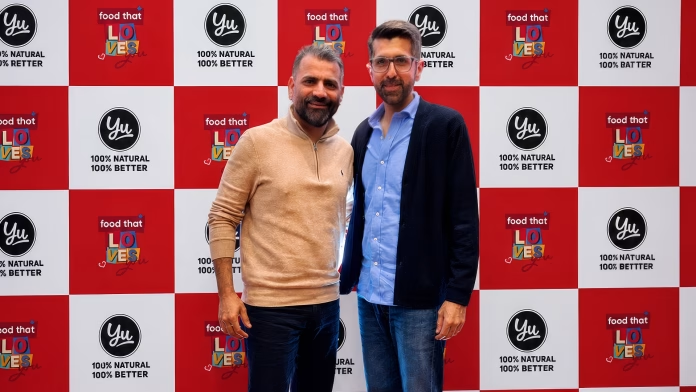
In a market where scale is often pursued through aggressive cash burn, Yu Foods has charted a different trajectory built on channel discipline and operational focus. The brand more than doubled its revenue from ₹35 crore to ₹75 crore in FY26, driven by a decisive pivot away from traditional D2C toward a “Quick Commerce First” model. As it enters FY27, Yu Foods is targeting ₹180 crore in revenue, supported by its emergence as a “core brand” across major delivery platforms and a growing presence in the healthy staples segment. At the heart of Yu’s growth is a consistent product lens: replace, simplify, and clean up what people already consume.

The strategic inflection point came with the company’s decision to deprioritize its owned website, avoiding high customer acquisition and logistics costs associated with low-ticket food products. Instead, Yu Foods concentrated on quick commerce platforms, achieving over 90% penetration across dark store networks. This shift translated into scale efficiencies, with the brand generating significant search demand and transitioning into a “core brand” category. As a result, procurement became system-driven, enabling monthly stock movement of approximately ₹12.5 crore without continuous negotiation. The approach also allowed the company to avoid fragmented general trade channels, preserving a tighter working capital cycle.

Product innovation has complemented distribution strategy. What stands out is Yu’s commitment to redefine indulgent categories with cleaner, natural ingredients and an uncompromising commitment to taste.. A key growth lever has been the expansion into “healthy staples,” particularly through the replacement of refined flour with whole wheat formulations. Noodles and pasta now contribute nearly 25% of total revenue, while the brand has established a leading position in the domestic ramen category on quick commerce platforms. In beverages, its single-ingredient coconut water has emerged as a top-performing SKU, reflecting strong consumer alignment with clean-label offerings.

Financially, the company is approaching an inflection point. With a monthly revenue run rate of ₹10 crore and EBITDA losses narrowed to approximately -3%, Yu Foods is positioned to achieve enterprise-level profitability in FY27. The projected increase in scale, with monthly revenues expected to reach ₹15–16 crore, provides operating leverage that supports a transition to positive EBITDA.

Looking ahead, the FY27 roadmap is centered on portfolio expansion within the “clean label” ecosystem. The company is preparing to enter adjacent categories such as low-sugar sauces, breakfast staples, and ready-mix products, while also evolving its hydration portfolio beyond coconut water into flavored and functional variants. Packaging innovation, including a potential shift toward cans, is being explored as volumes increase.

Offline retail continues to play a selective role in the company’s strategy. Presence in modern trade channels and institutional partnerships allows Yu Foods to maintain predictable throughput without the inefficiencies associated with widespread general trade distribution. This calibrated approach ensures that offline expansion supports, rather than dilutes, overall capital efficiency.

Yu ’ growth trajectory reflects a broader shift in FMCG strategy. Scale is increasingly being built through channel prioritization and product relevance rather than distribution breadth. By aligning itself with high-intent consumption platforms and focusing on functional, everyday categories, the company has repositioned from a challenger brand to an embedded player within the consumer’s purchase journey.

Advertisement

BeastLife’s Rapid Scale-Up: From D2C Challenger to ₹320 Crore Valuation

0

Gurugram-based BeastLife has emerged as one of the fastest-scaling brands in India’s sports nutrition segment, transitioning from a niche D2C startup in 2024 to a ₹320 crore valuation within two years. Founded by Gaurav Taneja and Raj Vikram Gupta, the company has combined creator-led trust with operational execution to build a high-growth, performance-focused brand in a category traditionally dominated by legacy supplement players.

The company’s financial trajectory reflects accelerated scale. Revenue grew from ₹36 crore in FY25 to approximately ₹100 crore in FY26, with an annualized run rate of ₹150 crore. This growth has been supported by strong digital demand and increasing brand recall within the fitness community. Over the medium term, BeastLife is targeting ₹500 crore in revenue, indicating an aggressive expansion roadmap anchored in both product innovation and distribution scale.

Capital infusion has played a critical role in enabling this growth. In April 2025, the company raised ₹1.9 crore with participation from Rinku Singh, which helped establish early visibility and brand credibility. This was followed by a ₹20 crore Pre-Series A round in April 2026 led by GVFL and Equentis, providing the resources required to invest in research and development, strengthen the leadership team, and expand distribution channels. The funding trajectory also underpins the sharp valuation increase from ₹120 crore to ₹320 crore within a year.

A key differentiator for BeastLife lies in its focus on proprietary product development. The launch of Creatine Nano 400 marks a strategic shift toward science-led innovation, positioning the brand beyond commodity protein supplements. By leveraging nano-engineering and advanced delivery mechanisms, the company aims to address absorption efficiency and performance outcomes—areas that remain underdeveloped in much of the domestic supplement market. This approach signals an intent to build defensible intellectual property rather than relying on standard formulations.

On the distribution front, BeastLife is evolving into an omnichannel brand. While digital channels remain the primary growth engine—spanning its own platform, marketplaces, and quick commerce—the company is selectively entering offline retail. The focus is on high-throughput environments such as gyms and specialty nutrition stores, where product education and trial can drive higher conversion. This calibrated expansion allows the brand to maintain capital efficiency while increasing physical visibility.

Looking ahead, BeastLife is also evaluating international opportunities, particularly in markets receptive to performance nutrition and clean-label formulations. The combination of domestic scale and differentiated product innovation provides a foundation for global expansion, although execution will depend on regulatory alignment and localized market strategies.

BeastLife’s evolution highlights a broader shift within India’s fitness ecosystem. The category is moving from influencer-led marketing toward performance-driven, research-backed products supported by disciplined distribution. By aligning community reach with product differentiation and capital efficiency, the brand is positioning itself as a long-term contender rather than a short-cycle D2C phenomenon.

Advertisement

Starbucks Q2 FY26: Turnaround Gains Steam as U.S. Traffic Roars Back

0

Starbucks Corporation has delivered its clearest signal yet that the “Back to Starbucks” reset is working. In fiscal Q2 2026, the company returned to simultaneous top-line and bottom-line growth for the first time in over two years—validating CEO Brian Niccol’s operational overhaul and pushing the brand back toward its “Third Place” roots.

Revenue rose to $9.5 billion (up ~8–9% YoY), while non-GAAP EPS jumped 22% to $0.50—well ahead of expectations. Margins also expanded to 9.4%, a notable improvement driven by tighter store operations and better labor productivity. With a global footprint now exceeding 41,000 stores, Starbucks isn’t just growing—it’s growing more efficiently.

The most important shift, however, is happening at the store level: transactions are back. U.S. comparable sales grew 7.1%, powered by a 4.4% increase in footfall—marking a full recovery to FY2022 morning traffic levels. This matters because Starbucks’ slowdown over the past two years wasn’t about pricing power; it was about declining visits. That trend has now reversed. Afternoon demand also picked up, fueled by beverage innovation like Refreshers and customizable energy drinks, broadening appeal beyond the traditional coffee crowd.

Under the hood, the “Back to Starbucks” strategy is less about flashy marketing and more about operational discipline. AI-led tools like the GROW Report are optimizing staffing and scheduling, improving service speed without increasing labor costs disproportionately. Meanwhile, app upgrades—such as scheduled pickup (rolling out May 2026)—aim to eliminate friction in mobile ordering, one of the brand’s biggest recent pain points.

Internationally, the picture is more mixed. While global comps rose 6.2%, China remained relatively flat on ticket growth despite higher transactions, reflecting ongoing pricing pressure and local competition. The partial restructuring of its China business with Boyu Capital signals a longer-term strategy to localize operations while managing geopolitical risk.

Looking ahead, Starbucks has raised its full-year outlook, now expecting comp sales growth of 5%+ and EPS between $2.25–$2.45. The company also plans to open 600–650 new stores globally in FY26—indicating confidence that the current momentum is sustainable.

Strategic Takeaway: Experience > Speed

Starbucks’ recovery highlights a broader consumer shift. While competitors optimized for speed and automation, Starbucks leaned back into human connection, consistency, and experience. By improving in-store execution and reducing digital friction, it has restored something more valuable than discounts or new SKUs—habitual daily visits.

In simple terms: Starbucks didn’t win by becoming faster—it won by becoming reliable again.

If you want, I can break down how this turnaround compares to McDonald’s or Domino’s operational playbooks—and whether it’s replicable in India through Tata Starbucks.

Advertisement

LPG Shockwave: ₹993 Hike Pushes Commercial Cylinders Past ₹3,000

0

India’s hospitality and small business ecosystem has been hit with an unprecedented cost surge as commercial LPG prices jump by ₹993—the steepest single-month hike ever—pushing 19-kg cylinder rates beyond ₹3,000 for the first time. The increase, driven by geopolitical disruptions linked to the Strait of Hormuz amid escalating tensions in West Asia, marks a critical inflection point for energy-linked inflation in India.

Across major cities, the new pricing reflects a near 45–50% spike in input costs for businesses that rely heavily on LPG. Delhi now stands at ₹3,071.50, Mumbai at ₹3,024, and Hyderabad tops the chart at ₹3,315. This sudden jump is particularly disruptive because commercial LPG is a non-negotiable operating input for restaurants, cloud kitchens, and street vendors—unlike discretionary costs that can be optimized or deferred.

Notably, domestic consumers remain insulated. The government has kept 14.2-kg household cylinder prices unchanged (₹913 in Delhi), signaling a clear policy choice: protect household consumption while allowing market-linked pricing to impact commercial users. However, this also means businesses are absorbing the full shock without subsidy buffers.

Beyond pricing, stricter regulatory measures have also kicked in. Mandatory OTP-based delivery authentication (DAC), extended refill gaps (25 days urban, 45 days rural), and compulsory Aadhaar-linked eKYC for Ujjwala beneficiaries are aimed at curbing diversion and black marketing—issues that typically intensify during supply shocks.

The Real Impact: “Menu Inflation” Begins

The immediate fallout is already visible. Industry bodies in cities like Bengaluru have flagged a 10–15% increase in menu prices, and that’s likely just the first wave. For small vendors and quick-service outlets operating on razor-thin margins, a ₹1,000 jump per refill isn’t absorbable—it gets passed directly to the customer.

This creates a cascading effect:

  • Restaurants & Cloud Kitchens: Higher cooking costs → price hikes or portion shrinkage
  • Food Delivery Platforms: Potential drop in order frequency as prices rise
  • Street Vendors: Most vulnerable segment; immediate pass-through to consumers
  • Inflation Basket: Food inflation could tick up in upcoming CPI data

Strategic Insight: Energy → Food → Consumer Wallet

This isn’t just a fuel story—it’s a second-order inflation event. LPG sits at the base of India’s informal and formal food economy. When its price spikes this sharply, it transmits quickly into everyday consumption—from ₹20 chai to ₹500 dine-outs.

In short, India has temporarily shielded households but shifted the burden to businesses—meaning consumers will still feel the impact, just indirectly through higher food prices.

If you want, I can break down how this hike will affect unit economics for Swiggy/Zomato restaurant partners and which business models are most at risk.

Advertisement

Swiggy x ixigo: Turning Train Journeys into a “Seat-to-Meal” Experience

0

In a smart convergence of travel-tech and food delivery, Swiggy has partnered with ixigo and Confirmtkt to embed food ordering directly into the train ticketing journey—effectively digitizing India’s iconic “dabba” culture for the modern traveler.

At the core of this integration is a seamless “seat-to-station” delivery engine. Instead of juggling multiple apps, passengers can now browse menus from over 40,000 restaurants, place orders, and schedule deliveries directly within ixigo or Confirmtkt while booking or during their journey. The system uses PNR-linked tracking to sync with real-time train movements, ensuring meals arrive precisely when the train reaches a selected station—removing the uncertainty that has historically plagued railway food delivery.

The scale of this rollout is significant, already covering 160+ major railway stations across India. But the real innovation lies in contextual convenience. Travelers can now swap generic pantry meals for curated, local specialties—think ordering petha while passing through Agra or vada pav in Mumbai—bringing regional food discovery into the journey itself. At the same time, it addresses a critical consumer concern: hygiene and reliability, offering verified restaurant options over unregulated platform vendors.

Strategically, this is more than a feature—it’s an ecosystem play. For Swiggy, integrating at the point of ticket booking drastically lowers customer acquisition costs and unlocks a high-intent user base. For ixigo, it strengthens its evolution from a utility app into a full-stack travel companion, increasing engagement and retention.

Zooming out, this partnership reflects a broader shift in Indian consumer tech: services are no longer standalone—they are layered into moments of intent. Travel isn’t just about getting from point A to B anymore; it’s about enhancing the entire journey experience. By embedding food into the booking flow, Swiggy and ixigo are redefining railway travel from a logistical necessity into a curated, personalized experience.

If you want, I can break down how this model compares to IRCTC’s existing “Food on Track” service and where Swiggy might gain (or lose) market share.

Advertisement

Conor McGregor Enters Energy Drinks with MAC: A Nootropic, Ketone-Fueled Bet on Performance

0

Conor McGregor has officially stepped into the high-stakes energy drink market with the launch of MAC Energy, unveiling the product at The Beverage Forum on April 28, 2026. The move marks a strategic pivot from his success in spirits—most notably Proper No. Twelve—into the fast-growing functional wellness space, where performance, cognition, and clean-label formulations are redefining the category.

MAC Energy is positioned as a “performance-first” drink, built around a combination of nootropics and metabolic enhancers rather than sugar-driven stimulation. Each can features 2g of GoBHB® ketones to provide an alternative energy source for endurance, 250mg of Cognizin® Citicoline to support focus and mental clarity, and 200mg of PurCaf® natural caffeine derived from green coffee beans. The formulation is entirely sugar-free and low in calories, aligning with the shift toward “clean energy” beverages among fitness-focused consumers.

The brand is set for its official retail debut on July 12, 2026, launching with six flavors that balance nostalgic appeal and modern taste profiles, including Forbidden Green Apple, Proper Punch, Orange Creamsicle, Honey Cream Soda, Macberry Lemonade, and Blackbeary Lychee. This wide flavor range signals an intent to compete not just on function but also on experience—an increasingly critical factor in the saturated energy drink aisle.

Strategically, MAC Energy reflects the evolution of the “athlete-operator” model. Rather than relying solely on celebrity branding, McGregor is leaning into ingredient-led differentiation—using clinically recognized compounds like Cognizin to justify premium positioning. This mirrors the playbook seen in brands like Prime Hydration and Neutonic, where functional benefits and creator influence combine to drive rapid adoption.

By entering the category with a science-forward formula and a strong personal brand, McGregor is betting that the next wave of energy drinks won’t be about “more caffeine,” but about smarter, cleaner, and more targeted performance.

Advertisement