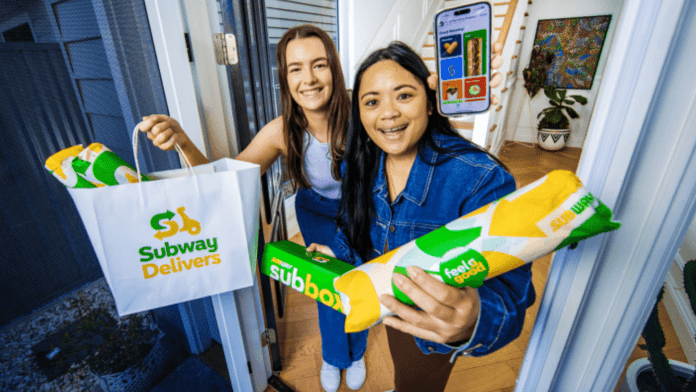
Subway has introduced its very own in-app delivery platform, known as Subway Delivers. Rodica Titeica, Director of Marketing for Subway ANZ, expressed that Subway Delivers represents the brand’s newest step forward in ensuring that quick and freshly prepared made-to-order meals are readily accessible to a greater number of Australians.
“We recognise how important convenience and ease of accessibility is in the increasingly busy lives of our customers. With the introduction of the new Subway Delivers in-app delivery service, Subway fans across Australia and New Zealand can get fast and fresh, healthy and convenient meals morning, noon and night,” Titeica said.
Via the Subway app, Subway Delivers offers fans an even more convenient way to order Subway’s famous Subs, salads, cookies, and more for instant delivery. Moreover, it provides the option to pre-order catering platters up to four weeks in advance.
To mark the app’s debut on September 15th, the brand commemorated the occasion by distributing 1,000 complimentary Footlongs at unexpected venues in Brisbane, Sydney, and Auckland.
The celebration continues today, on the 18th of September, offering customers the opportunity to enjoy free delivery via Subway Delivers until the 1st of October.
Beam Global, the producer behind Teacher’s whisky and Roku gin, has witnessed a remarkable surge in sales over the last two years, surpassing INR 1,000 crore in FY23. However, the introduction of new products has resulted in an expanded deficit.
During the fiscal year ending in March 2023, sales experienced a notable 54% surge, reaching INR 1,163 crore, in contrast to the INR 756 crore recorded in FY22. According to the most recent filing with the Registrar of Companies, net losses climbed to INR 299.7 crore for the last fiscal year, compared to INR 262.3 crore in the preceding year.
In FY21, it achieved net sales of INR 531 crore but incurred a net loss of INR 201 crore.
In its annual filing, the company stated that it is embarking on a consumer-insights-driven mission to enhance its core business within the House of Suntory, aiming to bolster growth in the premium segments of the whisky category in India.
“The company has outlined a long-term strategic vision and is transforming people capability and building exceptional excellence to strengthen its brand portfolio. This vision is well supported with investments and performance measurement in place across its brands, people, processes, IT capability and expansion of bottling capacity. The company enjoys strong support and confidence from the ultimate parent company and is strengthening its corporate governance by taking various measures,” the filing added.
Over the past three years, Beam Global has debuted a range of products, including Oaksmith Indian whisky, Japanese whiskies The Yamazaki and Hibiki, Roku Japanese gin, and Toki Whisky.
Beam Suntory, the parent company, ranks as the world’s third-largest spirits firm, trailing only Diageo and Pernod Ricard. They have set an ambitious global goal of achieving $1 billion in annual revenues in India by 2030. In the Indian market, Teacher’s stands as the fifth largest scotch brand. Moreover, the company that produces Jim Beam holds sway over more than a third of the American whisky category and exerts dominant control over the entire Japanese whisky segment, boasting a remarkable share of over 95%.
“US whisky has been a bridgehead subcategory for both Brown-Forman, with Jack Daniel’s, and Beam Suntory, with Jim Beam. These two brands accounted for about 1,500 nine-litre cases of 2022 US whisky volumes,” said a IWSR report.
On Saturday, Union Minister for Commerce and Industry Piyush Goyal emphasized the importance of collaboration within the spice industry to venture into untapped markets, bolster existing ones, and prioritize the development of value-added products, all with the goal of achieving $10 billion in exports by the year 2030.
“Currently our total exports of spices is at USD 4 billion. Rather than exporting spice in the raw form only, we should look for value-added products as we go forward. We should start building up more markets by exploring new markets and strengthening the existing ones. We should look at creating factories for value-added products to reach USD 10 billion exports by 2030 for the spices sector,” Goyal said addressing the World Spice Congress 2023.
Using an illustrative instance, the minister pointed out that during the COVID-19 pandemic, there was a substantial surge in demand for turmeric due to its medicinal attributes. In terms of exports, it possesses the potential to attain a remarkable $2 billion.
“If we focus all our energy on tumeric by developing value-added products, turmeric exports alone have the potential to touch USD 2 billion,” he added.
Additionally, the minister proposed the establishment of ‘Bharat’ as a distinguished brand or certification symbolizing top-tier quality and premium spice products.
“Let’s create a ‘Bharat’ brand or some certification that can help in associating high quality spices products to the country. Don’t export any sub-standard products that can harm the image of the country. The industry should focus on innovation, productivity, sustainability and exclusivity and market spices as a premium product when it goes to the world market,” Goyal said.
Furthermore, Goyal emphasized that there are more than 35 million (or 3.5 crore) individuals of Indian origin residing abroad who possess the potential to significantly contribute to the spice industry.
“Indian diaspora living overseas can help in expanding the spice consumption to others communities. In fact they can become your brand ambassadors and help the industry to grow its market internationally,” he stated.
The minister extended his congratulations to the Spices Board for hosting the Spice Congress after a gap of 7 years. He also urged them to arrange a world-class exposition, symposium, and conference for the spice industry in Delhi in 2024. This event would invite participation from all industry stakeholders, both domestic and international, including competitors and buyers, with the aim of garnering global attention and recognition.
“Spices represent the rich cultural heritage of our country. Therefore, the industry should invite all its competition and buyers from all over the world in larger numbers in the 2024 edition of the World Spice Congress and also make it into an annual event,” he added.
The minister stressed that the spices industry should seize this moment and take additional steps to secure a prominent position in the global market.
“As the biggest producer and consumer of spices, we should also encourage other countries to increase their spices consumption. We have a lot to offer, whether it is saffron from Kashmir or Kerala’s unmatched black pepper, Gujarat’s ginger or Nagaland’s chili, there is so much that India has to offer to the rest of the world. We should work to make India the preferred source of spices,” Goyal added.
Executives from major Indian companies have seized the opportunity presented by the recent G20 Summit in New Delhi and the United Nations’ declaration of 2023 as the International Year of Millets. They are now venturing into international markets with millet-based products, aiming to secure a pioneering position on the global stage.
Suhasini Sampath, Co-Founder of ITC-backed health foods brand Yoga Bar, which makes millet-based snack bars, muesli, chocos and now infant foods under its brand franchise Yoga Baby, said, “We are working very closely with the ITC exports team to take our products to the US and UAE.”
Sampath added, “We were sorting our trademarks in other world markets and now that we’ve gotten those in place, we are going to go aggressive on taking millets overseas.”
Despite the challenges posed by climate change affecting millet cultivation, as well as limitations in domestic storage and processing facilities, companies are embracing the trend.
“We are working on millet-based cone ice-cream, wafer chocolate, cookies and bread. These will be launched gradually in approximately 40 countries where we regularly export our consumer products,” said Jayen Mehta, MD, Amul.
He said the scale-up is in response to “the increase in awareness and interest in millet-based products globally.”
India holds the title of being the largest global producer and the second-largest exporter of millets such as jowar, bajra, and ragi.
Tata Consumer has revealed its strategic move to introduce its Soulfull brand of millet-based cereals to the United Kingdom through a collaborative venture with Tesco.
Marriott International has announced a collaboration with ITC Hotels to introduce a line of millet-based breads at specific hotels throughout the Asia-Pacific region, encompassing countries such as Japan, South Korea, Australia, and Indonesia. Ranju Alex, the Area Vice President of South Asia for Marriott International, highlighted that this partnership not only aims to raise awareness about the nutritional advantages of millets but also emphasizes their adaptability to cultivation in the face of challenging climatic conditions caused by climate change.
The Good Bug, a brand dedicated to gut health and operating in the direct-to-consumer space, has successfully raised $3.5 million in Series A funding. This funding round was spearheaded by Fireside Ventures, a venture capital fund specializing in early-stage investments within the consumer sector.
According to the company, it specializes in creating various probiotics targeting specific health concerns. Co-Founded by Prabhu Karthikeyan and Keshav Biyani, who is the nephew of retail mogul Kishore Biyani, The Good Bug benefits from the support of Think9 Consumer Technologies. This tech-driven company, led by Biyani’s daughters Ashni and Avni, offers invaluable assistance in brand development, leveraging its expertise in technology, data analytics, and marketing solutions.
Prabhu Karthikeyan & Keshav Biyani
The Series A funding, representing the company’s first institutional capital raising effort, will be used to drive product innovation, expand the team, and make strategic investments in brands, according to the company’s announcement.
Established in 2022, the company produces USFDA-approved solutions targeting chronic lifestyle issues like bloating, constipation, metabolic health, and weight loss through gut health. With a customer base of over 100,000, the company aims to achieve revenues of INR 250 crore within the next three years.
“We aim to pioneer and expand the gut health category in India, which has been an unexplored segment. We are unravelling the same by helping people get to the root cause of core health issues and holistically solve it,” Keshav Biyani, the Co-Founder of The Good Bug, said.
Biyani served as the Head of Strategy and International Business at Future Group, while also overseeing the home and personal care segment of the now defunct group.
Over the past five years, numerous health and wellness brands backed by venture capital have emerged to address a gap in the Indian direct-to-consumer market.
“As consumers are getting more health-conscious and looking for safe and effective solutions with long term benefits; we see a huge potential for gut health. The Good Bug is at the forefront of this booming segment with their innovative and effective products,” said Ankur Khaitan, principal, Fireside Ventures. The company is a venture capital fund primarily concentrated on the consumer sector.
The gut health industry is still in its early stages in India, but it’s experiencing rapid global growth. According to research conducted by Market.us, the worldwide digestive health market is projected to reach a value of $104.4 billion by 2032, with an expected compound annual growth rate (CAGR) of 8.2% during the forecasting period from 2023 to 2032. This growth is anticipated to be driven by the increasing awareness of the significance of dietary supplements, probiotics, and functional foods in maintaining digestive health.
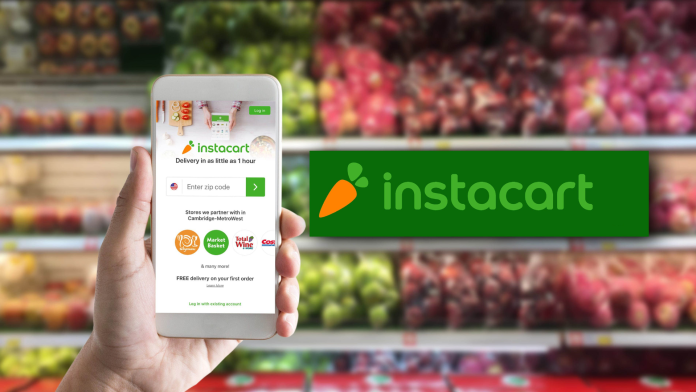
Instacart, the grocery delivery app, decided to increase its previously suggested price range for its initial public offering (IPO) on Friday. This adjustment in terms is aimed at achieving a fully-diluted valuation of potentially up to $10 billion, inspired by the remarkable performance of Arm Holdings during its debut.
The increase in price reflects strong investor interest in the San Francisco-based company. After patiently biding its time for years, the company is now gearing up to list its shares later this month.
September is shaping up to be a bustling period for new stock market debuts.
In the early, volatile trading session on Friday, shares of SoftBank’s chip designer Arm rose by almost 3%, building upon the strong finish they had on their debut trading day.
Yet another company within the Japanese investment giant’s portfolio, Neumora Therapeutics, is preparing to commence trading, and marketing firm Klaviyo is eyeing a listing in the upcoming weeks.
Data from Dealogic reveals that traditional U.S. IPOs have generated over $5 billion in proceeds in September. This marks the second-largest month for such stock offerings this year.
Instacart has announced that it will offer 22 million shares for sale at a price range of $28 to $30 per share, an increase from the previous range of $26 to $28 per share. At the upper end of this revised range, the IPO is expected to raise $660 million, surpassing the earlier target of $616 million.
Out of the overall proceeds, as much as $237 million may be allocated to existing Instacart investors who wish to divest their shares.
Nonetheless, the company’s revised valuation objective would still be merely a quarter of the $39 billion it was valued at during its previous funding round over two years ago.
Cornerstone investors have expressed their intent to purchase shares worth up to $400 million, a sum that would constitute approximately two-thirds of the total proceeds if these shares were priced at the upper end of the range.
Businesses now must navigate a dynamic world of social media channels, each with its own audience, content style, and engagement conventions. A one-size-fits-all strategy for social media marketing is no longer adequate. To fully flourish, you must first understand the peculiarities of each platform and then customise your plan appropriately. In this post, we’ll look at how to create platform-specific tactics that can help your business thrive across many social media channels.
Know Your Platforms
Understanding the essence of each social media platform is the first step. Here’s a quick breakdown:
Facebook: A versatile platform with a broad user base. Ideal for sharing diverse content types, including text, images, videos, and links. Engagement thrives on storytelling and community-building.
Instagram: A highly visual platform suited for image and video sharing. Ideal for showcasing aesthetics, lifestyle, and behind-the-scenes glimpses. Stories and Reels are excellent for short, engaging content.
Twitter: A fast-paced platform for short, snappy updates. Perfect for real-time engagement, news sharing, and trending topics. Use hashtags and concise messaging.
LinkedIn: The professional network for B2B connections and thought leadership. Ideal for sharing industry insights, articles, and company updates.
Pinterest: A visual discovery platform for inspiration and ideas. Best for showcasing products, DIY projects, and lifestyle inspiration.
YouTube: The go-to platform for video content, including tutorials, vlogs, and product demonstrations.
Audience Persona Matters
Tailoring your content begins with understanding your target audience on each platform. Demographics, interests, and behavior vary widely. Your content should resonate with the expectations of users on that particular channel.
Content Style and Format
Different platforms demand different content styles:
On Facebook, engaging storytelling works wonders, with videos and long-form posts often gaining traction.
Instagram thrives on visually appealing images and short video clips. Use hashtags strategically.
Twitter favors concise and timely updates. Utilize trending hashtags and engage in conversations.
LinkedIn appreciates thought-provoking articles, industry insights, and professional networking.
Pinterest demands eye-catching, pinnable images with well-optimized descriptions.
YouTube requires high-quality video content, including tutorials, vlogs, and product reviews.
Engagement Strategies
Engagement norms also vary:
Facebook values community engagement. Respond promptly to comments and foster discussions.
Instagram engagement thrives on likes, comments, and shares. Use Stories and Reels to interact with your audience.
Twitter relies on retweets, likes, and replies. Engage in conversations and share valuable insights.
LinkedIn engagement revolves around professional connections and comments on industry-related content.
Pinterest engagement involves pinning and sharing visually appealing content.
YouTube engagement is driven by likes, comments, and subscriptions. Interact with your viewers through comments and live streams.
Frequency and Timing
Consider the optimal posting frequency and timing for each platform. While Facebook and Instagram may benefit from daily posts, Twitter demands more frequent updates. Experiment with different posting times to identify when your audience is most active.
In the dynamic realm of social media marketing, understanding the subtleties of each platform is paramount to success. Tailoring your content, engagement strategies, and posting frequency to align with the preferences of each platform’s unique audience can significantly enhance your brand’s online presence. By decoding the essence of social media channels and customizing your approach, you’ll be better equipped to connect with your audience effectively and achieve your business goals in the ever-evolving world of social media.
A robust social media presence is no longer a choice in today’s wide digital marketplace; it is a need. However, merely having a presence on prominent social sites is insufficient.To truly succeed in the online realm, businesses need to unravel the secrets of engagement.
And to help you with that, we are here yet again with these strategies that can help your brand create a dynamic and thriving social media presence:
Understand Your Audience Like a Friend
Engagement starts with knowing your audience inside and out. Just like you would in a personal conversation, listen actively to your followers. Analyze their preferences, needs, and pain points. This understanding forms the foundation for crafting content that resonates and sparks interaction.
Create Content with a Purpose
Gone are the days when posting for the sake of posting would cut it. Every piece of content you share should have a clear purpose, whether it’s to educate, entertain, inspire, or inform. Align your content with your brand’s values and goals.
Diversify Your Content
Variety is the spice of social media engagement. Offer a diverse range of content types, from visually striking images and infographics to thought-provoking blog posts and engaging videos. Experiment and discover what resonates most with your audience.
Tell Stories, Not Sales Pitches
One of the secrets to engagement is storytelling. Craft narratives that connect with your audience on an emotional level. Share success stories, behind-the-scenes glimpses, and user-generated content that showcases the real human side of your brand.
Use the Right Platforms
Not all social media platforms are created equal, and they cater to different demographics and interests. Identify the platforms where your target audience spends the most time and focus your efforts there. Quality engagement is more important than quantity.
Consistency is Key
Regular posting keeps your audience engaged and your brand top of mind. Create a content calendar to ensure a steady stream of content that aligns with your brand’s messaging and goals.
Leverage User-Generated Content
Encourage your followers to become part of your brand’s story by sharing their own experiences and content related to your products or services. User-generated content not only fosters a sense of community but also provides authentic endorsements.
Engage Authentically
Engagement is a two-way street. Respond promptly to comments and messages. Acknowledge both positive and negative feedback with professionalism and a genuine desire to improve. Show your audience that you value their input.
Host Giveaways and Contests
Contests and giveaways can inject excitement into your social media presence. They not only boost engagement but also attract new followers. Ensure that the rules and guidelines are clear to avoid any misunderstandings.
Analyze and Adapt
Regularly review your social media analytics to gauge the effectiveness of your engagement strategies. Track metrics such as likes, comments, shares, and click-through rates. Use these insights to refine your approach and adapt to your audience’s evolving preferences.
A vibrant social media presence is not just about gaining followers but about fostering meaningful connections that drive brand loyalty and growth. To achieve this, focus on understanding your audience, creating purposeful content, and engaging authentically. By unraveling the secrets of engagement, your brand can stand out in the crowded digital landscape and thrive in the world of social media. Remember, the real secret lies in treating your social media followers as valued friends and partners on your brand’s journey.
In the noisy, ever-evolving landscape of social media, capturing your audience’s attention and building a lasting connection can be a challenging feat. However, one timeless approach has emerged as a powerful tool for businesses to cut through the digital clutter: strategic storytelling. In this article, we’ll explore how to harness the power of social media to showcase your business’s narrative effectively.
Unearth Your Business’s Unique Story
Every business has a story to tell, and it’s often rooted in its origin, values, or a compelling journey. Start by unearthing the core narrative that sets your business apart. Perhaps it’s the passion that fueled your startup, the challenges you’ve overcome, or the mission that drives your team. Your unique story is the foundation of your strategic storytelling.
Know Your Audience
Understanding your target audience is paramount when crafting a compelling narrative. Research their interests, demographics, and online behavior. This knowledge will help you tailor your storytelling to resonate with your audience’s values and aspirations.
Choose the Right Platforms
Not all social media platforms are created equal, and each has its unique audience and content format. Consider which platforms align best with your narrative and audience. Visual narratives may thrive on Instagram, while LinkedIn might be ideal for B2B companies with a professional story to tell.
Craft Engaging Content
Effective storytelling hinges on captivating content. Share stories through a variety of formats, such as written posts, images, videos, and even live streams. Ensure your content is not only visually appealing but also emotionally resonant.
Build Consistency and Authenticity
Consistency is key in building your brand’s narrative. Your storytelling should be authentic and true to your business’s values. Avoid generic or inauthentic narratives that may come across as disingenuous to your audience.
Use the Power of Visuals
Visual content is a potent storytelling tool on social media. Utilize high-quality images, infographics, and videos to convey your narrative. Visual storytelling can evoke emotions and make your message memorable.
Create a Content Calendar
Plan your storytelling efforts with a content calendar. This ensures a consistent flow of content that keeps your audience engaged and eager for the next chapter of your narrative.
Engage with Your Audience
Social media is a two-way street. Encourage interaction with your audience by asking questions, responding to comments, and actively participating in conversations related to your narrative. Engaging with your audience builds a sense of community.
Highlight Customer Stories
Incorporate customer stories into your narrative. Showcase their experiences and success stories with your product or service. This not only humanizes your brand but also provides social proof and credibility.
Analyze and Adapt
Regularly analyze the performance of your storytelling efforts. Monitor metrics like engagement rates, reach, and conversion rates. Use these insights to adapt your narrative strategy and refine your storytelling techniques.
In an age where attention spans are fleeting and content is abundant, strategic storytelling on social media can be your business’s secret weapon. By unearthing your unique narrative, understanding your audience, and crafting engaging, authentic content, you can not only capture your audience’s attention but also build lasting connections that foster brand loyalty. Remember, the most impactful stories aren’t just told; they are experienced and shared, making social media the perfect stage for showcasing your business’s narrative.
Creating an effective social media strategy for your company necessitates careful preparation, knowing your target audience, and adhering to your brand’s values. You can navigate the digital environment with confidence and watch your business grow in the realm of social media by defining clear goals, creating compelling content, and keeping a constant online presence. Remember that having the most relevant voice in social media marketing is more important than being the loudest.
Define Your Conversion Goals
Before diving into the intricacies of social media, it’s essential to have a clear understanding of what you want to achieve. Are you aiming to collect email addresses, make direct sales, or have potential customers schedule consultations? Identifying your specific conversion goals will shape your social media strategy.
Know Your Audience Inside Out
To drive conversions, you must intimately know your target audience. Understand their pain points, needs, and desires. This knowledge will enable you to create content that resonates and positions your product or service as the solution they’ve been seeking.
Choose the Right Social Media Platforms
Not all social media platforms are created equal, and the best platform for conversion-driven strategies may differ from one business to another. For B2B companies, LinkedIn may be the go-to platform, while visually appealing products may find success on Instagram or Pinterest. Select platforms where your audience is most active and where your conversion goals align.
Craft Engaging and Actionable Content
Content remains king in the world of social media marketing. Create content that not only informs but also encourages action. This could be in the form of compelling calls-to-action (CTAs) or educational content that prompts users to learn more about your product or service.
Implement Paid Advertising Strategically
While organic reach is valuable, social media advertising can be a game-changer for lead generation. Platforms like Facebook, Instagram, and LinkedIn offer highly targeted advertising options. Allocate a portion of your marketing budget to paid ads that drive traffic to landing pages optimized for conversion.
Optimize Landing Pages
The success of your social media campaigns often hinges on the effectiveness of your landing pages. Ensure that they are user-friendly, load quickly, and contain persuasive copy and visuals. A seamless user experience is crucial for converting social media traffic into leads.
Implement Lead Generation Forms
Many social media platforms offer lead generation forms that allow users to submit their information directly without leaving the platform. Utilize these forms to capture leads efficiently. Keep them short and sweet, asking for only essential information.
Track and Analyze Your Efforts
To fine-tune your strategy, it’s crucial to monitor and analyze your social media efforts. Track metrics such as click-through rates, conversion rates, and cost per conversion. Social media analytics tools can provide valuable insights into what’s working and where you can improve.
Nurture Leads Through Email Marketing
Once you’ve captured leads, don’t let them go cold. Implement an email marketing strategy to nurture your leads, providing them with valuable content and moving them closer to conversion. Personalization and segmentation are key to effective email marketing.
Test and Iterate
Social media is a dynamic field, and what works today may not work tomorrow. Continuously test different approaches, content formats, and messaging to optimize your conversion rates. Stay adaptable and open to change.
Transforming your social media strategy from a popularity contest to a lead-generation engine takes strategic thought and a thorough grasp of your target demographic. You can convert your social media efforts into a strong tool for driving leads and, ultimately, company success by defining clear conversion targets, creating compelling content, and optimising your strategy based on data and insights. Remember, it’s not just about the likes in the realm of social media marketing; it’s about converting those likes into quality leads.
We use cookies to ensure that we give you the best experience on our website. If you continue to use this site we will assume that you are happy with it.