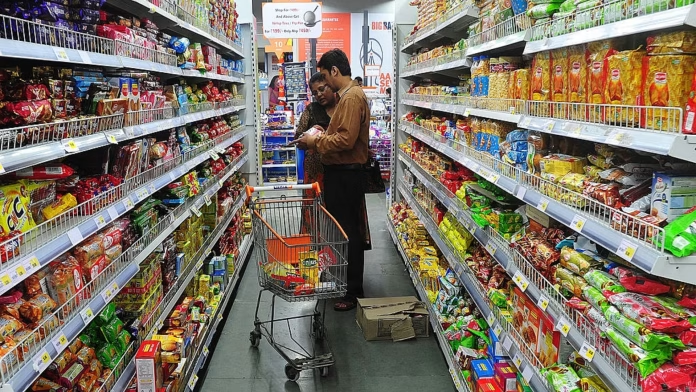
Executives from top fast-moving consumer goods (FMCG) companies have reassured that edible oil prices are unlikely to surge during the upcoming festive season, despite the severe moisture stress affecting the domestic soya bean crop. This stability is attributed to the favorable international supply situation. However, they caution that a potential price increase in edible oils may occur from December to April-May of the following year due to the anticipated impact of El Nino on oil-producing nations.
On the flip side, FMCG companies express concerns regarding rice production in the nation, particularly in many eastern states that are major producers of non-basmati rice. The insufficient rainfall in these regions could pose a threat to the current standing paddy crop in the fields.
“Monsoon is critical for the soya bean and groundnut crop. It should rain well in the next 10 days, otherwise the yield will be severely affected,” said BV Mehta, executive director, Solvent Extractors Association.
As per the India Meteorological Department’s data, 287 out of the country’s 717 districts experienced a rainfall deficit from June 1 to August 4.
“India is sitting on a good volume of imported oil and prices are unlikely to go up soon. But definitely, the scanty monsoon will have an impact on the soya bean crop… That may leave an impact on consumption,” said Angshu Mallick, managing director, Adani Wilmar.
In celebration of 52 years of coffee tradition and a toast to the future, TATA Starbucks joyfully reintroduces the enduring favorite – Anniversary Blend.
As coffee has evolved from a simple morning tradition into a platform for personal expression, a communal experience, and a cultural declaration, this cherished blend provides coffee enthusiasts with a cup that is both heavenly and significant.
Debuted in 1996 as a tribute to the company’s 25th anniversary, the Anniversary Blend quickly gained popularity as a seasonal favorite. This year’s festivities bring forth a reenvisioned blend, carefully aged for five years, highlighting the brand’s unwavering dedication to continually elevate the coffee experience for consumers nationwide.
Distinguished for its pronounced flavors, robust character, and unmistakable boldness, the 2023 Anniversary Blend is a harmonious blend of ethically sourced beans exclusively from Indonesia – a region that has been a source of inspiration for Starbucks since its inception in 1971. This unique blend draws its essence from the coffee-growing regions of Sumatra, West Java, and Sulawesi, resulting in a remarkable cup of Starbucks’ most daring blend. Enriched with spicy undertones, fragrant hints of smoked cedar, and allspice, complemented by subtle notes of black truffle and fresh tarragon, this dark-roasted masterpiece delivers an intense, earthy richness that truly embodies exceptional coffee.
The packaging of the Anniversary Blend captures the nurturing essence of the siren – an emblem closely associated with Starbucks – exuding a warm, inviting, and self-assured aura.
“The Anniversary Blend is our homage to Starbucks’ rich coffee heritage. Crafted with the finest ethically sourced Indonesian coffee and aged to perfection for five years, this blend showcases our steadfast commitment to innovation, offering a timeless taste. As Starbucks commemorates its 52nd year, we find immense joy in extending this extraordinary coffee experience to coffee aficionados nationwide. Coffee is no longer just a beverage; it’s an integral facet of our lives, a culture that binds us and the Anniversary Blend is here to further enrich this very culture,” shared Sushant Dash, CEO, Tata Starbucks.
The exclusive Starbucks® Anniversary blend comes in a 250-gram package, or customers can opt to enjoy any of their preferred beverages made with the Anniversary blend as their chosen espresso at Starbucks stores throughout India or through various delivery services.
Presently, Starbucks runs a total of 347 establishments in India, spanning 47 different cities. These outlets are operated through a joint venture known as TATA Starbucks Private Limited, operating under the brand name Starbucks Coffee – A TATA Alliance.
NuNectar, a rising star in India’s health and wellness retail sector, is excited to introduce Super Vita, an innovative and nutritious health beverage specially crafted for children. The brand has launched a groundbreaking digital marketing campaign featuring Rakshanda Khan, a renowned television actor and a dedicated mother.
It’s concerning to find out that children can consume as much as 5 kilograms of chemically processed refined sugar in a year, all from products labeled as “health drinks.” What’s even more worrisome is that many of these supposedly wholesome beverages frequently include preservatives and artificial colors.
Nevertheless, parents can now breathe a sigh of relief, courtesy of the emergence of a new startup, NuNectar Foods, offering a solution.
NuNectar’s Super Vita stands as a wholesome, junk-free health beverage tailored for children, fortified with 40 vital nutrients, and composed of a combination of three super grains: Barley, Bajra, and Wheat. Enhanced with the natural sweetness of jaggery and a delightful Swiss Chocolate flavor, Super Vita delivers a delectable taste without sacrificing health. What truly distinguishes Super Vita as free from unwanted additives is its complete absence of refined sugar, added preservatives, and artificial colors. Hence, every sip of Super Vita delivers authentic nutritional benefits.
In a marketing arena frequently filled with conventional messages from well-established brands, NuNectar is boldly delivering genuine communication to its audience through a unique digital campaign. This campaign not only introduces the product but also highlights the crucial significance of holistic nutrition in a child’s life. It underscores NuNectar’s dedication to becoming a reliable ally for parents in fostering their children’s health and overall well-being. This approach has resonated remarkably with the audience, generating overwhelmingly positive feedback.
“Super Vita is probably the only junk-free health drink for kids in India that is power-packed with 40 essential nutrients known to aid muscle and bone growth, bolster immunity and help support brain development. For parents seeking a truly wholesome choice for their children, Super Vita is the go-to health drink. Super Vita is tested by an accredited lab and is reviewed and recommended by professional nutritionists for kids,” said Hermann Arora, Founder.
In a brief period, Super Vita has rapidly gained momentum and is currently emerging as the favored choice among children’s health drinks on Amazon India. Additionally, it is conveniently accessible for purchase on the brand’s website, complete with attractive offers.
GoodGudi, a high-speed lifestyle retail chain specializing in household and consumer goods, has successfully secured seed funding. The financing round was spearheaded by AC Ventures, with active involvement from April Ventures, Capinity Partners, High Net Worth Individuals (HNIs), and notable angels such as Kunal Shah and Aprameya Radhakrishna.
According to insider reports, the funding in this round amounts to between $800,000 and $1 million.
Established by Anurag Gupta, Sagar Yarnalkar, and Chandan Kumar, Goodgudi has ambitious plans to establish over 40 retail outlets within the upcoming 24 months. The brand specializes in offering high-quality utility-focused products across diverse categories, encompassing home utilities, travel accessories, gifts, fashion accessories, personal care items, kitchenware, stationery, children’s products, and toys.
It’s important to highlight that Anurag Gupta and Sagar Yarnalkar previously founded the e-grocery startup Dailyninja, which was acquired by the Tata-owned grocery giant BigBasket in early 2020.
According to Goodgudi, the key feature of these stores will be the regular launch of new designs and product lines, ensuring that something innovative and appealing becomes available on the shelves every 30 days. This strategy is designed to cultivate an interactive and ever-evolving shopping experience for their customers.
The fast lifestyle retail sector has achieved remarkable global success, with prominent entities like Miniso, Daiso, Mumuso, and Ximivogue running highly profitable enterprises. Miniso, for instance, has expanded into the Indian market and currently operates over 250 stores in India.
Food delivery platforms, restaurant chains, and food service companies have urged the government to classify deliveries as “essential services, similar to those during pandemic lockdowns,” ahead of the G20 summit.
The government has announced that New Delhi will be designated as a “controlled zone” along with a series of restrictions and closures.
“Food and groceries are essential services. These deliveries were permitted even during Covid-19 lockdowns. From a consumer convenience perspective, it will be helpful if the government permits these services in compliance with guidelines,” said Dinker Vashisht, vice president, public policy, at food delivery and aggregator platform Swiggy.
In accordance with a public notice released by the Delhi government, all employers operating shops, commercial, and business establishments in New Delhi are required to shut down their operations from September 8 to September 10.
“Various government departments and ministries had been engaging with hospitality companies for the past many months with the objective of providing good experiences to guests during G20,” said Prakul Kumar, Secretary General of National Restaurant Association of India (NRAI), which represents 500,000 restaurant companies. “We were looking forward to it. But with complete closures leading to losses, at least deliveries should be permitted. We have no clarity and no guidelines on the matter so far.”
Executives have mentioned that the G20 long weekend, officially declared as a public holiday by the Center, is resulting in an increased number of people leaving the town, which is expected to have an additional impact on sales.
In a letter addressed to the Delhi government, the NRAI said, “Food delivery from restaurants may be permitted as part of essential services as was also done during the Covid-19 pandemic. This will help in mitigating to some extent the business disruptions and losses faced by industry due to the closures and restrictions.”
The G20 Summit is set to take place from September 9 to September 10, and it will witness the arrival of numerous world leaders in the capital.
While Delhi Police has said there is “no restriction on movement of essential commodities coming through Delhi borders”, it has not given any directives on allowing food deliveries. Traffic police has cautioned commuters that they may experience more-than-normal traffic on select roads, advising citizens to avoid such places during specified periods.
While groceries may be classified as essential services, executives said food delivery platforms will suffer the most in terms of loss of business opportunity.
According to officials, the Delhi government’s recent excise policy generated revenue exceeding INR 7,285 crore in the past year through the sale of more than 61 crore liquor bottles. This current excise policy, which has been in effect since September 1, 2022, was introduced as a replacement for the previous excise policy. The previous excise policy for 2021-22 had faced scrutiny from the CBI due to alleged irregularities in its implementation, prompting the government to adopt the new approach.
An officer from the Excise Department reported that the cumulative excise revenue collection for the period spanning September 1, 2022, to August 31, 2023, amounted to INR 7,285.15 crore, which included INR 2,013.44 crore collected in the form of value-added tax (VAT).
Contrastingly, the revenue generated from the new excise policy in 2021-22 amounted to INR 5,487.58 crore. This new excise policy, which had allowed private entities to participate in retail liquor sales, was revoked by the Delhi government the previous year following a recommendation by LG VK Saxena to initiate a CBI investigation into purported irregularities in its execution, as reported by officials.
At that time, the Deputy Chief Minister and Excise Minister, Manish Sisodia, faced arrest by the CBI in connection with a case it had filed concerning alleged irregularities in the 2021-22 excise policy. The excise policy had been enacted on November 17, 2021, and concluded in August 2022.
The previous excise policy came into effect on September 1, 2022, with Delhi government agencies assuming control over the retail sale of liquor within the city.
Officials have reported that starting from September 1, 2022, the four Delhi government entities – namely, the Delhi State Industrial and Infrastructure Development Corporation (DSIIDC), Delhi Tourism and Transportation Development Corporation (DTTDC), Delhi Consumer’s Cooperative Wholesale Store (DCCWS), and Delhi State Civil Supplies Corporation Limited (DSCSC) – have established more than 600 retail outlets throughout the city.
Being a cherished brand in the UK, PizzaExpress acknowledges its duty to the environment and society. That’s why the brand is delighted to declare its collaboration with Too Good To Go, the global leader in surplus food marketplaces.
After initially testing the food waste redirection initiative in 2022 as a part of their broader commitment to achieving Net Zero by 2040, PizzaExpress has now implemented Too Good To Go as a permanent program across its 360 restaurants in the UK and Ireland. This move ensures that surplus food is effectively utilized and not discarded.
Since its UK debut in 2016, Too Good To Go has successfully averted over 28 million surplus meals from ending up as waste. With this fresh collaboration, PizzaExpress is now aligned with their mission to combat food waste.
Through the complimentary Too Good To Go app, the 12.7 million registered users have the opportunity to buy a ‘Surprise Bag,’ containing a variety of surplus food items, all at a significantly reduced cost. When dining at PizzaExpress, guests may find themselves enjoying a surprise selection that could include a Lasagna with a slow-cooked ragu, spinach and ricotta Cannelloni, or a delightful combination of three other unexpected items like the renowned Dough Balls, Lemon & Herb Chicken Wings, or a sweet treat such as a Chocolate Brownie or Tiramisu.
According to PizzaExpress’ Sustainability Manager, Cherry Dejos, this partnership allows the brand to maintain its dedication to making a favorable environmental impact as it progresses towards achieving its Net Zero by 2040 objective.
“For our customers, the partnership with Too Good To Go means surplus meals from our restaurants across the UK and Ireland can be purchased at a lower price, including our delicious Lasagna and Cannelloni, while helping to curb food waste at the same time.
“This is just one of the ways we are committed to making a difference, and among our other sustainability targets is ensuring that by 2025, all of our direct suppliers have joined us on our journey by requiring them to have set their own Net Zero targets.”
Sophie Trueman, Too Good To Go’s country director UK & Ireland, added, “We are delighted to be partnering with PizzaExpress. Having already had fantastic feedback from our community during a successful trial period, we’re looking forward to helping PizzaExpress make a positive impact on the environment.
“At Too Good To Go, we believe that saving food from going to waste is a win-win – consumers can get delicious food for less, and with one simple action, we’re collectively doing something great for the planet. I know our users will jump at the chance to save PizzaExpress’ Surprise Bags and I can’t wait to see our partnership flourish.”
Zomato, the prominent foodtech company, has announced its intention to dissolve its subsidiary, Lunchtime, which operates in the Czech Republic, as stated in an official filing with the stock exchange.
“Pursuant to Regulation 30 of the Listing Regulations, we wish to submit that Lunchtime.cz s.r.o. (“Lunchtime”), step down subsidiary of Zomato Limited (“the Company”) situated in Czech Republic has initiated the process of liquidation on September 01, 2023,” said Zomato.
As per the foodtech leader, Lunchtime had no ongoing business activities. This subsidiary holds a valuation of INR 28.2 Lakhs and has not generated any revenue or made any contribution to Zomato’s overall net worth.
Zomato has been strategically closing underperforming subsidiaries globally to concentrate its efforts on the Indian market.
This year, Zomato has been actively streamlining its global operations by closing down subsidiaries in several countries, including Indonesia, Portugal, and Jordan. Additionally, the company has announced its forthcoming exit from the Philippines. It’s important to note that many of these subsidiaries were not engaged in active business operations.
At present, Zomato is solely engaged in active operations within India and the UAE. However, in November 2022, the Kuwait-based foodtech startup Talabat made the decision to discontinue Zomato’s food delivery unit in the UAE, which it had acquired for a reported $172 million back in 2019.
The Indian foodtech company continues to provide restaurant discovery and dining-out services in the UAE.
At the beginning of the year, Zomato announced its withdrawal from 225 cities across the country due to underperformance. In a shareholder letter, Zomato’s CFO, Akshant Goyal, stated that the foodtech company had ceased operations in approximately 225 smaller cities in January. These cities had contributed only 0.3% of Zomato’s Gross Order Value (GOV) during the third quarter of the fiscal year 2023 (October-December).
The leading foodtech company also implemented a platform fee ranging from INR 1 to INR 3 per order as part of its strategy to improve monetization and maintain operations in smaller cities. Zomato’s focus on monetization and cost reduction resulted in the company achieving a profit of INR 2 crore during the June quarter of FY24, marking this significant achievement for the first time.
Last week, both Tiger Global and SoftBank sold off their shares in the foodtech giant. Tiger Global made a complete exit from the startup, and this development led to a notable surge in Zomato’s share price.
Zomato’s stock performance has been strong in recent months, reaching a 52-week high of INR 102.85 per share just last month. As of 1:15 PM on Monday, September 4, the foodtech company’s shares were trading at INR 98.05 on the BSE, a modest increase from Friday’s closing price.
Arnav Sahni & Garima Kaushal, Co-Founders of Sploot
Delhi-based pet-parenting mobile app, sploot, recently achieved a major milestone by successfully securing $800,000 in its second round of seed funding. This significant accomplishment was made possible through a collaborative effort with Redstart Labs, a subsidiary of Info Edge, and generous contributions from angel investors.
With this new influx of funding, sploot is poised to broaden its range of services, encompassing options such as dog walking, grooming, and premium ready-to-serve dog food. Furthermore, the company is strategically preparing for territorial expansion to reach an even broader demographic of pet parents. sploot, widely regarded as a reliable companion for pet owners, streamlines various facets of pet care and tackles prevalent challenges through its supportive community and comprehensive service offerings.
With an impressive record of over 100,000 downloads combined from both the Play Store and App Store, sploot has provided in excess of 80,000 meals and organized over 100,000 dog walks exclusively in the Delhi-NCR region. The platform’s community-driven ethos has garnered substantial attention, amassing a dedicated following of over 82,000 Instagram followers.
Garima Kaushal, Co-Founder and CEO of sploot, shared her thoughts on the company’s mission, saying, “The idea for sploot came from seeing generations of pet parents learn by making the same mistakes. Sploot was our effort to help pet parents be better by learning collectively from each other and the experts. We believe that education about pet parenting is the first step towards influencing purchase decisions.”
Info Edge’s collaboration with sploot traces its origins to the initial seed funding round, where the company made a $500,000 investment in 2022.
Vibhore Sharma, a partner at Info Edge, commented on the pet care industry’s potential in India, stating, “Various studies value India’s pet care market at over $500 million, and it is likely to grow multifold at 20% annually. This growth will increase the demand for pet care products, services, and experts. sploot is on its way to being the platform for pet parents to get everything they need in one place.”
Sploot has garnered substantial support from a roster of prominent supporters, including Akshay Chaturvedi, the Founder and CEO of LeverageEdu and Fly; Yatish Talvadia, a serial entrepreneur and Angel Investor; Sanjay Singh, formerly associated with PayTM; Mukul, an angel investor and former member of Adobe; Aryan Mhaiskar, an Angel investor, and various others participating through GripInvest.
Akshay Chaturvedi, CEO of Leverage Edu, praised the app’s role in nurturing the pet parenting industry in India, saying, “India’s youth is now single-handedly giving rise to the pet parenting industry, and this is, in turn, giving rise to the demand for more things than just quality pet food, grooming, accessories, and other vet services. I am happy to see sploot enabling this generation of hustlers with the ease of pet parenting at just a click.”
Founded by Garima Kaushal (IIM A, XIC, SRCC) and Arnav Sahni (SRCC), sploot was born out of the founders’ deep love for pets and their unwavering dedication to promoting responsible pet ownership. This mobile app has forged a nurturing community, aiding users in navigating their pet parenting voyage while providing the convenience of a one-stop-shop for all things pet-related. Additionally, sploot has been a participant in Blume Ventures’ Lead Tribe and Google’s Appscale Academy programs, both of which empower early-stage entrepreneurs and cultivate the development of innovative tech startups.
Keventers, the renowned milkshake brand, is introducing a fresh range of shakes that effortlessly blend delicious flavors with budget-friendly options.
Keventers Value Shakes are now accessible at an incredibly budget-friendly rate of only INR 99. These shakes are available in three delightful flavors, offering a perfect combination of the brand’s signature taste and an exceptionally affordable price.
In light of heightened competition and the expanding need for a bolder pricing strategy in today’s market, the brand is unveiling an even more appealing price range for its milkshakes.
“Keventers Value Shakes is a new category for us and allows us to reach our customers at an even more accessible price point than ever before. Our journey at Keventers has always been about bringing joy through taste, and with this launch, we’re taking that mission to a new level. Affordable, delectable, and true to our quality standards – that’s the promise we’re delivering!” said, Agastya Dalmia, the visionary Founder & CEO of Keventers
Keventers Value Shakes offer an outstanding value proposition and are truly economical, giving customers unparalleled value for their money.
The Value Shakes selection includes three flavors: Vanilla, Chocolate, and Pineapple, all conveniently packaged in the standard 300ml Keventers bottles.
You can find the value shakes at all Keventers outlets throughout India, and they are also conveniently available for online orders via Swiggy and Zomato.
We use cookies to ensure that we give you the best experience on our website. If you continue to use this site we will assume that you are happy with it.