Tuesday, December 30, 2025
Home Blog Page 901

From Likes to Leads: How to Develop a Social Media Strategy That Drives Conversions

0

Creating an effective social media strategy for your company necessitates careful preparation, knowing your target audience, and adhering to your brand’s values. You can navigate the digital environment with confidence and watch your business grow in the realm of social media by defining clear goals, creating compelling content, and keeping a constant online presence. Remember that having the most relevant voice in social media marketing is more important than being the loudest.

  • Define Your Conversion Goals

Before diving into the intricacies of social media, it’s essential to have a clear understanding of what you want to achieve. Are you aiming to collect email addresses, make direct sales, or have potential customers schedule consultations? Identifying your specific conversion goals will shape your social media strategy.

  • Know Your Audience Inside Out

To drive conversions, you must intimately know your target audience. Understand their pain points, needs, and desires. This knowledge will enable you to create content that resonates and positions your product or service as the solution they’ve been seeking.

  • Choose the Right Social Media Platforms

Not all social media platforms are created equal, and the best platform for conversion-driven strategies may differ from one business to another. For B2B companies, LinkedIn may be the go-to platform, while visually appealing products may find success on Instagram or Pinterest. Select platforms where your audience is most active and where your conversion goals align.

  • Craft Engaging and Actionable Content

Content remains king in the world of social media marketing. Create content that not only informs but also encourages action. This could be in the form of compelling calls-to-action (CTAs) or educational content that prompts users to learn more about your product or service.

  • Implement Paid Advertising Strategically

While organic reach is valuable, social media advertising can be a game-changer for lead generation. Platforms like Facebook, Instagram, and LinkedIn offer highly targeted advertising options. Allocate a portion of your marketing budget to paid ads that drive traffic to landing pages optimized for conversion.

  • Optimize Landing Pages

The success of your social media campaigns often hinges on the effectiveness of your landing pages. Ensure that they are user-friendly, load quickly, and contain persuasive copy and visuals. A seamless user experience is crucial for converting social media traffic into leads.

  • Implement Lead Generation Forms

Many social media platforms offer lead generation forms that allow users to submit their information directly without leaving the platform. Utilize these forms to capture leads efficiently. Keep them short and sweet, asking for only essential information.

  • Track and Analyze Your Efforts

To fine-tune your strategy, it’s crucial to monitor and analyze your social media efforts. Track metrics such as click-through rates, conversion rates, and cost per conversion. Social media analytics tools can provide valuable insights into what’s working and where you can improve.

  • Nurture Leads Through Email Marketing

Once you’ve captured leads, don’t let them go cold. Implement an email marketing strategy to nurture your leads, providing them with valuable content and moving them closer to conversion. Personalization and segmentation are key to effective email marketing.

  • Test and Iterate

Social media is a dynamic field, and what works today may not work tomorrow. Continuously test different approaches, content formats, and messaging to optimize your conversion rates. Stay adaptable and open to change.

Transforming your social media strategy from a popularity contest to a lead-generation engine takes strategic thought and a thorough grasp of your target demographic. You can convert your social media efforts into a strong tool for driving leads and, ultimately, company success by defining clear conversion targets, creating compelling content, and optimising your strategy based on data and insights. Remember, it’s not just about the likes in the realm of social media marketing; it’s about converting those likes into quality leads.

Advertisement

Navigating the Digital Landscape: Building an Effective Social Media Strategy for Your Business

0

A strong online presence is essential for organisations trying to flourish and increase their reach in today’s fast-paced digital world. In this endeavour, social media has emerged as a significant instrument, providing a direct line of connection with clients as well as a venue for brand promotion. Navigating the digital realm and developing an effective social media strategy, on the other hand, may be a difficult endeavour.

  • Define Your Goals and Objectives

Before diving into the world of social media, it’s crucial to define your goals and objectives. Are you looking to increase brand awareness, drive website traffic, boost sales, or foster customer engagement? Setting clear and measurable goals will help you tailor your social media efforts to achieve the desired results. Your goals will serve as a roadmap for your social media strategy, providing direction and focus.

  • Know Your Audience

Understanding your target audience is fundamental to crafting an effective social media strategy. Research and analyze your ideal customers’ demographics, interests, and online behavior. This information will help you create content that resonates with your audience and build a more meaningful connection with potential customers.

  • Choose the Right Platforms

Not all social media platforms are created equal. Different platforms cater to various demographics and interests. It’s essential to select the platforms that align with your business and target audience. For instance, if you’re a B2B company, LinkedIn might be more effective than Instagram. Focus your efforts on a few key platforms rather than spreading yourself too thin.

  • Develop a Content Strategy

Quality content is the heart of any successful social media strategy. Create a content calendar that outlines what you’ll post and when. Your content should be engaging, relevant, and valuable to your audience. Mix up your content types, including videos, images, blog posts, and infographics, to keep your feed fresh and appealing.

  • Engage and Interact

Social media is a two-way street. Don’t treat it as a one-sided promotional channel. Engage with your audience by responding to comments, answering questions, and participating in conversations related to your industry. Building a genuine online community can foster customer loyalty and trust.

  • Monitor and Measure

Regularly monitor the performance of your social media efforts using analytics tools provided by the platforms or third-party software. Track key metrics such as engagement rates, click-through rates, and conversion rates. Use this data to refine your strategy and make informed decisions about what’s working and what needs improvement.

  • Stay Consistent and Authentic

Consistency is key to maintaining a strong social media presence. Post regularly and stick to your content calendar. Moreover, authenticity is valued by today’s consumers. Be transparent and authentic in your interactions, and avoid overly promotional content.

  • Adapt and Evolve

The digital landscape is constantly changing. What works today may not work tomorrow. Stay updated on the latest social media trends and algorithms, and be ready to adapt your strategy accordingly. Flexibility and agility are essential in the ever-evolving world of social media.

Creating an effective social media strategy for your company necessitates careful preparation, knowing your target audience, and adhering to your brand’s values. You can navigate the digital environment with confidence and watch your business grow in the realm of social media by defining clear goals, creating compelling content, and keeping a constant online presence. Remember that having the most relevant voice in social media marketing is more important than being the loudest.

Advertisement

Two Brothers Organic Farms set sights on US, targets INR 50 Crore sales by 2025

0
Two Brothers Organic Farms

Two Brothers Organic Farms, a direct-to-consumer organic grocery brand, has disclosed its intention to expand into the US market through a community outreach initiative, as outlined in their recent media release.

This strategic move aligns with their global expansion strategy, which is centered on catering to the Indian diaspora in key international markets such as the USA, Australia, the UK, and Dubai. Their ambitious goal is to secure 20 percent of the brand’s Gross Merchandise Value (GMV) and achieve projected sales of INR 50 crore by 2025.

Established in 2019 by Satyajit and Ajinkya Hange, fourth-generation farmers, the company is scaling its operations to market its range of organic offerings. These include sought-after elements of the Indian diet such as cultured ghee, wood-pressed oils, and natural sweeteners like jaggery.

Satyajit Hange and Ajinkya Hange

The Co-Founders are striving to address the issues arising from the recent export bans on rice and wheat in India. They are also focused on assisting the Indian diaspora in the US in discovering millets as a viable alternative.

Read More: India’s rice export ban triggers panic buying among NRIs in the US

Hange brothers shared, “We plan to meet environmental specialists, evangelists, and fellow agriculturists to promote Indian cuisine for health and well-being and portray Indian farms as prime sources of nourishing sustenance. The year 2023 is also the International Year of Millets, so we aim to educate the masses about the advantages of incorporating millets into our everyday diet.”

Read More: Two Brothers Organic Farms raises INR 14.5 Crore in Pre-series A with Akshay Kumar and Virender Sehwag coming in as investors

Advertisement

Everstone Capital cashes in on surging market, sells 25% stake in Restaurant Brands Asia

0
burgerking
Burger King (Representative Image)

Everstone Capital, the promoter of Restaurant Brands Asia, recently completed a significant transaction on Friday by selling a 25 percent stake in the company for INR 1,494 crore through block deals with a group of investors.

The private equity (PE) firm will maintain ownership of a 15.44 percent stake in the company, responsible for operating the Burger King brand in India.

With Friday’s deal, Everstone has now joined the ranks of numerous private equity firms that have successfully divested their investments through block deals, capitalizing on the surging stock markets and strong investor demand for high-quality stocks.

According to data from Prime Database, between January and August of this year, private equity (PE) and venture capital (VC) firms collectively exited investments worth INR 57,338 crore through block deals. In comparison, the figure for the same period in 2022 was INR 41,051 crore.

Among the noteworthy exits, Baring PE’s divestment of its 26.6 percent stake in Coforge for INR 7,684 crore stands out. Notably, the Alibaba group’s China-based firm, Antfin, recently offloaded its Paytm stake for INR 2,037 crore, and Tiger Global successfully sold its 1.44 percent stake in Zomato for INR 1,124 crore through block deals.

“In terms of private equity investments, the best thing that’s happened is that exits are much easier now. A lot of PE exits have happened through block deals. In the last two months, eight trades have taken place,” said Manisha Girotra, chief executive officer (CEO) of Moelis India.

According to bankers, over the past two years, the equity sell-down activity has been primarily driven by private equity investors and promoter sales through block deals, thanks to the stability and record highs in the secondary markets.

“Many private equity investors have been enthused with success achieved through sell downs on the secondary markets. This opens up sustainable alternative routes to exits through mergers and sale to other private equity investors,” said a banker.

“We are witnessing financialisation of corporate India due to the avalanche of private capital coming into India. In the last 2-3 years, private equity investors have been taking control in listed companies in addition to investment in unlisted subsidiaries and private companies. Many of these private investments have seen exits at high valuations, thereby giving confidence around sustainability and depth of the Indian market,” said S Ramesh, managing director (MD) & CEO, Kotak Investment Banking.

These investors are consistently generating and assessing a variety of investment opportunities, and it’s expected that a significant portion of them will lead to new deals.

“These sell downs would help improve liquidity, deepen equity markets and reduce impact costs,” he said.

Advertisement

Zomato commences liquidation process for Slovakian subsidiary; no impact on revenue expected

0

Zomato, the food delivery company, has officially commenced the liquidation process for its Slovakian subsidiary, as disclosed in a stock exchange filing on September 15th.

The subsidiary, as per BSE filings, had a net worth of INR 2.2 lakh. Zomato stated that since the subsidiary was non-operational, its liquidation would not significantly affect the company’s turnover or revenue.

“It may be further noted that Zomato Slovakia is not a material subsidiary of the Company, and the dissolution of Zomato Slovakia will not affect the turnover/revenue of the Company,” the company added.

According to filings, the subsidiary had no active operations and made a contribution of less than 0.0001% to Zomato’s total net worth.

The completion of the process is anticipated to take between 9 to 12 months, pending the necessary approvals.

This action aligns with Zomato’s strategy to scale back operations in smaller markets, redirecting attention towards India. In 2016, the company revealed its intention to withdraw operations from nine countries, including the US, the UK, Brazil, Italy, and Slovakia. Subsequently, it clarified that Italy and Slovakia were not considered focus markets due to the absence of deployed ground teams in these regions.

Read More: Zomato to liquidate Czech subsidiary Lunchtime as part of global downsizing strategy

Also Read: Zomato’s Indonesian subsidiary PTZMI starts liquidation process, no significant impact expected on turnover

Earlier this year, the Deepinder Goyal-led firm undertook the liquidation of its subsidiaries in Portugal and New Zealand, according to filings with the stock exchange.

Read More: Zomato’s shares soar as company initiates liquidation of Portugal-based subsidiary

In the first quarter of FY24, the company achieved a noteworthy turnaround, reporting a profit of INR 2 crore, compared to a loss of INR 186 crore during the same period last year. This achievement under the leadership of Deepinder Goyal happened well ahead of the company’s earlier guidance, which projected reaching profitability by Q2 FY24.

Read More: Zomato turns profitable in Q1 FY24, reports INR 2 Cr consolidated PAT

These figures have brought a significant boost of optimism to both Zomato’s investors and the stock market. Many founders and investors now believe that Zomato’s impressive performance will alter the perspective from which foodtech and quick delivery startups are evaluated, potentially persuading more venture capitalists to support them.

Read More: Zomato shares surge 8% and cross INR 100 milestone after Q1 FY24 profitability; stock reaches fresh 52-week high at INR 102.8

Also Read: Bernstein bullish on Zomato, predicts 21.7% gain with new INR 120 price target

Advertisement

Govt mulls stricter spice trade regulations amidst surging prices and consumer woes

0
Indian Spices
Spices (Representative Image)

According to sources, the government is contemplating the implementation of more stringent regulations governing the spice trade within the country. This move aims to tackle the ongoing rise in spice prices, as well as the escalating costs of various food items, which are adversely affecting consumers. Two government departments are currently in the process of compiling a report on the increased prices, with an action plan anticipated in the near future.

The Inter-Ministerial Committee (IMC) has convened three discussion sessions regarding this issue, and sources suggest that a decision from the Ministry of Consumer Affairs may be imminent. Additionally, there is a possibility that the report will be forwarded to the Ministry of Finance.

As per insider information, the government’s proposed action plan may involve reevaluating duty rates, implementing measures to curb illegal stockpiling, and engaging in discussions with manufacturers and various stakeholders to address the rising price levels.

In recent months, the costs of essential food items like vegetables and spices have experienced unpredictable fluctuations, resulting in challenges for consumers. This situation has arisen due to heightened domestic demand coinciding with constrained supply due to irregular weather conditions.

Read More: Spice prices soar: Consumers struggle as costs surge 20-80%, posing budget woes

The latest official food inflation report for August indicates a rate of 9.94 percent, a decrease from the previous month’s figure of 11.51 percent. It’s worth noting that food inflation contributes significantly, comprising nearly half of the country’s overall consumer price index.

In the meantime, the general domestic consumer inflation showed signs of moderation, settling at 6.83 percent last month. This represented a decline from the 15-month peak it had previously reached, although it remains above the RBI’s designated target range.

Numerous economists hold the view that inflationary forces continue to exert upward pressure on essential food items like vegetables, spices, cereals, pulses, and milk. Additionally, the repercussions of untimely rainfall on vital crop production remain a critical factor to monitor, particularly as the country approaches a delayed festive season.

Advertisement

Chick-fil-A set to make a UK comeback in 2025 with ambitious expansion plans

0
Chick-fil-A
The upcoming Chick-fil-A restaurants in the UK will feature a menu that includes the iconic Original Chick-fil-A Chicken Sandwich. (Representative Image)

US-based fast food restaurant chain Chick-fil-A is set to make a comeback in the UK market in early 2025, revealing its expansion plans.

The company’s return to the UK market comes just a few years after it shuttered its initial UK pop-up store. This closure followed protests by LGBTQA+ activists who raised concerns about the founding family’s support for Christian organizations that opposed same-sex marriage.

It plans to allocate over $100 million in investments over the course of the next ten years, with the ambitious aim of opening five new locations within the country during the first two years.

The expansion of new stores is anticipated to generate 80 to 120 fresh employment opportunities within the region, with team members benefiting from flexible work schedules and competitive compensation packages.

The company has announced that it will exclusively source all of its chicken from the UK and Ireland, ensuring that it utilizes 100% free-range eggs and complies with welfare certification standards.

Furthermore, the restaurants will adopt a distinctive owner-operator model, with nearly 80% of them being owned by individuals who operate just one restaurant, requiring a minimal investment of only $10,000.

Chick-fil-A chief international officer Anita Costello said, “We are excited our restaurants will bring new jobs and opportunities throughout the UK.

“Serving communities is at the heart of everything we do at Chick-fil-A and our unique local owner-operator model provides one-of-a-kind access to entrepreneurial opportunities.

“We look forward to sharing our authentic Chick-fil-A experience: providing fresh food prepared with high-quality ingredients served with our signature hospitality.”

The upcoming Chick-fil-A restaurants in the UK will feature a menu that includes the iconic Original Chick-fil-A Chicken Sandwich, along with freshly prepared salads and hand-breaded nuggets available throughout the day for guests to enjoy.

The restaurant brand has ambitious plans to establish its presence in Europe and Asia by 2026, with a further expansion goal of adding five more international locations by the close of this decade.

The launch of the UK store will mark the brand’s inaugural permanent establishment outside of North America.

Chick-fil-A UK operations head Joanna Symonds said, “From our earliest days, we’ve worked to positively influence the places we call home and this will be the same for our stores in the UK.

“We encourage our Operators to partner with organisations that support and positively impact their local communities, delivering great food and wider benefits to those around them.”

Advertisement

Nacho Shack spices up its presence in Florida with two new locations

0
Nacho Shack
Nacho Shack

US-based Tex-Mex restaurant brand Nacho Shack is expanding its footprint with two new locations on the horizon. One will be serving up its delicious fare in either Tampa, Brandon, or Riverview, Florida, while the other is set to delight taste buds in St. Petersburg, Florida.

The restaurant chain has made a name for itself with its “Modern-Mex” cuisine, a fusion that blends Latin spices, Cajun roux, and smoked meats to create a unique and memorable nacho topping experience.

In addition to its distinct nacho offerings, the menu features smoked wings, tacos, and power bowls.

Nacho Shack CEO Damon Ebanks said, “At Nacho Shack, we celebrate exploration and enjoyment. Food is more than sustenance; it’s a journey of discovery.

“That’s why we’ve crafted an environment where guests can explore new flavours, groove to international music and admire captivating artwork.”

The opening of the two new locations will introduce Nacho Shack’s culinary adventure to the residents of Tampa, Brandon and St Petersburg.

The upcoming restaurants will showcase an inviting design, vibrant artwork, and foster a family-friendly ambiance.

Robert Haynes, the franchisee for the Tampa, Brandon, or Riverview location, expressed his enthusiasm, stating, “We are thrilled to introduce Modern-Mex flavors to additional communities.”

“Our menu goes beyond nachos; it’s about redefining Tex-Mex cuisine and crafting unforgettable dining experiences.”

Based in Havelock, North Carolina, Nacho Shack is also looking to expand its presence in the country further and is currently looking for ideal leasing opportunities in new locations.

Advertisement

Papa John’s unveils new leadership roles to boost international expansion

0
Papa Johns
Papa John's (Representative Image)

Papa John’s International, Inc. has announced adjustments to its executive leadership group.

Amanda Clark, previously holding the position of Chief International and Development Officer, will take on the role of Chief Operating Officer for International. Her main responsibility will be overseeing and enhancing Papa John’s global market presence.

Joe Sieve, the Chief Restaurant Officer, will assume added duties related to North American expansion, all while maintaining his supervision of restaurant operations for both corporate and franchise establishments in North America.

Rob Lynch, the President and CEO of Papa John’s, underscored the importance of their extensive global footprint, which encompasses approximately 50 countries and territories. He emphasized the critical role that international expansion will play in shaping Papa John’s future.

The firm maintains its dedication to strategically investing in its global operations and infrastructure. Lynch expressed his trust in Amanda’s leadership as she focuses on implementing these strategies and fostering profitable growth for international franchisees.

The goal is to position Papa John’s as the top choice among quick-service restaurant (QSR) pizza brands for international franchise partners.

Since Joe joined Papa John’s last year, he and his team have implemented significant improvements in our restaurant operations.

These enhancements have resulted in observable boosts in comparable sales and better margins across our national network.

Bringing more than two and a half decades of experience in restaurant operations and development with other leading franchise restaurant brands, Joe’s expertise will play a pivotal role in driving Papa John’s growth initiatives in North America.

Ms. Clark and Mr. Sieve are scheduled to formally step into their new positions on September 18, 2023.

Advertisement

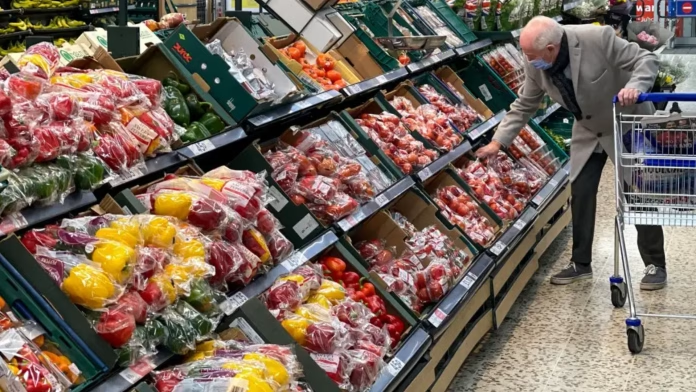
Canada considers tax measures to restore grocery price stability, warns retailers

0
shopping
(Representative Image)

Canada’s Prime Minister, Justin Trudeau, has issued a warning, indicating that taxes may be imposed if grocery retailers do not implement measures aimed at “stabilizing” food prices.

According to a document published on Trudeau’s web portal on September 14th, executives from the nation’s biggest food retailers have been summoned to a meeting in Ottawa next week to deliberate on proposed measures.

“In recent years, large grocers have been making more money, all while the cost of groceries has risen drastically and families are struggling to put food on their tables,” the document, covering the text of a speech given by the prime minister at a press conference in London, Ontario, read.

“We are also looking at all tools at our disposal, and we are not ruling out the use of tax measures, in order to restore the grocery price stability that Canadians expect.”

Canada’s government also intends to take steps to improve competition across the economy, “with a focus on the grocery sector”, it said.

Proposed changes to the Competition Act include empowering the competition regulator to intervene “in cases where significant retailers hinder smaller competitors from establishing nearby operations, resulting in diminished competition and consumer choices.”

According to Reuters, Canada’s top five food retailers, including Loblaw, Sobeys, and Metro, have been given until October 5th to develop plans aimed at stabilizing prices.

“Our government is taking concrete actions to stabilise food prices and improve competition in Canada,” François-Philippe Champagne, the minister of Innovation, Science and Industry, said in the document.

“That’s why the industry needs to step up with meaningful solutions. But that’s not all. We also need updated tools to modernise our competition environment. Our government will continue to work day-in and day-out to bring relief to consumers and increase competition.”

Sylvain Charlebois, a professor specializing in food distribution and policy at Dalhousie University in Halifax, proposed that the Canadian government draws inspiration from developments in France.

In August, France’s Finance Minister, Bruno Le Maire, engaged in two days of discussions with retailers and food producers, urging them to lower consumer goods prices. This call to action came after leaders of Carrefour and Les Mousquetaires raised concerns that inflation was causing people to reduce their spending on food.

Le Maire’s negotiations resulted in an agreement with retailers and certain manufacturers, establishing price limits and reductions on select products.

Speaking on Bloomberg Television about Canada’s proposals, Charlebois said they are “not really a signal you want to send if you want more competition and more investment into the country”.

He added: “If you want more competition, you need more players and more players who think they can make money. If you have a government putting brakes on food prices, guess what’s going to happen. Companies will sleep.”

In July, grocery inflation in Canada stood at 8.5%, showing a slight deceleration from June’s annual rate of 9.1%. However, it continues to outpace the overall headline rate for all items, which was at 3.3%, even though that had decreased from 2.8% the previous month.

Charlebois anticipates that food price hikes in Canada may decrease to approximately 5-7% by the end of the year, with the gap compared to the headline measure expected to narrow to near zero by April or May of the following year. Nevertheless, he cautioned about the potential repercussions of implementing price controls.

“If Loblaw is forced to bring down prices, it’s going to turn around and put more pressure on processors, family businesses and farmers who deal with grocers. You have to think about the entire supply chain.”

Advertisement