Monday, February 2, 2026
Home Blog Page 889

Priykant Gautam: The Visionary Behind Your Favourite Dining Experiences in India

0

When we think of restaurants as food enthusiasts or consumers, we often focus on the overall experience: the atmosphere, the mood, and everything about the location. It’s not just about the food; it’s about the entire journey. And if you’re someone with a profound passion for food, or perhaps dreaming of making your mark in the food industry, then the story of Priykant Gautam is one that will resonate with you.

Priykant Gautam’s journey begins with a vision and an unyielding passion for food. Growing up in a modest household that cherished culinary delights, Priykant’s love for food was evident from a young age. However, it wasn’t just about savoring delicious dishes; he harbored dreams of creating his culinary empire.

The Journey From 9 to 5 to a Business Tycoon:

The journey begins when this management grad who brings dreams decided to take a bold step and leave his safe 9 to 5 job and take risks. However, this journey was not a cakewalk. When Priykant decided to open up about his decision to his family, they were skeptical for the obvious reason as no one in the family belonged to the business line. However, his father stood with him as his backbone and told him to go for it. After getting the green light from his father, he decided to break the news to his friend and partner in business who was also a bit skeptical but later gave in.

And when all that was started, Priykant opened his first restaurant called the Smoke Factory in Noida. However, as Priykant describes it in an interview with Snackfax, people found it icky and felt, “What kind of name is ‘smoke factory’?” They often used to be misunderstood by the name. However, that never disappointed Priykant as he also adds, “Nothing becomes a brand in its initial stage. When people experience it, start liking it and believing it, it is at that point of time that it becomes a brand,” and that is when the road for Priykant started getting smoother and smoother.

Following the success of the Smoke Factory, Priykant went on to open Skyhouse Bar & Cafe in Noida. It’s clear that he was persistent in pursuing his passion for the food industry and creating unique dining experiences for his customers.

Hydrama in Gurgaon

Building a Restaurant Business From Scratch:

When we as consumers think of a fine dining experience, it is indeed not just about the food as it is everything that matters from ambiance to presentation and everything else. Fortunately, for us, business sharks like Priykant, know exactly what we as consumers look for!

On being asked in his interview with Snackfax about all the brands that are currently being operated by Priykant, he humbly mentions that there are around 10 locations throughout India that are handled by him, and some of these, we are pretty sure, are known by everyone, especially if one belongs to the NCR area.

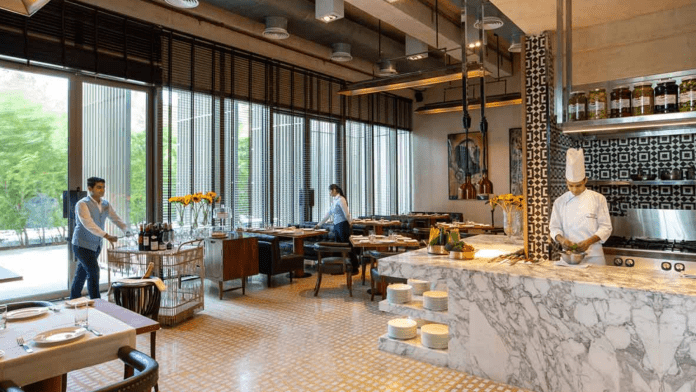
In India, Chef Harpal Singh Sokhi is a well-known figure, and his restaurant “Kaarigari: Ek Ehsaas” is equally famous. Kaarigari offers a carefully curated menu featuring dishes from renowned restaurants, all elegantly presented with Chef Sokhi’s distinctive touch. However, there’s another visionary behind Kaarigari who deserves recognition—Priyakant Gautam. He conceptualized this innovative dining experience, along with other popular establishments like PLAKA, where the head chef is the celebrity chef Ajay Chopra. Priyakant also ventured into the vibrant lounge bar scene with “High Drama” in Gurugram, showcasing his diverse interests. He even hinted at upcoming locations in Gurugram, Udaipur, and Delhi, promising a “new format” that promises to be unlike anything seen before, as he revealed in his conversation with Snackfax.

Plaka in CyberHub, Gurgaon

“Apart from that, I am also coming with chef Vicky Ratnani, along with whom I am trying to introduce a European bakery concept in India,” he reveals further that “I am also planning to come with chef Hari Naik, who is a Michelin star chef and also has a well-known restaurant in New York with a concept of an Indo-Mexican food concept.”

He is trying his hands on more innovative foods now as he is well aware of how a consumer tends to behave and about the market dynamics. “I have tried my hands on massy products, and now I am planning to try more innovative products as for the last few years customers are more into authentic foods with places with bursting environments rather than the trend before with darker places and fusion foods, hence the scenario is ideal for now, however, it is definitely going to bubble up in the coming years.”

He further adds that “There are three industries that can never go out of business as three basic needs for a human to survive, which are: 1. Roti (or food industry) 2. Kapda (fashion and clothing industry) 3. Makaan (real estate) and till the very last day of Earth these industries are gonna sustain as there is no alternative to them. 

However, people still feel it is a very risky industry and the thought process itself is that this is a scary industry to touch, and that the investment is very high, and in my experience, I can say that the consumer today is well-troubled and well-aware of what he wants to eat. Even in terms of interior, there has been evolution over the years as consumers are aware of food, the environment, and even the service process, and unless you aren’t a superhit about these three, you can’t really go anywhere and the food industry is not remotely close to how it looks on social media. They might show that they are into fusion foods but that is only for making reels there is no demand for it in the real-time market.”

Apart from that, he also talks about scalability and the target audience in his conversation with Snackfax. When it comes to scalability, Priykant says that a luxury restaurant cannot really go to a tier 2 or tier 3 city. However, if you take an example of a location like SOCIAL, where the price range is low and where people can connect socially. It is in a price range where anyone can connect with it.

Even the market sentiment in the food industry is very sunny for now as investors from around the world are pouring in so hopefully, it is all going north.

Today, Priykant Gautam stands as a testament to what determination, innovation, and a passion for one’s craft can achieve. His restaurant empire continues to expand, with a growing number of satisfied customers and culinary accolades.

Priykant’s journey serves as an inspiring example for aspiring young entrepreneurs, demonstrating that age need not be a barrier to success. His story underscores the importance of unwavering dedication, a customer-centric approach, and a willingness to adapt and innovate in the ever-evolving food biz.

Advertisement

FMCG companies to provide distributors with flexibility in selecting pack sizes for SKUs

0
FMCG
(Representative Image)

FMCG companies will provide distributors with the option to choose from a variety of Stock Keeping Units (SKUs) in different pack sizes, offering greater flexibility.

Previously, the All India Consumer Products Distributors’ Federation (AICPDF) had expressed apprehensions regarding the distribution of lower-priced SKUs specifically aimed at rural markets.

The federation, in its engagement with the Ministry of Public Distribution, has requested companies to classify their products into entry-level packs, small packs, and medium to large packs to facilitate smoother distribution.

“Currently, navigating the market is fairly difficult because every brand uses a different packaging approach, frequently adapted to certain regions and locations. For instance, some brands sell cooking oil in 12-litre cartons, while others sell it in 15- or 20-litre carton sizes. We give retailers and distributors the option to order 5-pack cartons, thus improving storage and broadening the range of products available for display and sale. This strategic initiative is designed to offer our valued retailers and distributors increased flexibility. They now have the choice of selecting multiple ranges of products but in lesser quantities, simplifying storage issues, and expanding the array of products they can showcase and provide to their customers. We are now introducing smaller packaging options for some of our best-selling items such as ike gluten-free flour and IndiMix,” said Shammi Agarwal, Director of Pansari Group.

The AICPDF had mentioned issues related to pricing confusion, inventory management, and retailers’ hesitancy as key concerns.

“The difference in per-gram pricing among the numerous SKUs within the same price bracket leads to consumer confusion,” the body said in a letter.

Companies have stated that they are sticking to standardized pack sizes, which have proven to be effective in boosting product sales.

“Packaging plays an essential role in expanding our local presence In FMCG. Right from the outset, we have maintained a commitment towards ensuring the consistency and clarity of our packaging. This thoughtful approach helps prevent any doubts related to the product’s weight and pricing. Even during the challenging times of the Covid-19 pandemic, we remained firm in our decision to retain our standard pack sizes,” said Manish Aggarwal, Director of Bikano, Bikanervala Foods Pvt Ltd.

Advertisement

Tea production drops by approximately 4% to 177.95 Million Kilograms in August

0
Tea
Tea (Representative Image)

Tea production across the country witnessed a decline of approximately four percent in August of this year, with the total output reaching 177.95 million kilograms. This marks a decrease when compared to the production volume in the same month the previous year, which amounted to 185.48 million kilograms.

Based on data from the Tea Board, tea production in northern India, mainly encompassing the states of Assam and West Bengal, declined to 158.04 million kilograms in the current month from the 170.97 million kilograms produced in August 2022.

In Assam, tea production volumes dropped to 99.78 million kilograms in August this year, down from 109.81 million kilograms in the same month of the previous year.

In West Bengal, production also saw a decrease to 53.65 million kilograms in August 2023, compared to 56.19 million kilograms in the corresponding month of the previous year.

According to sources within the tea industry, the decline in production in northern India can be attributed to adverse weather conditions and pest attacks.

On the contrary, there was an increase in production volumes in South India, reaching 19.91 million kilograms in August this year, compared to 14.51 million kilograms in the corresponding month of 2022.

Advertisement

BigBasket aims for profitability in 6-9 months, eyes IPO in 2025

0
Bigbasket
Bigbasket (Representative Image)

BigBasket, the Tata Group-owned online grocery retailer, has set its sights on achieving profitability within the next six to nine months, as stated by Co-Founder and Chief Marketing Officer Vipul Parekh.

In an interview on Monday, Parekh stated, “Our slotted grocery delivery business is profitable today. Our daily business (BB Daily) is very close to profitability. Our quick commerce business (BB Now) is some distance away from profitability but we expect it to get profitable in six to nine months. The moment the quick commerce business gets profitable which is six to nine months from now, we should be completely profitable (at the company level).”

Scaling the quick commerce or instant grocery delivery business is inherently challenging due to its characteristic low order values.

“We are not a standalone quick commerce business. We also have the daily milk business and online slotted deliveries. Since we use the same distribution centres and dark stores for all our businesses, the order volume per dark store is high which is a big advantage for us. The fixed cost per order comes down. Besides, we have private labels which lead to better gross margins,” said Parekh.

According to documents filed by the company with the Registrar of Companies (RoC) and sourced from the business intelligence platform Tofler, losses for BigBasket’s business-to-consumer (B2C) arm, Innovative Retail Concepts, surged from INR 813 crore in FY22 to INR 1,535 crore in FY23.

BigBasket is exploring the possibility of substantially expanding its offline presence.

“We are trying to figure out which is the best format for us to address the offline space,” said Parekh.

The company is mulling over the possibility of initiating preparations for an IPO in 2025.

“IPO will be a function of our profitability… I think, tentatively, 2025 is a good time to think about it,” Parekh said.

Advertisement

Lenders reject Space Mantra’s bid for Future Retail Ltd; NCLT extends insolvency period by 15 days

0
Big Bazaar
Big Bazaar (Representative Image)

The lenders of Future Retail Ltd have rejected Space Mantra’s bid for the debt-ridden firm, which is currently undergoing the Corporate Insolvency Resolution Process (CIRP). Despite Space Mantra’s efforts, their Resolution Plan for Future Retail Ltd (FRL) failed to secure the required number of votes in the e-voting process conducted by the Committee of Creditors (CoC).

It was put “for the consideration of the CoC on July 19, 2023… and pursuant to the decision taken by CoC through e-voting, concluded on 30th September 2023 at 9 PM (IST), the resolution plan submitted by Space Mantra Private Limited has not been approved by CoC”, FRL said in a regulatory filing on Monday.

It further added, “In view of the resolution plan not having been approved by the CoC, the next steps would be taken in accordance with the Insolvency & Bankruptcy Code 2016.”

Space Mantra was the single bidder for FRL. According to some media reports, Space Mantra had offered around INR 550 crore, which was very close to liquidation value. It was just 2.8 per cent of FRL’s outstanding dues of INR 19,773 crore to its financial creditors.

Moreover, in another filing FRL said that the National Company Law Tribunal (NCLT) has extended the deadline to complete the CIRP for 15 days, accepting the company’s request.

“Consequently, the last date for completion of CIRP of FRL is September 30, 2023,” it said.

This is the fourth extension granted by the Mumbai bench of FRL. Earlier, the deadline to complete CIRP of FRL was September 15, which was the third extension granted by the Mumbai bench of the National Company Law Tribunal (NCLT).

The insolvency proceedings against FRL were started by the tribunal on July 20, 2022.

The Insolvency & Bankruptcy Code (IBC) mandates the completion of CIRP within 330 days, which includes time taken during litigations.

Last week, Kishore Biyani, the erstwhile promoter of debt-ridden Future Retail, has moved the Bombay High Court against the forensic audit process of the company.

In August this year, Kishore Biyani and his brother Rakesh Biyani were asked by the Bank of India to respond to findings made in the forensic audit report by BDO, a forensic auditor appointed by the leading financial creditor of FRL.

The forensic auditor had submitted its report on August 9, 2023 and Bank of India sought representation/submissions from the company over the credit facilities availed by Biyani, which was replied by the resolution professional on August 28, 2023, FRL had said in a regulatory filing.

Advertisement

Little Moons expands further: Second factory set to open outside London as global growth continues

0
Little Moons
Little Moons

Little Moons, the UK-based mochi ice cream desserts business, is poised to open its second factory, marking its first plant outside of London.

Founded in 2010 by siblings Howard and Vivien Wong, the company has injected an undisclosed sum into the Kettering site in Northamptonshire, England. The 50,000-square-foot facility is scheduled to commence production in the first quarter of the upcoming year.

In 2020, Little Moons inaugurated a factory in Park Royal, located in the northern part of London. The company’s headquarters are situated in Farringdon, which is also within the capital city.

According to a statement, the company has expanded its range of ice cream wrapped in mochi dough treats to Australia, achieving retail sales of A$10 million ($6.4 million) since the launch in the previous autumn.

Little Moons reported a group turnover of £64.5 million ($78.6 million) for the 18 months ending on December 30, 2022, as compared to £25.5 million in the 12 months ending on June 30, 2021.

In the United Kingdom, Little Moons provides its products to major supermarkets such as Tesco, Sainsbury’s, and Morrisons. Additionally, the company has expanded its presence beyond the UK, with its products distributed by retailers in France, Germany, Austria, Switzerland, Denmark, Italy, Norway, Spain, and Croatia.

New Zealand is scheduled to join the list this coming autumn.

Last year, Little Moons entered into a minority interest sale with the US-based private-equity firm L Catterton, the details of which, including the amount and extent, were undisclosed.

According to documents submitted to Companies House in London, the company reported an adjusted EBITDA of £8.5 million over the 18 months ending in December, marking an increase from £6.9 million in the preceding 12 months.

However, the net profit declined to £1.5 million from £4.8 million.

“The UK and European ice-cream markets are very competitive and the trading environment places pressure on suppliers to deliver high-quality products at competitive prices,” the filing read.

“The business is executing a strategic programme, which includes building a new factory to expand our production capacity to satisfy growing consumer demand.

“The business will continue to focus on sales growth through deepening distribution with existing retail partners in grocery and out-of-home and expanding our presence in international markets.”

Advertisement

Meati Foods confident in achieving $1 Billion sales goal by 2025 despite slower demand for alternative proteins in the US

0
Meati Foods
Meati Foods (Representative Image)

Despite the decelerating demand for alternative-protein products in the US, Meati Foods maintains its confidence in reaching its $1 billion sales goal by 2025.

Based in Boulder, Colorado, the company has recently secured additional funding following its $150 million Series C funding round in July. They have introduced a direct-to-consumer service to complement their existing retail presence in Sprouts, Whole Foods Market, and Meijer.

Tyler Huggins, Co-Founder and CEO of Meati Foods, mentioned that the company’s assortment of mycelium-based meat alternatives, including chicken breast, breaded chicken cutlets, steak, and seasoned carne asada steak, can also be found in “several thousand foodservice establishments.”

Huggins clarified that there is no shortage of demand whatsoever, stating, “We definitely have a billion dollars worth of interest.” This comment was made in response to questions about the feasibility of the $1 billion target set by President Scott Tassani last year.

“We continue to build out our commercial platform as rapidly as we possibly can and are setting ourselves up for unprecedented growth. We’re being as aggressive as we possibly can.”

In June, Meati Foods disclosed staff reductions, although Huggins remained discreet about sharing additional details.

He countered, “We’ve set very ambitious and mission-driven goals. That path is a winding path. In the early days, it was all about speed, growth and getting to market and getting product out there in a substantial way and we’ve achieved that. We’re making difficult calls now to establish a sustainable business model.”

Huggins asserted that taste serves as the foremost factor distinguishing Meati Foods in a market experiencing a slowdown in sales growth. The co-founder, along with Justin Whiteley, who established the company in 2019, highlighted the products’ distinctive attributes, including their nutritional composition (comprising 95% to 97% mushroom root or mycelium) and their texture.

“It just shows you that the demand is there, the market is there. People want alternatives. They want diversity in their diet. It’s just got to be good tasting and it’s got to be real whole food,” he said.

“We’re not out there saying you’ve got to remove animals from the supply chain. We’re saying, yes, we believe in a regenerative, sustainable ethical food system for sure. But we also believe in diversity in our food system that includes both animals and non-animal-based products.”

Meati Foods, based in Thornton, Colorado, where it runs an expansive ‘mega ranch’ complete with in-house mycelium production, is experiencing substantial retail expansion. According to Huggins, the company’s operations are divided roughly 60-40 between brick-and-mortar retail and foodservice, reflecting its rapid growth.

“We recently launched a D2C platform, which is a great way to get product out there and see what people will like,” he said. “And then, from there, if we find one SKU works really well, we can roll that out through foodservice and retail.

The Thornton site can accommodate further manufacturing expansion and is operating at a run rate of “tens of millions of pounds of product”, Huggins explained.

“Our goal has always been impact and that requires scale. We went for it and it’s been paying off,” he added.

For now, Meati Foods remains focused on the US despite international interest with a key requisite of offering value to the consumer.

“We just provide such nutrient density. I would argue we are a great value and a great price comparison,” Huggins said when asked how the business positions on price to real meat.

“We’re a whole new category of meat that provides you with a much better nutritional profile than anything else out there in the market. And dollar to dollar, you get better nutrition.”

Meati Foods will use the new funding to try to foster further growth and expansion, along with entering new retail and foodservice partnerships. Last year, the company’s total external capital injection was $228m before the addition to the Series C financing.

“We’re definitely on a rapid ramp right now and just continue to support that growth,” Huggins said.

Advertisement

Oddlygood extends portfolio, buys Swedish vegan brand Planti from Kavli Holding

0
Planti
Planti (Representative Image)

Oddlygood, the plant-based dairy company primarily owned by Finland’s dairy powerhouse Valio, has acquired the Swedish vegan brand Planti from Kavli Holding, a Norwegian company.

The deal was completed on September 30th, with no financial specifics disclosed.

Under this agreement, Oddlygood will assume ownership of the Planti brand along with its associated intellectual property rights. Planti’s product lineup encompasses plant-based substitutes for milk, yogurt, and crème fraîche.

As a component of the acquisition, Valio has gained ownership of Planti’s manufacturing facility located in the Finnish city of Turku.

Kavli, the owner of brands such as its eponymous cheese, Korni flatbread, and Castle McLellan pâté, expressed its intention to concentrate on different product categories.

A spokesperson confirmed that the Turku factory will maintain its production of the same Planti product range.

According to the spokesperson, Valio plans to “sustain the development of Planti’s existing product lineup and intends to expand it within Oddlygood’s key markets. There are no immediate alterations planned for Planti’s product offerings.”

Valio introduced the Oddlygood brand in 2018. In May 2021, the company announced its plans to separate this business and seek a co-investment partner. By the close of the year, Mandatum Asset Management disclosed an investment of €25 million in the venture.

“Planti’s portfolio complements our existing offering and strengthens our market position, especially in spoonables and cooking,” Niko Vuorenmaa, the CEO of Oddlygood, said in a statement.

“This [deal] fits right into our strategy in which we, with the support of our owners Valio and Mandatum Asset Management, are actively pursuing opportunities to grow through acquisitions like this one.”

Oddlygood, headquartered in Helsinki, specializes in producing plant-based beverages, yogurts, baking items, and desserts. The company reported a turnover of €23.5 million ($24.6 million) in the year 2022.

Kenneth Hamnes, group CEO of Kavli Holding, said the company wanted to put its attention elsewhere. “To sell Planti is a strategic decision we have considered thoroughly, aiming to focus on other categories in our business,” Hamnes said.

“We have been waiting for the right match and buyer profile who has the capacity and ambition to develop Planti.”

In 2022, Valio, the majority owner of Oddlygood, recorded net sales of €2.24 billion, reflecting a notable 15.7% growth compared to the previous year, 2021.

The operating profit declined by 32%, amounting to €44.6 million. Valio’s net profit also saw a decrease of 28.7%, reaching €26.3 million.

Advertisement

Crisis Control 2.0: How to Safeguard Your Brand’s Reputation in the Social Media Age

0
crisis management

A brand’s reputation might be its most important asset in today’s hyper-connected world, when news travels at the speed of light and social media platforms function as the modern town square. This asset, however, is more fragile than ever before. The emergence of social media has heralded a new era in crisis management, known as Crisis Control 2.0. 

Social media platforms have democratized communication, allowing individuals and organizations alike to amplify their voices. While this presents opportunities for engagement and marketing, it also creates the potential for rapid reputation damage in the face of a crisis.

1. Preparedness is Key

The first rule of Crisis Control 2.0 is preparedness. A crisis can strike at any moment, and having a well-defined crisis management plan in place is essential. This plan should include clear roles and responsibilities, an escalation process, and predefined messaging guidelines.

2. Real-Time Monitoring

The speed at which information spreads on social media demands real-time monitoring. Brands should invest in social media listening tools to stay on top of conversations related to their products or services. Early detection of potential issues can be a game-changer in crisis management.

3. Respond with Empathy and Transparency

In the event of a crisis, how a brand responds matters immensely. Social media users expect prompt, empathetic, and transparent communication. Address the issue head-on, acknowledge any mistakes, and provide regular updates as the situation unfolds.

4. Activate Influencers and Advocates

Influencers and brand advocates can be powerful allies during a crisis. Engage with individuals who have a positive association with your brand and leverage their support to counteract negative sentiment.

5. Use Social Media for Good

Brands can use social media not only to manage crises but also to proactively contribute to social and environmental causes. Demonstrating a commitment to positive change can enhance a brand’s reputation and mitigate the impact of negative events.

6. Educate and Train Your Team

Your team should be well-versed in the protocols for handling crises on social media. Provide training on crisis communication, social media etiquette, and conflict resolution. It’s crucial that your entire organization understands its role in safeguarding the brand’s reputation.

7. Learn from Past Crises

Post-crisis analysis is vital. After the dust settles, conduct a thorough review of what went well and what could be improved. Use these lessons to refine your crisis management strategy.

8. Build Brand Resilience

Building brand resilience means cultivating a positive reputation that can withstand the occasional crisis. Consistently delivering on brand promises, providing excellent customer service, and actively engaging with your audience can all contribute to brand resilience.

In the social media age, a brand’s reputation is always on the line. Crisis Control 2.0 is about embracing the opportunities and challenges of this new era. It’s about being prepared, monitoring the digital landscape, responding with empathy and transparency, and using social media as a force for good. By following these principles, businesses can safeguard their brand’s reputation and emerge from crises with their integrity intact. Remember, in the age of social media, reputation is everything, and it’s worth every effort to protect it.

Advertisement

The Post-Purchase Journey: How to Keep Users Engaged and Delighted

0
Users Engaged

The customer journey does not finish at the moment of purchase in today’s business landscape; it is only the beginning. Keeping people engaged and satisfied after they’ve made a purchase is an important part of developing long-term connections and maintaining brand loyalty. In this article, we will look at the methods and techniques that businesses can use to guarantee that the post-purchase journey is as engaging and pleasurable as the initial purchasing experience.

Traditionally, businesses focused most of their efforts on acquiring new customers. While customer acquisition remains essential, the real game-changer is the shift towards nurturing existing customer relationships. It’s an acknowledgment that the post-purchase journey is where brands can truly shine.

1. Seamless Onboarding and Support

The moment a customer makes a purchase, the onboarding process begins. Whether it’s a physical product or a digital service, users need guidance to make the most of their purchase. Providing clear instructions, helpful resources, and readily accessible customer support sets the tone for a positive post-purchase experience.

2. Personalized Communication

Effective communication is key to maintaining engagement. Businesses can use data and insights to personalize their interactions with customers. Sending personalized recommendations, product updates, and special offers based on user preferences and behavior shows that the brand understands and values its customers.

3. Gathering Feedback and Listening

Actively seeking customer feedback and listening to their concerns can be invaluable. Not only does it help in addressing issues promptly, but it also demonstrates a commitment to improvement. Implementing feedback-driven changes and updates can enhance the user experience and foster loyalty.

4. Loyalty Programs and Rewards

Loyalty programs are a proven way to keep users engaged and coming back for more. Offering rewards, discounts, or exclusive access to loyal customers can incentivize repeat purchases and create a sense of belonging to a brand’s community.

5. Educational Content

Providing users with educational content related to their purchase can be highly beneficial. It helps users make the most of their product or service and enhances their overall experience. Whether it’s how-to guides, tutorials, or best practices, educational content adds value and fosters trust.

6. Surprises and Delights

Unexpected surprises can create memorable moments and foster delight. Brands can send handwritten thank-you notes, surprise gifts, or exclusive access to events or content. These small gestures can go a long way in deepening the emotional connection between the customer and the brand.

7. Community Building

Creating a community around your brand can be a powerful engagement strategy. Encourage customers to connect with each other, share experiences, and provide mutual support. Online forums, social media groups, or dedicated user communities can be platforms for this interaction.

8. Continual Innovation

Stagnation is the enemy of engagement. Businesses that continuously innovate and evolve their products or services keep users excited and engaged. Regularly introducing new features, updates, or even entirely new offerings can breathe fresh life into the post-purchase journey.

The post-purchase journey is an often-underestimated phase in the customer lifecycle. However, it’s where brands can truly differentiate themselves and create lasting bonds with customers. By focusing on seamless onboarding, personalization, feedback, loyalty programs, education, surprises, community-building, and innovation, businesses can ensure that their users remain engaged and delighted long after the initial purchase. In doing so, they set the stage for not just satisfied customers, but loyal brand advocates.

Advertisement