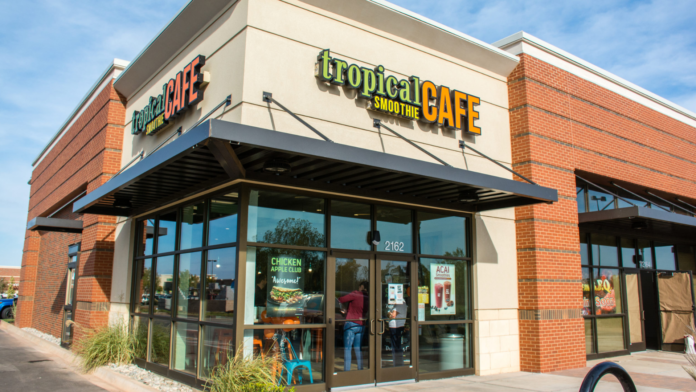
Levine Leichtman Capital Partners, a middle market private equity company, is reportedly considering the sale of the US restaurant chain Tropical Smoothie Café.
According to reports from Reuters, the prospective transaction might be assessed at $2 billion.
Levine Leichtman has appointed the investment bank Robert W Baird & Co to initiate the potential sale.
Sources, seeking anonymity due to confidentiality concerns, indicate that the sale is set to initiate as early as January 2024.
The potential valuation of Tropical Smoothie Café could reach 20 times its estimated 12-month annual earnings before interest, taxes, depreciation, and amortization (EBITDA) of $100 million.
Nevertheless, no assurance of a deal can be provided at this juncture.
Founded in 1997, Tropical Smoothie Café provides a variety of chocolate, vegetable, and fruit smoothies, along with wraps, salads, sweets, healthy bowls, flatbreads, and sandwiches.
Levine Leichtman Capital Partners acquired the brand in September 2020.
At the time of the acquisition, the US-based chain had 870 cafes.
Subsequently, Tropical Smoothie Café has expanded its presence by opening additional outlets, currently overseeing 1,335 cafés across 44 states in the US, predominantly through franchise operations.
During the third quarter of the fiscal year 2023, the Atlanta, Georgia-based chain registered positive same-store sales while persisting in its franchise expansion efforts.
Tropical Smoothie Café considered an initial public offering (IPO) in 2022, but the move was not executed after the IPO market became hostile, especially for restaurant companies.
In June 2023, the DYNE Hospitality Group, a franchisee of Tropical Smoothie Café, announced the opening of a new location in Little Rock, Arkansas.
S. Khonkaen Foods Plc, a manufacturer and distributor of processed food products, intends to allocate an investment of 300 million baht in the coming year to strengthen its operations both domestically and internationally.
Jarunpoj Rujirasopon, Chief Executive of International Business, stated that the investment would mainly focus on automating production to address the upcoming increase in the daily minimum wage. Additionally, a portion of the funds will be allocated to the company’s expansion efforts in China.
The company is in discussions with Chinese state enterprises and traders to broaden the range of products it intends to offer in the coming year, including items like fermented pork.
S. Khonkaen expects sales of 5 million yuan in the first year of operations, with the China business model set to be finalized by late next year.
Mr. Jarunpoj mentioned that S. Khonkaen also intends to bring some of its well-received products, such as meatballs and Isan-style sausages, to the US market.
In Europe, the company intends to supply its current products to Asian food service chain stores and restaurant chains, in addition to the Asian groceries it has been providing for many years.
S. Khonkaen Foods is further extending its range of seafood fish ball products into nations where hot pot cuisine enjoys popularity. The target markets encompass China, Taiwan, South Korea, Japan, Singapore, and Malaysia.
Jaraspon Rujirasopon, Chief Executive of Domestic Business, mentioned that the outlook for the pork business in the first quarter of 2024 is anticipated to enhance, given that the issue of smuggling has been resolved.
Mr. Jaraspon stated that the company intends to expand its presence in the domestic market through five strategies, which include increasing the availability of its products at traditional trade and wet markets.
Starting next year, the company’s new distribution partner plans to support growth through traditional trade, introducing new products within a price range of 10-20 baht in this segment, he said.
Furthermore, Mr. Jaraspon stated that there will be increased efforts to boost sales in wet markets by leveraging the established customer base of Mahachai Foods Co, a subsidiary of S. Khonkaen.
He expressed the company’s aspiration to attain profitability in its quick-service restaurant (QSR) business in certain months of this year. The goal is to break even during the first quarter of 2024.
To fortify the S. Khonkaen brand, the company intends to explore new product categories, boost consumer engagement, and improve the efficiency and performance of its farm through product mix management.
Through the implementation of these strategies, the company anticipates achieving double-digit revenue growth in 2024.
S. Khonkaen Foods anticipates that revenue for this year will remain unchanged compared to 2022.
For the first nine months of 2023, the company reported revenue of 2.3 billion baht, down 0.9% year-on-year, with a net profit of 42.2 million baht, a decline of 49.1%.
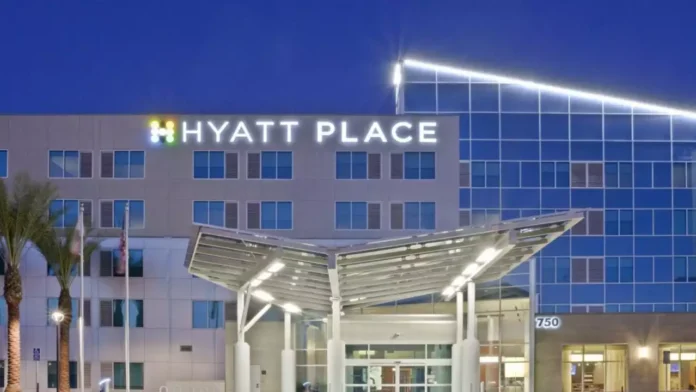
Hyatt Hotels Corporation has announced the debut of Hyatt Place Bodh Gaya, marking the entry of the Hyatt Place brand into Bihar and the ninth establishment of its kind in India.
The hotel’s minimalist design strives to create a tranquil atmosphere, and the property enjoys close proximity to renowned landmarks such as the UNESCO World Heritage site, Mahabodhi Temple, and the iconic Bodhi tree.
“The opening of Hyatt Place Bodh Gaya signifies a pivotal point in our growth plans for Hyatt brands in India. Bodh Gaya has long been a cornerstone of religious tourism, and we are delighted to foray into the spiritual capital of Buddhism. We are excited to be associated with the Saraf Hotel Enterprise and look forward to welcoming guests with an ideal hotel for their stay in the city,” said Dhruva Rathore, Vice President of Development, India & South West Asia, Hyatt.
Hyatt Place Bodh Gaya is designed to suit the contemporary traveler managing multiple responsibilities, offering rooms meticulously designed to provide vistas of the acclaimed Mahabodhi Temple. It effortlessly combines functionality with a tranquil atmosphere.
“We are delighted to introduce the second Hyatt Place hotel in the UNESCO World Heritage Site of Bodh Gaya, after Hampi. This new property, represents our eleventh hotel project with Hyatt and is a testament to our longstanding strategic collaboration for over 45 years. It is our constant endeavor to enhance the guest experience with unique offerings. And at Bodhgaya, we aim to deliver the highest standards of service excellence where our guests can find peace and tranquility in the enlightened land of the Buddha,” said Varun Saraf, Managing Director Saraf Hotels Enterprises.
Apart from its unique all-day dining establishment and The Market providing swift food options, the hotel includes a meditation room to assist guests in their wellness endeavors. Additionally, there’s a library lounge, enlightening visitors about the city’s significance and more.
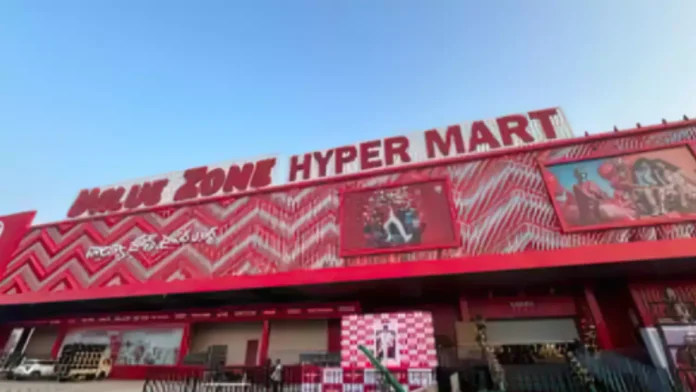
Retail chain Value Zone Hyper Mart has opened its first outlet mall in Patancheru, Hyderabad. Spanning 1 lakh sq. ft. of carpet area, the establishment is the largest outlet mall in the city, according to the company’s press release.
It was inaugurated by the actor and brand ambassador of the company, Nandamuri Balakrishna.
“Value Zone is well poised to create a new paradigm in retail. It will meet the need that’s emerging, wherein customers are seeking newer shopping formats and greater value for their spending,” said Suresh Seerna, director of Value Zone Hyper Mart.
The hypermart assures discounts of up to 70% on over 2 lakh products, encompassing a range of items such as fashion products, groceries, footwear, luggage, furnishings, stationery, mobile accessories, and more.
“Designed to enthrall, it’s spacious with well-thought-out interiors. Value Zone is a shopper’s paradise with virtually every product one can imagine. Shopping meets style, convenience meets value, and every purchase is a celebration,” said Keshav Gupta, another director of Value Zone Hyper Mart.
700 employees of Airbus Atlantic fell ill after the company hosted a Christmas dinner. The dinner, which included lobster, scallops, gone gars, and tournedos, was organized at a restaurant on-site in Montoir-de-Bretagne, western France, according to Fox News.
Health authorities in France have initiated an inquiry as 700 individuals out of the 2,600 attendees at the event exhibited “clinical signs of vomiting and/or diarrhoea” following the dinner on December 14th.
Nevertheless, the cause behind this incident has not been determined as of now.
Nowlenn, a staff member affected by the illness, characterized the ailment as distressingly painful. Nowlenn said, “I had colic and headaches like I’d never had before. It was worse than giving birth.”
A spokesperson from Airbus Atlantic conveyed that nobody was “seriously ill.”
Jean-Claude Iribarren, the secretary of the works committee, said that the food was cooked by the company’s canteen.
Irubarren stated, “People have been a little hasty about the causes. We are obliged to keep samples of every product served in the restaurant. They will be analysed by the ARS. The investigation will take several more days.”
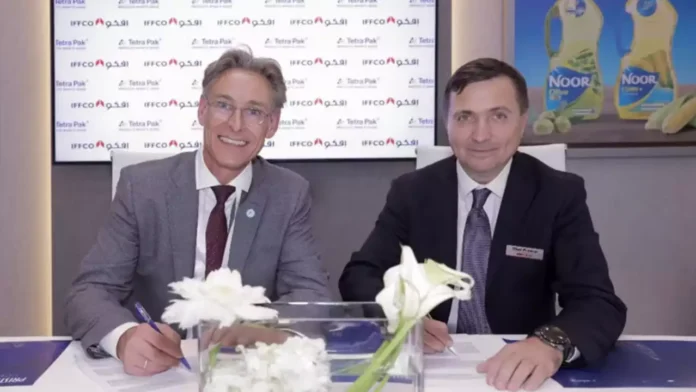
The IFFCO Group, as part of its strategic plans based on Environmental, Social, and Governance (ESG) principles in the Kingdom of Saudi Arabia, has signed a Memorandum of Understanding (MoU) with Tetra Pak. Tetra Pak, a leading global company in food processing and packaging solutions, is set to boost the momentum of sustainability initiatives within the manufacturing facilities of the IFFCO Group.
This groundbreaking collaboration between IFFCO, the UAE-based multinational FMCG group, and the renowned multinational entrepreneurial organization Tetra Pak establishes a strategic alliance. This alliance aims to uphold global standards through state-of-the-art practices and technologies, with the overarching goal of minimizing the group’s environmental impact.
IFFCO is expanding its operations in the Kingdom by constructing a cutting-edge factory equipped with the latest technology. The goal is to produce sustainable, high-quality, and delicious products locally, thereby adding value to the Saudi Arabian economy. Additionally, the initiative contributes to waste reduction, lower emissions, and adherence to green industry protocols. The factory’s initial focus will be on producing culinary creams, and a formal Memorandum of Understanding (MoU) with Tetra Pak has been established to ensure maximum efficiency without compromising on quality or food safety.
Rizwan Ahmed, executive director of IFFCO Group, explained that the KSA facility comes as a natural follow up to the group’s embedded ESG ethos, which is the principle driving force behind the group’s journey towards sustainability, saying, “IFFCO has since the very beginning, committed to a mission to manufacturing and marketing a well-integrated portfolio of FMCG food products that satisfy taste, quality and consumer demand without undermining our ethical values and commitments to eco-awareness throughout all processes and practices.”
“By working with the global expert Tetra Pak, we are actively contributing to ensuring sustainability at the plant, enhancing reliability, package recyclability, energy efficiency, and waste reduction, employing local skilled personnel and underpinning the country’s economic growth and future ambitions while strengthening IFFCO’s standing in the region as an advocate for change, reducing reliance on fossil fuels, and lowering our carbon footprint.”
Niels Hougaard, managing director at Tetra Pak Arabia Area said, “We are thrilled to partner with IFFCO in this impactful project in Saudi Arabia, reflecting our commitment to protecting people, food, and the planet. Together, we introduce advanced equipment and processes that reduce waste, enhance recyclability, and lower CO2 emissions. Our innovation prioritizes water efficiency, recycling and reusing processed water, with state-of-the-art and energy-efficient equipment. Every package tells a story, and we eagerly support IFFCO’s leading role in the GCC.”
IFFCO has put in place a comprehensive set of sustainability measures aimed at reducing the group’s environmental footprint. The approach is holistic, encompassing various aspects. Additionally, the group fosters partnerships with local suppliers and third-party entities, encouraging them to embrace and adopt sustainable practices as well.
The IFFCO group has recently published its report on Environment, Sustainability, and Governance (ESG). This report underscores the group’s dedication to sustainability goals, implementing sustainable practices throughout its operations and value chains. This signifies a crucial stride towards embracing genuinely sustainable changes in the food system. The group’s agenda of “Investing in the Future” aims to reduce greenhouse gas emissions, advance efforts towards net-zero targets, decrease waste generation, utilise packaging with a lower environmental impact, and address water scarcity.
SoftBank Vision Fund, the largest shareholder in IPO-bound omnichannel retailer FirstCry, has divested more shares, opening the door for additional family offices and individuals to acquire a stake in the firm.
The family offices of Indian cricketer Sachin Tendulkar, Ravi Modi from the ethnic wear brand Manyavar, Kris Gopalakrishnan, the co-founder of Infosys, and the TVS group family are reportedly among the investors acquiring shares in the company, according to knowledgeable sources.
This brings the cumulative value of the secondary share sale for FirstCry, leading up to next year’s anticipated public listing, to over INR 1,000 crore.
Out of the overall amount, SoftBank has reportedly divested shares worth approximately INR 600 crore, reducing its ownership in the company to below 25%, according to individuals familiar with the matter. The technology investor, led by Masayoshi Son, has gradually decreased its stake from around 29-30% over the past couple of years. On December 19, it was reported that FirstCry is poised to submit its draft IPO papers soon. The company is targeting a fundraising goal of $500-600 million through its upcoming public offering.
On August 21, it was reported that shares of FirstCry were acquired by three family offices: Ranjan Pai from Manipal Group, Sharrp Ventures, the investment office of Harsh Mariwala from Marico, and the DSP family office belonging to Hemendra Kothari.
Sources familiar with the matter indicate that SoftBank has invested approximately $400 million in the firm and has already garnered close to $300 million in returns. SoftBank’s first investment in FirstCry took place in 2020.
“The remaining stake could still be valued at $1 billion if it lists at a valuation of $ 4 billion or more,” a person aware of the matter said.
While FirstCry has not officially disclosed its IPO valuation, insiders suggest that it might fall within the $4 billion range. In its latest valuation, the company was appraised at just under $3 billion.
FirstCry and SoftBank declined to comment.
In a secondary share sale, current investors sell all or part of their holdings to new investors, and the proceeds do not contribute to the company’s funds. In contrast, a primary share sale involves issuing new shares, enabling the company to raise capital. FirstCry’s anticipated $500 million IPO is projected to include 35-37% of the offer through a primary share sale, with the remaining portion allocated to the secondary sale, also known as an offer for sale (OFS).
The newly acquired investors are becoming part of FirstCry’s capital table, alongside existing entities such as Premji Invest, the family office of Wipro founder Azim Premji, the Mahindra group, and other stakeholders.
Following Nykaa’s IPO in 2021, FirstCry is set to become the second Indian vertical e-commerce platform to go public. Headquartered in Pune, the company specializes in retailing products catering to children and mothers through both online and offline channels. With a nearing milestone of 1,000 retail stores in India, FirstCry also operates a subsidiary, Globalbees, focused on e-commerce consolidation.
FirstCry was established in 2010 by Supam Maheshwari, Sanket Hattimattur, Amitava Saha, and Prashant Jadhav. Maheshwari and Hattimattur serve on the company’s board, while Saha oversees Xpressbees, a logistics firm that originated from the e-commerce company. Nitin Agarwal holds the position of Chief Executive at Globalbees.
Around 75,000 merchants experienced growth in the double digits, while more than 20,000 sellers saw a tenfold increase in their business on Meesho, the ecommerce platform backed by Softbank, as reported on Sunday.
Meesho reported a profit for the current year and claims to have maintained profitability since it first reported its performance in July.
The company claimed that nearly 10,000 Meesho sellers crossed the INR 1 crore sales mark and 130,000 registered sales of over INR 1 lakh during 2023. Around “60% of these sellers come from small towns like Avinashi, Bharuch, Fiazabad and Silchar”, Meesho said.
Meesho mentioned that it added around 7 lakh new sellers this year, bringing the total number to 1.5 million.
The company documented transactions for 14 crore customers and asserted that almost 80% of the orders originated from tier-2 and smaller markets.
Meesho said it recorded a unique pattern of customers placing maximum orders on Sunday.
“Indian shoppers have consistently crowned Sundays as the ultimate shopping day for two consecutive years, beginning with an early bird rush at 7 AM and culminating in the wee hours at 3 AM,” the statement said.
A customer from Surat placed over 20,000 orders for artificial jewellery, the highest on an individual basis, and continues to shop on the platform.
“More than 6.7 million customers turned to Meesho to shop for hair fall control remedies. As awareness around self-care deepens, there is a discernible shift in consumer habits, with ceauty & personal care witnessing a 40% surge in growth,” the statement said.
A Mumbai resident claims that a dish he ordered from the city’s iconic Leopold Café via Swiggy came with a small strip of tablets inside it, sharing pictures of the same.
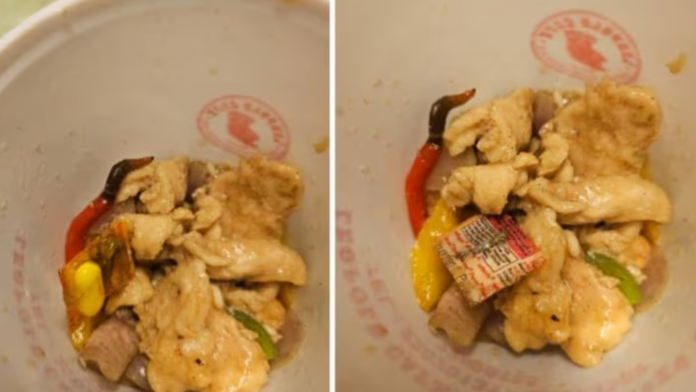
“My Mumbai Christmas Surprise ordered food from Swiggy from Leopold Colaba got this half cooked medicine in my food,” Ujwal Puri wrote on X (formerly Twitter), sharing photos and a video of a medicine strip in a plastic container of a chicken dish, with one tablet still inside it.
Leopold Cafe, located in Colaba, Mumbai, was among the first places targeted by terrorists during the 2008 Mumbai terror attacks. Ten people, including foreigners, were killed, and several others were injured. The café has preserved the bullet marks on its walls and windows, serving as a reminder of the attacks.
The upcoming general elections and a subsequent decrease in inflation are expected to boost consumer demand across various sectors, ranging from groceries to apparel to electronics, from March-April onwards. Chief executives of several prominent companies have noted that rural markets and products in the mass segment are already displaying indications of recovery.
Consumer goods companies had previously anticipated a recovery in demand during the December quarter. Although that anticipation hasn’t materialized, chief executives have stated that the slowdown in consumption has come to a halt. They further noted that sales of mass-segment products are now picking up after a gap of over three years.
“While green shoots of recovery are visible in rural India, the demand growth is still trailing urban markets,” Dabur India chief executive Mohit Malhotra said. “We are hopeful rural markets will post a strong recovery in the new year. We are already seeing the gap between rural and urban growth shrinking.”
Malhotra said that in 2023, urban markets have been the main contributors to growth, with modern trade and e-commerce taking the lead.
Neeraj Khatri, the Chief Executive of Wipro Consumer Care, responsible for the India business and the maker of Santoor soap, mentioned that there are signs of improvement in rural demand, and consumer confidence is on the rise each quarter.
“Price-led growth has tapered off in the industry and volumes are driving growth,” he said. “This should put industry on a better pedestal next year. Monsoon has been decent, so is government spending. It’s also time for rural people to come out from the debt (they had to avail) during Covid.”
Market researcher NielsenIQ reports that while volume growth for the fast-moving consumer goods (FMCG) industry in urban India has been on a positive trajectory since April-June last year, rural markets have experienced marginal growth this calendar year.
During the September quarter, urban markets exhibited a year-on-year growth of 10.2%, whereas rural markets grew by 6.4%, according to the report. Before the onset of the Covid-19 pandemic, rural markets were the primary drivers of overall growth, expanding at twice the rate of urban markets.
However, the demand has slowed down in the current quarter.
Mayank Shah, senior category head at Parle Products, a biscuits maker, mentioned that volumes remained stagnant in November-December, with only slight growth in value sales.
However, he anticipates a revival in the next quarter. “With elections around the corner, overall spending in the economy tends to increase. This should contribute to the revival, and we expect volumes to grow at a high single-digit rate in the next quarter,” Shah said.
Lalit Agarwal, CEO of V-Mart Retail, a retail chain with a focus on rural markets, also noted the presence of signs indicating an improvement in rural demand, despite ongoing challenges such as inflation and unemployment.
“But full recovery is expected around April-June, led by elections when rural economic activities get a boost,” he said.
Earlier this month, the Reserve Bank of India revised the GDP growth forecast for FY24 to 7%, up from the earlier estimate of 6.5%, citing a stronger-than-expected performance in the July-September quarter.
Corporate honchos also anticipate an increase in discretionary spending across various segments by the time of the elections.
“The general elections and increased government spending before that will put more money into the hands of consumers, boosting discretionary spending,” said Devaranjan Iyer, CEO of departmental store chain Lifestyle International. “Also, by then, we expect the huge spends on experience such as leisure and travel will normalise and consumers will shift their spending from buying experience to products,” he said.
Iyer anticipates a resurgence in discretionary demand, such as apparel, by May-June. He mentioned that in the October-December quarter, same-store sales were either flat or slightly negative.
Sales of both apparel and electronic products have been stagnant for more than a year, while those of mass-segment electronic products have remained subdued since the outbreak of the pandemic.
As per the research by GfK, there was a minor upturn in the mass segment during Diwali.
Industry executives said it continued even in December, buoyed by wedding-led demand in the Hindi heartland.
Kamal Nandi, the business head of Godrej Appliances, stated that market sentiments in December are undoubtedly more positive than last year, with a growth of 10-15% across various categories, including a noticeable pick-up in the mass segment.
“We expect demand should revive from April onwards due to elections, summer and more agricultural income,” he said.
Tarun Pathak, director at smartphone tracker Counterpoint Research, anticipates a general rebound in mobile phone sales as the prices of 5G phones continue to decrease and enter lower pricing tiers.
During the festive season, some positive signs were already apparent when brand-driven price drops boosted the sub-INR 12,000 segment, which had been severely affected for the last several quarters, he mentioned.
India witnessed a 9% year-on-year decline in smartphone shipments, amounting to 152 million units in 2022, according to Counterpoint. The projections for 2023 indicate an expected figure of 150 million units.
We use cookies to ensure that we give you the best experience on our website. If you continue to use this site we will assume that you are happy with it.