Monday, December 22, 2025
Home Blog Page 42

Ex-Sequoia India investor Shubham Poddar raises $3M for Amaani; Arab beauty brand AÏZA crosses $2M revenue in debut year

0

Amaani, a consumer startup rooted in Middle Eastern beauty and wellness traditions, has raised $3 million in seed funding to build its debut brand, AÏZA. The round was led by Peak XV’s Surge, earlier known as Sequoia Capital India & SEA, marking its first consumer and seed-stage investment in the MENA region.

Amaani was founded by Shubham Poddar, a former Sequoia India investor who played a key role in expanding the firm’s presence in the Middle East across fintech, foodtech and proptech. With AÏZA, Poddar has set out to create a modern Arab beauty label that blends regional heritage with advanced global formulations.

Launched online in May 2025, AÏZA draws on ingredients deeply tied to Arab culture, including dates, black seed, and bakhoor, while incorporating clinical actives developed in labs across Korea, Japan and Italy. Among its first products are Sukkar Rush, a lip treatment infused with date and honey; Scent Storm, a bakhoor and rose hair mist; and Date Setter, a brow and lash serum using date seed and castor oil.

The brand has already recorded more than $2 million in annualised revenue, buoyed by early traction in the UAE and Saudi Arabia, two of the world’s highest-spending beauty markets. “For decades, the Middle East has powered global brands. The world is now looking here for innovation,” said Poddar.

Industry data highlights the opportunity. The GCC beauty and personal care market is estimated at $12 billion and expanding at over 12 percent annually, according to Peak XV Managing Director GV Ravishankar. With rising digital penetration and growing demand for locally resonant products, Amaani plans to scale AÏZA regionally and globally while building a wider portfolio of brands inspired by Modern Arabia.

Advertisement

Ibrahim Ali Khan Joins Wrogn: Aditya Birla’s Youth Brand Kicks Off ‘Wrogn. But Real.’ Campaign to Woo 150M+ Gen Z and Millennials in India

0

Youth fashion brand Wrogn, part of Aditya Birla’s TMRW portfolio, has launched its latest nationwide campaign featuring Bollywood actor Ibrahim Ali Khan. Titled “Wrogn. But Real.”, the initiative focuses on encouraging young Indians to embrace individuality and imperfections in a culture often defined by polished appearances and constant pressure to perform.

The campaign film, released across digital and retail platforms, positions authenticity as the new marker of style. In the film, Khan delivers a pointed message that resonates with India’s Gen Z and millennials: perfection is overvalued, and real confidence comes from being unapologetically oneself.

Since its launch in 2014, Wrogn has carved out a distinct space in India’s fast-fashion market by appealing to young shoppers with its bold designs and unorthodox messaging. With “Wrogn. But Real.”, the brand is building on that ethos, aiming to further strengthen its connection with urban youth who increasingly seek brands that stand for values beyond clothing.

Anjana and Vikram Reddy, co-founders of Wrogn, said the campaign reflects the brand’s core philosophy of courage, authenticity and freedom of expression. “Young people today face tremendous pressure to fit in. Through this campaign, we want to remind them that style is not about conforming but about celebrating what makes you unique,” they noted.

For Ibrahim Ali Khan, who has quickly emerged as a youth icon, the association is personal. “Wrogn doesn’t try to put you in a box. It’s real, raw and imperfect, which is exactly how I view fashion. This campaign is about being effortless and unfiltered,” he said.

The campaign will be visible across digital, social media and retail touchpoints nationwide, reinforcing Wrogn’s position as one of India’s most influential youth-centric fashion brands.

Advertisement

Sourav Ganguly Teams Up with Myntra to Launch ‘Souragya’; Brand Debuts with 100 Styles Ahead of Festive Season as India’s Ethnic Wear Market Eyes $558 Billion by 2033

0

Former Indian cricket captain Sourav Ganguly has taken his first formal stride into the fashion business with the launch of “Souragya,” a premium ethnic wear brand created in collaboration with Myntra. The line debuts just ahead of Durga Puja and Diwali, festivals that typically fuel a sharp rise in apparel sales.

The brand will launch with close to 100 styles, available exclusively on Myntra’s app and website. The debut collection combines Bengal’s craft traditions with contemporary tailoring, featuring Kantha embroidery, Tant and Jamdani weaves, and Batik prints. Signature designs include kurta–dhoti sets, sherwanis paired with churidars, and kurta ensembles for festive occasions.

“This brand is about celebrating our heritage while presenting it in a way that resonates with today’s fashion-forward generation,” Ganguly said at the launch. “Myntra’s expertise has been vital in bringing this vision to life, ensuring Souragya blends timeless Indian design with accessibility and versatility.”

The timing reflects both cultural and commercial opportunity. India’s apparel market, valued at US$102.8 billion in 2022, is projected to touch US$146.3 billion by 2032, according to India Brand Equity Foundation. Within that, ethnic wear is among the fastest-growing categories. Business Research Insights estimates the segment at US$197.2 billion in 2024, with forecasts of US$558.5 billion by 2033, implying a compound annual growth rate of 12.6 percent.

Myntra, through its wholesale arm Myntra Jabong India, sees Souragya as a strategic addition to its House of Brands portfolio. “With the festive season beginning, Souragya offers customers an elevated take on ethnic fashion rooted in Bengal’s artistry,” said Suman Saha, CXO and Head of House of Brands.

For Ganguly, who redefined Indian cricket through leadership, this marks a fresh innings in entrepreneurship, positioning his cultural roots at the heart of a growing fashion market.

Advertisement

“MTR Maker Orkla India Cleared for Market Debut: 22.8 Million Shares to Hit Street in Rs 5,000 Crore IPO, Entire Stake Sale by Norway’s Orkla ASA”

0

Orkla India Limited, the company behind household food brand MTR, has secured the green light from the Securities and Exchange Board of India (SEBI) to launch its initial public offering. The filing shows the IPO will be a complete offer for sale of 22,843,004 equity shares by its Norwegian promoter group. The selling shareholders include Orkla ASA, Orkla Asia Holding, and Orkla Asia Pacific Pte. Ltd.

Although pricing details are yet to be announced, investment banking sources said the public issue could raise between Rs 4,000 crore and Rs 5,000 crore, depending on final valuations and investor appetite. If it meets those estimates, it would mark one of the largest IPOs in India’s packaged food space in recent years.

Headquartered in Bengaluru, Orkla India has steadily expanded its portfolio beyond traditional packaged spices and ready mixes. Under the MTR Foods label, the company now operates across multiple categories, including blended and pure spices, breakfast mixes, ready-to-cook meal kits, and ready-to-eat packaged foods. MTR traces its origins back to 1924 as a small restaurant in Bengaluru before being acquired by Norway’s Orkla ASA in 2007, which helped transform it into a national packaged food powerhouse.

The proposed listing comes at a time when India’s packaged food market is witnessing accelerated growth. Industry estimates project the sector to expand at a compound annual growth rate of nearly 9 percent, driven by rising urban incomes, demand for convenience foods, and deeper penetration into Tier-II and Tier-III cities. Analysts say the IPO will test investor appetite for consumer food companies in a crowded but rapidly growing market.

Advertisement

From mugs to cushions in half an hour: Tarun Joshi’s IGP deploys personalisation tech to disrupt India’s $65 bn gifting industry

0

Online gifting company IGP has unveiled a hyperlocal model that promises to deliver personalised products in just 30 minutes across more than 30 cities, in what could be a turning point for India’s rapidly growing direct-to-consumer gifting market.

The initiative is powered by the deployment of compact personalisation machines in IGP’s network of dark stores, a move designed to cut production times and reduce reliance on centralised warehouses. By embedding production closer to the customer, the company aims to combine speed, scale, and customisation.

According to the company, the new format enables delivery of over 250 types of personalised products – including mugs, cushions, keychains, stationery and home décor items – within half an hour. A wider catalogue of more than 600 products can be fulfilled on the same day.

“The gifting industry has always wrestled with the trade-off between thoughtfulness and speed. We have combined technology, logistics, and creativity to make personalisation as fast as it is meaningful, because emotions shouldn’t have to wait,” said Tarun Joshi, Founder and Chief Executive Officer of IGP.

India’s online gifting segment has witnessed accelerated growth in the last five years, driven by increased internet penetration, a culture of instant gratification, and rising demand for personalised experiences. Industry estimates place the Indian gifting market at over USD 65 billion, with personalised gifting accounting for nearly a fifth of this demand.

By introducing rapid delivery for custom products, IGP is betting on differentiation in a crowded market that includes players like Ferns N Petals and Archies, as well as e-commerce giants Amazon and Flipkart. The company believes the new model could set new benchmarks for customer expectations in time-sensitive occasions such as birthdays, festivals, and anniversaries.

Advertisement

Pizza Hut India Elevates Manish Guptaa to CMO; To Drive Value Deals, Innovation and Gen Z Campaigns While Retaining Tech Mandate

0

Pizza Hut India, part of Yum! Brands, has appointed Manish Guptaa as its new Chief Marketing Officer (CMO), handing him the responsibility of steering the brand’s marketing and consumer strategy at a time when competition in the quick service restaurant (QSR) segment is intensifying.

Guptaa, who has been with the company since 2019, was previously serving as Chief Digital and Technology Officer. While he takes charge of marketing, he will continue to manage the technology and digital portfolio until a successor is identified.

His new mandate includes expanding Pizza Hut’s value-led offerings, launching product innovations tailored for Indian consumers, and building sharper campaigns aimed at younger audiences such as millennials and Gen Z. The company said Guptaa will also focus on enhancing cultural relevance and shaping the brand’s next phase of growth in one of the world’s fastest-growing food service markets.

Rohan Pewekar, Managing Director, Pizza Hut Indian Subcontinent, said the company is confident that Guptaa’s leadership will further strengthen the brand’s position in India. “We are excited to see him take on the role of CMO and build on our ambition of being the first choice for today’s consumers,” he added.

During his tenure at Pizza Hut, Guptaa has overseen several digital-first initiatives. These include scaling the brand’s online commerce operations, building a performance marketing engine, and embedding data-driven insights into decision-making. The company noted that these efforts helped accelerate customer acquisition and deepen loyalty.

Pizza Hut operates more than 800 restaurants across India. With the QSR market projected to cross 1.5 trillion rupees by 2026, the company is betting on Guptaa’s combined expertise in technology and marketing to sharpen its competitive edge.

Advertisement

Palm Oil Flows Into India at 13-Month High as Imports Touch 990,528 Tons in August; Sunflower Oil Gains, Soyoil Slides, Canola Oil Returns After 5 Years

0

India’s palm oil imports soared in August to their highest in more than a year, as refiners rushed to secure supplies ahead of the festive season, lured by palm oil’s price advantage over soyoil. The rise is expected to ease excess stockpiles in Indonesia and Malaysia, the world’s top producers.

According to data released by the Solvent Extractors’ Association of India (SEA) on Monday, palm oil shipments into the country rose nearly 16% month-on-month to 990,528 metric tons, marking the highest level since July 2024.

The surge came at the expense of soyoil, with imports of the soft oil plunging 25% to 367,917 tons, the lowest in four months. Sunflower oil, however, staged a strong rebound, with imports climbing 28.5% to 257,080 tons — a seven-month peak.

In a notable development, India also imported 6,000 tons of canola oil in August, its first significant purchase of the commodity in nearly five years.

Overall edible oil imports rose 4.7% month-on-month to 1.62 million tons, also the highest since July 2024. The SEA noted that refiners have stepped up stocking to meet expected demand spikes during the September–November festive window, when consumption of fried foods and sweets rises sharply.

India, the world’s largest importer of vegetable oils, sources palm oil mainly from Indonesia and Malaysia, while soyoil comes from Argentina and Brazil, and sunflower oil largely from Russia and Ukraine.

Trade sources estimate that palm oil imports will remain above 800,000 tons in September as festive demand peaks. SEA data also showed that India imported 589,283 tons of duty-free edible oils from Nepal between November 2024 and July 2025, under a regional trade pact.

Advertisement

India’s Luggage Market to Hit Rs 267 Billion by 2028: VIP, Samsonite, Safari Race Ahead as Weddings and Travel Fuel 12% CAGR

0

India’s luggage market is on a strong growth trajectory, projected to expand at a compound annual growth rate (CAGR) of 12 percent over the next four years to touch Rs 267 billion by 2028, according to a new report by Motilal Oswal Financial Services.

The sector, which had contracted to Rs 60 billion during the pandemic in 2020, has staged a sharp recovery, clocking a 37 percent CAGR between 2020 and 2023. Analysts link this rebound to a surge in air and rail travel, coupled with an uptick in weddings and destination ceremonies where luggage plays a key role in gifting and trousseau purchases. The wedding-heavy November–December 2024 period alone witnessed more than 4.8 million ceremonies, adding significantly to sales.

Branded players, currently holding 52 percent of the market, are expected to outpace industry growth as consumers shift away from unbranded goods toward more durable, stylish, and premium luggage. Three major companies—VIP, Samsonite, and Safari—already account for about one-third of the total market.

The mass segment, priced under Rs 4,000, dominates with a 60 percent share valued at Rs 102 billion. Safari leads this category with 16 percent, followed by Aristocrat and Kamiliant. The mid-tier, comprising 30 percent of the market, is driven by VIP (21 percent through VIP and Skybags) and American Tourister (17 percent), both targeting value-conscious urban buyers through omnichannel presence and curated ranges.

The premium end, making up around 10 percent, is growing rapidly with Samsonite holding 20 percent and Carlton 8 percent, buoyed by international travel demand. Digital-first direct-to-consumer labels are also gaining traction, especially among younger consumers drawn to minimalist design and influencer-led marketing.

Advertisement

Little Spoon Aims for $150M Revenue in 2025: How Ben Lewis and Angela Vranich Built America’s 1 Kids’ Food Brand Without Retail

0

Little Spoon, the largest direct-to-consumer baby and kids’ food company in the United States, is on track to cross $150 million in net revenue this year, according to company executives. The milestone comes less than a decade after its founding and just a year after turning profitable in 2024.

Launched in 2017 by Ben Lewis and Angela Vranich, Little Spoon carved out a strong position in the crowded food market by targeting a niche often overlooked by big packaged food companies: clean, convenient, and nutritionally balanced meals for children. The company’s portfolio spans baby blends, toddler meals, snacks, and vitamins, with each product designed around rigorous sourcing standards and ingredient transparency.

Industry analysts point out that the brand’s success is striking not only because of its scale, but also because it has achieved nine-figure revenues without entering physical retail. While most packaged food companies rely on grocery distribution to drive volume, Little Spoon has grown entirely through its online subscription model, serving families across the country.

Executives attribute this growth to shifting consumer preferences among millennial and Gen Z parents, who have shown a greater willingness to pay a premium for fresh, minimally processed meals delivered directly to their doors. Since launch, the company has shipped tens of millions of meals and built one of the largest digital communities of parents in the United States.

With profitability secured and revenue scaling at double-digit rates, industry observers suggest Little Spoon could soon explore international expansion or strategic partnerships. For now, its ability to disrupt a traditionally retail-heavy category with a direct-to-consumer model has made it one of the most closely watched food startups in the country.

Advertisement

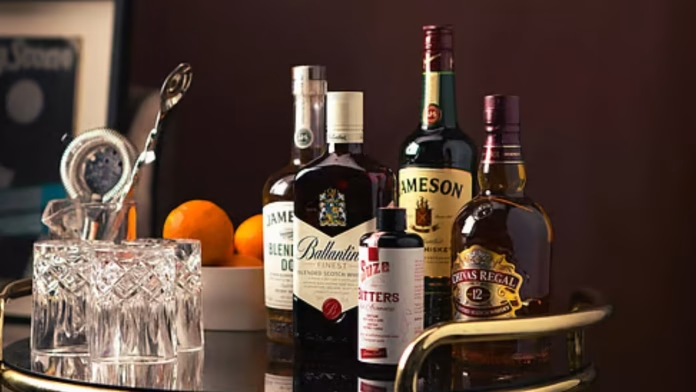
Gen Z Tips the Glass Differently: 1 in 4 Indians Now Prefers No/Low Alcohol; Startups like Sober & Catwalk Botanicals Join UB, Diageo in Chasing Metro Demand

0

India’s youngest consumers are reshaping the country’s drinking culture, steering demand toward no-alcohol and low-alcohol beverages. A recent NielsenIQ study shows that 24% of Indian consumers now opt for such alternatives, well above the global average of 17%. More than half of this segment is made up of millennials and Gen Z, making India the second-largest market for these drinks in Asia-Pacific after the Philippines.

The trend is most pronounced in metros where bars are moving beyond colas and virgin mojitos to offer sophisticated non-alcoholic cocktails. Industry leaders say this reflects a broader health and moderation shift. Vikram Bahl, chief marketing officer at United Breweries, said urban professionals and young consumers increasingly want inclusivity and balance without giving up the taste of beer. United Breweries’ latest report notes investments in alcohol-free innovation aimed at metro markets.

Diageo India is also tracking the space closely. Its CMO, Ruchira Jaitley, said Gen Z is adopting what she calls “zebra striping,” alternating between alcoholic and non-alcoholic drinks, and leaning toward cocktails and premium categories. Diageo recently bought a 15% stake in V9 Beverages, parent of non-alcoholic spirits brand Sober.

Local startups are riding the wave. Aditya Agarwal, founder of Sober, said non-alcoholic whiskey is the fastest mover, reflecting whiskey’s dominance as India’s most consumed spirit. Catwalk Botanicals’ Ishan Arora estimates the non-alcoholic segment remains a fraction of India’s premium alcohol market, which itself accounts for 8–9% of the country’s $42 billion alcobev industry.

Cultural observers believe the shift is as social as it is health-driven. Santosh Desai noted that younger consumers want the buzz and social ease of alcohol without its risks. Spencer’s Retail vice-chairman Shashwat Goenka added that Gen Z is drinking to stand out, unlike millennials who drank to blend in.

Advertisement