Friday, December 19, 2025
Home Blog Page 40

GST for Home Businesses: Do You Really Need It? Rules Every Entrepreneur Must Know

0

With India’s booming startup culture, many entrepreneurs are starting from their homes—whether it’s selling packaged food, running a cloud kitchen, crafting handmade goods, or offering services online. But one question keeps popping up: “Can I register for GST if my business is home-based?”

The answer is yes. The Goods and Services Tax (GST) doesn’t care if your office is a corporate tower or a spare bedroom. What matters is your annual turnover and the nature of your business.

When Is GST Registration Mandatory for Home Businesses?

GST registration depends on turnover thresholds:

  • ₹40 lakh (goods) – If you sell products and your annual turnover exceeds ₹40 lakh, GST registration is mandatory.
  • ₹20 lakh (services) – If you provide services and your turnover crosses ₹20 lakh, GST applies.
  • Special category states – In states like Assam, Manipur, or Nagaland, the threshold is lower (₹20 lakh for goods, ₹10 lakh for services).
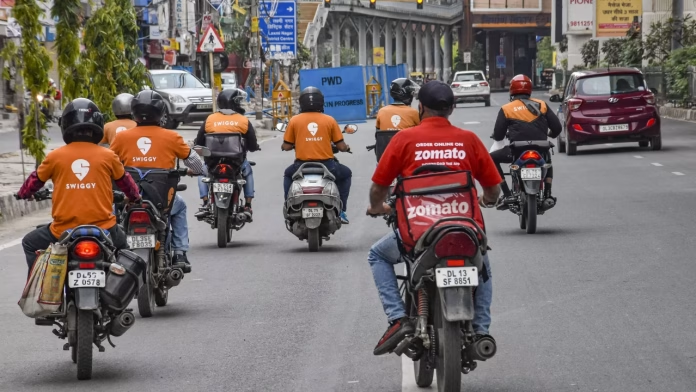
  • E-commerce sales – If you sell on platforms like Amazon, Flipkart, or Swiggy/Zomato, you need GST from day one, regardless of turnover.

Benefits of GST for Home-Based Entrepreneurs

Even if your turnover is below the threshold, voluntary GST registration can bring big advantages:

  • Sell on e-commerce platforms: Amazon, Flipkart, and Meesho require a GST number to onboard sellers.
  • Build customer trust: A GST invoice looks more professional and transparent.
  • Claim input tax credit: If you buy raw materials, packaging, or marketing services, GST registration allows you to offset taxes paid.
  • Expand easily: If your business scales, you won’t face compliance delays later.

Documents Needed for GST Registration at Home

Registering a home-based business is straightforward. You’ll need:

  • PAN card of the business owner
  • Aadhaar card
  • Address proof of the home premises (like electricity bill or rental agreement)
  • Bank account details
  • Passport-size photo

Yes—your home address can be your business address for GST registration.

Practical Examples

  • A home baker in Delhi selling cakes worth ₹8 lakh a year doesn’t need GST—unless she lists on Swiggy/Zomato.
  • A graphic designer earning ₹25 lakh a year from freelance clients must register under GST since the service threshold is ₹20 lakh.
  • A soap-maker selling on Instagram and Amazon must get GST, even if sales are just ₹5 lakh, because e-commerce mandates it.

The Bottom Line

So, can you have GST for a home-based business? Absolutely. Whether it’s mandatory or voluntary depends on turnover and selling channels. For small entrepreneurs, GST might look like a burden, but it can also unlock growth opportunities—from e-commerce sales to claiming tax credits.

Advertisement

Can You Claim GST Input Credit on Restaurant Bills? Here’s the Truth Businesses Need to Know

0

Since the Goods and Services Tax (GST) rolled out in India, one of the most common queries from business owners has been: “If I get a GST bill from a restaurant, can I claim input tax credit (ITC)?” The answer isn’t as straightforward as many assume, and it depends heavily on your type of business and how you use that expense.

The Rule: ITC on Restaurant Bills is Mostly Blocked

Under Section 17(5) of the CGST Act, ITC on food, beverages, and restaurant expenses is blocked unless you are in the food service or hospitality industry yourself. That means most businesses cannot use restaurant bills to reduce their GST liability.

For example, if an IT company hosts a team lunch at a restaurant and gets a GST invoice, they still cannot claim ITC. These expenses are treated as personal consumption or non-business-related, even if technically done for clients or staff.

When Can ITC on Restaurant Bills Be Claimed?

There are limited but important scenarios where you can claim ITC:

  • Caterers and food businesses: If you run a catering service, cloud kitchen, or hotel that provides food as part of taxable outward supplies, restaurant bills used for business inputs can qualify.
  • Re-selling or bundling food services: For instance, if a wedding planner includes meals in their package and sources them from a restaurant, ITC can be claimed because it directly contributes to taxable supply.
  • Employee meals as statutory requirement: In rare cases where labor laws require employers to provide meals (e.g., in factories), ITC eligibility may apply if supported by compliance.

Why Most Businesses Can’t Claim ITC on Restaurant Bills

The government’s reasoning is simple: to avoid misuse. If all businesses started claiming restaurant bills as business expenses, the scope for ITC fraud would skyrocket. By blocking ITC, the GST framework keeps restaurant and hospitality expenses outside the chain of credits—except for businesses directly engaged in food services.

What Businesses Should Do Instead

  • Classify expenses properly: Don’t wrongly claim ITC on restaurant invoices unless your business is eligible.
  • Negotiate contracts smartly: If you frequently host client meetings at hotels or restaurants, see if the venue can bill it under “conference packages” instead of pure food bills—sometimes that changes ITC eligibility.
  • Consult your GST advisor: Edge cases vary, and compliance depends on how the expense is recorded in your books.

The Bottom Line

So, if you’re asking: “Can I claim ITC on a restaurant GST bill?” — the answer is usually no. Only businesses in the food, catering, or hospitality space get that benefit. For most other sectors, restaurant expenses remain blocked credits.

Advertisement

Food Truck Business and GST: What Every Street Food Entrepreneur Must Know

0

Food trucks are no longer just a quirky city trend; they’ve become a booming part of India’s street food economy. From Mumbai’s shawarma vans to Delhi’s momos on wheels, the business has seen rapid growth. But with this rise comes an equally important question for food entrepreneurs: Do food trucks need to register under GST?

GST Rules for Food Trucks in India

Under the Goods and Services Tax (GST) framework, food trucks fall under the same category as restaurants and eateries since they serve prepared food. That means the tax rules are almost identical:

  • Turnover Threshold: If your food truck’s annual revenue exceeds ₹20 lakh (₹10 lakh in special category states), GST registration becomes mandatory.
  • Tax Rate: Food trucks, like small restaurants, are usually taxed at 5% GST (without Input Tax Credit) under the composition scheme.
  • Aggregator Sales: If you’re selling through platforms like Swiggy, Zomato, or Uber Eats, GST registration is compulsory regardless of turnover, since aggregators are required to collect tax at source.
  • State-to-State Movement: If your truck operates across state borders, GST registration is also required, even below the threshold.

Benefits of Registering Under GST

While small vendors may be tempted to skip registration if they’re below the threshold, there are clear advantages to being compliant:

  1. Credibility Boost – A GST number makes your food truck look more professional, especially when dealing with event organizers, corporate parks, or online platforms.
  2. Wider Reach – Without GST, you can’t legally partner with food delivery apps, missing out on a large customer base.
  3. Avoid Penalties – Operating above the threshold without registration can invite fines, interest, and even cancellation of business licenses.

Practical Example

Take the case of Bengaluru-based The Lalit Food Truck Company. Initially operating as a standalone truck, the brand expanded quickly and partnered with delivery platforms. Their decision to register for GST early not only ensured compliance but also made scaling smoother, helping them move into multiple cities.

Conclusion

So, do food trucks need GST registration? Yes—if you cross the turnover threshold, sell through aggregators, or operate interstate. Even if you’re under the limit, registering early can be a smart move for growth and legitimacy.

For any food truck entrepreneur, the bottom line is clear: GST isn’t just about compliance; it’s about future-proofing your business.

Advertisement

PepsiCo CEO Ramon Laguarta Meets PM Modi as Entire Global Board Lands in India; $91.8B Giant Bets Big on Rs 8,877-Crore India Business Amid GST Hike and Trade Tensions

0

PepsiCo Inc’s global chairman and chief executive Ramon Laguarta met Prime Minister Narendra Modi on Tuesday evening, underscoring the growing weight of India in the food and beverage giant’s global playbook. The high-profile meeting comes as trade frictions between Washington and New Delhi continue to simmer, even as India raised GST on sugary aerated drinks to 40 percent.

This was Laguarta’s first formal interaction with Modi in India, and the first time in a decade that PepsiCo’s entire global board has flown into the country. The $91.8 billion New York-headquartered company has named India one of its 13 global anchor markets, expected to drive more than 85 percent of PepsiCo’s future growth.

The visit, spread across three days with stops in Delhi and Hyderabad—where PepsiCo runs its global capability center—coincides with efforts by both nations to stabilize trade relations. On the same day, U.S. Trade Representative for South Asia Brendan Lynch led a delegation in talks with Indian officials, weeks after President Donald Trump imposed 50 percent tariffs on Indian exports while calling India “a dead economy.” Last week, however, Trump softened his stance, saying he was optimistic about a trade agreement.

India remains a growth engine for PepsiCo, where packaged beverages and snacks continue to expand. For the 12 months ending December 2024, PepsiCo India reported revenue of Rs 8,877 crore and profit after tax of Rs 883.4 crore. Its convenience foods business grew 4 percent internationally in the April-June 2025 quarter, with India cited as a key driver.

Despite early monsoons denting sales of aerated drinks, PepsiCo sees India’s low per-capita soft drink consumption and booming snacking culture as long-term opportunities. An insider put it simply: “Two board-level visits in five months show India is not just on the map—it is at the center of PepsiCo’s growth strategy.”

Advertisement

Why Your Rs 52 Amul or Mother Dairy Pouch Still Costs the Same Despite Finance Minister Sitharaman’s GST 2.0 Reforms

0

Consumers hoping for cheaper milk after the recent Goods and Services Tax (GST) overhaul may be disappointed. India’s largest dairy players, Amul and Mother Dairy, have clarified that prices of pouch milk — the daily essential for millions of households — remain unchanged, as it has always been exempt from GST.

The clarification comes amid speculation that prices of full cream, toned, and cow milk sold in pouches could fall by Rs 3 to Rs 4 under the new GST 2.0 framework. However, Gujarat Co-operative Milk Marketing Federation (GCMMF) Managing Director Jayen Mehta, which markets Amul, dismissed such reports, stating, “There is no change proposed in prices of fresh pouch milk as there is no reduction in GST. It has always been zero percent GST on pouch milk.”

The price cut will instead apply to Ultra-High Temperature (UHT) processed milk, commonly sold in Tetra Packs, after the GST Council reduced the rate from 5 percent to nil. UHT milk, which undergoes heating at over 135°C for a few seconds to eliminate microorganisms, can be stored for several months without refrigeration. Mother Dairy confirmed that revised UHT prices have been rolled out across markets this week.

On September 3, Finance Minister Nirmala Sitharaman announced sweeping changes to GST, calling them “Next-Gen Reforms” aimed at lowering living costs and boosting consumption. The 56th GST Council meeting merged the 12 percent and 28 percent slabs into two broad categories — 5 percent and 18 percent.

While the reform is expected to provide relief across sectors including healthcare, packaged food, and consumer goods, the country’s most consumed dairy product — pouch milk — will remain untouched. For now, households can expect cheaper UHT milk, but their morning milk packets will continue to cost the same.

Advertisement

Aditya Birla Fashion Bets Big on Gen Z: Launches OWND! With Plan to Rebrand 100 StyleUp Stores by FY26

0

Aditya Birla Fashion and Retail Ltd. (ABFRL) has announced the launch of OWND!, a youth-centric fashion label crafted for India’s Gen Z and trend-driven shoppers. The new brand, unveiled on Tuesday, signals the company’s sharpened push into the value fashion space, a segment expected to expand rapidly as younger consumers shape the country’s retail landscape.

ABFRL said OWND! will take over its existing StyleUp stores, which will be rebranded and remodeled under the new identity. The company has set an ambitious target of reaching 100 OWND! outlets by March 2026, strengthening its footprint in tier I and tier II cities where younger buyers are fueling growth.

The introduction of OWND! comes with a fresh brand identity, contemporary layouts, and a sharper merchandise strategy designed to align with Gen Z preferences. This demographic, estimated at over 375 million in India, is increasingly driving fashion choices online and offline with its appetite for affordable yet expressive style.

Sangeeta Tanwani, Chief Executive Officer of Pantaloons and OWND!, said the move is built on a deep understanding of youth culture and consumption shifts. “Young Indians are not only redefining fashion, they are reshaping cultural narratives. With OWND! we are creating a vibrant brand that speaks their language and builds true affinity. This is not just about clothes, it is about connection and community,” she said.

For ABFRL, OWND! represents more than a rebrand. The company sees it as a growth engine that will expand its presence in a category where international and domestic labels are competing aggressively. With a scalable business model and clear positioning, ABFRL is betting that OWND! will become a household name for India’s next generation of shoppers.

Advertisement

Do Small Restaurants Need GST? Rules, Exemptions, and Risks Explained

0

For many small restaurant and café owners, GST registration feels like an added burden. But the real answer to whether it’s “okay” to skip GST depends on your turnover, your partnerships, and how you run your business.


When Restaurants Can Avoid GST Registration

Restaurants are not required to register under GST if:

  • Their annual turnover is below ₹20 lakh (₹10 lakh in North-Eastern and hill states).
  • They do not sell via online food delivery platforms like Zomato, Swiggy, Uber Eats.
  • They run purely offline, serving walk-in customers only.

Example: A small tea shop or dhaba making ₹8–10 lakh annually from local customers doesn’t need GST.


When GST Registration Becomes Compulsory

Even if your turnover is below the threshold, you must register for GST if:

  • You sell food through delivery aggregators (Zomato, Swiggy, etc.).
  • You own a franchise outlet (like Domino’s, KFC, Subway).
  • You operate as part of a hotel with room tariffs above ₹1,000.

In these cases, skipping GST isn’t allowed, and non-compliance can lead to penalties.


Penalties for Not Registering Under GST

Failing to register when required can be risky:

  • 10% penalty of the tax due (minimum ₹10,000).
  • Possible delisting from delivery apps.
  • Legal notices and interest on unpaid GST.

Why Voluntary GST Registration May Still Help

Even if not compulsory, some small restaurants choose to register because it:

  • Adds credibility — customers trust bills with GST.
  • Enables growth — easier to partner with apps, expand into new markets.
  • Future-proofs the business — once turnover crosses ₹20 lakh, you’re already compliant.

Conclusion

So, is it okay for restaurants to not register under GST? Yes, but only if you stay under the turnover limit and operate purely offline. If you’re planning to scale, partner with delivery apps, or expand into franchises, GST registration isn’t just mandatory — it’s a business enabler.

Advertisement

Do Food Trucks Need GST in India? Rules, Tax Slabs & Penalties Explained

0

Food trucks are booming in India, offering quick, affordable meals with the flexibility of mobility. But along with growing popularity comes the question: Do food trucks need to register under GST? The answer isn’t one-size-fits-all — it depends on turnover, business model, and whether they partner with delivery apps.


GST Registration Rules for Food Trucks

Food trucks are treated like any other restaurant business under GST. That means:

  • Turnover threshold: If annual sales cross ₹20 lakh (₹10 lakh in North-Eastern and hilly states), GST registration is mandatory.
  • Aggregator sales: Even if turnover is lower, food trucks must register if they sell through Swiggy, Zomato, or other delivery apps.
  • Local-only operations: A single food truck serving only local customers and earning less than ₹20 lakh a year does not need GST registration.

👉 Example: A taco truck in Bengaluru making ₹15 lakh annually without online deliveries can skip GST. But if the same truck lists on Swiggy, GST becomes compulsory.


GST Rates for Food Trucks

Food trucks fall under the same slab as standalone restaurants:

  • 5% GST (without ITC) → Applicable to dine-in, takeaway, and delivery orders.
  • No Input Tax Credit (ITC) allowed under this 5% rate.

Why GST Registration Helps Food Trucks

Even when not mandatory, many food truck owners choose voluntary GST registration because it:

  • Builds credibility with customers and corporates hiring them for events.
  • Enables partnerships with delivery apps.
  • Prepares for scaling into multiple trucks or franchises.

Penalties for Non-Compliance

Operating without GST when eligible can lead to:

  • 10% penalty of tax due (minimum ₹10,000).
  • Loss of digital sales channels (Swiggy, Zomato delisting).
  • Legal issues during inspections.

Conclusion

So, do food trucks need GST registration? Yes, if turnover exceeds ₹20 lakh or if they sell online. For small local trucks operating below the threshold, GST may not be mandatory — but voluntary registration can open doors to growth.

For food truck entrepreneurs eyeing scale, GST isn’t just compliance — it’s a ticket to bigger business.

Advertisement

GST Rules for Restaurants and Hotels in India: Tax Slabs, Registration & Compliance Explained

0

If you run a restaurant, café, or hotel in India, chances are GST compliance is as important as your menu or service quality. Since the rollout of Goods and Services Tax (GST) in 2017, the food and hospitality industry has had to navigate evolving rules, changing tax slabs, and mandatory registration requirements. Whether you own a family-run dhaba, a quick-service chain, or a luxury hotel, understanding GST is critical to staying profitable and legally compliant.


GST Registration Rules for Restaurants and Hotels

The most common question business owners ask is: Do I need to register for GST? The answer depends on turnover and operations:

  • Turnover threshold: Restaurants and hotels with an annual turnover above ₹20 lakh (₹10 lakh in North-Eastern and hill states) must register under GST.
  • Food delivery apps: Even if turnover is lower, registration is mandatory if the business partners with online aggregators like Swiggy, Zomato, or Uber Eats.
  • Hotel businesses: GST applies if the room tariff per day exceeds ₹1,000. Lower tariffs are exempt.

👉 Example: A dhaba in Punjab earning ₹12 lakh yearly with only walk-in customers may avoid GST. But the same dhaba listed on Zomato would need compulsory registration.


GST Rates for Hotels and Restaurants

GST rates vary based on the type of service and establishment:

  • Standalone restaurants (non-AC/AC, dine-in or takeaway): 5% GST (without Input Tax Credit).
  • Restaurants inside hotels with room tariffs above ₹7,500: 18% GST (with Input Tax Credit).
  • Hotels:
    • Room tariff ₹1,000 or less → Exempt
    • ₹1,001 – ₹7,500 per night → 12% GST
    • Above ₹7,500 per night → 18% GST

👉 Example: Ordering a thali from your neighbourhood mess attracts 5% GST, while booking a five-star hotel room in Delhi with ₹8,000 tariff attracts 18%.


Input Tax Credit (ITC) Rules

One major change after 2017 is ITC restrictions:

  • Standalone restaurants: Cannot claim ITC at the 5% rate.
  • Hotel restaurants (with 18% GST): Can avail ITC, making it beneficial for larger establishments with higher operational costs.

This distinction often determines pricing strategies for chains like Barbeque Nation versus standalone eateries.


Compliance and Penalties

Non-compliance with GST rules can invite:

  • 10% penalty of the tax due (minimum ₹10,000).
  • Higher penalties for deliberate tax evasion.
  • Risk of delisting from food delivery platforms.

For businesses relying heavily on online orders, this can mean losing significant revenue.


Why GST Matters for Restaurants and Hotels

Beyond tax liability, GST compliance adds value to businesses:

  • Credibility: Customers trust bills with clear GST charges.
  • Digital partnerships: Delivery apps and OTAs (like MakeMyTrip) insist on GSTIN.
  • Business expansion: Franchises, investors, and banks favour compliant businesses.

Conclusion: GST Is the New Cost of Doing Business

For India’s hospitality industry, GST is here to stay. From OYO hotels in tier-2 cities to McDonald’s outlets in metro malls, compliance ensures smooth operations and customer trust. Small owners may see GST as paperwork, but in reality, it’s the gateway to scaling, securing partnerships, and competing with bigger brands.

If you’re planning to open or expand a hotel or restaurant, make GST registration part of your business plan — not an afterthought.

Advertisement

Ex-Sequoia India investor Shubham Poddar raises $3M for Amaani; Arab beauty brand AÏZA crosses $2M revenue in debut year

0

Amaani, a consumer startup rooted in Middle Eastern beauty and wellness traditions, has raised $3 million in seed funding to build its debut brand, AÏZA. The round was led by Peak XV’s Surge, earlier known as Sequoia Capital India & SEA, marking its first consumer and seed-stage investment in the MENA region.

Amaani was founded by Shubham Poddar, a former Sequoia India investor who played a key role in expanding the firm’s presence in the Middle East across fintech, foodtech and proptech. With AÏZA, Poddar has set out to create a modern Arab beauty label that blends regional heritage with advanced global formulations.

Launched online in May 2025, AÏZA draws on ingredients deeply tied to Arab culture, including dates, black seed, and bakhoor, while incorporating clinical actives developed in labs across Korea, Japan and Italy. Among its first products are Sukkar Rush, a lip treatment infused with date and honey; Scent Storm, a bakhoor and rose hair mist; and Date Setter, a brow and lash serum using date seed and castor oil.

The brand has already recorded more than $2 million in annualised revenue, buoyed by early traction in the UAE and Saudi Arabia, two of the world’s highest-spending beauty markets. “For decades, the Middle East has powered global brands. The world is now looking here for innovation,” said Poddar.

Industry data highlights the opportunity. The GCC beauty and personal care market is estimated at $12 billion and expanding at over 12 percent annually, according to Peak XV Managing Director GV Ravishankar. With rising digital penetration and growing demand for locally resonant products, Amaani plans to scale AÏZA regionally and globally while building a wider portfolio of brands inspired by Modern Arabia.

Advertisement