Friday, December 19, 2025
Home Blog Page 35

The Top 8 Social Media Food Marketing Strategies to Make Your Brand Go Viral in 2025

0

In today’s digital-first dining world, food is no longer just eaten—it’s photographed, shared, and reviewed before the first bite. From street food vendors to five-star restaurants, social media has become the ultimate growth driver for the food industry. But with endless posts flooding Instagram and TikTok, how do you stand out?

Here are the top 8 social media food marketing strategies that brands like Starbucks, Domino’s, and even local cafés are using to stay viral and relevant.


1. Invest in Drool-Worthy Visuals

Food is a visual experience. High-quality photography, close-up shots, and well-lit Reels can make your dishes irresistible. A burger dripping with cheese or a perfectly plated biryani can do half the selling online.


2. Ride the Reels and TikTok Wave

Short-form video dominates attention spans. Showcase cooking hacks, behind-the-scenes plating, or customer reactions with trending audio. Domino’s India regularly experiments with fun, quirky Reels that drive millions of views.


3. Encourage User-Generated Content (UGC)

Your customers are your best marketers. Create hashtags, encourage diners to tag your restaurant, and repost their content. Starbucks’ #RedCupContest became a global phenomenon this way.


4. Run Contests and Giveaways

People love free food. Weekly giveaways, “tag a foodie friend” contests, or discounts for sharing posts can multiply engagement and brand awareness.


5. Collaborate with Food Influencers

Influencers—especially micro-influencers—offer authentic reach. Inviting them to review your menu can put your brand in front of thousands of local customers who trust their recommendations.


6. Share Your Story, Not Just Menus

Audiences crave connection. Post about your journey, sustainability practices, or the inspiration behind a dish. Local cafés that highlight their farm-to-table sourcing often see stronger loyalty online.


7. Use Paid Ads Strategically

Targeted ads on Facebook and Instagram let you reach customers nearby with surgical precision. A small spend can lead to big returns, especially for time-sensitive promotions like “Happy Hour” or “Weekend Brunch Specials.”


8. Stay Consistent and Trend-Savvy

Social media rewards consistency. Post regularly, engage with your audience, and jump on trends that fit your brand’s personality. Remember, consistency builds trust—and trust drives orders.


The Final Bite

Food businesses that win on social media aren’t just posting—they’re creating experiences worth sharing. The right mix of visuals, storytelling, influencer partnerships, and interactive campaigns can transform any food brand into a digital sensation.

In 2025, whether you’re a home baker or a global chain, mastering these 8 social media food marketing strategies could be the difference between being scrolled past—or savored.

Advertisement

Ben Stiller Launches Stiller’s Soda With Three Nostalgic Flavors in New York

0

Hollywood actor and director Ben Stiller is moving into the food and beverage industry with the launch of his own soft drink label, Stiller’s Soda. The brand debuted this week with three nostalgic flavors—root beer, lemon-lime, and Shirley Temple—each positioned to appeal to consumers seeking familiar taste profiles with a healthier twist.

Every can of Stiller’s Soda contains just 30 calories and about 7 grams of sugar, making it significantly lighter than traditional soft drinks. The beverages also include added nutrients: 20 micrograms of Vitamin D, around 91–93 milligrams of Vitamin C depending on flavor, and 2.4 micrograms of Vitamin B12. In comparison, mainstream sodas like Coca-Cola typically provide no meaningful vitamin content.

The company is targeting an artisanal soda market valued at more than $650 million in the United States, according to industry trackers. Unlike functional beverages such as kombucha or probiotic sodas, Stiller’s Soda positions itself as a “classic soda for modern times,” aiming to balance indulgence with mindful consumption.

The first batch will be sold at select retailers in New York City, with nationwide shipping already available through Amazon. The brand has also confirmed expansion to Walmart.com in the coming months, followed by a broader rollout to national retail chains in 2026.

Stiller, who drew inspiration from childhood memories of Shirley Temple mocktails, said the goal was to create sodas that felt both familiar and updated. Actor and producer Justin Theroux has also partnered with the brand, contributing to its launch campaign designed to satirize the celebrity product boom while introducing the sodas with humor and nostalgia.

With its mix of recognizable flavors, added vitamins, and a health-conscious recipe, Stiller’s Soda enters a crowded market but aims to carve space by leaning into authenticity and mass-market appeal.

Advertisement

Reliance Brands Brings Stella McCartney to India with Ethical Luxury Stores and Ajio Luxe Launch

0

Reliance Brands Limited, part of Reliance Retail Ventures, has entered into a partnership with British designer Stella McCartney to launch her namesake fashion label in India. The collaboration marks a significant step for India’s luxury market, which consultancy Bain & Company projects will touch 85 to 90 billion dollars by 2030.

Stella McCartney, the daughter of Paul and Linda McCartney, is internationally recognised for pioneering cruelty-free fashion. Since establishing her label in 2001, she has built a global presence across 47 retail locations with distribution in over 70 countries. Unlike most luxury houses, the brand avoids leather, fur and exotic skins, focusing instead on plant-based and innovative animal-free materials. Her clientele includes high-profile figures such as Taylor Swift and Meghan Markle, positioning the brand firmly within the ethical luxury space.

Under the agreement with Reliance, standalone Stella McCartney boutiques will open in India within six months. Alongside physical stores, the collections will also be available online through Ajio Luxe, Reliance’s premium e-commerce platform. The offering will include ready-to-wear apparel as well as vegan footwear and accessories crafted with sustainable materials.

A Reliance Brands spokesperson said that the partnership aligns with India’s rising appetite for environmentally conscious fashion. “The Indian consumer base is increasingly style-aware and sustainability-focused, providing the right foundation for Stella McCartney’s values to take root,” the company noted.

Globally, sustainability-driven fashion labels have gained stronger traction in recent years, especially among younger buyers. In India, the premium and bridge-to-luxury fashion market alone is already valued at 7.86 billion dollars, driven by growing disposable incomes, expanding e-commerce reach and rising demand in tier-two and tier-three cities.

Reliance Brands currently manages more than 1,500 stores in India and represents luxury houses such as Valentino, Bottega Veneta and Burberry. The addition of Stella McCartney is seen as further strengthening its position in the high-end fashion space.

Advertisement

Luxury Brand Charlotte Tilbury Names Sobhita Dhulipala as Its First Indian Beauty Icon

0

British luxury beauty brand Charlotte Tilbury has appointed actor Sobhita Dhulipala as its first-ever Indian beauty muse, marking a strategic step in strengthening its presence in the fast-growing Indian beauty market. The announcement positions Dhulipala alongside global icons such as Bella Hadid, Kate Moss and Jourdan Dunn, who have long represented the brand’s glamour-driven identity.

The appointment is part of Charlotte Tilbury’s plan to deepen engagement with Indian consumers, a segment increasingly driving global growth in luxury and premium cosmetics. According to industry reports, India’s beauty and personal care market is projected to cross USD 30 billion by 2027, with premium skincare and makeup emerging as the fastest-expanding categories.

Dhulipala, who has gained international recognition through her roles in Made in Heaven and Monkey Man, said she viewed the collaboration as both personal and symbolic. “Beauty to me is self-expression and confidence. Charlotte Tilbury embodies that perfectly. To be the first beauty muse for India feels incredibly special, and I am excited to celebrate it with the launch of the new Airbrush Flawless Finish—an innovation that is aspirational yet effortless,” she said.

Industry experts see the move as a reflection of how Indian actors and models are becoming increasingly central to global luxury narratives. Over the past five years, leading European and American beauty houses have ramped up campaigns in India, often selecting local ambassadors to bridge aspirational branding with cultural relatability.

Charlotte Tilbury’s decision is also aligned with the brand’s international strategy of pairing product launches with star-powered endorsements. The Airbrush Flawless Finish range, which Dhulipala is championing, is among the brand’s most successful global offerings.

By naming Dhulipala, the company signals not only its recognition of India’s rising influence in luxury consumption but also its intent to create deeper, more authentic connections with a new generation of beauty consumers.

Advertisement

Zomato Launches AI-Powered ‘Healthy Mode’ to Rate Meals on Nutrition, Starting with Gurgaon

0

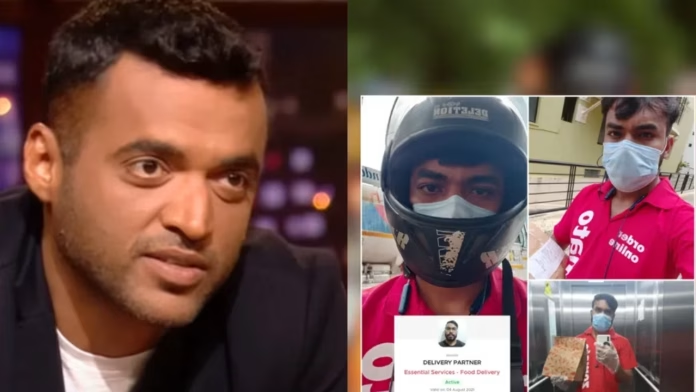
Online food delivery giant Zomato has launched a new feature called Healthy Mode that assigns nutrition-based ratings to dishes ordered through the platform. The initiative, announced by founder and CEO Deepinder Goyal, is designed to help customers make healthier food choices in a market where convenience has often trumped nutrition.

In a public post on X, Goyal admitted that while Zomato had revolutionised food discovery and delivery, it had not made eating better any easier. “We made it simple to order anything you craved, but we did little to guide people toward meals their bodies truly needed,” he wrote.

The new feature uses artificial intelligence and restaurant-provided data to evaluate each dish on multiple nutritional parameters, including protein, fibre, complex carbohydrates and micronutrients. Dishes are then assigned a Healthy Score ranging from “Low” to “Super.” Unlike traditional calorie counters, this model shifts focus to nutrient quality, a move Goyal described as “one of the biggest steps in correcting our blind spot.”

The service is currently live in Gurgaon and will expand to more cities in the coming months. According to Goyal, the feature is not limited to casual users looking for “light” meals but is built robust enough for professional athletes to identify suitable dining options.

In earlier remarks to ET, Goyal noted that Zomato’s frequent daily users already gravitate towards healthier, home-style restaurants, while the majority of its orders — nearly 70 per cent — come from customers who order only a few times a month and often choose indulgent foods. He stressed that the company’s responsibility lies in ensuring healthy choices are visible and accessible, even as the final decision remains with the customer.

Advertisement

P&G’s Olay Targets Double-Digit Growth in India with Anti-Aging Push and Omnichannel Strategy

0

Procter & Gamble’s skincare brand Olay is sharpening its focus on India’s fast-evolving beauty market with a push into anti-aging solutions and a wider omnichannel play. The company is targeting double-digit sales growth in the coming year, banking on consumer education and research-driven products.

Vikram Jeet Singh, category leader for beauty and haircare at P&G India, said only about 10 percent of Indian women currently use anti-aging products, despite nearly half reporting visible skin-aging concerns. “That shows the scale of opportunity. Our aim is to expand adoption through education and meaningful innovations that solve real skin problems.

Central to this strategy is Olay’s recently launched 7-in-1 cream, formulated after years of research into Indian skin types. Studies highlighted weaker skin barriers caused by pollution and climate, which the company says its new formulations directly address. Singh emphasized that new launches must be anchored in efficacy rather than novelty.

Over the past five years, Olay has quadrupled its online business, with marketplaces like Nykaa boosting discovery and quick-commerce platforms driving convenience-led purchases. Still, Singh pointed out that in-store beauty advisors remain influential in consumer decisions, reinforcing the brand’s omnichannel approach.

Olay, positioned as a premium skincare player in India for over two decades, is now eyeing expansion across price tiers and geographies. Demand is rising in tier-2 and tier-3 cities, aided by deeper internet penetration and rising disposable incomes. To capture this growth, the company is investing in AI-driven skin research, immersive product demonstrations, and digital engagement tools that highlight the science and bioavailability of its ingredients.

Looking ahead, Olay aims to broaden the anti-aging category itself, rather than chase volumes alone. “We want to grow the market, strengthen trust, and remain the most preferred premium skincare brand in India,” Singh said.

Advertisement

Petpooja Raises $15.5 Million Series C, Valuation Jumps 3.5X to ₹910 Crore

0

Ahmedabad-based restaurant software company Petpooja has raised Rs 137 crore ($15.5 million) in its Series C funding round, marking its first major fundraise in four years. The round was led by Dharana Capital with participation from Ashish Gupta, co-founder of Helion Ventures, along with Urban Company’s Abhiraj Singh Bhal and Varun Khaitan.

Regulatory filings show Dharana Capital contributed Rs 82 crore while Gupta added Rs 1 crore. The balance is expected to be disbursed in subsequent tranches. Industry tracker Entrackr estimates that the infusion values Petpooja at around Rs 910 crore ($103 million), reflecting a 3.5 times jump from its previous round. Once the remaining funds are allocated, the post-money valuation could shift further.

Founded in 2011, Petpooja began as a food delivery venture before pivoting into software-as-a-service. Today, it offers billing and management solutions for small and mid-sized food service businesses, positioning itself as a backbone technology for restaurants. The company claims to serve more than 100,000 outlets across India, the UAE, and South Africa. It also powers an estimated quarter of the online orders processed through Zomato and Swiggy.

The company said the new capital will be channelled into product development, AI-driven automation, and expanding customer support infrastructure. Petpooja’s financial trajectory has shown momentum, with revenue rising 43 percent year-on-year to Rs 76 crore in FY24. Losses also narrowed to Rs 13.4 crore, signaling a move toward greater operational efficiency.

So far, Petpooja has raised about Rs 185 crore across rounds. With this latest round, Dharana Capital will hold an 18.62 percent stake on a fully diluted basis, giving the investor significant weight in shaping the company’s next phase of growth.

Advertisement

Fun Flips Snacks by JK Foods Enter UAE Market Through Lulu Group Partnership

0

JK Foods, the company behind the popular snack brand Fun Flips, has entered the United Arab Emirates market through a strategic partnership with Lulu International Group, one of the region’s largest retail conglomerates. The collaboration has already given Fun Flips significant shelf presence across Lulu’s stores in the UAE, marking the brand’s first major step outside India.

According to a joint statement, Fun Flips has seen encouraging early traction in the UAE, aided by Lulu’s extensive retail footprint and strong consumer reach. Building on this start, JK Foods plans to scale up distribution across other Gulf Cooperation Council (GCC) nations, including Saudi Arabia, Oman, and Bahrain, with a longer-term ambition of establishing a stronghold throughout the Middle East.

Yusuff Ali M A, Chairman and Managing Director of Lulu Group International, said the partnership is built on a shared understanding of consumer preferences in the Gulf. “With our wide customer base and established presence, we believe Fun Flips has the right product appeal to gain significant momentum across the region,” he said.

Chaitanya Singhania, CEO of JK Foods, called Lulu the “ideal partner” for the brand’s global foray. “Their unparalleled distribution network and deep knowledge of local consumer behavior will help us introduce Fun Flips to a much wider audience and strengthen our international footprint,” he added.

Founded as part of JK Foods’ growing snack portfolio, Fun Flips has built a strong presence in India’s packaged foods market. The company sees the GCC as a natural next step, given the large expatriate population and rising demand for affordable, ready-to-eat snacks. The UAE launch represents the beginning of an aggressive overseas growth plan, with further rollouts expected in phases across the Gulf.

Advertisement

Kapiva Raises $60M Series D Funding Led by 360 ONE Asset, Vertex Growth; Plans Global Expansion

0

Ayurveda-focused direct-to-consumer (D2C) brand Kapiva has raised $60 million (about ₹532 crore) in its Series D funding round, underscoring the rising investor confidence in India’s wellness and nutrition sector. The round was co-led by 360 ONE Asset and Vertex Growth, with existing backers Vertex Ventures and 3one4 Capital also participating.

Founded in 2016 by Ameve Sharma and Shrey Badhani, Kapiva has built a portfolio of more than 100 products spanning herbal supplements, gummies, capsules, and skincare offerings. The company also provides access to consultations with certified ayurvedic doctors, strengthening its position at the intersection of tradition and modern health trends.

Kapiva said the fresh infusion will be directed towards scaling research and development, expanding its manufacturing base, and stepping up marketing initiatives to reach a wider consumer base. Speaking to Inc42, cofounder Ameve Sharma revealed that a portion of the capital will be earmarked for international expansion. The brand currently operates subsidiaries in the United States, United Kingdom, and the United Arab Emirates, which together contribute 5 to 10 percent of its overall revenue.

The latest investment builds on Kapiva’s steady rise in a crowded but fast-growing market for natural nutrition. India’s ayurveda-based consumer health segment has attracted increasing investor attention over the past few years, buoyed by demand for immunity-boosting and preventive health products. Analysts suggest that with rising disposable incomes and shifting consumer preferences, the sector is poised for further growth in both domestic and global markets.

Commenting on the partnership, investors highlighted Kapiva’s ability to marry scientific validation with India’s centuries-old wellness traditions as a key differentiator. With its new war chest, the company aims to solidify its presence in India while laying stronger foundations abroad.

Advertisement

HUL Shares Drop 3% as GST 2.0 Disrupts Trade; Q2 Growth Seen Flat

0

Shares of Hindustan Unilever Ltd (HUL) slipped nearly 3 per cent in early trade on Monday, touching a low of ₹2,443 on the NSE, after the consumer goods major flagged weak September quarter performance. The company said consolidated revenue growth for the July–September period will remain flat to low single digits, citing supply chain and trade disruptions triggered by the government’s recent GST rate revision.

The GST rationalisation, effective September 22, lowered tax rates on a wide range of fast-moving consumer goods. Categories such as soaps, shampoos, hair oils, toothpaste, talcum powder, lifestyle nutrition, and packaged foods now fall under the 5 per cent GST bracket, compared with 12–18 per cent earlier. Nearly 40 per cent of HUL’s product portfolio is impacted.

While the move is expected to benefit consumers and drive demand in the long run, the immediate effect has been a slowdown. Distributors and retailers postponed fresh orders to clear older inventory with higher MRPs, while consumers delayed purchases in anticipation of lower-priced stock. HUL noted that this trend is likely to weigh on sales through October as pipeline inventories adjust.

Brokerage JM Financial reported that HUL has already rolled out price cuts in the high single-digit to low double-digit range across several categories. The firm said lower primary sales in September reflected the destocking cycle across trade channels.

At 10:15 am, HUL shares were trading at ₹2,490, down 1 per cent from Friday’s close. The stock has corrected 16 per cent over the past year, underperforming the broader FMCG index, as demand recovery in rural markets and volume growth remain under pressure.

Advertisement