Saturday, December 20, 2025
Home Blog Page 30

Consumers to Get Bigger Packs at Same Price as FMCG Firms Adjust to GST Cut

0

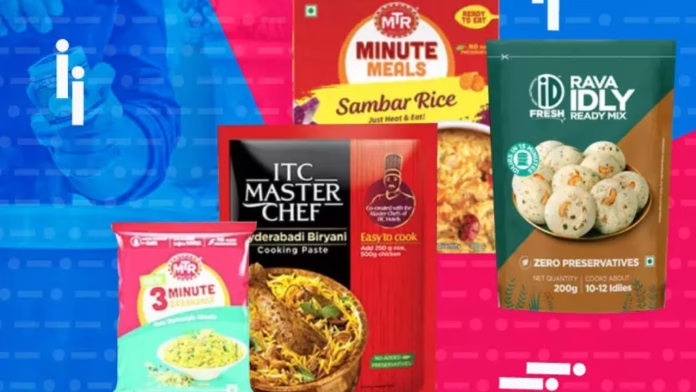
India’s daily essentials are poised to return to their familiar “magic price points” by mid-November, as the government has allowed fast-moving consumer goods (FMCG) manufacturers to increase pack weights instead of cutting prices to reflect recent GST reductions. The move is expected to simplify pricing and restore normalcy in kirana stores and modern retail outlets after weeks of confusion.

Following the September 22 GST rate cut, FMCG companies were compelled to move away from round price tags since there was no clarity on adjusting pack weights. That left consumers and retailers dealing with awkward prices such as ₹4.45 for a biscuit pack or ₹1.77 for a shampoo sachet. Now, with a verbal nod from the Central Board of Indirect Taxes and Customs (CBIC), companies can resume selling ₹5 or ₹10 packs by slightly increasing product quantity—typically between 6% and 12%.

Mayank Shah, vice president of Parle Products, said fresh production has already started in segments like snacks, while categories requiring packaging changes will follow suit shortly. “Consumers will soon see ₹5 and ₹10 packs back on shelves, with more weight for the same price,” he said.

The industry expects the shift to ease operational and consumer challenges. Angelo George, CEO of Bisleri International, said the return to rounded price points “was only a matter of time,” emphasizing that consumers prefer predictable pricing.

Earlier, companies like Mondelez and Bisleri had introduced odd prices—₹26.69 for Bournvita and ₹9 for a 500 ml water bottle—to reflect the tax benefit. Retailers often rounded off or compensated with candies, complicating transactions.

While most players are set to follow the new structure, Amul has opted to maintain its reduced prices until formal notification, saying the intent behind the GST cut was to pass on savings directly to consumers.

Advertisement

Italian Brand OVS Begins India Journey with Delhi Launch, Focuses on Sustainable Fashion

0

Italian fashion retailer OVS S.p.A. has officially entered the Indian market, opening its first 9,000 sq. ft. flagship store at Pacific Mall in Delhi. The launch marks a key milestone in the brand’s global expansion as it prepares to compete with international players such as Zara, H&M, and Uniqlo.

The company aims to bring the essence of Italian fashion—quality, longevity, and affordability—to Indian consumers, setting itself apart from fast-fashion trends. “We don’t believe in fast fashion. Our garments are made to last, using biocotton and recyclable fabrics,” said Carmine Di Virgilio, Global Chief Retail Officer at OVS Global.

Unlike many global brands that enter India through partnerships, OVS has opted for a direct investment model, a move that underscores its long-term commitment. “We prefer to go direct so we can train our teams in Italy and replicate the same brand experience here,” Di Virgilio explained. He added that OVS is investing not only in retail spaces but also in building a strong local team and robust operations network.

Despite higher operating costs, OVS will maintain price parity with Italy, ensuring its products remain competitively priced. “If we lose the right price, we lose the customer. We’d rather invest in the market than in margin,” Di Virgilio said.

The brand plans a measured rollout, with a second store set to open in Mumbai by spring-summer 2026, followed by two to three more by the end of the year. Initially, OVS will focus on physical retail to help consumers experience its products before expanding online.

With over 2,000 stores globally and €1.63 billion in 2024 net sales, OVS enters India with confidence, aiming to blend Italian craftsmanship with the aspirations of a new generation of Indian shoppers.

Advertisement

TABP Snacks & Beverages Bags $3 Million to Boost Production and Strengthen Nationwide Distribution

0

Coimbatore-based beverage company TABP Snacks & Beverages Pvt Ltd, known for catering to India’s fast-growing regional markets, has raised around $3 million (₹25 crore) in fresh equity funding. The round saw participation from LC Nueva Capital, Entrust Family Office, and individual investors Arun Kumar Mukherjee and Soumya Malani, signaling strong investor confidence in the company’s growth trajectory.

Founded by Prabhu Gandhikumar, TABP has emerged as a promising player in India’s value-driven beverage segment. From its beginnings in Coimbatore, the company has expanded operations to 11 states across India, establishing a strong foothold in Tier-2 and Tier-3 markets that form the heart of the “Bharat” consumption story.

LC Nueva, which first invested in the company in 2021, highlighted TABP’s consistent performance and sharp execution. Since that initial backing, the company has achieved an impressive compound annual growth rate (CAGR) of over 60 percent, driven by a mix of product innovation, distribution expansion, and consumer-centric offerings.

“TABP represents the best of what Bharat has to offer — resilience, innovation, and a deep understanding of local markets,” LC Nueva said in a statement. “This is not an overnight success but the result of years of focus and execution. We are proud to continue backing Prabhu and his team as they scale this homegrown brand nationwide.”

TABP plans to utilize the newly raised capital to expand production capacity, strengthen supply chain networks, and introduce new product lines targeted at mass and regional consumers. The company’s expansion underscores the growing appetite for affordable, quality beverages beyond metro India, and the rising investor interest in home-grown consumer brands that understand India’s diverse consumption landscape.

Advertisement

Coca-Cola Considers $1 Billion IPO for Indian Subsidiary Amid Record IPO Rush

0

Coca-Cola Co. is reportedly evaluating plans to list its Indian bottling subsidiary, Hindustan Coca-Cola Beverages Pvt. Ltd. (HCCB), in what could be one of India’s largest beverage sector IPOs. According to people familiar with the matter, the offering could raise close to $1 billion and value the company at around $10 billion.

Discussions with investment bankers have taken place in recent weeks, though the beverage giant has yet to appoint advisors for the transaction. If approved, the public listing could take shape sometime in 2026. Sources cautioned that the structure, timing, and size of the deal remain under consideration as deliberations continue. Coca-Cola has not issued an official comment.

A potential listing of HCCB would mark a major milestone for the Atlanta-based company’s India operations, which have grown to become one of its largest international markets. The move would also align Coca-Cola with a rising trend of global corporations tapping India’s robust IPO market. Over the past year, several multinational firms, including Hyundai Motor and LG Electronics, have listed their Indian arms, raising $3.3 billion and $1.3 billion respectively.

India’s IPO pipeline remains strong, buoyed by strong retail participation and a surge of domestic liquidity. A Coca-Cola listing would likely attract significant investor interest, given the company’s deep retail penetration across India. HCCB currently serves more than 2 million retailers and operates 14 bottling plants across 12 states, employing over 5,000 people.

However, Coca-Cola faces mounting competition in the Indian beverage market, particularly from Reliance Industries’ Campa Cola, which has been expanding aggressively with its value-priced offerings.

Recently, Coca-Cola also sold a minority stake in Hindustan Coca-Cola Holdings Pvt. Ltd., HCCB’s parent company, to the Jubilant Bhartia Group — a move analysts see as part of a broader effort to localize ownership ahead of a potential market debut.

Advertisement

Kidswear Label Orange Sugar Raises Rs 4 Crore to Expand D2C and Quick Commerce Channels

0

Homegrown kidswear brand Orange Sugar has raised Rs 4 crore in a pre-seed angel funding round led by Consumer Collective by Atrium and Ramakant Sharma, marking a key milestone in its journey to become a trusted name in children’s apparel. The round also saw participation from several notable angel investors including Saurabh Jain, Srivatsan Chari, Kunal Mahipal, Meghana Agarwal, and Sunil Khaitan.

Founded by Tarun Agrawal, Payal Agarwal, and Bharath Gupta, Orange Sugar focuses on everyday cotton essentials for children up to 10 years old. The brand has positioned itself in the premium comfortwear space, combining soft, breathable fabrics with child-safe design. The latest infusion of capital will be directed toward expanding product categories, strengthening e-commerce and quick commerce presence, and scaling offline retail in major Indian cities.

Speaking about the milestone, Tarun Agrawal, co-founder of Orange Sugar, said, “This fundraise validates our mission to bring quality and trust to the children’s apparel category. With the backing of experienced investors, we’re now ready to innovate faster, reach more families, and build a stronger brand ecosystem.”

Orange Sugar currently retails through leading platforms such as Myntra, FirstCry, and Nykaa Fashion, along with its own D2C website, which has recorded consistent traction in recent quarters. The company also plans to enhance its parent engagement programs, strengthen supply chain efficiency, and build a wider retail footprint to capture India’s fast-growing kidswear market, projected to touch Rs 1.5 lakh crore by 2028, driven by rising disposable incomes and demand for safe, stylish children’s clothing.

With its latest fundraise, Orange Sugar aims to establish itself as a homegrown, design-forward label that combines everyday practicality with thoughtful craftsmanship — a positioning that resonates strongly with today’s young, urban parents.

Advertisement

Scarters’ New Luggage Line to Boost Average Order Value, Propel FY26 Growth Plans

0

Mumbai: Direct-to-consumer lifestyle brand Scarters is charting an ambitious path for FY26, aiming for 50% year-on-year growth as it steps into the premium luggage and travel gear segment. The bootstrapped company, known for its design-led work accessories, expects its newly launched cabin luggage and suitcase collection to drive higher average order values (AOVs) and broaden its customer base.

After maintaining steady growth of 20-25% annually, Scarters anticipates AOVs to rise from ₹7,500 to the ₹20,000–₹30,000 range this fiscal year. “With our luggage portfolio now live, we’re seeing strong demand from frequent travelers and professionals. It’s a natural evolution for the brand as we continue to innovate across lifestyle categories,” said Darshan Shah, Founder of Scarters.

What began as a niche work accessories venture during the pandemic has grown into a complete lifestyle ecosystem spanning tech gear, wallets, organizers, and travel products. The company has remained profitable, choosing to reinvest earnings to fuel organic expansion.

Currently, tier-1 cities such as Mumbai and Bengaluru contribute nearly 80% of Scarters’ sales, with increasing traction from tier-2 regions like Pune, Surat, and Ahmedabad. Around 95% of total sales come from online platforms, with Scarters’ website alone accounting for nearly 70%. The brand is also piloting offline formats through airport counters and shop-in-shop models with partners like Broadway and Relay.

Scarters’ approach blends functionality with design innovation. Its newly launched cabin suitcase, developed over three years and now patent-pending, features a modular sleeve system allowing users to change looks and utility without replacing the core unit. The company also plans to enter lifestyle segments such as pickleball, golf, and travel accessories.

“We’re not chasing hyper growth,” Shah said. “Our focus is on building a brand that stands for thoughtful design, quality, and longevity.”

Advertisement

Zepto Bags $450 Million at $7 Billion Valuation: Aadit Palicha Says Startup Now Sits on $900 Million Cash Pile

0

Zepto, the Mumbai-based quick commerce unicorn, has secured $450 million in a fresh funding round, catapulting its valuation to $7 billion — nearly double from its previous round just months ago. The round saw participation from existing backers such as Glade Brook Capital, Nexus Venture Partners, StepStone Group, and Goodwater Capital, alongside new institutional investors eager to tap into India’s booming instant delivery space.

Co-founder and CEO Aadit Palicha announced that Zepto now holds $900 million in cash reserves, positioning it strongly against rivals Blinkit and Swiggy Instamart. “Our capital position is stronger than ever. We are building not just for growth, but for long-term profitability,” Palicha said in a statement.

Founded in 2021 by Stanford dropouts Aadit Palicha and Kaivalya Vohra, Zepto has rapidly scaled its 10-minute delivery model across major Indian cities. The company claims to have achieved EBITDA positivity in several key markets and is on track for company-wide profitability in 2026.

Zepto’s dark-store network — now crossing 350 locations nationwide — continues to be the backbone of its operations, enabling deliveries of groceries, snacks, and daily essentials in record time. The firm has also begun experimenting with non-grocery categories, including personal care and home goods, to expand its average order value.

With this round, Zepto cements its position as India’s fastest-growing consumer internet company, defying skepticism around the sustainability of the quick commerce model. Investors are betting big that Zepto’s disciplined execution and capital efficiency could make it the first profitable player in India’s hyper-competitive instant delivery market.

Advertisement

Greek Yogurt Powerhouse Chobani Raises $650 Million to Boost U.S. Manufacturing Capacity and Fuel Next Phase of Growth

0

Greek yogurt giant Chobani has secured a massive $650 million in equity funding, signaling strong investor confidence in the company’s continued growth and innovation plans. The funding round is set to fuel expansion projects at Chobani’s manufacturing plants in Twin Falls, Idaho, and Rome, New York, two key hubs that drive the brand’s production across the country.

The company, which began in 2005 with a mission to make better food more accessible, has grown into one of the most recognized names in the dairy and plant-based food segment. This new capital injection, combined with Chobani’s robust operating cash flows, is expected to strengthen its supply chain, increase production capacity, and support innovation in new product categories.

Chobani’s Twin Falls facility is already one of the largest yogurt manufacturing plants in the world, while its Rome, New York site plays a central role in the brand’s East Coast distribution. The planned expansions aim to meet surging consumer demand for Chobani’s wide range of Greek yogurts, oat milks, and functional beverages.

Beyond growth, the company continues to emphasize its social impact initiatives, including partnerships that fight child hunger and support refugees. By reinvesting in its U.S. operations, Chobani reaffirms its commitment to sustainable food production and community-driven values.

With this latest funding milestone, Chobani is not just scaling its production—it’s doubling down on its mission to bring nutritious, responsibly made food to more consumers across America.

Advertisement

Heritage Foods Sees Double-Digit Growth in Curd, Paneer, and Ice Cream Sales in Q2 FY26

0

Heritage Foods Ltd reported a 14.8% year-on-year increase in revenue from its value-added products (VAP) segment, reaching ₹3,417 million in the second quarter of FY26, driven by steady consumer demand, portfolio expansion, and strategic pricing initiatives.

Despite challenging weather and fluctuations in milk procurement costs, the company maintained operational resilience by leveraging its diversified sourcing network across key regions. Milk procurement volumes stood at 16.1 lakh liters per day, marginally lower by 2% year-on-year, as Heritage prioritized high-margin VAP categories over bulk sales during a lean production phase marked by butter shortages.

Strong demand for curd, drinkables, paneer, and ice cream propelled a 15% year-on-year rise in VAP sales, with overall volumes up 10.4%. The company also reduced its low-margin B2B fat sales by 86% while expanding its B2C portfolio, which grew 35% year-on-year. This strategic shift improved profitability and enhanced the quality of earnings.

A calibrated 4.5% price increase, combined with a premium product mix, helped offset higher input costs. Net milk realization rose by ₹2.43 per liter, reflecting sustained consumer confidence and strong brand positioning.

Following the September GST revision, Heritage passed on benefits to consumers through total price cuts, improving competitiveness against unorganized sector players. Integration of HNFPL and co-branded initiatives under the LIVO label on Flipkart also contributed to market reach and digital visibility.

Looking ahead, Heritage expects festive demand, better milk availability during the flush season, and recently commissioned VAP and ice cream capacities to drive growth in the second half of FY26. The company remains focused on strengthening its value-added dairy portfolio, expanding retail reach, and improving operating margins through efficiency-led growth.

Advertisement

Luxury Market Rebounds: LVMH’s Strong Quarter Triggers $80 Billion Stock Rally

0

Shares of LVMH Moët Hennessy Louis Vuitton surged to their highest single-day gain in more than two decades on Wednesday, sparking a powerful rally across Europe’s luxury sector. The world’s largest luxury conglomerate jumped as much as 14 percent after reporting stronger-than-expected third-quarter results, signaling a turnaround in Chinese demand that had long weighed on the industry.

The rebound in sentiment added nearly $80 billion in market value to the STOXX Europe Luxury 10 Index, lifting peers such as Hermès, Kering, Richemont, Burberry, and Moncler by 5 to 9 percent. The surge marks the strongest collective performance for luxury stocks since early 2024, as investors grew confident that the industry may finally be emerging from its two-year slump.

LVMH, controlled by French billionaire Bernard Arnault, reported its first quarterly sales growth of 2025, outperforming analyst expectations across all divisions, from fashion and beauty to jewellery and spirits. Analysts at Bernstein said the results “surprised positively,” while fund managers noted renewed optimism around upcoming management and creative shifts at major houses.

Sales in mainland China, a critical growth engine for the luxury industry, turned positive after months of weakness. Consumers responded strongly to experiential retail formats, including Louis Vuitton’s ship-shaped boutique in Shanghai. Spending by travelling Chinese shoppers also improved, though it remained below pre-pandemic levels.

Despite the upbeat quarter, analysts remain cautious. LVMH’s Chief Financial Officer, Cécile Cabanis, warned that global economic uncertainty and currency fluctuations could weigh on the group’s fourth-quarter performance.

UBS expects luxury sector sales to grow 4 percent organically in 2026, with momentum building in the second half as new designer collections reach stores. Still, the latest rally suggests renewed faith in the resilience of global luxury, led once again by LVMH’s enduring influence.

Advertisement