Friday, December 19, 2025
Home Blog Page 26

Zepto Gears Up for a $500 Million IPO: Aadit Palicha’s Quick Commerce Rocket Targets July–September 2026 Listing

0

Quick commerce startup Zepto is gearing up to take a major step toward going public, with plans to file its draft IPO papers later this month. The Mumbai-based firm aims to raise $450–500 million through a public market listing, according to sources cited in a recent report by The Economic Times.

The company is expected to confidentially file its draft red herring prospectus (DRHP) with the Securities and Exchange Board of India (SEBI) within the next few weeks. Zepto, which became one of India’s fastest-growing quick commerce players, is targeting a stock market debut between July and September next year.

This move follows Zepto’s recent $450 million funding round, which valued the company at around $3.6 billion. The fresh capital injection helped strengthen its balance sheet ahead of its IPO ambitions.

However, Zepto is also tightening its belt by implementing cost-optimization measures to manage cash burn. This includes layoffs and reduced customer acquisition spending, as the company focuses on achieving operational efficiency and long-term profitability.

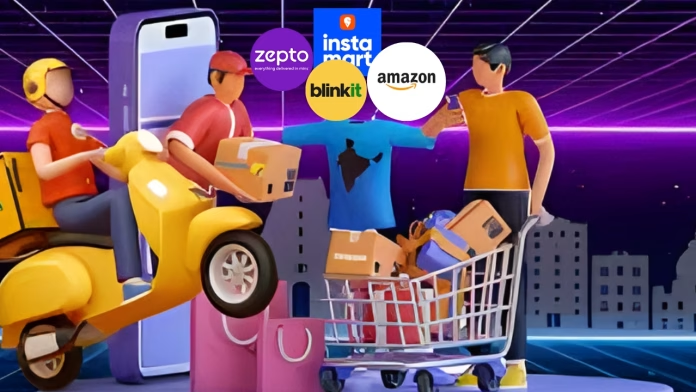
Founded in 2021 by Aadit Palicha and Kaivalya Vohra, Zepto disrupted India’s grocery delivery market with its promise of ultra-fast deliveries. Competing against Swiggy’s Instamart, Zomato’s Blinkit, and BigBasket’s BB Now, Zepto’s upcoming IPO will mark a significant milestone for the country’s quick commerce industry.

If successful, the listing could make Zepto one of the youngest Indian startups to tap the public markets, signaling growing investor confidence in the quick commerce model despite the sector’s ongoing struggle with high costs and thin margins.

Advertisement

Beauty and Personal Care Brand Protouch Bags ₹17.7 Crore to Fuel Expansion in India and Overseas

0

Beauty and personal care appliance startup Protouch has secured ₹17.7 crore ($2 million) in a pre-Series A funding round led by venture capital firm GVFL, with participation from Enrission India Capital and Anicut Capital. The round values the company at around $10 million post-money.

The Bengaluru-based startup plans to use the fresh funds to broaden its product lineup, strengthen its research and development capabilities, and scale both online and offline distribution across India and international markets. Protouch also aims to set up its own manufacturing unit over the next few years as part of its long-term expansion strategy.

Founded in 2022 by entrepreneur Tanisha Lakhani, Protouch focuses on technology-driven beauty and grooming appliances designed for Indian consumers. Its portfolio includes LED-based skincare and haircare devices, automatic multi-stylers powered by airflow technology, ceramic trimmers, and a growing range of grooming tools, serums, and personal care products.

In just two and a half years, the company claims to have served more than two lakh customers in India and entered the Middle East market. Over the same period, it has achieved a 15-fold increase in revenue while remaining profitable. Prior to this round, Protouch had raised around ₹8 crore in funding. The brand’s products are available through its own direct-to-consumer website and major ecommerce marketplaces, including Amazon, Flipkart, and Myntra.

Mihir Joshi, Managing Director of GVFL, said the investment reflects confidence in Protouch’s ability to lead the growing beauty-tech segment in India. He added that the company’s focus on innovation and consumer insight brings salon-quality experiences into homes.

Founder Tanisha Lakhani said the funding will help accelerate the brand’s mission to make professional-grade beauty devices accessible to households, adding that consumers today seek faster and more efficient solutions powered by smart technology.

Advertisement

Swiggy Instamart Launches Protein Category with Food Pharmer’s ‘Only What’s Needed’ Brand

0

Instamart, the quick commerce arm of Swiggy, has launched a dedicated protein category to meet the growing consumer appetite for health and nutrition-focused foods. The move marks a strategic expansion into functional foods, a segment gaining strong momentum among urban consumers.

The launch coincides with the debut of Only What’s Needed (OWN), a protein brand founded by health influencer Revant Himatsingka, popularly known as Food Pharmer. OWN joins Instamart’s platform as part of its curated health portfolio, designed to make protein-rich products more discoverable and accessible to a wider audience.

The newly introduced section will feature an assortment of products catering to various dietary preferences and price points, allowing consumers to explore convenient, high-quality protein options without compromising on transparency or taste. The initiative reflects Instamart’s growing focus on health-conscious assortments, following rising demand for nutrition-led foods, supplements, and beverages across Indian metros.

“Making protein more accessible to India took time, transparency, and a shared vision,” said Phani Kishan Addepalli, co-founder and chief growth officer of Swiggy. “Convenience helped us reach here, but it’s trust that will take us further,” he added, emphasizing the company’s focus on maintaining quality while expanding its product range.

Industry experts say the entry of platforms like Instamart into specialized nutrition categories signals a shift in consumer behaviour, as urban households increasingly look for quick yet mindful food choices. By integrating brands like OWN, Instamart aims to strengthen its position as a one-stop destination for everyday essentials and wellness products alike.

With health and convenience continuing to shape food consumption trends, Instamart’s protein push reflects how quick commerce players are evolving beyond impulse-driven grocery deliveries toward more value-led, lifestyle-oriented offerings for India’s growing health-conscious audience.

Advertisement

Swiggy Q2 FY26 Loss Widens to ₹1,092 Crore as Revenue Surges 54% to ₹5,561 Crore

0

Swiggy’s revenue soared 54% year-on-year to ₹5,561 crore in the second quarter of FY26, even as the food delivery major widened its losses amid higher spending on advertising and promotions. The company posted a consolidated loss of ₹1,092 crore for the quarter ended September 2025, compared with ₹626 crore a year earlier, according to its latest regulatory filing.

The Bengaluru-based firm, which competes with Zomato, saw its total expenses climb 56% to ₹6,711 crore. Advertising and sales promotion costs nearly doubled to ₹1,039 crore, while delivery-related expenses rose 30% to ₹1,426 crore. Employee costs stood at ₹690 crore and finance costs more than doubled to ₹48 crore.

Despite the loss, Swiggy’s food delivery vertical maintained profitability at the adjusted EBITDA level, supported by a 19% jump in gross order value (GOV) to ₹8,542 crore. Monthly transacting users rose 34% year-on-year to 22.9 million, with more than one-third availing multiple services. Adjusted EBITDA margin for food delivery improved to 2.8% of GOV, up 125 basis points from a year ago.

Instamart, Swiggy’s quick-commerce business, posted robust growth with GOV up 108% year-on-year and 24% sequentially to ₹7,022 crore. Average order value climbed 40% to ₹697 as the network expanded to 1,102 dark stores across 128 cities. Contribution margin improved 200 basis points quarter-on-quarter to -2.6%, and adjusted EBITDA loss narrowed to ₹849 crore.

Swiggy’s out-of-home consumption segment also remained profitable, with GOV up 52% year-on-year and an EBITDA margin of 0.5% of GOV.

Managing Director and Group CEO Sriharsha Majety said Swiggy delivered its strongest order growth in two years, driven by innovations like Bolt, 99 Store, Deskeats, and health-focused offerings. The board will meet on November 7 to consider raising up to ₹10,000 crore through public or private offerings, including QIPs.

Advertisement

Tata Consumer’s New-Age Brands Drive 32% of India Business in Q2 FY26

0

Tata Consumer Products Ltd (TCPL) reported strong earnings for the September quarter, driven by a surge in demand for its portfolio of emerging food brands that are rapidly reshaping the company’s India business.

The company said its ‘Growth’ segment—which includes Tata Sampann, Tata Soulfull, Capital Foods, and Organic India—expanded 27 per cent year-on-year and now contributes 32 per cent to its domestic revenue mix. Tata Sampann remained the standout performer, posting a 40 per cent sales jump on the back of growing demand for packaged pulses, spices, and ready-to-cook foods.

Tata Soulfull continued to build on the consumer shift toward millet-based snacking and breakfast options, while Capital Foods, which owns Ching’s Secret and Smith & Jones, maintained steady growth despite temporary disruptions linked to the GST transition. Organic India also saw stable momentum in its health and wellness offerings.

For the quarter ended September 30, consolidated revenue from operations rose 18 per cent to ₹4,966 crore. Group net profit increased 11 per cent to ₹407 crore, while EBITDA grew 7 per cent to ₹675 crore. The company said both its branded and non-branded international businesses registered healthy performances, growing 9 per cent and 26 per cent respectively in constant currency terms.

Tata Consumer’s Ready-to-Drink beverages division clocked 25 per cent growth despite unseasonal rains that impacted consumption in several markets. The company also introduced 25 new products across its portfolio, focusing on health, convenience, and premium categories.

Chief Executive Sunil D’Souza said the company delivered its second consecutive quarter of double-digit growth in its core tea and salt categories, while Tata Starbucks expanded its footprint to 492 outlets across 80 cities, strengthening its presence beyond metro markets.

Advertisement

Vintage Coffee & Beverages Reports 137% Profit Surge in Q2 FY26; Revenue Climbs 90%

0

Vintage Coffee & Beverages Ltd delivered a strong performance in the September quarter, reporting a 137% year-on-year jump in profit after tax to Rs 17.83 crore, backed by robust demand and improved operational efficiency. The company’s revenue for the quarter surged 90% to Rs 135.61 crore, while operating profit rose 120% to Rs 21.38 crore, according to a regulatory filing on Monday.

For the first half of FY26, the coffee manufacturer posted a profit of Rs 32.07 crore, a 166% increase over the same period last year. Revenue for the six-month period climbed 106% to Rs 237.22 crore, with operating profit up 138% at Rs 38.61 crore.

Chairman and managing director Balakrishna Tati said the company’s growth was driven by strong demand across product categories and better capacity utilization. “Despite a challenging business environment, we achieved significant progress in scaling our operations and improving profitability,” he said, adding that the company remains confident of maintaining its growth momentum in the second half of the fiscal.

Vintage Coffee is also ramping up its production capacity. It expects to commission an additional 4,500 metric tonnes per annum (MTPA) of spray-dried and agglomerated coffee capacity by the end of FY26, which will raise its total installed capacity to 11,000 MTPA.

In a major step toward product diversification, the company plans to establish a greenfield freeze-dried coffee plant with a capacity of 5,000 MTPA by FY28. The project will be funded through proceeds from a recent preferential equity issue.

Tati added that equipment orders for the new plant have already been placed with a leading European manufacturer, covering about 70% of the total project cost, paving the way for future growth and premium product expansion.

Advertisement

Baba Ramdev’s Patanjali Foods Reports Best-Ever Quarter, Yet Shares Fall 5% — Here’s Why the Street Isn’t Happy

0

Patanjali Foods Ltd. witnessed a sharp 5% fall in its share price on Monday after the company’s Q2 results failed to impress the Street, even though the FMCG major reported robust growth across key parameters. The stock reaction came as a surprise, considering the firm’s standalone net profit surged 67.2% year-on-year, marking its best-ever quarterly performance.

According to the company’s financial report, revenue from operations rose 20.9% compared to the same quarter last year, driven by higher sales in edible oils and packaged food segments. The Baba Ramdev-led company said profitability metrics improved substantially, supported by better operating efficiency and cost control measures.

Despite the impressive numbers, analysts noted that the results fell short of market expectations, as investors were anticipating even stronger volume growth and margin expansion. This mismatch between high expectations and reported figures triggered short-term profit-taking in the counter.

Brokerage firm ICICI Securities retained an ‘Add’ rating on Patanjali Foods, setting a target price of ₹650 per share, indicating potential upside from current levels. The brokerage highlighted the company’s strong fundamentals, expanding distribution network, and growing presence in the fast-moving consumer goods (FMCG) space as key positives.

Experts believe that the recent correction may offer a buying opportunity for long-term investors, given the company’s consistent revenue growth and profitability trajectory. However, they caution that near-term volatility could persist as the market recalibrates its expectations.

Patanjali Foods continues to be one of the most watched stocks in India’s FMCG sector — blending traditional wellness appeal with modern business growth ambitions.

Advertisement

PepsiCo May Bring Alcoholic RTD Drinks to India with Varun Beverages

0

Varun Beverages Ltd (VBL), PepsiCo’s largest bottling partner outside the United States, is in early discussions with the beverage major to jointly explore India’s fast-emerging alcoholic ready-to-drink (RTD) market. The move could mark PepsiCo’s debut in the country’s alcohol segment and signal a new chapter in its three-decade-old alliance with VBL.

“We are in talks with PepsiCo to see if we can introduce some of their low-alcohol, ready-to-drink beverages in India,” said Ravi Jaipuria, chairman of RJ Corp, VBL’s parent company, during a post-earnings call. He added that these products are gaining traction globally and India offers strong growth potential.

The discussions come soon after VBL announced a distribution partnership with Danish brewer Carlsberg for select African markets. PepsiCo, meanwhile, has already entered the global RTD alcohol space through collaborations with AB InBev and Diageo. In Canada, it recently launched SVNS Hard 7Up with Labatt Breweries, while in the UK it partnered Diageo for a Captain Morgan and Pepsi Max cocktail.

If finalized, the collaboration will extend VBL’s portfolio beyond soft drinks for the first time. The company has already informed exchanges that it plans to test opportunities in beer, wine, whisky, gin, rum, and vodka across India and international markets. “We will move carefully, starting with Africa and evaluating India next,” Jaipuria said.

Industry experts caution that the RTD segment, while lucrative, involves complex distribution and stringent regulatory norms. Still, market projections are promising: India’s RTD alcoholic beverages market is expected to grow at a 6% CAGR between 2025 and 2035, outpacing global averages, according to Future Market Insights.

The move comes at a time when India’s soft drink sales are under pressure following a weak summer season and rising competition from new and regional beverage brands.

Advertisement

Delhi Govt to Retain Control of 700 + Liquor Vends as Revenue Races Past ₹7,000 Crore — What It Means for Drinkers and Retailers

0

Delhi’s upcoming excise policy is set to bring major changes to the city’s liquor retail system, with the government expected to continue its control over all liquor stores. This means that only government-run liquor outlets will operate across the capital, ending any speculation about private players returning to the business.

According to officials, the focus of the new policy is on creating a more organized, transparent, and socially responsible retail environment. To achieve this, the Delhi government plans to redesign its existing liquor stores into larger, modern spaces located in malls and shopping complexes. These outlets are expected to be better managed, more customer-friendly, and aligned with urban infrastructure standards.

Another key proposal under the new excise framework is the relocation of liquor shops away from densely populated residential areas. This move aims to reduce local disturbances and address long-standing complaints from residents. Additionally, the profit margin structure for retailers is likely to be overhauled to encourage stocking of premium liquor brands, which could enhance both consumer experience and revenue generation.

Experts believe that while the continuation of government-run stores may limit competition, it will also ensure stricter oversight, minimizing issues like overcharging and policy misuse. The Delhi government’s focus, they say, is clearly on transparency, compliance, and responsible consumption rather than aggressive retail expansion.

With these sweeping reforms, the excise policy is poised to reshape how Delhiites buy their alcohol — bringing order, regulation, and a new retail experience to the city’s liquor landscape.

Advertisement

United Breweries Quarterly Earnings Dip as Unusual Monsoon Impacts Operations

0

India’s largest brewer, United Breweries Ltd (UBL), reported a 3% year-on-year decline in both sales volume and value for the quarter ended September 2025, after heavy and prolonged monsoon rains disrupted operations and hurt demand in key beer markets.

Chief executive officer Vivek Gupta said the “unusual monsoon” caused flooding at three UBL breweries and impacted several major markets, including Karnataka, Odisha, West Bengal, and Telangana, where category sales dropped nearly 40%. “We are disappointed with the financial results, but this is just one quarter. Our long-term plan remains on track,” Gupta told analysts in the company’s post-results call.

UBL’s total revenue from operations fell 21% year-on-year to ₹3,735.6 crore, while net sales stood at ₹2,051 crore, down 3%. The company’s standalone gross profit slipped 5% to ₹878 crore, and EBITDA dropped sharply by 39% to ₹145 crore, reflecting the combined effect of weather-related disruptions, inflationary pressure, and regional taxation issues.

Despite the overall decline, UBL’s premium segment continued to perform strongly, growing 17% year-on-year, led by Kingfisher Ultra and Kingfisher Ultra Max. The company also expanded its portfolio of value brands, introducing London Pilsner and Kalyani Black in Odisha and West Bengal to drive recovery in mass-market segments.

Gupta highlighted broader market challenges, including tax hikes and licensing delays. Karnataka, traditionally India’s beer capital, saw a 14–15% decline in category sales following repeated excise duty increases. Telangana, too, faced a double-digit dip due to delays in retail licensing.

The company is now focusing on improving productivity, managing input costs, and converting certain fixed costs into variable ones. Gupta added that the brewer remains confident about regaining growth momentum once weather and regulatory conditions stabilize.

Advertisement