Thursday, December 18, 2025
Home Blog Page 1241

Blinkit faces service disruptions in Delhi-NCR as delivery partners protest

0
blinkit
Around 1,000 Blinkit delivery executives in the National Capital Region have recently joined competing quick-commerce firms like Swiggy Instamart, Zepto, and BB Now. (Representative Image)

The services of quick-commerce platform Blinkit, owned by Zomato, have been disrupted in the Delhi-NCR region due to a strike by its delivery partners. The strike was initiated in response to changes in their pay structure.

“Sorry for the inconvenience. Your store is under maintenance,” reads a message from the startup on its app in some areas of the national capital.

The Morning Context has reported that Blinkit implemented a new pay structure for its delivery partners starting from Monday midnight. Under the new system, the partners must reserve their time slots and fulfill designated targets to receive payment on a per-kilometer basis. The delivery partners, however, argue that this would result in a decrease in their earnings.

Responding to SnackFax’s query on the issue, a Blinkit spokesperson said, “We have introduced a new payout structure for our partners that compensates them based on their effort to deliver an order. This is an opt-in exercise, and our teams are on the ground to answer any questions from the partners.”

The company did not provide a detailed breakdown of the new pay structure and stated that it is actively working towards restoring service to all affected stores as soon as possible.

“Although some locations have experienced disruptions, we are actively engaging with our partners to get the stores back up and running for our customers,” the spokesperson added.

The current strike by Blinkit’s delivery partners is not an isolated incident of gig workers protesting against their employers. In the past year, quick-commerce company Dunzo and food delivery platform Swiggy have also faced numerous protests, largely due to disputes over their payment structures. For example, Swiggy’s delivery executives in Kochi went on strike in November of last year, calling for an increase in their pay.

Last year in Bengaluru, Dunzo riders staged a protest against the startup citing various grievances such as alterations in login timings and incentive structures.

The quick-commerce industry is a fiercely competitive and capital-intensive sector. Swiggy’s Instamart, Zepto, Dunzo, and Tata-owned Bigbasket are some of the major players vying for a greater market share in this field.

Reliance Retail’s JioMart ceased the operations of JioMart Express, its quick-commerce delivery division, earlier this year. JioMart Express was launched in March 2022.

According to a Fairwork report, gig-worker conditions were deemed the worst at Indian startups like Ola, Uber, and Dunzo.

A report from government think tank NITI Aayog predicts that the number of gig economy workers in India will increase to 23.5 million by 2029-30, up from 7.7 million in 2020-21. The report recommends extending social security benefits to both platform and non-platform gig workers.

Advertisement

Godrej Consumer Products invests INR 100 crore in Early Spring to foster new brands

0
Godrej Consumer Products
Godrej Consumer Products Ltd (GCPL) reported a revenue of INR 6,951.56 for the fiscal year that ended on March 31, 2022

Godrej Consumer Products Ltd, a leading FMCG company, has announced plans to invest INR 100 crore in Early Spring, a newly established consumer fund by Spring Marketing Capital (Spring) aimed at early-stage ventures.

Spring Marketing Capital is developing an investment franchise that prioritizes brand building and supports visionary founders in creating the brands of the future.

Godrej Consumer Products, the FMCG division of the Godrej group, will serve as the cornerstone investor in a new INR 300-crore early-stage consumer fund established by Spring. In addition to providing financial support, Godrej Consumer Products will leverage its expertise and experience to assist founders in developing robust and sustainable businesses.

“Enabling companies to leverage marketing expertise along with capital, Spring’s first fund of INR 150 crore continues to invest in companies at Series A and beyond. The Early Spring Fund will be investing INR 5 crore to INR 20 crore in each company, from seed to pre-Series A stage,” it said.

In response to this development, Omar Momin, Head of M&A at Godrej Consumer Products, stated that the move aligns with the company’s mission of providing consumers with health and beauty products that promote wellness.

“We intend to leverage our understanding of consumer space and learnings over the last decades to enable early-stage founders focused on building strong offline as well as online presence by offering differentiated products in India,” he said.

Godrej Consumer Products is one of the top companies in the emerging markets of India, Indonesia, and Africa, with a significant presence in household insecticides, air care, and hair care products.

Advertisement

Kulfilicious, the UAE’s top Kulfi brand, set to launch in India with its first outlet in Bengaluru

0
Kulfi

Kulfilicious, a well-known Kulfi brand adored by many in the United Arab Emirates, is preparing to introduce its genuine Kulfi experience to Bengaluru, India. With a strong commitment to crafting authentic Kulfi and Kulfi-inspired goods, Kulfilicious has established itself as a household favorite in the UAE.

Kulfilicious has been flourishing since its inauguration in Al Nadha in 2014, with its exceptional assortment of more than 40 traditional Kulfi flavors, currently comprising four primary outlets and a total of 14 functioning outlets. The brand’s triumph can be attributed to its unwavering dedication to quality, inventiveness, and customer contentment.

At present, they exclusively serve as the Corporate Suppliers for Dubai World Trade Centre, Sanjeev Kapoor Restaurants, Dubai Parks and Resorts, as well as several 5-star establishments across the UAE.

Bengaluru, a city known for bringing individuals together through diverse flavors, serves as a melting pot of various cultures. Kulfilicious has now targeted this city and intends to inaugurate its first outlet in Indiranagar, Bengaluru, India.

Speaking on the occasion, Nilish Carvalho, Co-Founder, Kulfilicious, added, “We are thrilled to be expanding internationally and launching our wide range of premium products in Bengaluru. As a vibrant metro city with a diverse and multicultural population, it is the ideal location for us as a brand to showcase our cherished offerings to a wider audience. Our mission is to provide an exquisite and high-quality kulfi experience that surpasses the expectations of Indian dessert lovers and also elevates Indian dessert to a higher pedestal. We are committed to expanding our presence throughout India and eventually delighting taste buds with our unique and delicious flavors in the years to come.”

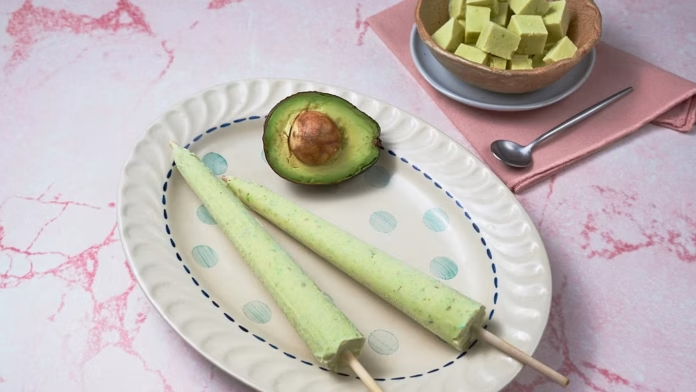
Kulfilicious prides itself on its usage of top-notch quality ingredients. Their Kulfi is produced utilizing the finest natural components and is authentic and traditional, free from preservatives, artificial colors, or stabilizers. The brand’s diverse menu offers an array of Kulfi flavors, ranging from classic favorites such as Malai and Kesar Pista to newer flavors like Butterscotch, Avocado, Blueberry, and many others. They also provide Kulfi-based Cold Coffee, Shakes, and Faloodas. Furthermore, they offer creative flavors to cater to global palates, such as Snickers, Oreo, Ferrero Rocher, and KitKat.

By blending tradition and innovation, Kulfilicious is prepared to create a buzz in Bengaluru. Their goal is to become the go-to dessert destination this summer for all Kulfi enthusiasts in the city.

Kulfilicious is thrilled to introduce its delectable Kulfi to India, the birthplace of Kulfi, and is optimistic about establishing a strong presence in the Indian market. With its emphasis on quality and customer contentment, Kulfilicious is bound to capture the hearts of its Indian clientele.

Advertisement

Bel Group and Climax Foods unite to revolutionize the dairy industry with AI-Powered Plant-Based cheese products

0
Babybel

The Bel Group, a well-known provider of branded cheese products worldwide, has recently teamed up with biotech company Climax Foods in a distinctive collaboration. Their primary objective is to create a new range of plant-based cheese products, which can help tackle the difficulties that the dairy industry is facing due to the worsening climate crisis.

The objective of the partnership is to develop plant-based versions of popular food brands such as Kiri®, Laughing Cow®, Babybel®, Boursin®, and Nurishh®. The focus is on creating affordable, nutritious, and eco-friendly products that are nearly identical to their dairy-based counterparts. To accomplish this goal, the companies will combine their respective skills and leverage data science and artificial intelligence (AI) technology. Bel has invested in Climax Foods Inc. to support the advancement of this innovative solution.

“Food is a key lever to address climate change, and we, at Bel, have a strong determination to explore new territories and develop innovative solutions that will define the future of food, for all,” said Cécile Béliot, CEO of the Bel Group in a press statement. “The products we will develop in partnership with Climax have the potential to make a big difference: they can meet the three-fold challenge of sustainable, nutritious, and accessible. This collaboration epitomizes our co-innovation strategy by combining their distinctive technological data science and AI platforms and expertise with Bel’s pioneering and historical knowledge.”

Climax Foods has utilized predictive analytics and AI to gain a thorough comprehension of the molecular structure of animal-based foods. This expertise enables them to produce plant-based alternatives that replicate the texture, taste, and nutritional value of their dairy-based equivalents. Through the utilization of their AI technology, Climax Foods can accelerate the product development cycle and unlock the enormous potential of plant-based ingredients to create groundbreaking recipes in significantly less time than traditional methods.

Climax Foods CEO Dr. Oliver Zahn said, “AI and data can be game changers in food in terms of delivering optimal taste and texture while at the same time making it affordable and sustainable. Evolving recipes over time is what we’ve been doing for hundreds of years. In addition to changing consumer preferences, climate change requires us to accelerate the evolution of food. Together with Bel, we can make a significant positive impact so that people and the planet are better off.” 

In 2020, Climax Foods, headquartered in California, received a funding of $7.5 million. Its Founder, Oliver Zahn, formerly a data scientist at Google, SpaceX, and plant-based food tech leader Impossible Foods, secured support from prominent investors such as Tom Chi, Co-founder of GoogleX, Manta Ray Ventures, and S2G Ventures. Recently, the company announced its collaboration with global conventional cheesemaking expert, Caroline Di Giusto, and its plans to establish a pilot and production center in Petaluma. Its objective is to create “Deep Plant Intelligence,” which combines molecular-level data about animal products with its exclusive plant-based ingredients database.

Climax Foods’ team of food scientists has successfully created several prototypes of specialty cheeses, including brie, blue, feta, and goat cheese, which replicate the taste and texture of their dairy-based equivalents. Bel intends to launch these innovative plant-based products in Europe and the United States by the end of 2024, as part of its effort to achieve a well-balanced portfolio of 50% dairy products and 50% plant-based/fruit products. The company aims to contribute to the transition towards a new food system model that can provide sustenance to 10 billion people by 2050 while reducing the environmental impact.

Caroline Sorlin, Chief Venture Officer of Bel, said, “Our group has always distinguished itself in its ability to dare and change the game with its innovative products. The challenge of the food transition is so big that collaborative innovation and the merging of skills is imperative. This partnership is definitely a source of pride, but above all, it is excellent news for the plant-based cheese market.”

Bel, the company that has already introduced a plant-based alternative to its popular Babybel cheese and established its own plant-based cheese label, Nurishh, declared its collaboration with two other firms last year. One is Superbrewed Food, situated in the United States, with whom Bel is collaborating to design dairy-free cheese using biomass fermentation. The other is Standing Ovation, a French precision fermentation dairy firm, who will assist Bel in developing microbe-based casein proteins for use in its cheese product line.

Advertisement

Sula Vineyards reports 30% surge in sales of premium wines in FY23

0
Sula Vineyards
(Representative Image)

Sula Vineyards Limited, a wine producer listed on the stock exchange, revealed in its Q4 & FY23 sales update that sales of their elite and premium wines have increased by 30% in FY23 when compared to the previous fiscal year, FY22.

As per a media release, the wine producer has achieved its highest ever annual revenue for both its own brand sales and wine tourism business. The company’s own brand sales volume has surpassed 1 million cases, and for the first time, their elite and premium wines have crossed the 500,000 case mark.

In Q4 FY23, the wine producer’s own brand sales experienced a year-on-year growth of 15%, while their wine tourism business saw an 18% year-on-year growth.

Excluding the sale of wine, wine tourism encompasses revenue from room bookings, food and beverage sales, merchandise sales, and any other related services.

The wine producer announced that their wine tourism business has been thriving, with a total revenue of INR 80 crore in FY23, compared to INR 44 crore in FY19. They anticipate this business to reach INR 100 crore in the upcoming year.

The aforementioned figures provided in the release are provisional, unaudited, and may be subject to change following the completion of the statutory audit.

Rajeev Samant, CEO of the company said, “FY23 has been one of the most momentous and successful years in Sula’s 23-year journey. Our focus on premiumisation is reaping rich dividends – more than 52 percent of 1 million cases are our elite & premium wines including our Sula Vineyards, RASA & the source brands. That share was just 46 per cent in pre-pandemic FY19.”

According to Sula Vineyards, the number of individual tastings conducted at their vineyards has increased by 66% compared to the previous year, with over 130,000 tastings held.

According to Samant, the wine producer will prioritize their highly profitable own brands, while also trimming down their imported brands business.

Advertisement

Indian cricketer Hardik Pandya makes strategic investment in chef-crafted food brand Yu

0
Hardik Pandya Yu

Yu, a brand that specializes in chef-crafted instant foods, has enlisted the services of Hardik Pandya as both an investor and brand ambassador. According to Bharat Bhalla and Varun Kapur, Co-Founders of Yu, Hardik and the brand have formed a long-term partnership to endorse the brand in India and abroad.

Although the brand declined to disclose the exact amount of investment made by the cricketer, it confirmed that the arrangement with Hardik Pandya is a structured transaction for a minority stake in the company.

“Hardik Pandya has participated with a minority investment in the company with the objective of creating long-term value. Funds from the investment will be used towards launching the brand’s maiden campaign during the ongoing IPL season as well as the upcoming ICC World Cup in India later this year,” said the Co-Founders.

During the series A round in October 2022, Yu secured Rs 20 crore in funding through a combination of equity and venture debt. The equity portion of the investment was spearheaded by prominent public markets investor Ashish Kacholia and featured involvement from existing investors, including Manish Choksi and Varun Vakil from the Asian Paints Promoter Group.

Additionally, the DPIIT’s Start Up India Seed Fund program, which supports technology-based start-ups with its INR 945 crore initiative, participated in the round and approved Yu as a beneficiary.

With 15 stock keeping units (SKUs) in its lineup, the packaged food brand is currently distributed through over 4,000 brick-and-mortar stores, as well as various e-commerce and q-commerce portals. In addition, it has established a presence on over 100 institutional campuses and also exports its products to countries such as South Africa, the US, and Singapore.

“We have also tied up with various airlines like SpiceJet and Akasa Air,” they added.

Presently, the brand generates 40% of its sales through online channels, with 10% stemming from exports, while the remaining 50% is evenly split between offline and other distribution channels.

Over the next year, Yu intends to expand its existing product portfolio by introducing 8-10 additional unique offerings.

Having established a 24,000 sq. ft. integrated facility in Gurugram, the brand has reported a revenue growth of 100% in the past 6 months.

“We are on track to clock Rs 14-15 crore revenue during Q1FY24 by selling close to 2 million units. At an overall level, we are growing at a rate of 75 per cent QoQ,” they stated.

By the end of this quarter, the brand is eyeing to touch the break-even point.

Advertisement

Chandigarh’s Night Food Street implements first price hike in 5 years, increasing 75 food items by 20% to 100%

0
Chandigarh Night Food Street

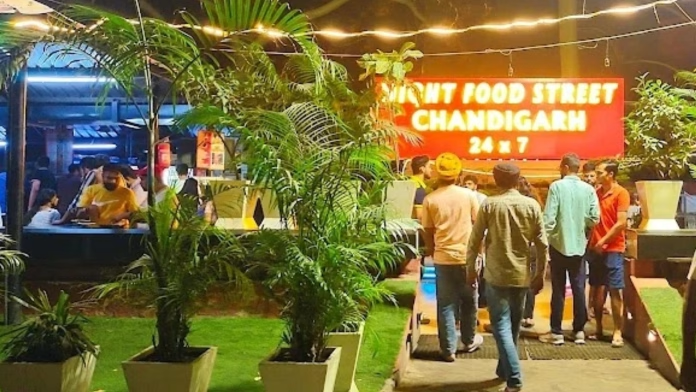
The Chandigarh municipal corporation has recently announced a price increase of 20% to 100% on 75 food items at the Night Food Street in Sector 14. This marks the first revision of prices in five years.

The food street, situated in close proximity to both PGIMER and Panjab University (PU), mainly serves students and patient attendants throughout the night.

A committee was formed to review the pricing of food items and recommended an increase of 20% to 100%, as well as changes to certain terms and conditions of allocation.

According to a municipal corporation official, the new rates will be implemented in the upcoming contract as the current agreement is set to expire in a few months.

The new prices for food items at the Night Food Street in Sector 14 have been announced. Tea will now cost INR 10, whereas it was previously INR 5, and coffee will be priced at INR 20 instead of INR 15. Additionally, the price of parantha will increase from INR 15 to INR 30, shahi paneer from INR 75 to INR 110, dal makhni from INR 45 to INR 70, and chilly paneer from INR 75 to INR 120.

The rate of the vegetarian thali has also been revised, increasing from INR 75 to INR 90, while the special vegetarian thali will now cost INR 120 instead of INR 100.

The municipal corporation has also approved a policy regarding temporary tables and chairs in front of eating joints. As per the new policy, the charges levied by the civic body will be based on the area covered outside by the joints, rather than the number of chairs and tables set up, which is the current practice.

Advertisement

OfBusiness ventures into food processing industry with acquisition of Koeleman India

0
ofbusiness

OfBusiness, a B2B marketplace, has expanded its operations into the food processing industry through the acquisition of Koeleman India, a subsidiary of Koeleman Foods International based in the Netherlands. The agreement involves the purchase of the entire 100% stake in the company.

According to ET’s report, the agreement has an estimated worth of approximately $10 million.

Koeleman India, located in Bengaluru, operates a food processing facility in Narsapura, Karnataka. The company specializes in processing various fruits and vegetables including gherkins, olives, and baby corn, among others. Additionally, it serves as a supplier of these products to prominent food corporations in the United States, Europe, and Australia.

Through the acquisition, OfBusiness will obtain access to Koeleman India’s food processing plant and the company’s export markets.

“The Indian food processing industry is witnessing many transactions in the branded and private label space, and this transaction signifies the growing appetite among large groups in expanding their presence in this high-growth segment,” Sreeraj Krishnamoorthy, vice president of Singhi Advisors, said.

The Koeleman Group received advisory services from Global Investment Bank Limited for this transaction.

OfBusiness was established in 2016 by Asish Mohapatra, Ruchi Kalra, Vasant Sridhar, Bhuvan Gupta, and Nitin Jain. The company primarily deals in purchasing raw materials, with a particular emphasis on agriculture and construction materials, for small and medium-sized enterprises (SMEs) throughout India. OfBusiness is supported by a number of investors, including SoftBank, Tiger Global, Norwest, Zodius, and Matrix Partners.

In addition to procuring raw materials for SMEs, OfBusiness offers cash-flow based financing to these businesses through its financial division, Oxyzo. In March of last year, Oxyzo achieved unicorn status.

OfBusiness saw a significant increase in its net profit in FY22, with a year-on-year (YoY) rise of 3.6X to INR 201.11 crore. The company’s revenue from operations also experienced substantial growth, increasing more than four-fold to INR 7,139 crore during the fiscal year that ended in March 2022.

OfBusiness has launched a mobile app that aims to onboard small, medium, and micro enterprises (SMEs), traders, farmers, and distributors. According to Nitin Jain, one of the Co-Founders of OfBusiness, the app provides information on raw material prices and industry news, thereby reducing market opacity.

Advertisement

Smart shopping tips: 5 groceries you should always have on hand and never buy at the last minute!

vegetables

We’ve all been there – you’re about to start cooking dinner and realize you’re missing a key ingredient. The temptation to run to the grocery store and grab what you need at the last minute is strong, but it’s not always the best idea. In fact, there are some groceries that you should never buy at the last minute, as they may not be fresh or of high quality. In this article, we’ll explore 5 such groceries and why it’s important to plan ahead when grocery shopping.

The Importance of Planning Grocery Shopping:

Planning ahead when grocery shopping has numerous benefits. For one, it can save you money, as you’re more likely to stick to a budget and avoid impulse buys. It can also save you time, as you’ll have a list of what you need and won’t have to wander aimlessly around the store. Additionally, planning ahead can help you make healthier choices, as you’ll have the opportunity to research recipes and make a list of ingredients accordingly.

When you do find yourself in a situation where you need to run to the store for a forgotten ingredient, it’s important to be mindful of what you’re buying. Certain groceries may not be fresh or of high quality when purchased at the last minute, which can affect the taste and nutritional value of your meals. 

5 Groceries You Should Never Buy At the Last Minute 

A. Light green avocados

Avocados are a popular ingredient in many dishes, from salads to guacamole. However, when it comes to buying avocados, you need to be careful. Light green avocados may look appealing, but they are not yet ripe. If you buy these avocados at the last minute, you may end up with unripe and hard avocados that are difficult to use.

Instead, look for avocados that are dark green or black in color. These avocados are ripe and ready to eat. You can test if an avocado is ripe by gently pressing on the skin. If it gives slightly, it is ready to eat.

B. Frozen meat and poultry

Frozen meat and poultry can be a convenient option when you’re running low on groceries. However, buying these items at the last minute can be risky. If the item has been thawed and refrozen multiple times, it can be unsafe to eat.

In addition, frozen meat and poultry may not be as fresh as fresh meat and poultry. If you plan on cooking the meat or poultry right away, you may be able to use frozen items. However, if you plan on storing the meat or poultry for later use, it is best to buy fresh items.

C. Tomatoes

Tomatoes are a versatile ingredient that can be used in many dishes. However, buying tomatoes at the last minute can be problematic. Tomatoes are fragile and can spoil quickly. If you buy tomatoes that are already starting to go bad, they may not last very long in your fridge.

Instead, look for tomatoes that are firm and free of blemishes. If you plan on using the tomatoes right away, you can buy ripe tomatoes. However, if you plan on storing them for a few days, it is best to buy slightly under ripe tomatoes.

D. Green bananas

Bananas are a popular fruit that can be used in many dishes or eaten on their own. However, buying green bananas at the last minute is not a good idea. Green bananas are not yet ripe and may be difficult to peel and eat.

Instead, look for bananas that are yellow or slightly green. These bananas are ripe and ready to eat. If you prefer your bananas to be a little firmer, you can buy slightly under ripe bananas. These bananas will ripen over the course of a few days.

E. Frozen fish

Like frozen meat and poultry, frozen fish can be a convenient option when you’re running low on groceries. However, buying frozen fish at the last minute can be risky. If the fish has been thawed and refrozen multiple times, it can be unsafe to eat.

In addition, frozen fish may not be as fresh as fresh fish. If you plan on cooking the fish right away, you may be able to use frozen items. However, if you plan on storing the fish for later use, it is best to buy fresh items.

There are certain groceries that you should avoid buying at the last minute. Light green avocados, frozen meat and poultry, tomatoes, green bananas, and frozen fish are all items that can be problematic if not purchased at the right time.   

Advertisement

Follow Varun Dhawan’s diet plan and sculpt your abs to perfection!

0
varun dhavan

Varun Dhawan, the popular Bollywood actor, has always been known for his charming looks, amazing acting skills, and his dedication to fitness. He is one of the fittest actors in the industry today and is known for his toned abs. Varun Dhawan’s abs have been the talk of the town for a while now, and people are always curious to know about his workout routine and his diet plan. 

Varun Dhawan’s abs diet plan:

Varun Dhawan’s abs diet plan is a well-balanced diet that includes healthy carbohydrates, proteins, and fats. He follows a strict diet plan to maintain his abs and ensure that his body is getting enough nutrients to support his workouts. Here’s a breakdown of his diet plan:

1. Breakfast:

Varun Dhawan starts his day with a high-protein breakfast that includes egg whites, oats, and a protein shake. He also includes a fruit like banana or apple to provide his body with the necessary carbohydrates.

2. Lunch:

For lunch, Varun Dhawan usually eats brown rice, grilled chicken, and vegetables. He avoids white rice and processed foods that are high in calories and unhealthy fats.

3. Snacks:

Varun Dhawan’s snacks are usually high-protein snacks like boiled eggs or protein bars. He also includes nuts like almonds or walnuts to provide his body with healthy fats.

4. Dinner:

For dinner, Varun Dhawan usually eats grilled fish or chicken with vegetables. He avoids carbohydrates at dinner and ensures that he eats his dinner at least two hours before going to bed.

5. Hydration:

Varun Dhawan ensures that he drinks at least 3-4 liters of water every day to stay hydrated. He also drinks coconut water and green tea to provide his body with essential nutrients and antioxidants.

6. Supplements:

Varun Dhawan also takes supplements like whey protein and multivitamins to ensure that his body is getting enough nutrients to support his workouts. 

Varun Dhawan’s abs diet is a combination of healthy eating habits and regular exercise. His diet focuses on consuming lean protein, healthy fats, and complex carbohydrates, while avoiding processed foods and sugars. 

Additionally, he includes a variety of fruits and vegetables in his diet to provide essential nutrients to his body. Along with a balanced diet, Varun also follows a strict exercise routine that includes weight training and cardio to help build muscle and burn fat. 

By following his disciplined approach to diet and exercise, Varun Dhawan has been able to achieve a toned and muscular physique that inspires many of his fans to adopt a healthier lifestyle. While it may not be easy to follow his diet and exercise regimen, incorporating some of his healthy habits into our own daily routine can help us lead a more fulfilling and healthy life.

Advertisement