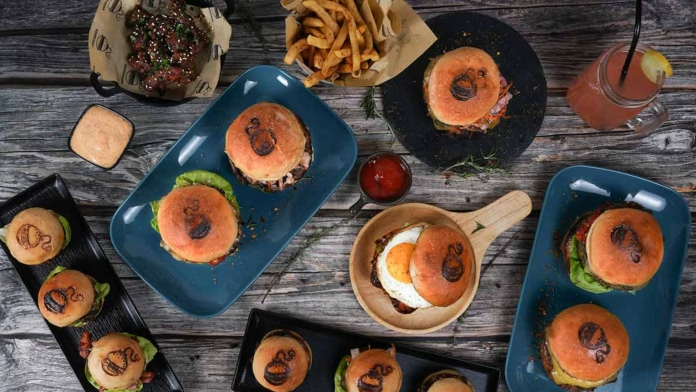
BoomBurger takes pride in its extraordinary burgers, meticulously handcrafted using an exquisite selection of genuine, top-tier ingredients carefully sourced from various corners of the globe. (Representative Image)
BoomBurger, the renowned cloud kitchen brand, has officially opened its doors to the public in the lively neighborhood of Andheri Lokhandwala, located in Andheri West, Mumbai. This eagerly anticipated launch brings the delectable flavors of BoomBurger to the doorstep of citizens, inviting them to indulge in a mouthwatering culinary experience.
BoomBurger takes pride in its extraordinary burgers, meticulously handcrafted using an exquisite selection of genuine, top-tier ingredients carefully sourced from various corners of the globe. This ensures that every bite retains the unparalleled flavors and essence of each remarkable creation.
The menu features classic burgers for the purists out there, inspired by some of the most famous burger joints in America, as well as burgers from left field, such as Boeuf Bourguignon, Masala Dosa, Thai Chicken Green Curry, Mushroom Alfredo, and Korean Fried Chicken. To complement the burgers, BoomBurger offers a variety of sides, including Boomfries, Boom Wings, K-Town Chicken Bites, Boom Sauce, Tomato Relish, and Sambar Mayo. The drinks menu features Pink Lemonade, Peach Iced Tea, and Lemon Iced Tea.
“We are thrilled to launch BoomBurger and offer our customers unique and delicious gourmet burgers at affordable prices. Our focus is always on quality, and we are excited to share our passion for food with our customers,” shared a representative of BoomBurger.
To mark its debut, the brand is rejoicing with enticing promotions on Zomato. Patrons now have the opportunity to enjoy a buy 2 get 1 free deal and exclusive flat 30% off discounts on their exquisite line of gourmet burgers, which pay homage to legendary dishes from various corners of the globe.
In an endeavor to transform its ownership model, Subway is actively seeking substantial franchisees in the United States. However, the global sandwich chain is encountering difficulties in persuading investors to come on board, mainly due to underwhelming restaurant profits and the existence of antiquated stores.
Two advisors have revealed that multiple multi-unit operators, who fit Subway’s criteria of being sophisticated and financially robust franchisees, considered the prospect of joining the chain by acquiring batches of restaurants. However, upon observing the meager profits generated, these operators chose to withdraw from the opportunity.
Lawyer Justin Klein and consultant John Gordon said their clients were deterred by low margins and the prospect of making necessary renovations.
In an effort to depart from its current reliance on small franchisees, many of whom operate just one or two shops and often struggle to sustain themselves, Subway announced its intentions to transition its business model. The company has shut down numerous U.S. locations since 2016.
In April, Subway organized its inaugural gathering exclusively for multi-unit owners, convening over 15 franchisees in Miami who were actively exploring avenues for expansion within the company.
During that same month, Subway made an announcement regarding five fresh agreements with multi-unit operators, involving the consolidation and transfer of over 230 existing restaurants. Interestingly, only two of these agreements entailed new owners entering the chain for the first time.
In a statement, Subway said, “There is strong interest in growth opportunities with Subway from multi-unit operators. All five multi-unit owner agreements were significant investments that demonstrate the confidence that both existing and new operators have in our brand and future.”
However, despite these developments, there are still concerns among certain major operators regarding Subway’s store-level profit margins. An undisclosed source, familiar with the chain’s unit economics and the criteria considered by prominent multi-unit franchisees seeking expansion, expressed this apprehension. Due to the confidential nature of the information, the source preferred to remain anonymous.
The average annual sales volume for Subway’s U.S. restaurants has not been disclosed by the company. However, industry experts and insiders estimate the figure to be less than $500,000, positioning it as one of the lowest in the industry.
According to QSR Magazine, Jersey Mike’s and Firehouse Subs, both competitors of Subway in the sandwich shop industry, generate annual sales volumes exceeding $1.1 million and $900,000 respectively. It is worth noting that Firehouse Subs is owned by Restaurant Brands International Inc.
Subway told Reuters that in May, it “achieved its highest weekly average unit volume in the U.S. since 2010,” but declined to disclose the dollar amount.
Unattractive:
At the International Franchise Expo in New York, Subway showcased its booth, featuring green, yellow, and white flyers highlighting the brand’s impressive over 12 percent comparable sales growth. The promotional material also outlined the desired characteristics Subway seeks in multi-unit operators, which include strong leadership, shared values, and a minimum net worth of $150,000 per location.
However, the feeling of attraction may not be mutual.
Klein, the franchise attorney, said that since 2022, his firm examined three multi-unit Subway deals on behalf of clients interested in investing in the chain for the first time. All three walked away, even as the firm did “a very healthy amount of restaurant M&A,” he said.
There are various reasons contributing to the lack of mutual attraction. These include concerns regarding the potential outcome if the company is acquired by private equity firms, potentially valuing it at $10 billion. Additionally, there are stores with limited value and others that require significant investments for equipment upgrades and renovations, further adding to the uncertainties.
“We couldn’t close any Subway deal. We’d love to, though,” Klein said. “Subway’s a solid brand, and for the right investor it’s a great opportunity.”
Consultant Gordon had discussions with a fast-food operator who was presented with an opportunity to oversee all Subway locations in Nevada and New Mexico. However, the operator eventually turned down the offer due to the narrow profit margins and the requirement to renovate the outdated stores, as explained by Gordon.
Franchise Times magazine’s ranking of the 100 largest multi-unit U.S. restaurant franchisees by revenue in 2022 revealed an interesting trend: none of these top franchisees had Subway in their portfolio. Instead, these leading franchisees owned numerous outlets of other popular chains, such as Wendy’s, Pizza Hut and Taco Bell (owned by Yum Brands), Burger King (owned by Restaurant Brands), Applebee’s (owned by Dine Brands), and various other brands.
“When we see more of those operators entering (Subway) for the first time, to me that’s a signal that the brand is on a different path,” said consultant Alicia Miller, Managing Director of advisory firm Catalyst Insight Group.
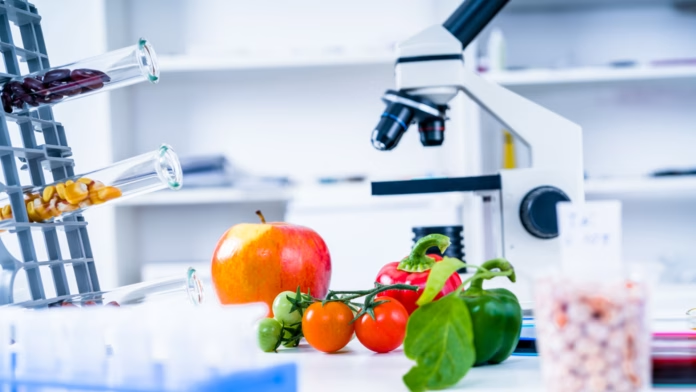
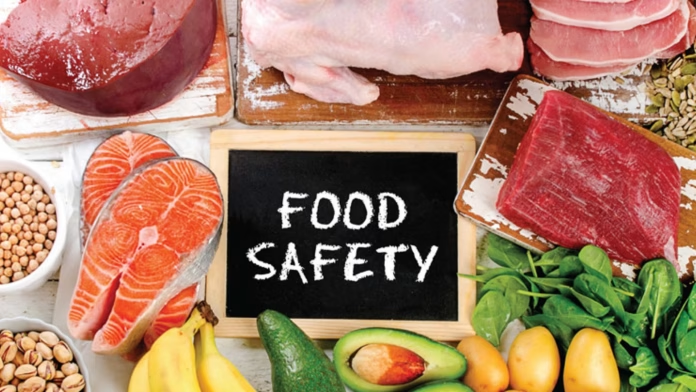
At present, the state of Nagaland possesses just a single food safety laboratory situated in Kohima, along with three Modified Food Safety on Wheels (MFSW) units. (Representative Image)
On Wednesday, Y Kikheto Sema, the Commissioner and Secretary for Health and Family in Nagaland, highlighted the absence of manufacturing and expiry tags on numerous imported food products within the state.
In order to ensure the provision of safe food to its residents, Y Kikheto Sema expressed concern that Nagaland should not be treated as a dumping ground for adulterated and sub-standard products. Sema further stated that the state government has made a request to the Central government to establish five essential food laboratories and Modified Food Safety on Wheels (MFSW) equipped with sufficient manpower.
At present, the state of Nagaland possesses just a single food safety laboratory situated in Kohima, along with three Modified Food Safety on Wheels (MFSW) units.
The official affirmed that once the necessary equipment and resources are in place, they will thoroughly examine both imported and locally produced food items. Any adulterated food will be banned from being sold within the state, ensuring the safety and quality of the food supply.
Underlining the significance of consuming high-quality food, Sema emphasized the need to establish well-regulated markets specifically designed for vegetable and fruit vendors.
Sema remarked that while clothes and cars are sold in air-conditioned markets, the essential items we consume, such as vegetables and fruits, are being sold on the streets, indicating a disparity in treatment.
Sema delivered his remarks during the commemoration of the 5th World Food Safety Day, which was organized by the Food Safety Authority (FSA) under the Department of Health and Family Welfare Nagaland. The event took place in the state capital, focusing on the theme “Food Standards Saves Lives.”
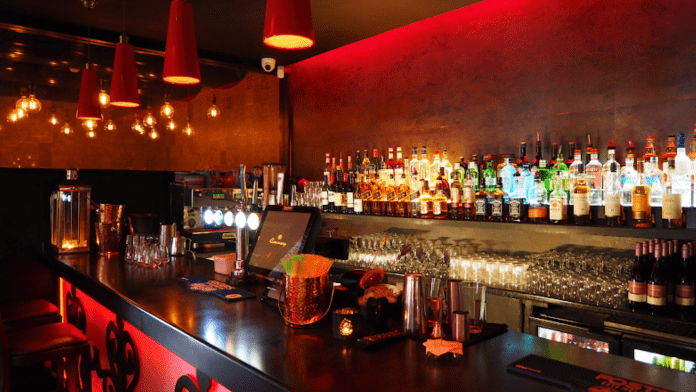
The Delhi excise department has issued a warning to hotels, clubs, and restaurants serving liquor. According to officials, these establishments face the risk of “stern action,” which includes the possibility of license cancellation, if they fail to install functional CCTV cameras on their premises. The department’s enforcement branch has observed instances of non-functional closed-circuit television (CCTV) cameras during routine inspections conducted at certain clubs, hotels, and restaurants.
“It hampers the inspection work of the excise department,” an official said.
According to a senior official from the department, inspection teams depend on CCTV footage acquired from hotels, clubs, and restaurants to identify violations. Unfortunately, the licensees frequently refuse to provide the footage, claiming that their cameras are not working properly.
“In view of the above, all the licensees of hotels, clubs and restaurants holding excise licences are hereby directed to ensure that the CCTV cameras are installed at appropriate locations within and outside the licensed premises and that they are properly functional and all the activities at the premises with a proper back-up of CCTV coverage are recorded without any break,” a notice issued recently by the department said.
Non-compliance will be “viewed seriously”, it added.
As per the notice issued, if the inspection teams discover non-functional CCTV cameras at hotels, clubs, and restaurants without a valid justification, it will be regarded as a deliberate lapse. In such cases, strict action, including the potential cancellation of the license, may be taken against the responsible party.
“During inspection, our teams face problems in verifying the claims of the licensees due to a lack of CCTV footage. A common excuse given by those against whom we have complaints is that the cameras are out of order,” the officer said.
The senior officer mentioned that there have been occurrences where licensees and their staff have engaged in altercations with inspection teams during raids.
“The licensees seek to disown any irregularities like more than the permissible number of seats allowed at their premises and such others. But when we demand CCTV footage from them, they claim it to be unavailable due to technical reasons,” the officer said.
The senior officer emphasized that the installation of CCTV cameras at licensed premises is a crucial requirement for obtaining an excise license. The owners of clubs, hotels, and restaurants serving liquor should not disregard this requirement, as it holds significant importance.
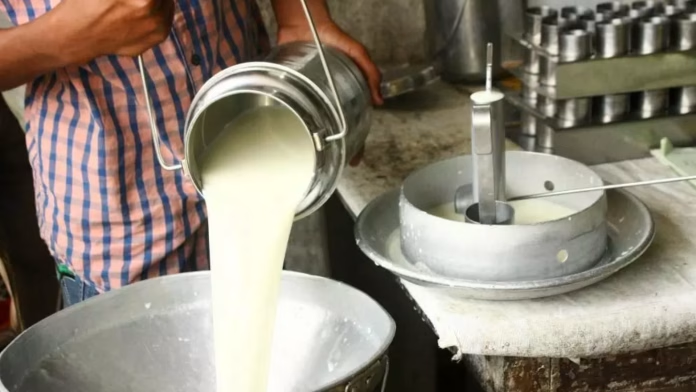
Through these FPOs, the government plans to facilitate the direct purchase of milk from producers at the village level, ensuring that they receive fair and suitable prices for their milk. (Representative Image)
With the aim of benefiting milk producers, the Uttar Pradesh government has initiated a proposal to set up dairy farmers producers organizations (FPOs). Through these FPOs, the government plans to facilitate the direct purchase of milk from producers at the village level, ensuring that they receive fair and suitable prices for their milk.
Inaugurating the Nand Baba Milk Mission Office and a Milk Development portal on Tuesday, animal husbandry and milk development minister Dharmpal Singh said, “INR 1,000 crore has been spent under the Nand Baba Milk Mission to develop the dairy sector over the past five years and now the government is making arrangements to purchase milk directly from milk producers in villages through milk cooperatives. To this end, there is a proposal to set up dairy FPOs. In 2023-24, we will carry out a pilot project by setting up a dairy FPO each in five districts, in which women will also play an important role.”
Rajneesh Dubey, the ACS (Animal Husbandry and Dairy Development), highlighted the significant prospects available for new industries to invest in the dairy sector. He further mentioned that the state government has introduced a dairy promotion policy with the objective of maximizing benefits for all stakeholders involved.
The minister also expressed a proposal to create a comprehensive database of milk producers within the state. This initiative aims to streamline the process of acquiring indigenous breeds of cows from other states, as well as provide incentives to progressive farmers for enhancing cattle breeding and related practices.
The minister stated that in order to effectively oversee the various projects under the Nand Baba Milk Mission, a committee led by the chief secretary has been established at the headquarters level. Additionally, committees headed by district magistrates have been formed at the district level. Furthermore, provisions have been made to distribute testing kits to farmers for cattle diseases and milk adulteration testing, ensuring the well-being and quality of the dairy industry.
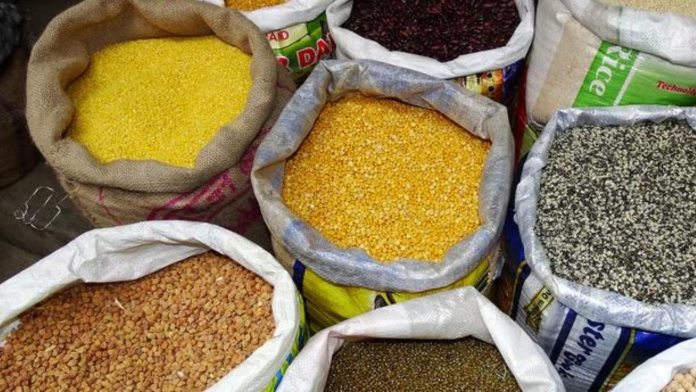
On June 2, the government took action by imposing a stock limit on tur and urad for retailers, wholesalers, importers, and processors. This measure will remain in place until October 2023. (Representative Image)
Following the government’s implementation of a stock limit on traders and processors on June 2, there has been a slight decline in the prices of tur dal. Nonetheless, the dal processing industry anticipates a sustained firmness in tur prices for the next three to four months due to a shortage in the supply.
The dal mills process raw whole tur beans to produce split tur or tur dal. Since January, the prices of ex-mill tur dal have risen by approximately 30%. Last week, the prices of unprocessed whole tur surpassed INR 100/kg, which is the government’s comfort level. This significant increase in prices is believed to be the motive behind the implementation of the stock limit.
On June 2, the government took action by imposing a stock limit on tur and urad for retailers, wholesalers, importers, and processors. This measure will remain in place until October 2023.
Stockists, traders, importers, and processors stated that they had anticipated the decision.
“The stock limit may not lead to much decline in tur prices as there is a shortage,” said Suresh Agarwal, President, All India Dal Millers’ Association. “When the production is less, nothing can help much to alleviate the prices.”
Trade sources said that at the current levels, many stockists have started booking profits in tur dal, which has improved the arrivals in the markets. “They are booking profit in tur and investing in chana and other commodities,” said a trader, who did not want to be identified.
Rupesh Rathi, a dal miller from Maharashtra, said, “Whole tur prices will remain above INR 100/kg as there is a shortage. Imports are also not enough.”
Zomato, the popular food and grocery delivery platform, has joined the ranks of companies eager to enhance the customer experience through cutting-edge technology. Sources have revealed that Zomato is now actively experimenting with generative artificial intelligence (AI). By incorporating this innovative technology into their operations, Zomato aims to streamline their services and provide customers with an even smoother and more efficient experience.
One of the sources revealed that the company based in Gurgaon, along with owning the quick commerce platform Blinkit, has intentions to expand its team by hiring engineers specialized in machine learning, data science, and natural language processing. The purpose behind this recruitment drive is to enable the development of AI-based products.
“Zomato has appointed a head of AI product development to drive these efforts,” the person said, adding that the team will be looking to integrate AI into various customer interfacing features such as search and notifications, in addition to backend tools such as product photography, customer support, etc. These tools will be built for both Zomato and Blinkit.
“A large part of customer communications within the app are already automated…but the integration with generative AI will be able to handle the increasing loads more efficiently and effectively,” the person added.
The development was confirmed by a spokesperson from Zomato.
According to the spokesperson, “Over the past year, Zomato has tuned neural networks that predict food preparation and delivery time, amongst other things. Similarly, Blinkit has used machine learning to optimise supply-chain cost and reduce delivery times.”
“We are experimenting with generative AI. For example, Blinkit now provides almost unlimited recipes, along with ingredients required, on its app,” he addded.
Internet companies worldwide are rapidly integrating AI tools to enhance their services.
Recently, MakeMyTrip Founder Deep Kalra revealed the company’s ambitions to harness the power of generative AI in order to build core capabilities. As part of this initiative, MakeMyTrip intends to collaborate with industry leaders to develop and refine advanced AI tools tailored for their online travel agency platform.
It has come to light that Zomato is actively engaged in product development within the AI domain, collaborating with notable companies such as Google, Adobe, OpenAI, Microsoft, and more. By partnering with these industry leaders, Zomato aims to leverage their expertise to enhance and innovate its offerings in the field of artificial intelligence.
“Zomato and Blinkit have continuously hired engineers with machine learning skills for the past few years,” the Zomato spokesperson said. “We are always on the lookout for talented engineers who can help us develop new models to create services that delight the customers and bring efficiency to business processes.”
In a recent blog post, Albinder Dhindsa, the Chief Executive of Blinkit, shared exciting news about the development of “Recipe Rover.” This innovative engine, powered by ChatGPT and Midjourney, was created by a dedicated team of engineers and a product manager at Blinkit. Its primary function is to suggest recipes and assist users in finding the necessary ingredients.
ChatGPT and Midjourney are two distinct generative AI engines crafted by prominent entities in the field. ChatGPT is an innovative creation of OpenAI, while Midjourney Inc., based in California, has developed its own advanced generative AI engine. These engines possess unique capabilities and contribute to the cutting-edge advancements in the field of AI technology.
The tech world has been captivated by the remarkable abilities of generative AI models like OpenAI’s ChatGPT and Google’s BARD. These models have gained significant attention for their capacity to tackle intricate inquiries, generate code, and produce content by leveraging expansive language models. By accepting straightforward text inputs, they are capable of delivering human-like responses, showcasing the immense potential of these large language models.
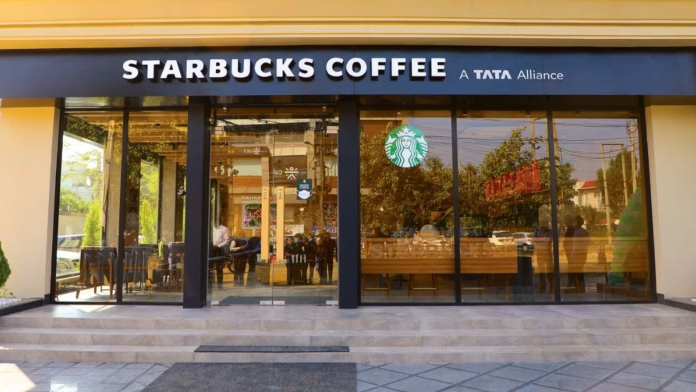
In a bid to expand its presence in small towns and counter the intense competition posed by domestic startups, Starbucks is overhauling its strategy to entice Indians, even children, with a range of smaller and more economical beverages. This move comes as the company aims to solidify its position in one of its fastest-growing markets.
As one of the pioneering foreign coffee brands to venture into tea-loving India, Starbucks has achieved the milestone of opening 343 stores over a span of nearly 11 years. However, this growth rate pales in comparison to the rapid expansion of domestic chains Third Wave and Blue Tokai, backed by private equity, which have successfully launched approximately 150 stores in the last three years alone.
“As you grow in size, you need to get new consumers,” said Sushant Dash, the Chief Executive of Starbucks in India, adding that the chain’s “pricing play” would help shatter a perception that it is expensive.
As part of its strategic revamp to cater to the preferences of affluent Indians who favor smaller portions, the company has introduced a new beverage called “Picco.” This six-ounce drink is priced at $2.24, offering a more affordable option. Additionally, Starbucks has also included milkshakes on its menu, priced at $3.33, further expanding its offerings to appeal to its target audience.
According to an undisclosed industry source, Starbucks intends to expand its presence by opening additional stores in smaller towns.
The new offerings from Starbucks are exclusive to India and not available in China, Singapore, or the United States.
According to Euromonitor’s estimations, India’s specialty tea and coffee cafe market, though relatively small, is valued at $300 million and projected to grow by 12% annually. In addition to Starbucks, Tim Hortons from Canada and Pret A Manger from Britain are also expanding their presence in the market, albeit with only a few outlets.
“Excessively large portion sizes are an American phenomenon,” said Devangshu Dutta, head of retail consultancy Third Eyesight.
“Indian consumers are value-conscious. If adjusting portion sizes down to what is more normal helps make prices accessible, that’s a double win.”
As an analyst, he was among those who believed that the move by Starbucks, operating in India through a joint venture with Tata Group, had the potential to enhance its sales further. In the fiscal year 2022/23, Starbucks achieved a record-breaking sales figure of $132 million.
While Starbucks continues to maintain its dominance in India, competition is brewing in the capital city of New Delhi and the technology hub of Bengaluru. In these areas, numerous Third Wave cafes are frequently packed with customers, rivaling the popularity of Starbucks outlets.
“We’ve lost 30 cups a day to them,” said a barista at a Starbucks shop in Delhi that sells 7,500 drinks a month, referring to a Third Wave that opened nearby months ago, but already sells 3,700.
In various regions, Starbucks has encountered competition from local contenders, with China being the most prominent example. With 6,200 stores, Starbucks caters to the largest market outside of the United States in China.
Over the past five years, Luckin Coffee has employed discount strategies to attract customers to its primarily pickup or delivery-focused network of 10,000 stores in China.
BET ON CHAI:
In India, Starbucks has continuously incorporated domestic elements into its offerings to enhance their appeal. However, the company is now intensifying these efforts, following the footsteps of global giants such as McDonald’s and Domino’s.
According to estimates, only 11% of Indian households consume coffee, while a significant majority of 91% prefer tea. Hot milky tea, known as “chai” in Hindi, is readily available at roadside stalls, where hundreds of cups are sold each day for as low as 10 rupees (equivalent to 12 U.S. cents).
Previously, Starbucks had only one milk chai “latte” on its menu, prepared using tea syrup. However, the company has now introduced “Indian-inspired” tea options infused with popular spices like cardamom, which are beloved in many Indian households. These tea offerings, starting at INR 185 ($2.24), aim to cater to the local preferences and flavors.
The drinks were introduced to attract those who do not drink coffee and shun Starbucks, said Dash, adding the company would retain its focus on coffee and not make chai a primary offering.
The launch of smaller, cheaper beverages in India indicates Starbucks may have seen “a decline in traffic related to a pushback” on higher prices, said Chas Hermann, a U.S.-based restaurant consultant and former Starbucks executive.
COMPETITION, SMALL CITIES PUSH:
In May, a YouTube video captured scenes reminiscent of Starbucks’ initial opening in India, as people lined up outside the first Starbucks store in the city of Aurangabad. The attraction was a one-for-one offer, drawing customers to eagerly queue up in anticipation of their visit.
However, its competitors are catching up swiftly, and a price war has ensued in the market.
Shortly after Starbucks introduced their milkshakes priced at $3.33, specifically targeting children, Third Wave responded by launching their own line of milkshakes at a price 20% lower, at $2.71.
In Bengaluru, Third Wave outlets have become popular meeting spots for startup investors and founders. Surpassing Starbucks, Third Wave currently operates over 40 stores in the city, according to data from real estate analytics firm CRE Matrix, whereas Starbucks has 35 stores.
Third Wave’s Chief Executive, Sushant Goel, said he planned to add 60 to 70 stores every year, with a focus on big cities. He saw Starbucks’ cheaper, small-sized drinks as a response to competition in “an incredibly price-sensitive market”.
Matt Chitharanjan, Chief Executive of Blue Tokai, said it had “seen success in converting customers from Starbucks”, partly because of lower prices.
Despite the presence of competition, Dash expressed his unwavering determination. On the other hand, Starbucks acknowledges the threat posed by rivals, although they do so discreetly.
During the review of a lease agreement for a Bengaluru mall, Reuters discovered that Starbucks included a clause of “cafe exclusivity.” This provision prevents the mall owner from allocating space to competing “premium” brands, such as Third Wave and Blue Tokai, on the same floor as Starbucks.
“Going deeper into smaller cities, beyond the metros, is the only way to grow,” said Ankur Bisen, Head of retail at India’s Technopak Advisors.
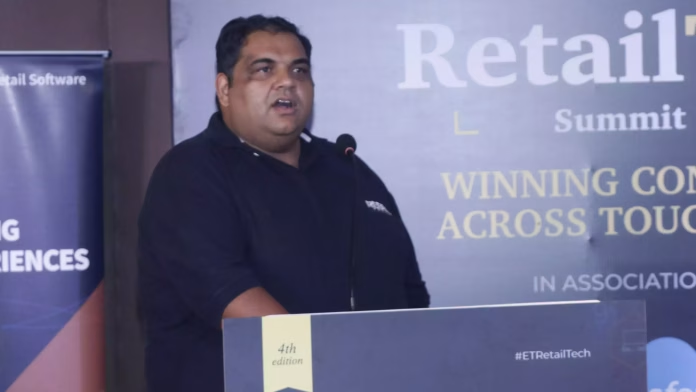
Ankush Grover recounted the inspiring story of Rebel Foods, underscoring the brand's dynamic utilization of technology across its kitchen operations to effectively run a multitude of restaurants and brands.
At the fourth edition of the ETRetail Tech Summit in Mumbai, Ankush Grover, Co-Founder of Rebel Foods, highlighted the transformative impact of convenience on the eating experience for consumers. He emphasized that the ease of food ordering, order tracking, and streamlined payment processes are revolutionizing and completely reshaping the way people enjoy their meals.
“The old system was to go to a restaurant and wait in line to order food. The introduction of online food ordering systems has changed the entire generation with convenience across ordering, tracking, paying, and eating.”
Grover recounted the inspiring story of Rebel Foods, underscoring the brand’s dynamic utilization of technology across its kitchen operations to effectively run a multitude of restaurants and brands. By leveraging the power of technology, Rebel Foods has experienced exponential growth, elevating its kitchen count from 200 to an impressive 400, while also venturing into international markets. The brand’s successful entry into the UAE and Indonesia was driven by its unwavering commitment to building a supply chain infused with state-of-the-art technology, enabling seamless operations and scalability.
Furthermore, Rebel Foods has extended its reach by providing its advanced technology operating system to other food brands, enabling them to expand and operate more efficiently. Simultaneously, the company has embarked on an active investment strategy, acquiring other brands to further strengthen its portfolio. In a strategic move to enhance its offerings, the food-tech unicorn has also unveiled its own food court, featuring a diverse selection of its renowned brands under one roof.
Presently, Rebel Foods boasts an impressive collection of over 45 brands under its umbrella, showcasing its diverse culinary offerings. With a remarkable global presence, the company has established a staggering network of 4,000 internet restaurants, solidifying its position as a prominent player in the food industry worldwide.
In an official statement released on Wednesday, the Ministry of Health and Family Welfare announced that Kerala has emerged as the top-performing state in the food safety index. The fifth edition of the State Food Safety Index was unveiled by Dr. Mansukh Mandaviya, the Union Minister for Health and Family Welfare, on World Food Safety Day (June 7). The index serves as an evaluation tool to gauge the performance of states and union territories across six distinct aspects of food safety, as outlined by the ministry.
According to the statement, Kerala has secured the top ranking among the larger states, followed by Punjab and Tamil Nadu. Among the smaller states, Goa has emerged as the leader, followed by Manipur and Sikkim. Additionally, among the union territories, Jammu and Kashmir, Delhi, and Chandigarh have secured the first, second, and third ranks respectively.
Chief Minister Pinarayi Vijayan took to Twitter to congratulate the state for the achievement. Vijayan said that the “historic achievement” by the state was thanks to the various initiatives such as the food safety grama panchayat scheme implemented in 140 panchayats and the Safe and Nutritious Food at School project carried out in 500 schools.
Proud moment as #Kerala tops the State Food Safety Index 2023 in the large state category by @fssaiindia! It comes as a deserving recognition of GoK's committed efforts in the sector, including the exemplary implementation of Safe and Nutritious Food at School.
— Pinarayi Vijayan (@pinarayivijayan) June 7, 2023
In a Facebook post, he mentioned that in addition to the aforementioned rankings, numerous food safety awareness classes were conducted at the state level for the general public. This initiative played a significant role in contributing to their success.
According to State Health Minister Veena George, the state has not only attained the highest position in the food safety index but also witnessed a twofold increase in revenue for its food safety department during the 2022-23 fiscal year compared to the previous financial year of 2021-22.
As per the statement, the award, which included a trophy and plaque, was conferred by Union Minister for Health and Family Welfare Mansukh Mandaviya. On behalf of Kerala, the honor was accepted by Food Safety Commissioner V R Vinod.
Dr Mandaviya announced that 2,500,000 food business operators will be trained by FSSAI in the next 3 years to ensure that food quality standards are met across the country. He also announced the setting up of 100 Food Streets across the country which meet the quality benchmark for food safety, hygiene, and nutrition. “Food quality is a part of wellness”, Dr Mandaviya said.
We use cookies to ensure that we give you the best experience on our website. If you continue to use this site we will assume that you are happy with it.