Sunday, December 21, 2025
Home Blog Page 1057

Never settle for boring meals again: Learn the healthy cooking tricks Master Chefs swear by!

healthy cooking tricks

In the world of culinary artistry, master chefs possess an array of secret techniques and tricks that elevate their dishes from ordinary to extraordinary. While taste and presentation are paramount, these culinary maestros also prioritize the health and well-being of their patrons. In this article, we will delve into the realm of master chefs and unveil the healthy cooking tricks they swear by, enabling you to create flavorful, nutritious, and unforgettable meals in your own kitchen.

The Art of Flavor Enhancement: Master chefs have mastered the art of flavor enhancement, turning simple ingredients into culinary masterpieces. Here are some healthy cooking tricks they employ to elevate the taste of their dishes:

  • The Power of Herbs and Spices: Herbs and spices are the secret weapons of master chefs. These flavorful additions can transform a bland dish into a sensory delight. Experimenting with herbs like basil, cilantro, and thyme, as well as spices such as cumin, paprika, and turmeric, can add depth and complexity to your meals without relying on excessive salt or unhealthy fats.
  • Embracing Citrus: Citrus fruits, such as lemons, limes, and oranges, are prized by master chefs for their ability to brighten flavors. A splash of citrus juice or zest can provide a burst of tanginess that enhances the overall taste of a dish. Additionally, the natural acidity in citrus fruits can help tenderize meat and act as a healthier alternative to vinegar or processed condiments.
  • Building Layers of Flavor: Master chefs understand the importance of building layers of flavor. This involves sautéing aromatics like onions, garlic, and ginger to release their natural oils and create a flavorful base for the dish. By incorporating this technique into your cooking, you can elevate the taste profile of your meals and reduce the need for excessive salt or unhealthy additives.
  • Exploring Umami: Umami, the fifth basic taste, adds a savory and satisfying element to dishes. Master chefs harness the power of umami by incorporating ingredients like mushrooms, tomatoes, miso paste, soy sauce, and nutritional yeast. These umami-rich ingredients lend depth and complexity to vegetarian and vegan dishes, making them incredibly satisfying.

Healthier Cooking Techniques: Master chefs not only prioritize flavor but also employ cooking techniques that promote healthier eating. By adopting these techniques, you can create nutritious and delicious meals without sacrificing taste:

  • Grilling and Roasting: Grilling and roasting are excellent cooking methods that enhance flavor without adding excessive fat. Grilling imparts a smoky flavor to vegetables, lean proteins, and seafood, while roasting caramelizes the natural sugars in vegetables, resulting in rich flavors and appealing textures. These techniques require minimal added fats, making them healthier alternatives to deep-frying or sautéing in oil.
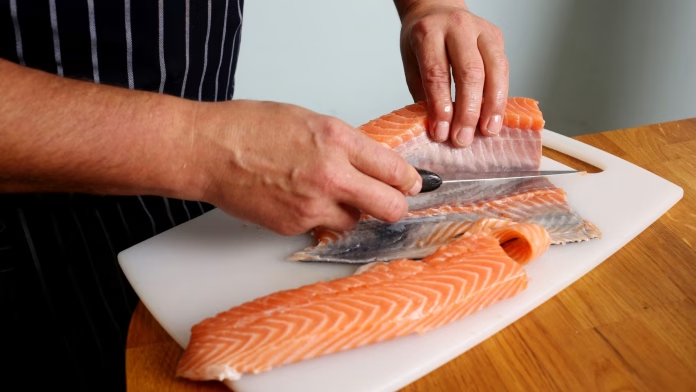
  • Steaming: Steaming is a gentle cooking method that preserves the natural flavors, colors, and nutrients of ingredients. By using a steamer basket or bamboo steamer, you can cook vegetables, fish, and poultry to perfection without the need for added oils or fats. Steaming not only retains the nutritional integrity of the food but also imparts a delicate and moist texture.
  • Stir-Frying: Stir-frying is a quick and efficient cooking technique that involves high heat and minimal oil. It allows for the retention of nutrients and vibrant colors in vegetables while creating a deliciously crisp texture. By using a small amount of heart-healthy oils like olive oil or sesame oil and incorporating an array of vegetables, lean proteins, and aromatic spices, you can create a well-balanced and flavorful stir-fry.
  • Sous Vide Cooking: Sous vide is a technique widely used by master chefs to achieve precise and consistent results. It involves vacuum-sealing ingredients in bags and cooking them in a water bath at a controlled temperature for an extended period. Sous vide cooking ensures that flavors are locked in while preserving the nutrients and tenderness of the food. This technique also reduces the need for added fats or oils.

Creative Ingredient Substitutions: Master chefs are masters of improvisation, often swapping out ingredients to create healthier versions of classic dishes. Here are some creative ingredient substitutions they swear by:

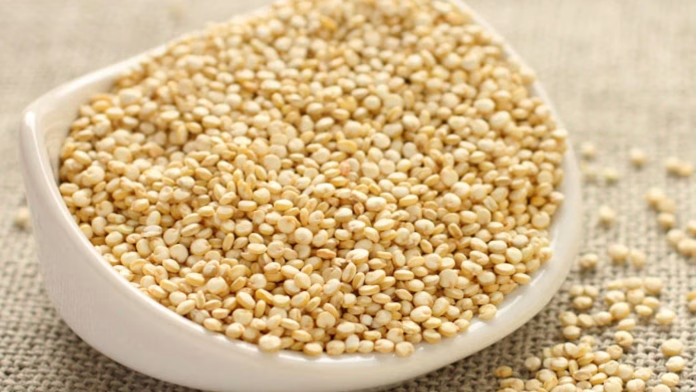
  • Whole Grain Alternatives: Master chefs often substitute refined grains with whole grain alternatives like quinoa, brown rice, or whole wheat pasta. These options are higher in fiber, vitamins, and minerals, providing a healthier and more satisfying meal.
  • Plant-Based Swaps: To add a nutritional boost to their dishes, master chefs incorporate plant-based swaps. For example, they might substitute animal protein with legumes, tofu, or tempeh, providing a plant-powered alternative that is high in protein and low in saturated fat.
  • Healthier Fats: Rather than relying on unhealthy fats, master chefs opt for healthier options like olive oil, avocado oil, or coconut oil. These fats provide essential nutrients and can add a subtle flavor to dishes, enhancing taste without compromising health.
  • Natural Sweeteners: Instead of using refined sugars, master chefs experiment with natural sweeteners like honey, maple syrup, or dates. These alternatives offer a touch of sweetness while providing additional nutrients and a lower glycemic impact.

Mindful Portion Control and Plating Techniques: Master chefs understand that presentation plays a vital role in the enjoyment of a meal. They employ mindful portion control and plating techniques to create visually appealing and satisfying dishes. By using smaller plates, arranging food artfully, and balancing colors and textures, you can enhance your dining experience and promote mindful eating. This mindful approach can help you savor each bite, control portion sizes, and ultimately prevent overeating.

Final Thoughts:

Elevating your cooking skills and creating healthy yet delicious meals is within reach. By incorporating the healthy cooking tricks master chefs swear by, you can transform your culinary endeavors and never settle for boring meals again. From flavor enhancement and healthier cooking techniques to creative ingredient substitutions and mindful plating, these tricks will empower you to create nourishing and memorable dishes that cater to both your taste buds and your well-being. So, step into the kitchen with confidence, embrace your inner culinary artist, and let these master chef-approved techniques guide you on a journey of culinary excellence and better health.

Advertisement

TVS Motor Company and Zomato collaborate to electrify delivery fleet: 10,000 electric scooters to be deployed in 2 years

0
Zomato
(Representative Image)

TVS Motor Company has announced a new partnership with Zomato, the popular online food delivery platform. Under this collaboration, TVS Motor Company will deploy 10,000 electric scooters in Zomato’s delivery fleet over a period of two years.

According to a regulatory filing, TVS Motor Company stated that this partnership aligns with their dedication to green and sustainable mobility solutions. They emphasized that it reinforces their journey towards electrification in various mobility sectors.

Additionally, it complements Zomato’s initiatives aimed at facilitating the integration of electric vehicles (EVs) among their last-mile delivery associates, the company stated.

“With the success of TVS iQube Electric, we are expanding our electric offerings across multiple segments and last-mile delivery services stand at the opportune inflection point towards faster adoption of EVs,” TVS Motor Company, Senior Vice President, Electric Vehicles, Manu Saxena said.

He further said, “This strategic partnership adds another milestone in TVS Motor’s journey to provide smart and reliable EV products and services with the lowest total cost of ownership to our delivery partners.

As part of the partnership, TVS Motor has announced plans to roll out over 10,000 TVS electric scooters within a two-year timeframe.

The company additionally stated that it would guarantee access to charging stations for delivery partners onboarded on Zomato within their proximity. Moreover, it emphasized the importance of seamless digital integration to facilitate a hassle-free delivery experience for the partners.

Zomato Chief Operations Officer, Rinshul Chandra said Zomato is committed to 100 per cent EV adoption by 2030, and is “the first food ordering and delivery platform to join Climate Group’s EV100 campaign”.

The company is now partnering with over 50 companies in the EV ecosystem with the intent of onboarding over 1 lakh EV-based delivery partners on its platform within the next two years, he added.

“This association with TVS Motor adds further momentum to our commitment, given their global repute in the sustainable mobility domain,” Chandra said.

TVS Motor Co announced that as a part of their partnership, they handed over 50 TVS iQube Electric scooters to delivery partners who joined Zomato. The event took place in Hyderabad, and the scooters were provided through a fleet operator called Chartered Bikes Pvt Ltd x BLive.

Having ventured into the electric mobility sector in 2020, the company proudly announced the sale of more than 100,000 electric vehicles (EVs).

Advertisement

Indian liquor industry witnesses 14% growth in sales volume in FY23, premium segment priced over INR 1,000 surges by 48%

0

According to the industry body CIABC, sales of Indian-made foreign liquor (IMFL) experienced a 14 percent increase in volume, reaching 385 million cases in the fiscal year 2022-23. Notably, premium IMFL products priced over INR 1,000 per 750ml bottle saw remarkable growth, rising by 48 percent. These sales figures indicate that the impact of Covid-19 has completely subsided, as they are nearly 12 percent higher than the pre-pandemic levels of FY 2019-20.

The industry is projected to witness a growth of 8 percent in the current fiscal year, as stated in a report by the Confederation of Indian Alcoholic Beverage Companies (CIABC). The report highlights that the industry is expected to reach a volume of around 412-415 million cases, with each case containing 9 liters.

In the fiscal year 2023, whisky retained its position as the largest segment within the industry, accounting for 63 percent of the total sales. It is projected to achieve a sales volume of approximately 243 million cases, solidifying its significant presence in the market.

Moreover, after many years of decline, Gin seems to have reversed the trend and is back in growth, added the report CIABC, which is the apex body of the Indian Alcoholic Beverage Industry.

As per the report’s findings, the liquor industry has observed a persistent trend of premiumization, wherein consumers increasingly opt for higher-priced offerings.

“Higher price segments are growing much faster than the lower segments and the share of brands above INR 500 per 750ml bottle is now at 20 per cent,” it said, adding the price segment of INR 1000 and above is dominated by imported products and reported 48 per cent growth.

Approximately 79 percent of total sales in the market are attributed to low-priced products, which are sold at prices below INR 500 per 750ml bottle, signifying their continued dominance in the industry.

Of the total sales, approximately 21 percent were attributed to products priced between INR 500 to INR 1,000, while a modest 3 percent came from higher-priced offerings above INR 1,000, primarily comprising imported goods.

According to the report, there has been an increase in the market share of Indian products priced at INR 1,000 and above, rising from 18 percent to 20 percent in FY23. This indicates a faster growth rate for Indian products in this segment compared to their imported counterparts.

CIABC Director General Vinod Giri said, “Liquor industry has sailed through the adverse impact of the Corona pandemic on sales. After a slowdown for couple of years, we are again on fast sales growth path.”

The CIABC report states that with few exceptions, consistent growth has been observed across various regions in India.

“It has grown by 32 per cent in Western region, 22 per cent in Eastern region, 16 per cent in Northern region and 9 per cent in the Southern region,” it said.

Like earlier, the Southern region has remained the largest contributor to sales volume with 58 per cent share followed by West and East, which contributed 22 per cent equally.

With the North region contributing 16 percent of the overall sales, it is worth noting that states like Punjab have witnessed a remarkable growth of 54 percent compared to the previous year.

“This appears that the new excise policy has had a very positive effect in a state where IMFL segment has historically been very sluggish and smaller compared to even neighbouring states including Himachal and Uttarakhand,” it said.

Despite facing challenges such as disruptions caused by excise policy changes and the unavailability of numerous brands, Delhi managed to maintain a robust year-on-year annual growth rate of 36 percent.

“However, a closer analysis shows that much of this growth is attributed to the First quarter of 2022-23 when various trade schemes and promotions were run to liquidate the stock in view of the impending changes in the excise policy. Thereafter sales growth has been trending down reaching negative range,” it said.

Nevertheless, certain states experienced a decline in sales. For instance, Telangana witnessed a decrease of 6 percent, while UP saw a slight decline of 1 percent, and Uttarakhand observed a decrease of 3 percent in sales.

According to CIABC’s outlook, it anticipates a recovery in sales for Telangana and Uttarakhand, while expecting other states to maintain their growth momentum.

“Following the likely Growth Momentum, we expect the liquor industry to end the year FY 23-24 to end around 412-415 million cases which would be a growth of 7-8 per cent,” it said.

CIABC said it may see challenges in UP, West Bengal and Delhi unless appropriate regulatory interventions are made in these states.

Advertisement

SPAR Hypermarket joins ONDC, expands reach and accessibility for customers

0
SPAR Hypermarket
SPAR Hypermarket (Representative Image)

SPAR Hypermarket, a subsidiary of the multinational conglomerate Landmark Group, made an official announcement on Tuesday via a media release stating its membership in the Open Network for Digital Commerce (ONDC).

With this integration, SPAR Hypermarket’s D2C catalog can now be viewed on all apps that consumers are using within a rapidly developing network. This significant advancement will empower the hypermarket chain to expand its customer base by ensuring that its products are accessible to all buyers on ONDC.

The move will help the brand grow its presence across the country and help achieve its goal of aligning with the new-age shopper by being present across easy points of access.

Vipin Bhandari, Managing Director and Chief Executive Officer, Max Hypermarket India, said, “As a brand that is always looking to innovate and disrupt the market, joining ONDC is a great move for us.

T Koshy, Managing Director and Chief Executive Officer of ONDC, said, “As ONDC network aims to create a transparent e-commerce ecosystem creating equal opportunities for all, we are happy to see SPAR Hypermarkets get on board.”

Initially, SPAR intends to commence its services catering to shoppers in Bangalore before gradually extending its reach to encompass other popular regions within the ONDC (Open Network for Digital Commerce) framework.

Advertisement

ONDC introduces fully automated grievance redressal system and plans online resolution mechanism to enhance services

0
ONDC
ONDC

ONDC, the government-promoted Open Network for Digital Commerce, is making significant strides in enhancing its service offerings. T Koshy, the CEO of ONDC, announced on Tuesday that the platform now boasts a fully automated grievance redressal system. Furthermore, ONDC is actively working on implementing an online resolution mechanism to further streamline the resolution process.

The ONDC (Open Network for Digital Commerce) is a strategic endeavor established by the Ministry of Commerce and Industry with the aim of fostering a supportive framework that empowers small retailers to leverage the opportunities presented by digital commerce.

The ONDC is not merely an application, platform, intermediary, or software. Instead, it is a comprehensive set of specifications meticulously crafted to promote the development of open, unbundled, and interoperable networks.

Read More: How to use ONDC – The affordable food delivery app that’s creating waves against Swiggy and Zomato

“Just like ONDC enables searching for a product and buying for a product… it also enables (filing of) complaints. The complaints seamlessly go through from the buying side to the selling side… In addition to the completely automated grievance redressal… we are also enabling an online dispute redressal system,” Koshy said at industry body CII’s MSME Growth Summit.

Established on December 31, 2021, ONDC is registered as a Section 8 company.

Furthermore, he expressed that over the past few months, ONDC has achieved noteworthy progress, with the number of sellers and service providers on the network surpassing one lakh, while the network participants have exceeded 50.

Advertisement

CCL Products to establish high-tech coffee plant in Andhra Pradesh, invests INR 400 Crore

0
CCL
CCL Products (India)

CCL Products (India) Ltd, previously recognized as Continental Coffee Ltd, has announced its plans to establish a state-of-the-art manufacturing facility at Continental Coffee Park, located in the village of Kuvvakolli in Tirupati district, Andhra Pradesh. This ambitious project entails a substantial investment of INR 400 crore.

Situated across a vast expanse of 22 acres, the plant is geared to produce spray-dried instant coffee with an impressive annual capacity of 16,000 metric tonnes.

During a press conference held on Tuesday, Challa Rajendra Prasad, Founder and Chairman of CCL Products, revealed that production at the new plant is scheduled to commence in the fourth quarter of the current financial year. He further mentioned that the funding for the new plant will be sourced through internal accruals and a partial term loan.

In a noteworthy event last week, Andhra Pradesh Chief Minister YS Jagan Mohan Reddy initiated the establishment of the new plant, which is anticipated to create over 100 direct job opportunities. Starting with modest origins, the company has experienced remarkable growth over the past 28 years, progressing from a manufacturing setup with a capacity of 3,000 tonnes per annum (TPA) to an astonishing 55,000 TPA.

Currently, CCL possesses a total of four manufacturing plants, with two located in India and one each situated in Vietnam and Switzerland.

Advertisement

Beer sales in Delhi plunge 52% in May due to extreme weather conditions and supply issues

0
beer

According to the Delhi government’s excise department, beer sales in Delhi experienced a significant decline of 52% in May this year compared to 2022. This drop in sales is attributed to the weather conditions, specifically the occurrence of temperatures exceeding 40 degrees Celsius on 16 days until May 31.

Industry sources have reported several factors contributing to the issue, such as a reduced variety and emphasis on specific brands, unavailability of chilled options in retail shops, limited stock in stores, and companies redirecting their product supply to states with higher profit margins.

In May of this year, beer sales in Delhi amounted to 8.3 million liters, a significant decrease compared to the 17.3 million liters sold during the same month last year. Furthermore, during the first five months of 2023, beer sales reached 31.1 million liters, reflecting a notable decline of approximately 43% compared to the corresponding period in the previous year.

Beer sales have seen a substantial drop of over 40% this year compared to 2022 and pre-Covid periods. In 2019, before the impact of the pandemic, the month witnessed sales of 12.6 million liters.

Delhi boasts a network of 574 retail shops along with approximately 900 hotels, restaurants, and clubs.

During the initial five months of 2023, the cumulative beer sales amounted to 31.1 million liters, representing a decline of nearly 43% compared to the 54.2 million liters sold during the corresponding period in 2022. In 2019, a total of 49.5 million liters had been sold in the same five-month period.

According to excise officials, beer currently accounts for over one-third of the total volume of liquor sales during the peak summer season. However, industry insiders argue that the potential for beer sales is much higher, given the prolonged duration of intense heat and high humidity levels in Delhi, which lasts for approximately six months of the year. Unfortunately, policy changes implemented midway through 2022 have resulted in a significant decline of nearly 50% in beer sales.

“Due to poor availability, those living close to border areas prefer going to Haryana and UP to buy the stock. So, the sales in neighbouring towns have been steadily increasing at 15-20% annually,” said a liquor company official.

AB InBev, a prominent player in the beer industry, highlighted the notable disparity in the availability of alcoholic beverages between Delhi and neighboring cities such as Gurgaon and Noida. According to an official, despite placing orders, liquor stores in Delhi occasionally fail to collect their stock, resulting in a lack of availability.

“We seek a level playing field across retail vends in Delhi, which is an important market. Availability of our premium brands across off-trade channels (shops) is totally divergent to our wide availability across on-trade channels in hotels, restaurants, bars and clubs in the city,” an AB InBev spokesperson said, adding, “We are working with the state corporations to make our brands available across shops in Delhi.”

As per a senior official from the excise department, although certain shops were favoring specific brands, the situation is showing signs of improvement over time.

“We are focusing on the quality of shops now. The size of shops, stock availability and the overall buying experience are improving,” said an official.

Vinod Giri, Director General, Confederation of Indian Alcoholic Beverage Companies, however, said Delhi witnesses a crisis for beer in the summer because of several factors, some outside the control of Delhi government and others rooted in the Delhi excise policy and rules.

“At 550-plus, the current outlet base is grossly inadequate to serve the city size of Delhi. Many shops are small and have less space — a big problem for stocking up a product like beer. Half the shops don’t even have chillers,” he said.

“Also, Delhi excise rules force the companies’ billing price to be the lowest in the country. When demand surges, well-known brands prioritise sales to higher-margin states,” he added.

Advertisement

Vegetable prices skyrocket in Tamil Nadu as reduced arrivals cause soaring costs

0
vegetables
Vegetables (Representative Image)

Consumers in Tamil Nadu are feeling the pinch as vegetable prices soar due to reduced arrivals. The wholesale price of tomatoes in Chennai has surged from INR 40 per kg last week to INR 80 per kg on Monday, doubling within a short span of time.

According to traders, the price of a 15-kg box of tomatoes witnessed a significant jump from INR 500 on Saturday to INR 900 on Monday. There are concerns that the prices may continue to rise further. In the retail market, tomatoes were being sold at approximately INR 100 per kg.

S Muhammed Rafiq, a retail trader at Koyambedu market, has stated that the increase in prices over the course of the week can be attributed to a shortage in supply. This scarcity has had a severe impact on businesses operating in the market.

Over the past 30 days, there has been a substantial increase in the wholesale prices of onions and shallots (sambar onions). Onions have seen a surge from INR 10 per kg to INR 25 per kg, while shallots have experienced a jump from INR 40 per kg to a range of INR 70-INR 90 per kg. Additionally, ginger prices have risen significantly from INR 60-INR 70 per kg to INR 200 per kg within a span of one month.

The price of Sabre beans has increased by INR 80 per kilogram, rising from INR 30 last month. Elephant yam (karunai kilangu) is now being sold at INR 50 per kilogram, compared to INR 40 per kilogram last month. The price of yam (senai kilangu) has doubled, reaching INR 50 per kilogram. Brinjal and beetroot are both being sold at INR 50 per kilogram. On Monday, the price of snake gourd and chayote (chow chow) also reached INR 30 per kilogram, gradually increasing over the past 30 days.

There have been fluctuations in the prices of certain items such as beans and ladies finger. Last month, the price of ladies finger ranged from INR 15 to INR 60 per kilogram, but on Monday it was INR 35 per kilogram. The price of beans decreased from INR 120 per kilogram to INR 100 per kilogram.

The intense heat and lack of water have affected arrivals to the wholesale market, thereby leading to the price rise, said Senthil Kumar of Anna Wholesale Vegetable Seller’s Association.

“Prices are on the rise for the last one month and we expect it to go up further in the coming days as festivals are lined up before the Aadi month.”

The Muhurtham days scheduled for July 5, 7, and 9 are anticipated to result in a rise in demand.

On Monday, due to a decline in arrivals at MGR Market in Coimbatore, tomatoes were available at INR 80 per kilogram in the wholesale market and INR 95 per kilogram in the retail market.

“Due to limited arrival from nearby areas like Krishnagiri and Udumalaipettai and neighbouring states of Karnataka, the price went up. On an average day, the market receives up to 2,300 tonnes of tomato and it dropped to 400 as on Monday,” said P Marisan, a wholesale commission agent from the market.

The primary cause for the decrease in arrivals is attributed to the monsoon rainfall in Karnataka, as stated by the source.

Advertisement

Tamil Nadu’s Tasmac goes digital: Complete computerization to transform liquor sales operations

0

The Tamil Nadu State Marketing Corporation (Tasmac), a government-owned entity responsible for liquor sales, is set to undergo a complete computerization process. This transformation will encompass all aspects of its operations, including stock indenting, transportation from distilleries, and the entire sales process.

Multiple grievances were lodged against Tasmac employees for overcharging tipplers beyond the maximum retail price (MRP). In cases where the buyers insisted on receiving the correct change, they were denied the liquor altogether.

As a result, numerous outlets witnessed confrontations and physical altercations due to these incidents.

Read More: Tamil Nadu minister cracks down on liquor price complaints, mandates display of MRP lists at Tasmac outlets

According to sources within Tasmac, it has been revealed that the invoicing and payment processes will also be computerized. This development will enable buyers to receive printed bills for their purchases at retail shops.

Additionally, the inventory throughout the state can be monitored in real time by utilizing a QR code system.

The implementation of this latest measure will effectively resolve various initial challenges associated with the operations of the state government-controlled cooperative.

According to reliable sources, the public sector undertaking Railtel (NS:RAIT) has secured a contract worth INR 294 crore for the project.

In the fiscal year 2022-23, Tasmac recorded an annual turnover of INR 44,000 crore.

Advertisement

Karnataka’s dairy brand Nandini puts Kerala expansion plans on hold amidst controversy

0
nandini milk
Nandini milk (Representative Image)

In a recent development, Nandini, a renowned dairy brand based in Karnataka, has decided to postpone its expansion plans in the southern state of Kerala. Although the company had recently opened a few outlets in Kerala, it has now chosen to put its further expansion in the state on hold.

According to J Chinchurani, the Minister for Animal Husbandry, Dairy Development, and Milk Cooperatives in Kerala, she has been officially notified by the CEO of Karnataka Milk Federation (KMF), known by the trade name Nandini, about the decision to temporarily halt the expansion plans in Kerala.

“Information has been received from the CEO that Nandini will not open new outlets in the state for the time being,” the minister told reporters.

Welcoming the KMF’s decision, Chinchurani said this shift has come in the wake of change of government in Karnataka following the victory of the Congress.

She also said the state wanted the milk and milk products of the Kerala Cooperative Milk Marketing Federation’s (KCMMF) Milma.

The CPI (M)-led LDF government in Kerala had recently expressed concern over the entry into the state of milk and dairy products from Karnataka’s Nandini.

To address the matter, the Kerala government had lodged a formal complaint with the National Dairy Development Board (NDDB) seeking a resolution.

Earlier, Chinchurani had emphasized that both Nandini and Milma were government-supported organizations. Consequently, she stated that obtaining permission from the respective state was necessary when venturing into another state’s territory.

In April this year, KCMMF termed as “unethical” the tendency of some state milk marketing federations to aggressively enter markets outside their respective states.

It was criticising the KMF’s move to open its outlets in parts of Kerala to sell its Nandini brand of milk and other products.

Milma, back then, had said this involved a total breach of the cooperative spirit based on which the country’s dairy sector has been organised for the benefit of millions of dairy farmers.

Such practices from any side will jeopardise the spirit of cooperative principles that have been nurtured for a long time by mutual consent and goodwill, it had said.

Advertisement