Wednesday, February 25, 2026
Home Blog

Start following Kiara Advani’s simple yet powerful morning ritual for glowing skin

Have you ever stopped to marvel at Kiara Advani’s radiant and flawless skin? In the exquisite glamour that is Bollywood, Kiara Advani stands out not just for her acting genius but also for her luminous and healthy skin. Amidst the overwhelming myriad of options surfaced by the beauty industry, this simple yet transformative ritual is not only a fad, but the cornerstone of her radiance.


The secret might be simpler than you think. It’s not a gruelling workout or a 10-step skincare routine; it’s a simple cup of warm water, with a slice of lemon in it. Kiara’s morning habit of indulging in warm water infused with the zest of fresh lemons has become a conscious choice rooted in her approach to holistic well-being. The actress recommends this refreshing elixir not only for its skin-enhancing benefits but also for the multiple benefits it has in improving your overall health and vitality.  

 

Hansa Yogendra, Director of The Yoga Institute in one of her videos on the health benefits of lemons mentioned, “Drinking one glass of lemon water every day in the morning will benefit you for a lifetime”.  Her claim can further be supported by a research published in the Journal of Science and Technology which reveals that “It is a healthy appetiser and helps to treat diseases with digestive aids. Lemon does not disclose any adverse effects, according to literature, but it is used all over the world as a traditional medicine”. Vitamin C, which is abundantly present in lemons, fights toxins and increases collagen production in the body, both of which help in treating acne as well as tightening the skin and reducing fine lines and wrinkles. While lemons are famously known for their Vitamin C component, not many people are aware of their Potassium-rich skin, which is an important mineral for nervous stimulation as well as maintaining blood pressure. Here are a few more benefits of adding lemon water to your everyday diet:- 

  • Immediately soothes muscle cramps
  • Peptin in lemons makes us feel fuller, thereby, helping in weight loss
  • Boosts immunity by stimulating the production of White Blood Cells in the body
  • Removal of kidney stones 
  • The lemon peel when infused in water for 30 minutes, activates its bioactive compounds which boost immunity and prevent our bodies from cellular damage
  • It also helps in the release of digestive enzymes which help in better absorption of nutrients

 

This simple kitchen hack has proudly made its way into the celebrity wellness circuit. Not only Kiara Advani but also Alia Bhatt, Deepika Padukone, Kriti Sanon, and Malaika Arora have this one drink in common at the break of dawn.

Here are 3 ways, you can incorporate the lemon water glow into your morning routine:- 

  1. Warm ginger lemon tea- Boil a glass of water with crushed ginger. When its done, squeeze a lemon into your glass and have it warm. To enjoy it in place of your morning tea, you may add a teaspoon of honey to it.

2. Ginger lemon shot – Take an inch of ginger root, and one squeezed lemon. Add enough water to blend it (3-4 tablespoons) in a blender, and have it as a morning shot.

3. Lemon-infused detox water- Cut up slices of one lemon and add it to your water bottle. Have 1-2 glasses of lemon water in the morning, and keep having the rest throughout the day. 

While lemon water offers a myriad of health benefits, it’s crucial to exercise moderation. One lemon a day is a healthy limit, and people with gastroesophageal reflux disease should be cautious about excessive lemon juice intake. As with any dietary rituals, balance is key to ensuring you enjoy the advantages without overdoing it. 
Bewakoof Founder Prabhkiran Singh to Exit in March; TMRW Charts Next Phase

0

Prabhkiran Singh, founder and CEO of Bewakoof, will step down from his role at the end of March 2026, concluding a 14-year journey at the helm of the digital-first fashion label. The announcement was made by TMRW, which owns a majority stake in the brand.

Singh, who launched Bewakoof in 2012, cited personal reasons — including health and family priorities — for his decision to move on. He will oversee a structured transition through March to ensure operational continuity and leadership stability.

Bewakoof was acquired by Aditya Birla Fashion and Retail Ltd (ABFRL) in February 2023 through its digital venture TMRW in a ₹200 crore majority stake deal. Since the acquisition, the brand has accelerated its omnichannel expansion, moving beyond its core D2C platform to strengthen marketplace presence and build a growing offline footprint.

Currently, Bewakoof operates over 30 exclusive brand outlets and is on track to reach 40 stores by March 2026 as part of its broader retail strategy. The focus under TMRW’s stewardship has been on enhancing supply chain capabilities, building operating discipline and driving sustainable growth across channels.

Prashanth Aluru, CEO of TMRW, highlighted that the post-acquisition phase has centred on creating a stronger foundation for long-term scale. Singh, meanwhile, expressed confidence in the brand’s trajectory, stating that the company is in a strong position and well-aligned with TMRW’s long-term roadmap.

With Singh’s departure, Bewakoof enters a new chapter — transitioning from founder-led entrepreneurship to institutionally driven expansion within ABFRL’s growing digital portfolio.

Advertisement

‘Purpose Before Profit’: IKEA India CEO Patrik Antoni on Building for the Long Term

0

Patrik Antoni, CEO of IKEA India, outlined what it takes to build a billion-dollar brand in one of the world’s most diverse and complex consumer markets — clarity of purpose, deep customer understanding and long-term trust.

Antoni emphasised that for IKEA, business begins with vision rather than immediate financial outcomes. The company’s goal, he said, is to create a better everyday life for the many people — with profitability emerging as a result of delivering value to customers. “If you have happy customers, you will get profit. The brand comes from that interaction,” he noted.

India, he acknowledged, requires heightened sensitivity to regional diversity. With its varied languages, cultures and traditions, the market demands continuous learning and listening. IKEA invests heavily in consumer research to ensure its offering aligns closely with local needs. For Antoni, purpose and profitability are not opposing forces but complementary ones that must move together.

Central to this strategy is IKEA’s philosophy of “democratic design.” Every product must meet five criteria — functionality, aesthetic appeal, sustainability, affordability and quality. Rather than cutting features to lower costs, the company maintains global standards while adapting solutions to fit Indian lifestyles. “It’s the solution that matters, not just the individual product,” Antoni said.

Despite the rise of ecommerce, Antoni remains bullish on the role of physical stores in long-term brand building. While digital channels provide convenience and valuable consumer insights, he believes in-store experiences are critical for creating emotional connection. IKEA often enters markets online first to understand purchasing behaviour before rolling out physical formats. Going forward, the company envisions a portfolio of store formats ranging from compact 1,500-square-metre outlets to large 15,000-square-metre spaces, supported by digital reach.

On localisation, Antoni stressed the importance of staying relevant without diluting brand identity. With a global portfolio of 7,000 products, adaptation often lies in how products are presented rather than reinvented. Local sourcing, particularly in textiles, plays a significant role in IKEA India’s strategy, leveraging the country’s strengths while maintaining global consistency.

For Antoni, scaling in India is less about chasing short-term gains and more about building enduring trust — a foundation where purpose leads and profit follows.

Advertisement

Zomato and Swiggy Reclaim Growth Momentum as Food Delivery Picks Up in December Quarter

0

India’s online food delivery sector staged a stronger-than-expected rebound in the October–December quarter, with Zomato and Swiggy both crossing the 20% gross order value (GOV) growth mark after several muted quarters.

Eternal-owned Zomato reported a 21.3% rise in GOV, while Swiggy posted 20.5% growth, outperforming their medium-term guidance band of 18–20%. The acceleration signals a shift in strategy as the duopoly pivots back to expanding its user base, particularly among price-sensitive and low-order-value customers.

Affordability Back in Focus

Both platforms have ramped up efforts to attract budget-conscious consumers and newer segments such as health-focused diners. Swiggy has scaled its “99-store” offering, featuring items priced under ₹99, while Zomato reduced the minimum order value for free delivery under its Gold loyalty programme to ₹99 from ₹199. Affordable menus, curated carts under ₹250, and value-driven campaigns have collectively driven volume growth.

A senior industry executive noted that growth had bottomed out two to three quarters ago, after which the trend reversed. Much of the recovery has been led by customers with average order values between ₹100 and ₹200 — a segment expected to compound over time.

Profit Cushion Enables Expansion

The renewed focus on user acquisition comes as both firms report stronger profitability in food delivery, giving them the margin cushion to step up investments. In the December quarter, Zomato posted ₹531 crore in adjusted EBITDA, up 25% year-on-year, while Swiggy’s food delivery business saw adjusted EBITDA rise 48% to ₹272 crore.

Platform fees — introduced at ₹1 in 2022 and gradually increased to ₹15 — have also contributed to improved margins. Food delivery remains the profit engine for both companies even as they continue to invest heavily in quick commerce.

Between the two, Zomato held a 57.3% market share in the quarter, compared to Swiggy’s 42.7%, with the Gurugram-based firm gaining incremental share over the past few quarters. Monthly transacting users rose 21.5% for both players, reaching 24.9 million for Zomato and 18.1 million for Swiggy.

Quick Delivery Models Under Scrutiny

While affordability has boosted core delivery volumes, the ultra-fast 10-minute delivery model continues to face economic challenges. Swiggy has retained its Bolt service but shut down its café-style vertical Snacc. Zomato exited its quick delivery experiment earlier, and other players have scaled back similar offerings due to high unit costs and inconsistent repeat demand.

Rising Competitive Pressure

The rebound also comes amid growing competitive interest in the space. Mobility platform Rapido is expanding its food delivery service Ownly, while Walmart-owned Flipkart is reportedly evaluating an entry into online food delivery, with a pilot expected in Bengaluru later this year.

India’s online food delivery market, estimated at around $9 billion in FY25, is projected to reach $25 billion by FY30, according to Jefferies. Analysts believe sustained order growth strengthens the incumbents’ ability to invest in pricing and incentives without significantly eroding margins.

At a time when new entrants are preparing to step up competition, the December-quarter rebound suggests that Zomato and Swiggy still command strong network effects and meaningful headroom for user expansion — reinforcing food delivery as a high-stakes, winner-takes-most business.

Advertisement

Maazah Raises $2 Million Seed Round to Scale Retail Presence Amid Condiment Boom

0

Minnesota-based condiment brand Maazah has secured $2 million in seed funding from a group of family offices, marking a key milestone in its growth journey from farmers’ market favorite to a nationally distributed clean-label brand.

Founded by sisters Yasmeen and Sheilla Sajady, Maazah is known for its globally inspired dips and sauces that cater to the rising demand for bold flavors and better-for-you ingredients. The fresh capital will be used to accelerate retail expansion, strengthen supply chain operations and support broader distribution across the United States.

Expanding National Footprint

Maazah has already built a strong retail presence, securing shelf space in leading grocery chains such as Whole Foods Market and Sprouts Farmers Market. The brand has also entered multiple regional divisions of Costco, underscoring its scalability and appeal among bulk-buying consumers. In addition, Maazah products are available in select independent and specialty grocery stores nationwide.

The brand’s clean-label positioning and flavor-forward offerings have helped it tap into consumer appetite for authentic, globally influenced condiments that elevate everyday meals at home.

Riding the Condiment Investment Wave

Maazah’s funding round comes amid heightened investor interest in the sauces and dips category, which has seen a wave of acquisitions and strategic investments in recent months.

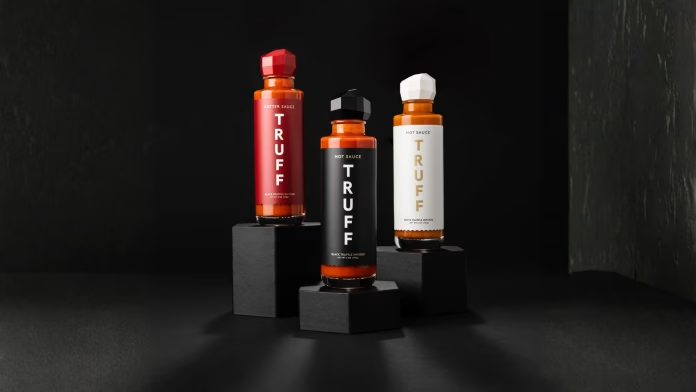
Notable deals include Bachan’s, acquired by The Marzetti Company for $400 million; Tapatio, purchased by Highlander Partners; and Sabra, in which PepsiCo bought out its joint venture partner’s stake for over $240 million. Premium hot sauce maker TRUFF and other emerging players have also attracted significant investment.

With the condiment aisle emerging as one of the fastest-growing and most dynamic segments in the consumer packaged goods industry, Maazah’s $2 million seed round provides the runway to scale production, deepen retail partnerships and capture share in a category that continues to sizzle.

Advertisement

Domino’s Tops US Sales Estimates as Value Deals Drive Demand

0

Domino’s Pizza exceeded Wall Street expectations for fourth-quarter U.S. same-store sales, buoyed by aggressive value promotions and new menu launches that resonated with cost-conscious consumers.

Shares of the pizza chain rose about 5% in early trading after the company reported a 3.7% increase in U.S. same-store sales, surpassing analysts’ estimates of 3.47%, according to LSEG data. The performance reflects a broader trend across the quick-service restaurant (QSR) sector, where brands are leaning heavily on value offerings to attract customers facing higher everyday expenses.

Domino’s has relaunched its “Best Deal Ever” promotion at $9.99 and introduced new items such as Parmesan-stuffed crust pizza to stimulate demand. The strategy mirrors moves by rivals including McDonald’s and Yum Brands, which have also rolled out value meals to capture budget-conscious diners.

Analysts noted that Domino’s continues to gain share within the U.S. pizza category. Ari Felhandler of Morningstar said the company is well positioned to win customers through its value-driven menu, strong digital capabilities and efficient delivery network. The chain’s partnership with DoorDash has further expanded its customer reach.

Chief Executive Russell Weiner said the company expects to meaningfully increase its market share within the U.S. QSR pizza segment this year. Domino’s projects U.S. same-store sales growth of around 3% in fiscal 2026, similar to last year, with stronger growth anticipated in the first half.

Internationally, however, same-store sales rose 0.7%, missing estimates of a 1.03% increase amid softer demand and heightened competition in markets such as Australia and Japan.

On the earnings front, quarterly diluted earnings per share rose to $5.35 from $4.89 a year earlier, narrowly missing analysts’ expectations of $5.37.

Advertisement

7UP Unveils ‘Mandarin Citrus’ as Part of Its New Endless Summer Lineup

0

7UP is adding a burst of seasonal freshness to its portfolio with the launch of Mandarin Citrus, a limited-edition flavor headlining its upcoming “Endless Summer” campaign. The new variant is designed to capture warm-weather demand with a lighter citrus profile aimed at consumers seeking refreshing alternatives as temperatures climb.

Rather than entering the crowded orange soda segment dominated by bold, syrup-forward competitors, 7UP is building on its signature lemon-lime heritage. Mandarin Citrus retains the brand’s classic crisp, clear base while introducing a subtle infusion of juicy mandarin. The result is positioned as a softer, slightly sweeter citrus finish engineered for refreshment rather than heaviness.

The flavor strategy reflects a nuanced shift toward more refined summer beverages, appealing to drinkers who prefer clean, crushable sodas over intensely sweet formulations. By keeping the mandarin notes balanced and understated, 7UP aims to differentiate itself within the seasonal category.

To broaden its appeal, Mandarin Citrus will launch in both regular and Zero Sugar formats, aligning with continued growth in the low- and no-calorie beverage segment. The dual rollout ensures the brand can cater to both traditional soda consumers and health-conscious buyers seeking lighter options.

As beverage shelves gear up for peak summer demand, Mandarin Citrus is set to position 7UP as a refreshing, easygoing contender in the seasonal soda lineup.

Advertisement

The Cheesecake Factory Bakery Debuts in India with Bengaluru Launch, Targets ₹250 Crore in Five Years

0

The global bakery division of The Cheesecake Factory Bakery has opened its first outlet in India in Bengaluru, marking its entry into the country’s rapidly expanding premium dessert and café segment. The brand has partnered with Bengaluru-based The Gourmet Cafe for its India rollout, adopting a local operating partner model to drive expansion and market development.

Operated by The Gourmet Cafe, the India business is targeting revenues of ₹200–250 crore over the next five years, as it scales its footprint across key urban markets and taps into rising demand for premium dessert formats among affluent consumers.

55 Outlets Planned Nationwide

As part of its expansion roadmap, The Cheesecake Factory Bakery plans to open 55 outlets across India over the next four to five years. Following its Bengaluru debut, the company aims to launch three to six additional outlets in the city in 2026 before expanding into major metros including Mumbai, Delhi, Chennai, Hyderabad and Ahmedabad. Over time, the brand also plans to enter emerging markets such as Chandigarh, Kochi and Coimbatore.

The company has already signed agreements with four malls and intends to open six stores this year across high-consumption centres.

Partnership-Led Strategy

The India foray is being led by The Gourmet Cafe, which will oversee store rollout, localisation and brand building.

“We see strong demand in India for globally recognised dessert brands and premium café experiences. Bringing The Cheesecake Factory Bakery® to India is a significant step in our journey to introduce world-class dessert offerings to Indian consumers through The Gourmet Café platform,” said Masthan Adam, Founder and CEO of The Gourmet Cafe.

Premium Café Market Gains Momentum

India’s growing base of globally exposed consumers, rising discretionary incomes and increasing preference for experiential dining have made the country an attractive destination for international bakery and café brands.

The Cheesecake Factory Bakery’s entry reflects a broader wave of global food and beverage players targeting India’s organised café and dessert retail space, where premium, occasion-led consumption formats are gaining traction.

Founded in Bengaluru, The Gourmet Cafe is a multi-brand F&B company focused on curated menus and dine-in experiences, and will anchor the brand’s expansion as it builds a nationwide presence.

Advertisement

Viral Maggi Stall at Wedding Sparks Debate: ‘Make It Compulsory at Every Shaadi’

0
Viral Maggi Stall at Wedding Sparks Debate: ‘Make It Compulsory at Every Shaadi’

A video showing a packed Maggi counter at an Indian wedding has gone viral, triggering a lively debate on social media about whether the iconic instant noodles deserve a permanent spot on every shaadi menu.

The clip, shared on Instagram by Aditya Verma, captures a long queue of guests gathered around a dedicated Maggi stall at a wedding venue. Amid sprawling buffets, international cuisines and live cooking stations that typically define modern Indian weddings, it was the humble bowl of Maggi that stole the spotlight.

In the video, Verma highlights the crowd at the stall and humorously suggests that wedding planners should consider making Maggi a mandatory offering at celebrations. His caption — loosely translated as “Make Maggi compulsory at every wedding” — quickly resonated with viewers, many of whom echoed the sentiment in the comments section.

Indian weddings are often synonymous with elaborate food spreads featuring dozens of dishes across cuisines. Yet the viral clip underscored how comfort food can outshine even the most luxurious offerings. Several users joked that while five-star buffets may impress, guests ultimately gravitate towards familiar favourites.

Adding to the buzz, the official Instagram handle of Maggi joined the conversation with a playful “We agree,” further fuelling the online banter.

Over the years, wedding menus have evolved to include sushi bars, artisanal desserts and midnight chaat counters. However, the popularity of this Maggi stall suggests that nostalgia continues to wield strong influence over food choices. For many Indians, Maggi represents childhood memories, hostel nights and late-evening cravings — a simple comfort that, even at the grandest of celebrations, can become the ultimate crowd favourite.

Advertisement

MyDesignation Raises ₹40 Crore in Series A to Accelerate Offline Expansion

0

Kerala-based D2C streetwear brand MyDesignation has raised ₹40 crore (approximately $4.8 million) in a Series A funding round co-led by RPSG Capital Ventures and Veltis Capital, with participation from existing investors Multiply Ventures and Dominor Investments. Veltis Capital also doubled its existing stake in the company.

The fresh capital will be used to expand MyDesignation’s offline presence in key southern markets, including Chennai and Hyderabad, while deepening its footprint in Bengaluru. The startup plans to open eight new stores by the end of 2027 and introduce additional product lines as part of its next growth phase. It is also looking to strengthen its senior leadership team through strategic hires.

Founded in 2020 by husband-wife duo Swaroop Krishnan and Gopika B Raj, MyDesignation specialises in culturally inspired streetwear for men and women. The brand follows a drop-based, community-led model, drawing inspiration from traditional art forms, mythological characters and South Indian heritage blended with global cultural influences. Its catalogue includes printed T-shirts, hoodies and oversized shirts, and the company claims to have served over one million customers to date.

While the brand primarily operates through its direct-to-consumer website, it currently runs five exclusive retail stores across Bengaluru, Kochi, Trivandrum and Calicut. MyDesignation has chosen not to list on third-party marketplaces, instead adopting a duo-channel strategy focused on its own online platform and offline outlets to retain greater control over margins, pricing and customer experience.

The startup had previously raised $1.3 million in a seed round in April 2025 from Multiply Ventures and Dominor Investments.

MyDesignation’s offline push mirrors a broader trend among D2C fashion brands seeking sustainable growth beyond ecommerce. With India’s overall ecommerce market projected to reach $400 billion by 2030 and the streetwear segment expected to touch $26 billion by 2026, many digital-first labels are turning to physical retail to scale brand presence and deepen customer engagement.

Advertisement

Surya Brasil Expands India Portfolio After Strong US Growth

0

Brazilian clean beauty brand Surya Brasil is broadening its product portfolio in India, reinforcing its flagship Henna Cream range while introducing new hair care and treatment products as part of a larger growth strategy.

The expansion comes on the back of a 30% growth in the US market last year, where the brand outperformed the overall hair colour category, according to company disclosures citing NielsenIQ data. Encouraged by this momentum, Surya Brasil is now sharpening its focus on India as a priority growth market.

In India, the company plans to extend its presence beyond henna-based hair colour by launching complementary offerings, including treatment-led and cleansing hair care products. The move is aimed at building a more comprehensive clean beauty portfolio tailored to evolving consumer preferences for natural and chemical-free solutions.

“The expansion of our portfolio in India is both strategic and meaningful,” said Clelia Angelon, Founder and CEO of Surya Brasil, highlighting the importance of the market in the company’s global roadmap.

While Henna Cream remains central to Surya Brasil’s India play in the natural hair colour segment, the brand — which operates in over 40 countries — is increasing marketing and trade investments locally to scale distribution and enhance brand visibility.

Advertisement