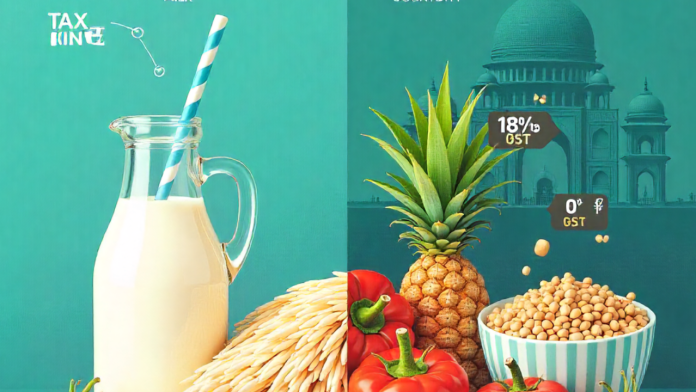
Since the rollout of the Goods and Services Tax (GST) in India in 2017, few areas have drawn as much discussion as its impact on food. From everyday essentials like rice and milk to dining out at restaurants, GST has reshaped how food businesses operate and how much consumers pay. But the rules aren’t uniform—different categories of food items and restaurant services fall under different slabs.
GST on Food Items: Essentials vs Processed Goods
Not all food items attract GST. In fact, many staples continue to remain tax-free.
- Exempt (0% GST): Fresh fruits, vegetables, milk, curd, eggs, rice, wheat, flour, and pulses are outside the GST net. This keeps everyday consumption affordable.
- 5% GST: Branded cereals, packaged food grains, edible oils, and some frozen vegetables fall into this category.
- 12% GST: Items like butter, cheese, ghee, packaged dry fruits, and frozen meat products.
- 18% GST: Processed foods, ready-to-eat packaged meals, biscuits, chocolates, soft drinks, and ice cream.
This tiered approach means a packet of branded rice attracts 5% GST, while loose rice from the local kirana is exempt—something many consumers don’t realize.
GST on Restaurants: Dining Out Costs Explained
Restaurants were among the most debated sectors under GST. Initially, a higher rate applied, but it was later rationalized to encourage dining out and boost the industry.
- 5% GST (No Input Tax Credit): All standalone restaurants, whether air-conditioned or not, charge a flat 5% GST. However, they cannot claim input tax credit (ITC) on raw materials or supplies.
- 18% GST (With Input Tax Credit): Restaurants located inside hotels with room tariffs above ₹7,500 per night fall under this slab. These outlets can claim ITC.
- Takeaway and Delivery: Treated at par with dine-in, with 5% GST charged on food orders through delivery apps like Swiggy and Zomato.
This structure has simplified billing for consumers but has also forced restaurants to rethink pricing strategies, especially since ITC benefits are restricted.
Why GST Matters for Food Businesses
For small grocery stores, packaged food sellers, or restaurant owners, understanding GST rates is crucial to price products correctly and stay compliant. Misclassification—say, billing frozen parathas at 5% instead of 18%—can lead to penalties.
The Consumer Perspective
While GST has made dining out more transparent, it has also highlighted the difference between essentials and “luxury” consumption. A thali at a local restaurant attracts 5% GST, while a chocolate bar or a fizzy drink might cost significantly more in tax terms.
The Bottom Line
GST on food items and restaurants reflects India’s balancing act: protecting essentials from inflation while taxing processed and luxury consumption at higher rates. For businesses, clarity in classification and compliance is key. For consumers, it pays to know which items are taxed—and which remain tax-free.