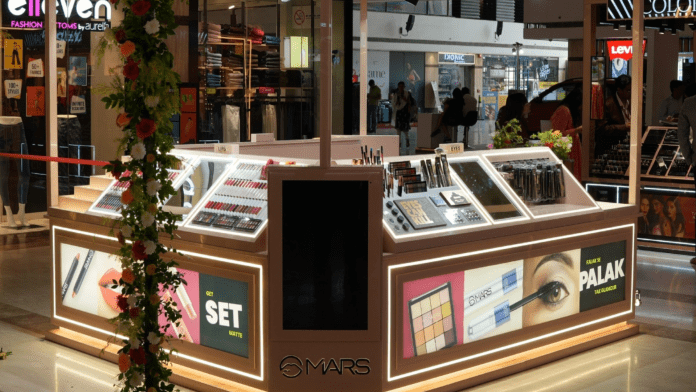
MARS Cosmetics, a prominent name in the beauty and makeup industry, has introduced its first kiosk, ushering in an exciting and immersive shopping experience in the lively heart of New Delhi. Located within the esteemed V3S Mall in Laxmi Nagar, this remarkable achievement signifies a significant stride in MARS Cosmetics’ ongoing pursuit of growth and expansion.
Featuring an extensive selection of over 300 SKUs spanning products for Eyes, Lips, Face, and Makeup Tools, this kiosk provides customers with an unmatched opportunity to immerse themselves in product trials. It serves as a sanctuary for those who relish the hands-on experience of in-person shopping, all the while serving as a vital hub for gathering invaluable customer insights. The kiosk’s design embodies the company’s steadfast dedication to beauty and aesthetics, with four distinct sections – “Face,” “Face Tools,” “Eyes,” and “Lips” – ensuring a personalized shopping journey that caters to individual customer needs. The soft pink color scheme exudes sophistication and complements the company’s trending products, establishing an inviting ambiance for beauty enthusiasts.
Mukan Jain, Brand Manager at MARS Cosmetics said, “The launch of our inaugural kiosk in the vibrant city of New Delhi signifies a significant stride in our mission to bring MARS Cosmetics closer to our cherished customers. Our kiosk not only showcases our extensive product range but also offers a hands-on, immersive experience that cannot be replicated online. We envision the opening of more such stores in the near future.”
MARS Cosmetics holds ambitious expansion goals, with a strategic emphasis on setting up kiosks and stores in key locations throughout Delhi. Additionally, the brand aims to extend its presence nationwide, ensuring that premium beauty products are readily available to a broader audience across India.
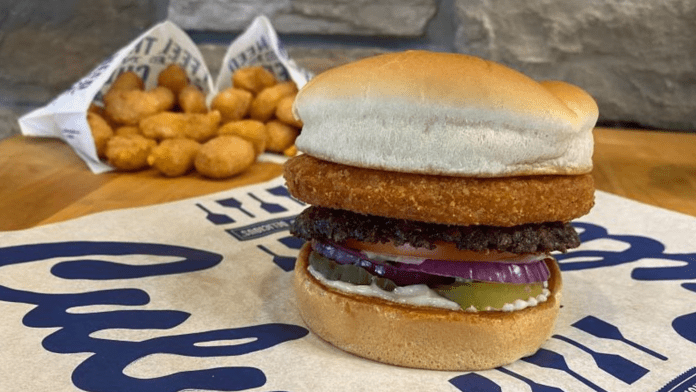
US-based Culver’s, a fast-casual restaurant chain, is gearing up for the much-anticipated relaunch of the CurderBurger on October 2, 2023.
In 2021, the brand initially introduced the CurderBurger, featuring a delectable cheese curd topping, and then brought it back in 2022.
Culver’s menu development director Quinn Adkins said, “The enthusiasm we’ve seen since the CurderBurger’s inception continues to amaze us.
“We can’t wait to bring it back for a third year and we hope this only-at-Culver’s delight continues to bring smiles to our guests’ faces as it has since it debuted two years ago.”
Culver’s has announced that the burger will be available in all of its nationwide restaurants, with it remaining on the menu until either October 31, 2023, or while supplies last.
Culver’s also noted that the reintroduction of the CurderBurger aligns perfectly with National Cheese Curd Day, celebrated on October 15, 2023.
During June of this year, Culver’s introduced the Lemon Berry Layer Cake and Dark Chocolate PB Crunch to its seasonal summer menu.
The Lemon Berry Layer Cake showcases Culver’s rich and creamy vanilla fresh-frozen custard, with layers of mixed berries, a swirl of zesty lemon, and delectable butter cake fragments.
Conversely, the Dark Chocolate PB Crunch includes dark chocolate fresh-frozen custard, Butterfinger chunks, and a luscious peanut butter swirl.
SLMG Beverages, the leading company under the Ladhani Group umbrella, boasting bottling franchises for Coca-Cola throughout Uttar Pradesh and Uttarakhand, has set its sights on achieving a revenue of INR 10,000 crore by 2025. Paritosh Ladhani, the Joint Managing Director of SLMG Beverages Pvt Ltd, shared this ambitious goal.
In 2022, the company posted a revenue of INR 3,600 crore, and it anticipates closing the year 2023 with a revenue of INR 4,600 crore.
“Going by the revenue growth, we should touch the INR 10,000 number by 2025 and we will continue to grow aggressively. This quarter has been impacted by Monsoon as there has been rain in every month,” said Ladhani.
In the challenging year of 2020, the company’s revenue declined from INR 2,100 crore to INR 1,500 crore. However, it rebounded in 2021, reaching pre-pandemic levels with the company reporting a revenue of INR 2,200 crore during that year.
“Pandemic impacted every business but we bounced back immediately. We have invested a lot on plant and this year we will open two new plants, taking the total count to 9,” the executive said.
The company is projected to triple its capacity by the year 2030.
SLMG boasts a vast network, with more than 1.5 million outlets, supported by over 1,500 distributors and 30 warehouses.
“We track per capita consumption and in India it is still on the lower side. There is a lot of scope to grow and our investment in increasing the capacity is in line with the growth we are aiming for,” Ladhani said.
The company has made a significant investment of INR 1,500 crore in plant, machinery, and automation.
“Majority of our fleet which transport bottles is EV and in addition we also take care of the environment by recycling water and using solar power,” he said.
The company has experienced a dramatic reduction in the demand for glass bottles, with its contribution to production now standing at just 3%, compared to its previous share of 90%.
SLMG is progressing towards becoming the first Indian franchise bottler to allocate $1 billion in investments for the Coca-Cola business in India.
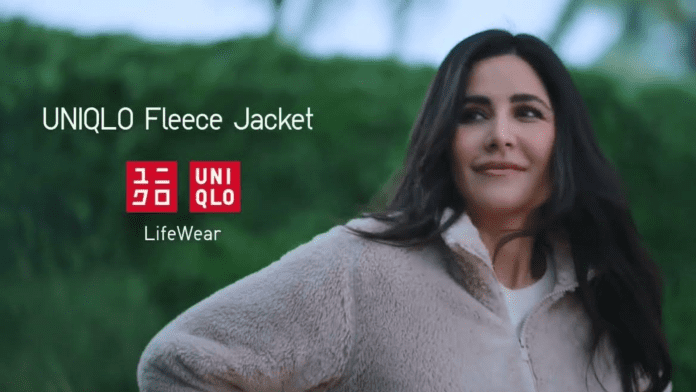
Uniqlo, the renowned Japanese apparel retailer, has appointed Bollywood actress Katrina Kaif as its first brand ambassador in India, aiming to captivate discerning shoppers and expand its store network.
The 40-year-old actor is set to appear in Uniqlo’s campaign videos across various digital and offline platforms, as announced by the retailer on Tuesday. Kaif now joins the likes of tennis star Roger Federer, who assumed the role of Uniqlo’s global brand ambassador back in 2018.
In this one-year collaboration, the Bollywood actor will lend their endorsement to the brand’s Fall-Winter 2023 campaign, which will span across all media channels, encompassing print, digital, outdoor advertising, and in-store promotional materials.
Uniqlo, which marked its entry into the Indian market in 2019, currently operates 10 stores across the country, with two more in development. While the majority of these stores are situated in Delhi-NCR, there is one each in Lucknow, Chandigarh, and Zirakpur, Punjab. The brand is now poised to expand into Mumbai, attracting consumers of all age groups with its versatile and casual clothing lines.
Kaif said, “Uniqlo has been my go-to brand for daily essentials and over the years I have admired how functional and innovative their products are. Their simple, high-quality clothing is also very versatile, and perfect to build one’s everyday wardrobe with,” she said.
Katrina Kaif’s upcoming appearance is set for the Bollywood movie “Tiger 3,” slated for release during Diwali.
“We are extremely pleased to have Katrina Kaif join us as Uniqlo’s first brand endorser in India,” said Tomohiko Sei, chief executive officer, Uniqlo India.
Uniqlo belongs to Fast Retailing, Japan’s largest fashion conglomerate. Among the group’s eight brands, Uniqlo stands as the largest, alongside GU, Theory, PLST Comptoir des Cotonniers, Princesse tam.tam, J Brand, and Helmut Lang.
During the fiscal year 2022, Uniqlo India reported a remarkable 64% increase in income compared to the previous year, reaching INR 391 crore, as per information obtained from the financial intelligence platform Tofler. However, the company has not yet disclosed its financial results for fiscal year 2023.
In the ever-evolving landscape of India’s food delivery market, one company has emerged as a true game-changer. Nino Foods, founded in 2020 by Nishant Jhaveri and his friend Pranav Mehra, is making waves in the digital-first food space. This innovative startup is not just about creating delicious food; it’s about transforming the way food brands operate and expand in a post-pandemic world.
Nino Foods started its journey by taking over Francesco’s, a well-known Mumbai-based pizza brand that was grappling with the challenges posed by the pandemic. The company’s founders saw an opportunity to transform Francesco’s into a digital-first brand, and they did so with remarkable success. This marked the beginning of Nino Foods’ mission to create new brands in the digital-first food space.
One of their notable brands, Nino Burgers, became the fastest-growing brand on Swiggy in Mumbai upon its launch. Francesco’s Pizzeria, under their management, has risen to become Mumbai’s #1 thin-crust gourmet pizza brand. These achievements serve as a testament to the innovative strategies employed by Nino Foods.
Cloud Kitchens Revolution:
Nino Foods operates premium cloud kitchen brands across 12 locations in Mumbai. These brands include Nino Burgers, Kudo Rolls, Flash Pizza, Francesco Pizzeria, Macho Momo, and Hot Wings. What sets Nino Foods apart is its central kitchen, where all base items are freshly prepared daily. This approach not only ensures quality but also enables the company to efficiently share infrastructure and manpower across its brands.
In an exclusive interview with SnackFax, Nishant Jhaveri, Co-Founder, Nino Foods, said, “The new vertical which was one of the experiments we were running. We were helping other food entrepreneurs or family around food businesses across Bombay, Delhi Pune, Bangalore.”
Moreover, Nino Foods leverages hyper-local data for menu optimization, staying ahead of the curve in meeting customer preferences. This data-driven approach enhances their ability to provide exceptional food experiences.
A New Growth Partner Model:
In a bold move, Nino Foods is introducing a groundbreaking growth partner model. Leveraging their tech and supply chain expertise, they enable partners to launch leading food brands using their existing space and manpower, without the need for additional investment. The goal is clear: helping other kitchens maximize revenue on platforms like Zomato and Swiggy using Nino Foods’ platform and marketing expertise.
Nino Foods has already garnered substantial interest, with over 50 prospective partners on their waitlist. The company promises to unveil some exciting virtual brands in the near future.
Nino Foods offers a compelling proposition to potential partners:
Zero Investment: Partnering with Nino Foods requires no new capital investment. Existing employees and equipment can be used to get started.
Easy & Flexible Contracts: Transparent and partner-friendly terms make collaboration straightforward.
Rapid Deployment: Nino Foods understands the urgency of getting started. They promise to make your kitchen live in under 10 days.
Pan India Supply: Leveraging Nino Foods’ pan India supply chain network provides pricing benefits typically reserved for larger corporations.
Actionable Data Insights: Detailed insights on your business and actionable steps to enhance it are part of the package.
End-to-End Training: Nino Foods’ training process is designed to be easily understood and implemented.
Capitalizing on a Booming Market:
The digital-first food brand space, where Nino Foods operates, received a significant boost during the pandemic-led lockdowns. As people turned to food delivery services, many food brands and startups saw unprecedented growth. In India, the food delivery market is valued at $10 billion and continues to expand. During the pandemic, average order values rose from INR 250 to INR 350, highlighting the immense potential in this sector. Nino Foods strategically focuses on the premium segment (orders above INR 400), which accounts for 50 percent of industry revenues.
A Promising Future:
In 2021, Nino Foods successfully raised $1.6 million in seed funding from prominent investors, including Y Combinator, Soma Capital, Uncommon Capital, and serial entrepreneur Harry Hurst. This investment reflects the confidence that industry leaders have in the company’s potential to disrupt the food delivery landscape further.
With an impressive track record, a unique growth partner model, and a relentless focus on delivering quality, Nino Foods is poised to continue its remarkable journey of transforming the way India experiences food. As they prepare to launch a series of exciting virtual brands, the company is set to redefine the culinary landscape once again, one delicious meal at a time.
Paine Schwartz Partners, a US-based private-equity investor, has successfully concluded a fund aimed at the food and agribusiness industries, securing $1.7 billion in capital commitments.
Paine Schwartz Partners surpassed the initial goal for its Paine Schwartz Food Chain Fund VI, raising over $1.5 billion. The New York-based investor referred to this achievement as “the most substantial fund exclusively focused on investing throughout the food and agribusiness value chain.”
Since 2010, Paine Schwartz Partners, managing $5.7 billion in assets, has been dedicated to investments in the food and food-related sectors. In 2014, the company initiated its inaugural food-chain fund.
Fund VI represents Paine Schwartz’s most substantial fund thus far, boasting a 17% increase compared to its previous $1.4 billion Fund V. The company noted that the new fund drew interest from a wide range of investors, including pension funds, sovereign wealth funds, endowments/foundations, family offices, and other institutional investors with a focus on real assets, private equity, and impact-oriented investments.
The fund’s primary focus will be on sustainable investments within the food and agribusiness sector. It will prioritize businesses that promote increased agricultural productivity while simultaneously reducing resource consumption. Additionally, the fund will target companies that facilitate access to healthier, more nutritious, and safer food options.
Recently, Paine Schwartz spearheaded a consortium that successfully secured a $1.58 billion takeover offer acceptance from the Australian fresh produce firm, Costa Group. Notably, around 40% of Fund VI’s capital has already been utilized, encompassing the Costa Group transaction, as well as investments in AgroFresh Solutions, Elemental Enzymes, HGS BioScience, and Monterey Mushrooms.
Kevin Schwartz, the investor’s CEO, said, “Our ability to exceed our initial fundraising target in a challenging market environment reflects our firm’s track record and the continued resonance of our sustainable investment focus with investors.
“With Fund VI, we are continuing to invest to feed a growing population better food with more efficient use of resources. Food and agribusiness has been the fastest-growing sector for more than 15 years and continues to be underserved by the investment community.
“Guided by our core themes, we are targeting investments in segments associated with long-term growth that have limited commodity exposure and limited private-equity competition.”
Investors in the fund included the District of Columbia Retirement Board and the Connecticut Retirement Plans and Trust Funds.
Tyson Foods has revealed its intention to merge its Prepared Foods business division with the company’s Growth organization.
As per Tyson’s statement, the integrated entities will maintain their emphasis on “brand establishment, operational efficiency, and expanding market reach.” At the same time, they will emphasize improving swiftness and flexibility through collaborative endeavors.
Melanie Boulden, presently serving as the Chief Growth Officer at Tyson Foods, is assuming the added responsibility of Group President of Prepared Foods. Tyson has stated that this move is in direct alignment with the company’s vision and strategy, which centers on generating value, sustaining growth, and improving the customer and consumer experience.
Boulden will now oversee Tyson Foods’ diverse array of products, catering to its retail, foodservice, and e-commerce offerings, which encompass well-known brands like Tyson, Jimmy Dean, Hillshire Farm, and Ball Park.
Boulden said, “Creating a more unified team across Prepared Foods and Growth empowers us to anticipate and respond to business challenges and opportunities with greater impact. As we continue to build for the future, we remain committed to fostering the customer and consumer-centric approach that will drive us forward and help us deliver results against our strategy.”
Donnie King, president and CEO of Tyson Foods, added, “I am fully confident we have the right enterprise leadership team in place to drive growth across our entire business. The categories we operate in present unique challenges, and as the industry leader, we believe our strategy and structure position us to win in today’s marketplace.”
Myntra, the e-commerce giant, is bolstering its beauty collection in anticipation of its flagship festival sale. According to Sharon Pais, Chief Business Officer at Myntra, an impressive three-quarters of shoppers on the platform engage with the beauty section, with one in every three female customers choosing to shop on Myntra Beauty.
The beauty department currently boasts an impressive collection of over 1,500 brands, featuring a vast selection of more than 90,000 unique stock-keeping units (SKUs), which includes approximately 200 international brands.
“Myntra beauty has become an important category for us along with fashion. Our customer base of beauty buyers is primarily in the age group of 18 to 35, who are young, trend-first, and have disposable income. Our selection is wide across every price,” said Sharon Pais, Chief Business Officer, Myntra.
The offerings within the beauty category have seen a remarkable fourfold expansion since 2020, and this year alone, the company has introduced nearly 50 new international brands to its lineup.
“We are growing specifically at 3X compared to the market and we are optimistic about festival demand given the momentum which indicates that we should see a good festival season,” added Pais.
Genderwise, the beauty vertical at Myntra has experienced a substantial uptick in men buying skincare products on the platform.
“In H1 this year – Myntra Beauty has witnessed a 200 per cent y-o-y growth in customers buying men’s skincare products. Acne and pimple care, hair removal spray, ingredients-led products like serum, face wash, and body wash, foundation and concealer, among others are gaining popularity,” noted Pais.
Myntra places significant emphasis on its annual festival sale, making it a central focal point of their strategy. In this edition of the Big Fashion Festival (BFF), a total of 6,000 brands are participating, offering a staggering selection of over 23 lakh styles encompassing fashion, beauty, and lifestyle products.
Pais mentioned that more than 300 brands are making their debut in the festival sale within the beauty vertical.
Ahead of the upcoming Big Fashion Festival (BFF), Myntra has added four well-known K-Beauty brands to its lineup, namely Numbuzin, Peripera, Axis-Y, and Isntree. With the inclusion of these brands, Myntra Beauty’s collection now encompasses over 25 K-Beauty brands.
The company has also organized distinctive engagement events, partnering with both Loreal’s Paris Fashion Week and Lakme Fashion Week.
“With a thriving base of young beauty enthusiasts, we believe impactful collabs such as these help us gain a larger mind share with this audience,” Pais said.
Homegrown burger chain Burger Singh is set to extend its footprint in Nagpur, Maharashtra, with the exciting announcement of two new outlets strategically positioned across the city.
The brand already boasts a dual presence in Nagpur’s Orange City, with two company-owned, company-operated (COCO) outlets located at Sadar and Shradhanand Peth.
“We are thrilled to be a part of Nagpur’s vibrant food scene. Our quintessential Indianised flavours have already seen a wonderful response in the region,” Kabir Jeet Singh, Founder of Burger Singh said.
“We also actively look for franchise partners in the region with the intention of matching the right influencer with the right location, ensuring that we constantly deliver an elevated dining experience to our customers,” Singh added.
Burger Singh, a rapidly expanding domestic burger chain, launched its first establishment in Gurugram back in 2014. Since then, it has witnessed swift expansion across India, establishing a presence in cities such as Delhi-NCR, Lucknow, Jaipur, Dehradun, Jammu, Nagpur, Ahmedabad, Jhansi, Chandigarh, Amritsar, and several others. Additionally, the chain is currently in the process of outfitting another 12 franchises across the nation.
Notably, Burger Singh proudly proclaims its status as the first Indian burger chain to make an international mark, with three outlets and one food truck now serving customers in London.
The effects of the August drought are making their presence known on corporate financial statements.
Downtrading, the trend in which consumers transition from larger product packages to smaller ones due to financial strain or rising inflation, has intensified within the fast-moving consumer goods (FMCG) sector. According to information from the retail intelligence platform Bizom, smaller product packages have experienced more significant growth compared to medium or high-priced ones across a wide range of FMCG categories. The data from Bizom also indicates that overall sales witnessed an approximately 11% decline in August 2023 compared to the previous year.
According to Akshay D’Souza, the Chief of Growth and Insights at Bizom, the shortfall in rainfall during August seems to be contributing to the increasing prevalence of the downtrading trend.
Procter & Gamble Hygiene and Health Care’s VP (finance) Gautam Kamath said, “Retail inflation for the months of July and August have averaged 7% and August rainfall has shown an 11% negative deviation from norm, driving the caution. On anecdotal evidence, September rainfall appears to have bounced back – and might have a big say in how the rest of the year goes.”
He informed analysts that P&G holds a “guardedly positive” perspective regarding the market’s growth outlook.
Usually, prominent FMCG companies provide products at various price points to ensure that consumers can find options within the company’s product range.
At P&G’s first investor meeting conducted recently, MD L V Vaidyanathan emphasized the company’s ongoing commitment to setting higher standards of excellence across all competitive price tiers.
“We are leveraging this superiority to grow markets and, as a result, P&G’s share to sustainably build the business. Noticeable superiority is increasingly important in an inflationary environment, as consumers reassess value across all elements of their budget,” said Vaidyanathan.
According to the data, beverage sales for mid-priced packs dropped by 9.8%, while sales for lower-priced packs increased by approximately 6% (refer to the graphic). Similarly, in the branded commodities category, sales declined by 9% for mid-priced packs, but lower-priced packs experienced a growth of 7.7%. Within the personal care sector, consumers shifted from high-value packs, resulting in an 8% decrease, to mid-priced packs, which saw an 8.5% growth.
Bizom reported that the advent of the festive season led to a reversal of the trend, particularly in the confectionery and packaged foods sectors.
We use cookies to ensure that we give you the best experience on our website. If you continue to use this site we will assume that you are happy with it.