According to trade sources, the central government is considering a rollback of the 40% export duty imposed on Bangalore rose onions and Krishnapuram rose onions grown in Karnataka and Andhra Pradesh, respectively.
On August 19, the government implemented a 40% duty on all varieties of onions exported from India in an effort to control the surging onion prices. Market sources noted that this move led to an approximately 70% decline in onion exports.
Meanwhile, during a meeting convened on Monday, traders based in Nashik resolved to prolong their ongoing onion strike, which commenced on September 20. It is improbable that this will have any significant impact on onion prices within the nation.
The Agri Commodities Exporters’ Association, acting on behalf of rose onion exporters, has formally appealed to the government to permit the export of 10,000 tonnes of Bangalore rose onions and Krishnapuram rose onions without imposing export duties during the period from October to December.
On Monday, India announced its approval for the export of 75,000 metric tonnes of non-Basmati white rice to the United Arab Emirates (UAE).
In a notification, the Directorate General of Foreign Trade (DGFT) said: “Export of 75,000 MT of non-Basmati white rice to the UAE is permitted through National Cooperative Exports Limited.”
In the fiscal year 2023, India recorded exports amounting to $2.2 billion for non-Basmati white rice, with Kenya, Madagascar, Benin, and the United Arab Emirates ranking among the primary destinations.
During July, India imposed a ban on the export of non-basmati white rice. However, export allowances will be granted on a case-by-case basis, considering permissions extended by the government to meet other countries’ food security requirements and in response to their governments’ requests.
Last month, export quotas for non-basmati white rice were allocated to Bhutan, Mauritius, and Singapore. According to a statement from the Directorate General of Foreign Trade, Bhutan was granted permission to export 79,000 metric tons of non-basmati white rice, while Singapore and Mauritius received export quotas of 50,000 tons and 14,000 tons, respectively.
Australia-based burger restaurant Burger Head has decided to close its doors in the coming weeks. This choice stems from the worsening financial troubles the establishment is experiencing, with inflation and increased interest rates further contributing to its challenges.
As per a Sky News report, the eatery, established in 2017 by Joshua Deluca and Timothy Rosenstrauss, had expanded to include four restaurants and three food trucks.
Nevertheless, owing to the financial crisis, the restaurant brand had to shutter its establishments in both Blacktown and Casula.
Both the Blacktown and Casula restaurants were launched within a mere ten-week span of each other in the year 2022.
Alongside the two restaurant locations, a production kitchen in Wetherill Park was also inaugurated during that same timeframe.
The brand has currently made the decision to cease operations at its last two remaining stores in Botany and Penrith, with the closure scheduled for October 29, 2023.
The media house quoted Messrs Deluca and Rosenstrauss as saying, “The past seven years have been nothing shy of an incredible journey of ups, downs and everything in between, but unfortunately, we’ve decided to hang up the apron.
“There’s no denying that hospitality is considered one of the hardest industries there is. To survive and thrive for as long as we have, we’ll be forever proud of our accomplishments and eternally grateful for the support of everyone along the journey.”
After the Covid-19 pandemic, the restaurant brand expanded its presence in the region at an accelerated pace, a move that is now identified as the key contributor to the brand’s current financial challenges.
Neeraj Biyani, the former Co-Founder of Paper Boat, along with Vikash Singhal, Mandeep Bhatia, and Eeti Sharma, have introduced Asaya, a skincare brand for individuals with melanin-rich skin tones, as stated in a press release.
“Building a brand takes time, but I firmly believe in Asaya’s compelling proposition, both in product and emotion. With Asaya, we aspire to empower women and men across India to challenge outdated beauty norms and really revel in the skin we are in,” said Biyani, Co-Founder of Asaya.
Conceptualized and formulated in Florida, Asaya offers a variety of products across several platforms, starting at a price of INR 449, and available on the brand’s official website, Amazon, Big Basket, JioMart, and Flipkart.
“Melanin-rich skin like ours is structurally different from other skin tones. For instance, it’s much more sensitive, and care for it needs to be hypoallergenic. At Asaya, we have tirelessly worked to ensure our formulae are melanin-first, and our products are designed for Indian skin’s specific needs,” said Dr. Arundathi Nagaraj, head – research board, Asaya.
Asaya presents its product line, categorizing them into two distinct categories: “under one sun” for sun protection and “running deep” for hydration solutions. The materials used in crafting these products are sourced from the USA, Europe, and Korea.
Currently, the skincare brand has secured approximately $0.5 million in funding from angel investors and its founders. According to the release, it has set a target to raise $1.2 million within the next 4-6 months.
Myntra, a leading e-commerce destination in India for fashion, beauty, and lifestyle products, has unveiled an innovative AI-powered chatbot named “Maya.” This chatbot is designed to enhance and customize customers’ shopping experiences, making them more efficient. Initially available during Myntra’s annual Big Fashion Festival (BFF), Maya empowers users to effortlessly navigate the extensive range of styles, offering tailored recommendations and real-time conversational assistance.
Maya serves as an intelligent and intuitive virtual assistant, adept at grasping the unique requirements of users. Harnessing the wealth of products within Myntra’s extensive catalog, which spans 2.3 million items across fashion, beauty, footwear, and home categories, Maya offers pinpointed product recommendations, ensuring customers discover precisely what they seek. Moreover, Maya excels in interactive shopping conversations, deftly managing intricate inquiries, such as event-specific fashion tips or gift suggestions. By maintaining contextual awareness throughout the dialogue, Maya provides a smooth and hassle-free shopping experience, substantially expediting the decision-making process.
Fueled by OpenAI’s ChatGPT, Maya seamlessly blends natural language processing with Myntra’s proprietary cataloging and search technology, perfectly aligning with contemporary shopping and interaction preferences. Users can engage with Maya in a manner akin to interacting with a sales assistant, receiving instant and pertinent fashion guidance.
Initially, this feature will be accessible to 10 percent of Myntra’s user base, with plans for broader availability in the future. Future enhancements will encompass summarizing ratings and reviews, assisting in size selection, and integrating voice and image capabilities. Additionally, Maya will soon extend its support to vernacular languages, catering to users in tier II and III cities. Robust safeguards have been put in place to prevent misuse, ensuring that Maya responds exclusively to relevant inputs on the platform.
Raghu Krishnananda – Chief Product and Technology Officer, Myntra said, “The introduction of our AI-powered shopping assistant, Maya, marks a significant milestone in our journey to elevate the shopping experience of millions of fashion-forward shoppers in the country by providing a conversational interface to our users. As the festive season kicks in, we eagerly look forward to our customers engaging with Maya, with the confidence that their quest for finding the perfect fashion and lifestyle needs will be met with enhanced convenience.”
Myntra’s Big Fashion Festival guarantees an exhilarating festive season with enticing deals on both domestic and international brands. Shoppers can further enhance their festive savings by availing an extra 15 percent discount when utilizing Myntra’s co-branded credit card, developed in collaboration with Kotak Mahindra Bank, thus amplifying the value of their celebratory purchases.
Mumbai-based DB Realty Ltd. on Monday said it will acquire shares in Bamboo Hotel Global Centre Pvt., Goan Hotels & Realty Pvt. and BD And P Hotels Pvt. for more than INR 2,300 crore.
DB Realty stated that these transactions constitute related party deals and are conducted on an arm’s length basis. The company emphasized that this move will facilitate its entry into the hospitality industry.
In a regulatory filing, DB Realty informed that it has entered into separate share purchase agreements to acquire shares of Bamboo Hotel Global Centre (Delhi) Pvt Ltd, Goan Hotels & Realty Pvt Ltd and BD And P Hotels (India) Pvt Ltd.
As per the filing, Bamboo Hotel and Global Centre (Delhi), a joint venture between Prestige Hospitality Ventures Ltd. and Marine Drive Hospitality & Realty Pvt., is constructing a hotel complex ‘Prestige Trade Centre at Aerocity, New Delhi.
DB Realty will acquire 10,10,000 Class A equity shares in Bamboo Hotel for a total consideration of INR 608.88 crore.
The property is leased out by Delhi International Airport to Bamboo Hotel for 57 years, including a lease extension of 30 years.
The total built-up area of the project is about 3.3 million sq ft.
DB Realty will acquire 78,250 equity shares for a total consideration of INR 1,410.68 crore in Goan Hotels & Realty, which is a wholly-owned subsidiary of MDHRPL.
MDHRPL owns a five-star hotel under the brand of Grand Hyatt Goa, at Bambolim, Goa.
Separately, DB Realty will acquire 2,12,69,325 shares for INR 339.12 crore in BD And P Hotels (India). BD and P Hotels is a subsidiary of MDHRPL, which holds a 75% stake and owns the Hilton Mumbai International Airport hotel.
Samosa Singh, the popular fast-food restaurant chain, made an exciting announcement on Monday, revealing the opening of its latest outlet in Thane, Maharashtra. Positioned along the Sita Vihar CHS Ltd road in the heart of Naupada, Thane (West), this new addition promises to delight locals and samosa enthusiasts alike.
“Mumbai has always been a special market for Samosa Singh and we got a lot of love from this beautiful city so, opening our flagship store @Thane is special,” Shikhar Veer Singh, Founder, Samosa Singh said.
Nidhi Singh, Co-Founder Samosa Singh said, “Nothing beats the satisfying crunch, warmth, and flavour of India’s favourite snack–Samosas, and with our expansion in Mumbai–we are further strengthening the bond our country shares with food.”
Established in 2016 by Nidhi Singh and Shikhar Veer Singh, the Bengaluru-rooted snack brand, Samosa Singh, proudly asserts itself as India’s pioneering snacking company, boasting a dedicated scientific core team with over 100,000 hours of intensive research.
Over the past three months, the brand has successfully inaugurated around six brick-and-mortar outlets and significantly broadened its footprint, now encompassing over 50 locations across South and West India. Samosa Singh’s ambitious goal is to achieve nationwide expansion within the next 20 months.
Local FMCG (Fast-Moving Consumer Goods) brands are swiftly expanding, intensifying their competition with national brands. They have surpassed national brands by achieving double-digit sales growth in the last two quarters, taking advantage of a decrease in inflation.
Regional brands like Rungta Tea, Balaji Wafers, Mario Rusk, and Bovonto soft drinks are bolstering their presence by expanding, diversifying, and enhancing brand recognition. They have emerged even stronger in the aftermath of pandemic disruptions.
Rungta Tea, operating in markets such as Uttar Pradesh, Rajasthan, and Bihar, is establishing tea parlors akin to Chai Point and Chaayos while assembling an e-commerce team to expand its footprint.
“We are growing faster than many national brands in markets we are present in and have relationships with distributors and customers. Now we are moving to the next level with tea parlours and ecommerce, while continuing with quality and innovation,” said Girjesh Rungta, managing director of Rungta Tea.
According to a recent report by Kantar Worldpanel, local brands experienced a 12.7% growth in volume from last April to this April, surpassing the 8.2% growth rate of national brands. This growth was attributed to the innovation and expanding distribution networks of regional brands, as stated by the consumer monitoring firm.
Rajkot-based snacking firm Balaji Wafers, which has been aggressively wooed by PepsiCo’s Indra Nooyi and other large snacks giants, is setting up its first plant in North India, in Lucknow. “Our expansion plan is to go across India, well beyond Gujarat, one territory at a time,” Chandubhai Virani, Founder of Balaji, said. “We will continue to follow our value-for-money strategy.”
Executives mentioned that the movement of regional market leaders expanding their reach nationwide is evident across various product categories such as snacks, tea, biscuits, detergents, soaps, and toothpastes.
“The key is ownership. We see regional brands primarily driven by founders who are directly involved in operations,” said Sumit Agarwal, Co-Founder of Vitrak ExtendReach, a platform for traditional trade distribution. “That gives them the nimbleness and quick response time to market challenges.”
They also have “razor-sharp focus on the category”, he said. “Unlike, say, an HUL, these brands don’t focus on different categories at the same time,” Agarwal said. “Also, they operate with no frills – they are able to give enhanced value to the consumer.” Bovonto soft drinks is laying out plans to take its products such as orange and ginger ale fizzy drinks, beyond its core markets in Tamil Nadu and Andhra Pradesh. Mario Rusk has roped in actor and singer Diljit Dosanjh as its first brand ambassador.
Jubilee Hills, Hyderabad proudly unveils its latest culinary gem: Halo – Cocktail Bar & Kitchen. This newly inaugurated dining establishment guarantees a unique and unforgettable experience by harmoniously combining the serenity of nature, culinary mastery, and modern mixology. Whether you yearn for a peaceful retreat in the lap of nature or an epicurean journey that delights your palate, Halo assures an exceptional encounter.
The creative minds behind Halo – Cocktail Bar & Kitchen are a dynamic team of devoted restaurateurs. This exceptional ownership ensemble includes Sunaina Errabelli and Sandesh Reddy, recognized for their achievements with Obvsly Gelato in both Hyderabad and Chennai. Teja Govind, celebrated for his contributions to establishments like Fat Pigeon, Ragi, and Chubby Cho in Hyderabad, is also part of the team. Additionally, Swethan Reddy, renowned for his ventures such as Pisco By The Beach and Toro Toro in Goa, as well as Cafe Montagne in Leh, brings his expertise to the table. Leading the culinary direction at Halo is Chef Rohan D’souza, a distinguished chef and partner behind notable brands like Pisco by The Beach (Goa), Chop at The Urban Eatery (Nairobi), Blue Turtle (Goa), The Lazy Goose (Goa), Toro Toro (Goa), and Cafe Montagne (Leh).
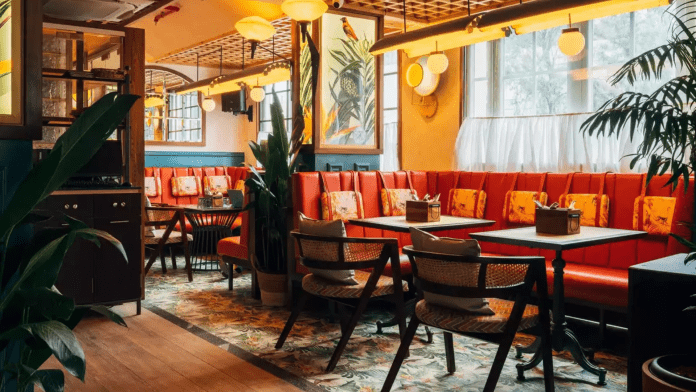
Halo draws its inspiration from the very heart of nature to craft an atmosphere that exudes freshness and warmth. As you enter, you’ll be enveloped by a vibrant, verdant setting, where bamboo and ropes guide your journey. Within the restaurant’s extensive dining area, you’ll discover outdoor, upper, and indoor sections, all elegantly adorned with earthy hues and an abundance of lush foliage, creating an enchanting ambiance of tranquil natural beauty.
Halo’s culinary offerings guarantee an enchanting journey for your taste buds. Take, for instance, the Black Pepper Indian Salmon, where tender salmon skewers are meticulously glazed with a zesty black pepper sauce, achieving a harmonious blend of succulence and spice. If you’re in the mood for a South Indian twist, the Punugulu with Smoked Tomato Chutney presents delicate rice dough balls paired with a smoky homemade chutney, offering a light yet flavorful appetizer. Whether you’re savoring the BBQ 5 Spice Chicken & Mushroom Kofta Skewers or indulging in the richness of Truffle Ricotta Cannelloni, each bite is a masterful fusion of flavors. Halo’s dishes epitomize the art of blending diverse tastes, making it a culinary destination like no other, ensuring an indelible dining experience.
Halo’s bar is an immersive journey where each sip narrates a unique tale. Anchored in the use of fresh ingredients and inventive techniques, the bar menu offers flavors that evoke feelings of nostalgia and comfort. In this exclusively fresh-focused bar, canned juices are eschewed to ensure that every cocktail is a genuine and vibrant encounter. Within the confines of Halo’s bar, every flavor serves as a cherished memory, waiting to be relished, and each glass embodies their dedication to crafting fresh and distinctive tastes.
abCoffee, the specialty coffee chain, has successfully secured $2 million in seed funding through a round led by Tanglin Venture Partners. Notable participation in this funding round also came from 100X.VC, Panthera Peak, OTP Venture Partners, and various angel investors.
In an official statement, the Mumbai-based startup announced its intention to utilize the newly acquired funds for enhancing its technological infrastructure, broadening its product offerings, and enhancing accessibility to its products throughout India via its network of retail grab-and-go outlets.
Established in 2022 by Abhijeet Anand, abCoffee was created with the mission of increasing the accessibility of specialty coffee within India. The company provides an extensive range of freshly brewed coffee selections, all meticulously sourced from Chikmagalur.
Currently, the startup maintains a presence with 12 outlets in both Mumbai and the Delhi-NCR region.
Commenting on the funding, Founder and CEO Anand said, “This investment will enable us to accelerate our growth and bring our unique coffee experience to more neighbourhoods across India. In the coming, 8-12 months, we keep the same momentum of growth; ensuring people are at heart of everything and bring the abCoffee’s specialty coffees to India’s new neighbourhoods.”
abCoffee distributes its products through its physical outlets, as well as on popular platforms such as Swiggy and Zomato, in addition to its official website. The company faces competition from other startups in the coffee industry, including names like Blue Tokai Coffee Roasters, Rage Coffee, and Third Wave Coffee Roasters.
Within the larger coffee market landscape, it goes head-to-head in competition with FMCG giants such as Nestle and Hindustan Unilever.
Earlier this month, Blue Tokai secured an undisclosed amount of funding from the investment entity Ka Enterprises, associated with actor Deepika Padukone, as part of its ongoing Series B funding round. This funding round comes on the heels of the coffee startup’s initial Series B investment of $30 million back in January of this year.
As per research conducted by Statista, the Indian coffee market had an estimated worth of $0.5 billion in 2023, with a projected Compound Annual Growth Rate (CAGR) of 9.04% expected to propel it to further expansion by 2028.
We use cookies to ensure that we give you the best experience on our website. If you continue to use this site we will assume that you are happy with it.