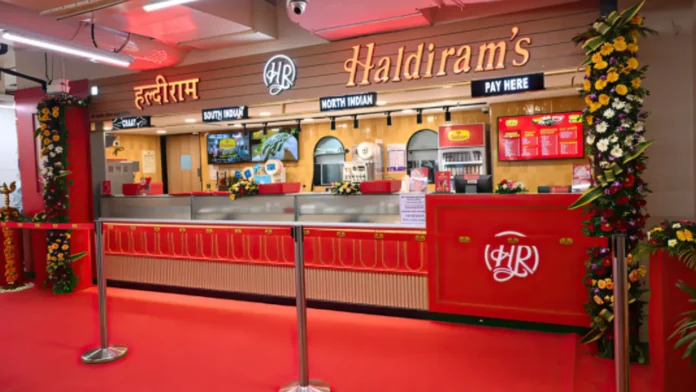
Haldiram’s, the renowned Indian restaurant and sweets chain, unveiled its latest food court in Mumbai, Maharashtra, as stated in a press release on Friday. Situated at Acme Mall in Santacruz, the establishment will feature an extensive array of their well-loved dishes, such as Raj Kachori, Chole Bhature, Pav Bhaji, and various other delectable options.
Haldiram’s Celebrates Grand Opening of Latest Mumbai Outlet
The inaugural event, which took place on October 27, 2023, was graced by the esteemed presence of key figures from Haldiram’s and Reliance Retail. Among the distinguished attendees were Neeraj Agrawal, Director, along with notable leaders from Reliance Retail, including Damodar Mall, CEO of Grocery Retail, Manu Bansal, Regional Business Head, and Jagdish Pancholi, State Business Head.
Neeraj Agrawal, director, Haldiram’s Food International, Nagpur, expressed his enthusiasm, stating, “Our aim is to provide customers with a range of delicious snacks and sweets, coupled with a joyous dining experience. We are thrilled to bring the rich and diverse flavours of India to Santacruz, Mumbai.”
Nagpur Branch holds a prestigious reputation in the realm of Indian cuisine, celebrated for its diverse assortment of snacks and delectable dishes. Over the course of more than eight decades, Haldiram’s Nagpur has firmly cemented its status as a reliable and respected brand within the industry.
In its quarterly results, Reliance Industries Limited (RIL) announced that the digital and new commerce divisions constituted 19% of Reliance Retail’s overall revenue during the second quarter (Q2) of the fiscal year 2023-24 (FY24).
During the preceding June quarter, these sectors comprised 18% of RIL’s retail division’s revenue.
In the second quarter (Q2) of the fiscal year 2023-24 (FY24), Reliance Retail’s revenue from operations increased by 19.5% year-on-year (YoY) to INR 68,937 Cr, and the net profit saw a YoY growth of 21% to INR 2,790 Cr.
Reliance Retail Portfolio:
Reliance Retail boasts a portfolio of brands that includes JioMart, AJIO, Netmeds, and Trends, offering a wide array of products from footwear to electronics, available through both online and offline retail channels.
The digital and new commerce segments demonstrated consistent expansion across various product categories, with strong operational performance. In particular, the new commerce division achieved ‘vigorous growth’ within the electronics category, driven by the sales of smartphones and premium televisions. Reliance Retail increased its network of electronics-selling merchants by 44% year-on-year (YoY).
AJIO
In the same period, the e-commerce platform AJIO witnessed a 50% year-on-year (YoY) expansion in its product catalog, while the premium segment Ajio Luxe increased its offerings by 61%. Reliance Retail also announced that its online furniture branch, Urban Ladder, ventured into the business-to-business (B2B) sector through institutional sales during the review period.
A year after the November 2022 acquisition of Metro Cash & Carry, Reliance Retail is still in the process of integrating the wholesaler’s operations with its new commerce grocery vertical.
JioMart, the prized asset within RIL’s digital and new commerce portfolio, has reported a consistent growth trajectory, marked by a significant uptick in both traffic and average transaction values. RIL stated that JioMart also expanded its product offerings by threefold and its network of sellers by twofold in the past year.
“I am delighted to report that we have delivered yet another quarter of stellar performance and achieved an all-time high across financial metrics. The performance is a testament to our customer-centric approach that defines Reliance Retail and we look forward to serving our customers this festive season with renewed optimism and enthusiasm,” Isha Ambani, executive director of Reliance Retail Ventures Ltd, said.
Reliance Retail (Representative Image)
JioCinema
The conglomerate’s media division maintained strong momentum, with streaming service JioCinema playing a significant role in this success. JioCinema’s growth was notably driven by its emphasis on sports, particularly cricket, as the company’s investments in sports programming resulted in a substantial increase in viewership on the streaming platform.
In its quarterly report, RIL also observed a decrease in the media division’s EBITDA due to substantial investments in sports and digital sectors. The company highlighted that these investments are essential in the short term to establish a compelling consumer offering within the media arm.
Following JioCinema’s successful acquisition of media rights for both domestic and international matches featuring the Indian cricket team, RIL reported that the broadcast of the India-Australia match garnered almost 9 crore viewers on JioCinema.
Acknowledging the growing shift in live sports consumption towards digital platforms, RIL stated that its media division intends to utilize Viacom18’s extensive content library to attract users seeking high-quality content and boost user engagement.
The conglomerate also reported that JioCinema’s advertising revenue experienced continued growth, primarily driven by its original digital content.
“JioCinema continued its journey of entertaining audiences with premium content like Bigg Boss OTT, Taali, Kaalkoot, and Khatron Ke Khiladi amongst others. Bigg Boss OTT became the most streamed entertainment property in India, watched by over 100 Mn viewers, generating 30 billion minutes of watch-time,” the company said.
This development coincides with reports suggesting that Reliance is currently engaged in discussions with Disney to potentially acquire Disney’s operations in India, which would include Disney+ Hotstar, as a means to enhance and expand JioCinema’s content offerings.
In the quarter ending September 2023, RIL’s consolidated profit after tax (PAT) surged by 29.7% year-on-year to INR 19,878 Cr. In a similar vein, Jio Platforms, the digital subsidiary, witnessed a 12% year-on-year increase in net profit, reaching INR 5,297 Cr in Q2 FY24.
IndiaMART InterMESH, a B2B marketplace, recorded a modest 2% increase in its combined net earnings, reaching INR 69 Cr in the second quarter (Q2) of the financial year 2023-24 (FY24), up from INR 68 Cr in Q2 FY23.
Nonetheless, the net profit plummeted by 17% on a quarter-on-quarter (QoQ) comparison, sliding from INR 83 Cr. This decline was primarily attributed to substantial investments in workforce, technology, sales, and customer service.
IndiaMART InterMESH Net Profit:
At the same time, operational revenue surged by 22% to INR 295 Cr in the quarter ending September 2023, compared to INR 241 Cr in the corresponding quarter of the previous year. In a sequential comparison, operational revenue increased by 4% from INR 282 Cr.
“We are happy to report continued growth in revenue, deferred revenue, and healthy operating margins in this quarter… With the rising internet adoption and on the back of healthy cash flows, we are confident of the long-term growth and sustained value creation for all our stakeholders,” said IndiaMART cofounder and chief executive officer (CEO) Dinesh Agarwal.
The company witnessed a 22.5% year-on-year (YoY) increase in expenses, totaling INR 225 Cr during Q2 FY24. The most significant portion of these expenses was allocated to employee benefits, amounting to INR 132.4 Cr in Q2 FY24, followed by ‘other expenses’ at INR 82.3 Cr.
Earnings before interest, taxes, depreciation, and amortization (EBITDA) increased by 19% year-on-year (YoY), reaching INR 80 Cr during the period being examined.
The prominent B2B marketplace recorded a total traffic of 28.8 Cr and 2.4 Cr unique business inquiries in Q2 FY24, reflecting respective increases of 10% and 6%. The number of supplier storefronts on IndiaMART surged to 77 Lakh, while the count of paying subscription suppliers reached 2.09 Lakh by the end of September 2023.
The company achieved an annualized revenue per paying subscriber of INR 53,525, and the number of live listings on the platform reached 10.2 Cr in Q2 FY24.
IndiaMART’s combined cash and investment holdings amounted to INR 1,910 Cr by the conclusion of Q2 FY24.
The company’s shares closed Friday’s trading session with a 4.06% gain, reaching INR 2,766.20 on the BSE.
TajSATS, the inflight catering service of India, has entered into a concession agreement with Noida International Airport (NIA) to establish an in-flight kitchen facility.
The forthcoming greenfield airport in Jewar, known as Noida International Airport, is set to improve transportation links to and from Delhi NCR, Noida, and Western Uttar Pradesh.
Speaking on the occasion, Manish Gupta, Chief Executive Officer, TajSATS said, “The pace of addition of airports in India, which include marquee developments such as Noida International Airport present a tremendous growth opportunity for airline catering. We are delighted that it has partnered for this prestigious project with NIA. TajSATS with its strong network and market leadership will deliver a premium in-flight and lounge catering, leveraging its four decades of experience. This signing strengthens our presence in Delhi NCR as this will be the second facility in the region.”
TajSATS New Project:
TajSATS will establish the in-flight kitchen facility using a design, finance, build, operate, and transfer (DBFOT) model spanning 37 years. This arrangement encompasses passenger and crew meal services, the handling of in-flight catering equipment, as well as the loading and unloading of meals.
Christoph Schnellmann, Chief Executive Officer, Noida International Airport, said, “We are pleased to welcome TajSATS to build and operate an In-Flight Kitchen at the Noida International Airport. This partnership is a key milestone for us toward developing a modern, consumer-centric culinary experience for our customers. We believe meals are an integral part of a distinguished in-flight and airport experience. Company comes with a vast experience in serving numerous airports and we feel that their offering will synergize with ours to provide a thorough world-class experience to our customers.”
Positioned strategically within the airport, the cutting-edge kitchen will span 40,000 square feet and have the capacity to provide over 15,000 meals daily during its initial phase. Additionally, the kitchen will be well-prepared to cater to the lounge areas and the food and beverage establishments both within and near the airport. This addition will bring TajSATS’ total production facilities in India to nine.
Moonshine Food Ventures has unveiled its latest F&B establishment, the Glasshouse World Grill & Bar, situated in Worldmark, Gurugram.
Taking inspiration from a greenhouse with its distinctive glass enclosure, combined with sleek metal and glass elements, the majority of the area is designed as an open-air dining space. Here, guests can enjoy captivating views of the night sky and the sunlit daytime sky, all while sitting atop a burgeoning structure on the restaurant’s top floor. With seating for 150 patrons, the restaurant boasts a 360-degree panoramic view, thanks to its unique glass exterior. To ensure comfort year-round, the enclave features a retractable roof.
Glasshouse World Grill & Bar Opens offers panoramic experience!
Remaining true to its name, Glasshouse is adorned with an array of planters and a herb wall, infusing the space with lush green tranquility. What’s more, Glasshouse is set to tantalize taste buds with a diverse range of borderless cuisines that draw inspiration from the flavors and culinary traditions from around the globe.
The charming dining area seamlessly connected to an adjacent bar, along with the blossoming garden that beautifully embodies the green essence of the location, sets an enchanting scene. However, what truly captivates is the extraordinary menu crafted by Michelin-star chef Atul Kochhar. The menu boasts an array of intriguing delicacies such as Betel Leaves Sambal, Angoori Wine Tikka, Goat Tartine, Mozambique Wings, Char-Grilled Pesto Fish, Bombay Sadak Pizza, Paneer Kashmiri, Nadan Curry, Raw Banana Sri Lankan Curry, and Glasshouse Katsu. As for desserts, there are exceptional options like Mid Summer, Walk in the Forest, Winter Darkness, Rose Garden, and more.
As Vishal Anand, Founder, Moonshine Food Ventures notes, “We intend to spread the experience like wildfire. People should be able to walk into a restaurant and come out feeling refreshed, revitalized, and well taken care of. That is what Glasshouse represents; a blend of diversity with the customer at the fore. It’s all about offering that wholesome experience, from the gourmet meals and amazing cocktails to some of the best alco-beverages out there,” he says.
Strategies for Effective Communication: Coming up as a new player can be a difficult task in a world where brands are fighting for consumers’ attention. Developing genuine connections with your audience through communication that works is the key to a successful brand launch. We will discuss how to establish your brand in a crowded market, from telling your story to fostering trust.
Effective communication isn’t just about broadcasting your brand’s message; it’s about forging connections that resonate with your audience. A well-told brand story can captivate and engage your audience, making your brand memorable.
Transparent and honest communication builds trust, a vital component for any emerging brand and effective communication helps define your brand’s identity and sets it apart from the competition.
Strategies for Effective Communication in Brand Emergence
To make your brand’s presence felt in the market, consider these strategies:
1. Define Your Brand’s Story:
Start with a compelling brand story that reflects your vision, values, and mission. Make it relatable to your audience.
2. Create Engaging Content:
Develop a content strategy that aligns with your brand story. This includes blog posts, social media updates, videos, and more.
3. Consistency in Branding:
Ensure that your brand’s visual identity and messaging remain consistent across all platforms. This builds brand recognition.
4. Transparency and Authenticity:
Be open and honest in your communication. Customers appreciate authenticity and transparency.
5. Engage with Your Audience:
Actively engage with your audience on social media and through comments and emails. Respond to queries and feedback promptly.
6. Collaborate and Network:
Collaborate with influencers, industry experts, or other brands that share your values. Networking can help expand your reach.
7. Customer Testimonials:
Showcase customer testimonials and success stories on your website. It builds trust and credibility.
8. Community Building:
Create or join communities related to your industry or niche. Participate in discussions and share your expertise.
9. Data-Driven Insights:
Use data and analytics to understand what resonates with your audience and refine your communication strategy accordingly.
10. Visual Storytelling:
Utilize the power of images and videos to tell your brand’s story visually. People often remember visuals more than text.
Measuring the Success of Your Communication Strategies
Audience Engagement: Monitor metrics like likes, shares, comments, and shares on your content.
Conversion Rates: Measure how many of your engaged audience members take desired actions, such as signing up for newsletters or making purchases.
Brand Awareness: Assess the growth in your brand’s recognition and recall among your target audience.
Customer Satisfaction: Gather feedback and conduct surveys to measure customer satisfaction and loyalty.
Emerging as a brand in a crowded marketplace isn’t an insurmountable challenge. Crafting meaningful connections through effective communication strategies can set your brand on the path to success. By defining your story, creating engaging content, and engaging with your audience, you can build trust, establish your identity, and stand out in the competitive landscape. In the world of brand emergence, communication is your most potent tool for making a memorable and lasting impact.
Customer-Centric Continuity News: One thing never changes in the ever-changing business world: the importance of building enduring relationships with customers. However, how can a business build relationships that endure over time rather than just engage in transactions? The solution is to adopt a customer-centric strategy that guarantees consistency in your communications with clients.
Customer-centric continuity is about maintaining a seamless and consistent customer experience at every touchpoint as the consistency in customer interactions fosters trust. When customers know what to expect, they’re more likely to feel secure and loyal. Continuity in your customer-centric approach can lead to long-term loyalty, resulting in repeat business and referrals. A positive, consistent experience leads to a good reputation, which can significantly impact your brand’s success.
Navigating the Path to Customer-Centric Continuity
To build long-lasting relationships, businesses should follow these steps:
1. Develop a Comprehensive Customer-Centric Strategy:
Begin with a well-defined strategy that outlines your customer-centric approach. This strategy should include a clear vision, goals, and principles that guide your interactions with customers.
2. Consistent Messaging:
Ensure that your messaging, whether through marketing, customer support, or sales, is consistent in tone, values, and promises. The message should reflect your commitment to customer-centricity.
3. Streamline the Customer Journey:
Analyze the customer journey to identify potential gaps or areas where continuity could be improved. Make it easy for customers to navigate the path from awareness to purchase and beyond.
4. Invest in Customer Support:
Offer reliable and responsive customer support. Ensure that the quality of support remains consistent, irrespective of the channel customers use to reach out.
5. Personalization at Scale:
Leverage technology and data to personalize customer experiences. Use automation and AI to tailor interactions while maintaining a human touch.
6. Gather and Act on Feedback:
Listen to customer feedback and use it to improve your products, services, and customer interactions. Show customers that their opinions matter.
7. Employee Training:
Train your employees in customer-centric principles and provide them with the tools to deliver continuity in their interactions.
8. Continual Improvement:
The quest for customer-centric continuity is ongoing. Regularly evaluate your strategies and seek ways to enhance the customer experience.
Customer Retention: Measure how well your strategy is retaining existing customers.
Referrals and Advocacy: Assess the number of referrals and brand advocates your company has.
Net Promoter Score (NPS): Evaluate how likely customers are to recommend your brand to others.
Customer Satisfaction (CSAT): Monitor customer satisfaction with your products, services, and interactions.
In a world of fleeting interactions, customer-centric continuity is the beacon that guides businesses to build enduring relationships. It’s not just about being customer-focused; it’s about maintaining that focus throughout the customer journey. By developing a comprehensive strategy, providing consistent messaging and support, and continually improving, companies can navigate the path to long-lasting relationships that stand the test of time. In a customer-centric world, continuity is the key to lasting success.
Making a name for yourself online in the fast-paced world of food brands is an exciting challenge. Your online presence is the first thing that piques the interest of potential customers in this digital age. Effective lead generation strategies are therefore essential.
The internet is the go-to recipe book for modern diners. Whether it’s finding a restaurant, ordering takeout, or discovering a new recipe, your food brand must be where the diners are as the internet gives you access to a global audience, allowing you to expand your reach beyond the local crowd.
Online lead generation helps create an interactive and engaging relationship with your audience, enhancing customer loyalty and leads to effective lead generation that can translate into increased sales, whether through online orders, reservations, or in-store visits.
Online Lead Generation Tactics
Here are some mouthwatering tactics to help generate leads for your food brand:
1. Aesthetic Food Imagery:
Showcase your food’s visual appeal with high-quality images and videos. Visual content is irresistible to food enthusiasts.
2. Recipes and Tutorials:
Share recipes, cooking tips, and tutorials related to your cuisine. People love to recreate restaurant-style dishes at home.
3. Blogging and Content Marketing:
Create a blog on your website with articles on food trends, culinary insights, and behind-the-scenes stories. Share these across social media for increased visibility.
4. Social Media Engagement:
Regularly post on social media platforms, interact with followers, and conduct food-themed contests to keep your audience engaged.
5. Email Marketing:
Build an email list by offering a tempting lead magnet like an exclusive recipe book or a discount code. Use email marketing to share updates and promotions.
6. Influencer Partnerships:
Collaborate with food influencers to reach their dedicated followers. Influencers can introduce your brand to a broader audience.
7. Online Ordering and Delivery Services:
Make sure your website offers a seamless online ordering and delivery experience. The convenience factor can lead to more leads and repeat orders.
8. Customer Reviews and Testimonials:
Encourage satisfied customers to leave reviews and testimonials on platforms like Yelp, TripAdvisor, and Google. Positive reviews can attract new customers.
9. Social Proof:
Share photos or posts from customers enjoying your food. User-generated content builds trust.
Invest in targeted online advertising campaigns, such as Google Ads or Facebook Ads, to reach potential customers actively searching for food.
Parameters to Generation Success
Website Traffic: Monitor the number of visitors to your website.
Conversion Rates: Measure how many website visitors become leads or customers.
Email Subscriptions: Track the growth of your email list.
Social Media Engagement: Analyze likes, shares, and comments on your social media posts.
Online Orders: Keep tabs on the number of online orders or reservations.
In the digital dining world, your food brand’s success depends on your ability to effectively generate online leads. By tantalizing your audience with appealing visuals, informative content, and convenient online ordering options, you can create a lasting impression. Lead generation is not just about growing your customer base; it’s about creating a culinary journey for your audience that’s unforgettable and utterly delicious.
It’s common to compare sales to a delicate dance, in which partners may have different rhythms and steps. Likewise, a one-size-fits-all sales process might not be the most effective strategy if your audience is large and your product line is diverse. The secret to success is developing a specialised sales process that is suited to your audience and your product.
The Importance of a Custom-Fit Sales Process
A cookie-cutter sales process can’t effectively address the specific needs and characteristics of your product and your audience as each product or service you offer may have distinct features, benefits, and use cases. A one-size-fits-all sales approach might not do justice to the nuances of each product. Your customer base may consist of a variety of segments, each with its own preferences, pain points, and buying behaviors. A generic sales process may not resonate with all these segments.
In today’s competitive environment, personalization and a tailored approach can set your business apart. It shows that you truly understand your customers’ needs.
Creating a Custom-Fit Sales Process
Here’s how to create a sales process that’s tailored to your products and audience:
Product Segmentation:
Start by segmenting your products or services into categories based on their unique attributes and benefits. This helps you understand the specific selling points for each.
Audience Segmentation:
Analyze your audience and segment them according to demographics, psychographics, and buying behaviors. Create detailed buyer personas for each segment.
Aligning Product and Audience:
Match each product segment with the most relevant audience segment. For example, a high-end product may be better suited for an audience with a higher income level.
Customized Sales Approach:
Craft a sales approach for each product-audience pairing. This approach should consider the needs, preferences, and pain points of both sides.
Sales Team Training:
Train your sales team to understand the nuances of each product and audience. They should be able to adapt their approach based on the pairing.
Measuring the success of your custom-fit sales process involves tracking a variety of key performance indicators (KPIs):
Conversion Rates: Measure how effectively the sales process converts leads into customers for each product-audience pairing.
Customer Retention: Assess the customer retention rates for each segment, as this reflects the satisfaction and effectiveness of the sales process.
Sales Team Performance: Evaluate the performance of your sales team by segment, considering factors like closing rates and customer feedback.
Product Performance: Monitor the sales of each product segment to determine if the sales process is effectively highlighting its unique selling points.
In a diverse business environment, a custom-fit sales process is not just a luxury but a necessity. It’s the key to effectively addressing the specific needs of your products and the nuances of your audience. By aligning products with the most relevant audience segments and customizing your sales approach, you’ll be better equipped to drive success and stand out in a crowded market. In this age of personalization, a tailored approach to sales can make all the difference.
Consumer Expertise: Developing a culture of expertise among your customers can be transformative in an era where consumers have access to a wealth of information. Providing customers with comprehensive knowledge and insights goes beyond simply exhibiting your product line; it can foster greater brand growth, advocacy, and loyalty.
Consumer expertise isn’t just about selling a product; it’s about creating an informed and engaged customer because informed consumers trust your brand more, leading to increased customer loyalty.
Knowledgeable customers are more likely to advocate for your brand and refer others and engage more deeply with your products, leading to higher usage and repeat purchases.
Fostering Consumer Expertise: A Step-by-Step Guide
To nurture consumer expertise in your product line, follow these steps:
1. Develop Educational Content:
Create detailed product guides, tutorials, and how-to videos. Make these resources readily available on your website and through email marketing.
2. Host Webinars and Workshops:
Offer live and recorded webinars and workshops that delve into the intricacies of using your products effectively.
3. User-Generated Content:
Encourage customers to share their experiences and insights through reviews, social media, and community forums. Highlight user-generated content that offers valuable information.
4. Provide Customer Support:
Invest in robust customer support channels that can answer queries and provide expert advice promptly.
5. Leverage Social Media:
Share informative content and engage with customers on social media. Address their questions and provide additional tips and tricks.
6. Create an Online Community:
Establish an online community or forum where users can connect, discuss, and share knowledge about your products.
7. Offer Certification Programs:
Develop certification programs for advanced product knowledge. Customers who complete these programs can be recognized as experts.
Measuring Expertise Success
To gauge the effectiveness of your consumer expertise efforts, consider these metrics:
1. Customer Engagement: Monitor how often customers engage with your educational content and participate in events.
2. Customer Satisfaction: Gather feedback to measure satisfaction with the level of expertise they gain.
3. Referrals and Advocacy: Assess the number of referrals and brand advocacy stemming from knowledgeable customers.
4. Product Usage and Retention: Measure product usage rates and customer retention, as informed customers are more likely to continue using your products.
Nurturing consumer expertise is not just a marketing strategy; it’s a commitment to empowering your customers and fostering brand loyalty. In a world where knowledge is highly valued, the deeper your customers’ understanding of your product line, the more likely they are to remain loyal and become advocates for your brand. By going beyond the basics and offering consumers the tools and resources they need to become experts, you’re not just selling a product – you’re cultivating a community of knowledgeable enthusiasts who will contribute to your brand’s success.
We use cookies to ensure that we give you the best experience on our website. If you continue to use this site we will assume that you are happy with it.