Friday, January 16, 2026
Home Blog Page 791

WayCool keeps supply chain focus as SunnyBee Market joins Fresh2Day

0
SunnyBee
SunnyBee Market

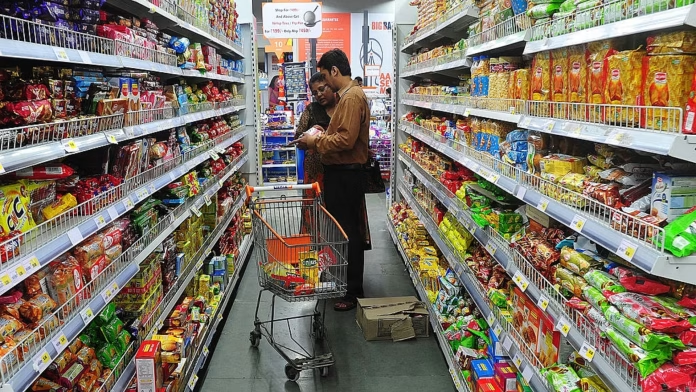
In a significant transaction within the Chennai grocery retail industry, WayCool, valued at INR 2,000 crores, has concluded its retail operations under the SunnyBee Market brand. Sources report that Fresh2Day has acquired the brand for an undisclosed amount.

WayCool will continue prioritizing the reinforcement of its supply-chain business, which currently encompasses over 20 distribution centers.

“Waycool continues its B2B enterprise business in the areas of fresh, staples, and dairy, supply chain management, and contract manufacturing,” the source said.

Established in July 2015, SunnyBee stands as a comprehensive premium food store, providing a diverse range of over 5,000 Stock Keeping Units (SKUs) spanning various categories, including regular and exotic fruits, vegetables, dairy products, staples, and both Indian and international foods.

With 11 outlets in Chennai, SunnyBee Market oversees SunnyBee Santhai, an interface connecting farmers and consumers. The SunnyBee mobile app facilitates doorstep deliveries, and within the store, customers can safely utilize the Self-Checkout service.

Fresh2Day, a Chennai-based food and grocery store, features a curated catalog of more than 200 carefully selected products.

“Our main goal is to provide a hassle-free and premium shopping experience with fresh and top-quality products at the lowest prices in the market,” says information in social media.

WayCool Foods stands as India’s foremost food and agtech platform, actively collaborating with over 200,000 farmers through its farmer engagement initiative, Outgrow.

WayCool’s portfolio of consumer brands includes Madhuram, Kitchenji, L’exotique, Dezi Fresh, Freshey’s, AllFresh, and Just Potate.

“With the addition of SunnyBee stores inventory and more, our plan is to reach 35+ Superstores by the end of this financial year,” stated T Annamalai, Founder & CEO of Fresh2Day.

Adding to this, he mentioned that Fresh2Day, boasting 23 retail Superstores in Chennai, has secured its position as the second-largest player in the fruit and vegetable format in the city.

“Sourcing is key and is the most important aspect of our business. We work with several farmers across south India through our collection centres, and our stringent quality checks makes this brand popular among customers,” he said.

“Fresh2day has hired most of SunnyBee’s staff as an internal understanding with its parent company. With this takeover, the company has more than 400+ staff taking care of the needs of its 10,000+ daily customers, said Sanjoy Das, Chief Strategy Officer, Fresh2Day.

R Sathyanarayanan, Associate Professor of Marketing, IFMR Graduate School of Business, Krea University, said, “Waycool is a strong supply-chain and agritech player. Though they manage various businesses in the farm-to-fork value chain, the multi-store, brick-and-mortar retail business is a different ball game and capital-intensive. To be a completely vertically integrated player at this point might dissipate the firm’s energy and resources. The move to focus more on the core business will help WayCool strengthen itself, he said.

Advertisement

Restaurant chain Chowman continues Bengaluru expansion with seventh outlet in Koramangala

0
Chowman
Chowman (Representative Image)

Chowman, the Chinese dine-in restaurant brand, expanded its presence in Bengaluru with the inauguration of its seventh outlet, as revealed in a press release on Monday.

Situated in Adugodi, Koramangala, Bengaluru, the recently unveiled store, boasting 34 seats, occupies a spacious 1500 sq. ft. area.

“Koramangala has consistently held a prime spot on our list of top locations since our entry into Bangalore in 2020,” said Debaditya Chaudhury, managing director of Chowman. “We were receiving numerous orders from Koramangala after the launch of our Bellandur and Indiranagar outlets last year, and were forced to decline them during peak hours.”

Having successfully launched its restaurants in Kolkata, Bengaluru, Delhi-NCR, and Hyderabad, Chaudhury mentioned that the chain is now gearing up to expand its footprint.

“The next destinations on the horizon include Mumbai and Pune in the West, followed by Chandigarh in the North, and Chennai in the South,” Chaudhury added.

Chowman restaurants present an extensive menu featuring a diverse range of flavors, including options such as fish, chicken, prawn, lamb, and crab meat, among others.

Established by the musician-turned-entrepreneur Chaudhury, the company originated as a modest restaurant in Kolkata back in 2010. Presently, the brand boasts a nationwide presence, operating 34 outlets in total, including 22 in Kolkata, seven in Bengaluru, four in Delhi-NCR, and one in Hyderabad.

Advertisement

Mokobara continues omnichannel expansion with Mumbai store launch

0
Mokobara
Mokobara

Travel and lifestyle brand Mokobara has opened its first store in Mumbai, as shared by a company official on social media. The store is situated on the ground floor of Phoenix Palladium mall in Lower Parel, Mumbai.

“Ecstatic to announce the launch of our very first store in Mumbai at Phoenix Palladium. First ones are always super special and the response we received from everyone today has been nothing less than phenomenal,” said Ayushi Yadav, head of business development at Mokobara in a LinkedIn post while sharing the images of the new store.

In May 2023, the company entered the realm of brick-and-mortar retail with the opening of its first retail store in Bengaluru at Phoenix Marketcity, Whitefield.

The D2C brand, headquartered in Bengaluru, provides a range of products, including travel bags, briefcases, totes, slings, wallets, and accessories.

In July, the company revealed its second retail store on the 12th Main Road in Indiranagar, covering 800 sq. ft. of space. This independent outlet represents Mokobara’s inaugural flagship in the country. Subsequently, the retailer launched its third brick-and-mortar store in Bengaluru, situated at Phoenix Mall of Asia.

Established in early 2020 by Sangeet Agarwal and Navin Parwal, Mokobara originated as a direct-to-consumer online luggage brand. In addition to its brick-and-mortar outlets, the brand also sells its products through its dedicated e-commerce platform and various online marketplaces, including Flipkart, Myntra, Amazon, and Nykaa.

“Super excited to announce that we’ll be opening up multiple retail stores all across India very, very soon,” said Agrawal, founder at Mokobara in a social media post a month ago.

The brand is intensifying its focus on omnichannel expansions, with plans to open more than 20 retail stores in the fiscal year (FY) 2024, as outlined in a prior press release.

Advertisement

Hindustan Unilever to bring 1.3 Million kirana stores onto ONDC to counter e-commerce giants

0
Hindustan Unilever
Hindustan Unilever (Representative Image)

Hindustan Unilever (HUL) has announced its commitment to facilitate the onboarding of approximately 1.3 million kirana stores onto the Open Network for Digital Commerce (ONDC) established by the central government. This initiative aims to empower these stores to effectively compete with e-commerce platforms and fast-service grocery retailers.

The move is an extension of HUL’s internal ordering app Shikhar, which facilitates direct orders for small neighborhood stores. Representing about a third of HUL’s sales from local retailers, Shikhar underscores the company’s prominent position as the country’s largest packaged consumer goods firm. Notably, in the preceding year, HUL made history by becoming the first fast-moving consumer goods (FMCG) company to integrate with ONDC through its multi-brand direct-to-consumer platform, UShop.

“We realised that retailers need to service orders directly instead of HUL doing it through UShop. That’s the real democratisation of ecommerce,” said Kedar Lele, executive director, customer development for HUL. “With Shikhar, they have come half way and are beginning to order on their own. In the future, 1.3 million retailers could become available on the ONDC network and buy not just HUL products but anything that the retailer sells.”

Lele mentioned that HUL functions as a “digitalization agent” or a supportive team, guiding neighborhood retailers to compete effectively with the leading players in the e-commerce industry, particularly in the realm of hyper-local services.

To begin with, HUL is piloting the initiative through an integrated module in Shikhar known as the Shikhar Seller app. This application allows neighborhood kirana stores to go live on ONDC, presenting an opportunity to sell their complete product catalog online. Currently, the pilot phase is active in New Delhi and Bengaluru, encompassing 60 outlets, with plans for a gradual nationwide scale-up.

“This is the right time in our belief to start enabling because as ONDC starts growing, is the time when the retailer starts plugging into it. And with that momentum, we will be able to service the retailer as well and they will be able to hold on to their share of business, which otherwise will become difficult for them,” said Lele.

ONDC stands as an openly accessible and inclusive platform with the goal of democratizing e-commerce. Its purpose is to empower small merchants by providing them access to advanced technologies and improved business mechanisms. Currently, out of approximately 12 million mom-and-pop stores in India, only a meager 0.12% are technologically enabled. Furthermore, e-retail constitutes only 4% of the expansive $800 billion retail market in India. ONDC seeks to address these gaps and enhance the digital presence of small businesses in the country.

Joining the open network presents an opportunity for retailers to operate within an e-commerce ecosystem that functions without pre-determined barriers, as emphasized by experts.

“ONDC ensures a level playing field for digital retailers of all sizes, granting visibility and democratising the digital commerce landscape. Sellers enjoy the freedom to set their terms and conditions, register once for discoverability and retain high profit margins without commission deductions. Direct connections with buyers eliminate intermediation risks and third-party charges, boosting profitability,” said T Koshy, managing director, ONDC, adding that the network also offers services such as logistics and enhanced analytics, enabling retailers to optimise operations and enhance overall business performance.

HUL boasts the most extensive retail network coverage among FMCG companies in India, distributing its products to nine million kirana stores. Last year, Unilever, its parent company, hailed its Indian unit as a digital and innovation powerhouse, as numerous local technological and digitization initiatives like Shikhar gained adoption in various developing nations.

Advertisement

Bikanervala chairman Kedarnath Aggarwal dies at 86, leaving a resilient legacy in India’s snack industry

0
Kedarnath Aggarwal
Kedarnath Aggarwal

Kedarnath Aggarwal, chairman of one of India’s largest and most well-known packaged snacks and sweets companies, Bikanervala Group, scripted one of India’s best-known stories in ethnic snacking. He leaves behind a rich legacy of resilience and determination, having passed away on Monday at the age of 86.

In the 1950s, Kedarnath Aggarwal, alongside his brother Satyanarayan Aggarwal, initiated the Bikanervala journey as street vendors in Old Delhi. Armed only with a legacy from their hometown in Bikaner and an unwavering determination to succeed, they began their entrepreneurial venture. Fondly known as Kakaji by family and friends, Kedarnath, the patriarch of the Bikanervala Group, commenced his odyssey with a modest family “business” – a single sweet shop named Bikaner Namkeen Bhandar in Bikaner.

Despite humble beginnings, the brothers decided to expand their enterprise and relocated to Old Delhi, a move that brought with it numerous challenges in the early days. Kedarnath and his brother, starting with the sale of bhujia and rasgulla in buckets on Old Delhi’s streets, faced adversity with resilience. Remaining steadfast in their pursuit, they eventually established a shop in Delhi’s Chandini Chowk, gradually constructing their business brick by brick, incorporating both resilience and cherished recipes from their hometown of Bikaner.

Today, the group commands a turnover of INR 1,300 crore, with a presence spanning over 150 outlets across India and overseas. The Bikanervala restaurants, as per the company’s records, witness a monthly footfall of one crore, a number that surges during festive seasons.

Competitors in the western snacks market, such as PepsiCo, ITC, Prataap Snacks, or Parle Products, have consistently failed to erode the commanding market share held by the triumvirate of Bikanervala, Haldiram’s, and Bikano.

The current snack market is valued at INR 1.5 lakh crore, with only 55% organized, making it a fiercely competitive industry.

Despite frequent enticements from major corporate entities and private equity firms seeking stake buyouts, the emerging generation of entrepreneurs in the Bikanervala family remains steadfast in resisting such proposals.

“Kakaji’s departure is not just a loss to Bikanervala; it’s a void in the culinary landscape. His vision and leadership will forever guide our culinary journey,” Shyam Sunder Aggarwal, managing director of Bikanervala Group, said in a statement issued on Monday.

The group has a global footprint that extends to the US, New Zealand, Singapore, Nepal, and the Middle East.

Advertisement

India’s edible oil imports surge to record highs in FY 2022/23: Palm Oil and sunflower oil soar, while soyoil declines

0
edible oil
(Representative Image)

India’s palm oil and sunflower oil imports saw substantial growth in the fiscal year 2022/23, surging by 24% and 54%, respectively, reaching record highs. This notable increase was fueled by a resurgence in consumption and the attractive pricing of these oils, which were available at a considerable discount compared to the rival soyoil, according to a leading trade body’s report on Monday.

Increased acquisitions by the world’s largest importer of vegetable oils may contribute to a decrease in palm oil stocks in Indonesia and Malaysia, providing support to benchmark futures. This heightened purchasing activity could also lead to a reduction in inventories in Black Sea countries that produce sunflower oil.

Palm oil imports reached 9.79 million metric tons in the marketing year ending on October 31, 2022, while sunflower oil imports rose to 3 million tons, according to a statement from the Mumbai-based Solvent Extractors’ Association of India (SEA).

Imports of soyoil for the year experienced a 12% decline, totaling 3.68 million tons, primarily due to its trading at a premium compared to palm oil and sunflower oil for the majority of the months.

Edible oil imports for the year soared to a historic high of 16.47 million tons, marking a 17.4% increase from the previous year. The surge was attributed to the government’s decision to reduce the import tax on edible oils to 5.5%, stimulating overseas buying, according to the statement from the Solvent Extractors’ Association of India (SEA).

During the previous year, the government lowered import taxes in response to the global increase in edible oil prices. However, according to a dealer based in New Delhi affiliated with a global trade house, these taxes were not subsequently raised when prices in the world market decreased.

“The price correction in the world market, coupled with lower duties, made edible oil cheaper and boosted consumption,” the dealer said.

Increased imports raised vegetable oil stocks to 3.3 million tons on November 1, compared to 2.46 million tons a year earlier, as reported by the Solvent Extractors’ Association of India (SEA).

India predominantly procures palm oil from Indonesia, Malaysia, and Thailand. In contrast, it imports soyoil and sunflower oil from Argentina, Brazil, Russia, and Ukraine.

From November to January and July to September, Indian refiners engaged in aggressive buying due to favorable prices in the global market. However, in October, they significantly reduced imports due to elevated stocks, as explained by Rajesh Patel, the managing partner at GGN Research, an edible oil trading and brokerage firm.

In October, the nation’s palm oil imports decreased by 15% compared to the previous month, totaling 708,706 tons, marking the lowest figure in the past four months, according to the Solvent Extractors’ Association of India (SEA).

Soyoil imports plummeted by 62% in October compared to September, reaching 135,325 tons, the lowest level in 34 months. Simultaneously, sunflower oil saw a decline of 49%, totaling 153,780 tons, marking its lowest point in the past 7 months, according to the reported information.

Advertisement

Diwali festivities drive liquor sale boom in Delhi, generates revenue of over INR 525 Crore

0

In the three days leading up to Diwali on Sunday, residents of Delhi purchased approximately 64 lakh liquor bottles, amounting to a value of around INR 121 crore, as reported by officials. Official data indicates that the week preceding Diwali witnessed a sale of over one crore liquor bottles, contributing INR 234.15 crore to the government’s revenue.

“The sale of liquor picks up during festivals like Holi and Diwali in Delhi as it is not only bought for personal consumption and stocking but also for giving as gifts,” a senior excise department official said.

Official statistics reveal that the overall sales during the 17 days leading up to Diwali surpassed three crore bottles, generating a revenue of INR 525.84 crore.

Liquor sales gained momentum just before Diwali, with establishments selling 17.33 lakh, 18.89 lakh, and 27.89 lakh bottles on Thursday, Friday, and Saturday, respectively. Officials noted that the shops were closed on Diwali, which was observed as a dry day.

The collective sale of more than 64 lakh bottles within three days resulted in a total revenue of INR 120.92 crore. In comparison, the preceding year witnessed the sale of 13.46 lakh, 15 lakh, and 19.39 lakh liquor bottles in the three days leading up to Diwali.

Officials reported a significant surge in liquor sales on the eve of Diwali, with a recorded bumper sale amounting to INR 53.89 lakh.

Officials noted a substantial increase in liquor sales in Delhi during the 17 days preceding Diwali this year, with the number surging from 2.11 crore bottles in 2022 to over three crore. This represents a remarkable 42 percent growth.

The average daily number of bottles sold during this festival period increased to 17.93 lakh, a notable rise from 12.44 lakh in 2022. This growth in average daily sales during this period amounted to 5.49 lakh bottles or 44 percent, according to officials.

Four Delhi government corporations operate more than 650 liquor stores in the national capital.

Prior to the festival season, the corporations were instructed to place orders and ensure ample stocking for Diwali sales, as stated by the excise department officer.

Advertisement

Empathy-Driven Insights: The Role of Customer Journey Mapping in Design Thinking

0
customer journey mapping

The combination of empathy and strategy is revolutionary in the field of design, which brings innovation and human experience together. A key component of design thinking, customer journey mapping shows itself to be a powerful tool for understanding the complex dance that occurs between customers and products. Through the use of customer journey mapping, this article explores the significant influence of empathy-driven insights and how it changes design thinking into a dynamic process that is in tune with the end-user’s pulse.

Design thinking is more than just a methodology; it’s a mindset that places the user at the epicenter of the design process. At its core lies empathy—a deep understanding of the user’s needs, desires, and pain points. Customer journey mapping, an integral component of design thinking, extends this empathy into a visual representation that traces the user’s interactions with a product or service across various touchpoints.

1. Walking in the User’s Shoes: The Power of Empathy

Empathy is the cornerstone of effective design. Customer journey mapping allows designers to step into the shoes of the end-user, experiencing their journey firsthand. By mapping out each interaction, from initial awareness to post-purchase, designers gain a holistic view of the user’s emotions, frustrations, and moments of delight. This intimate understanding forms the bedrock upon which impactful design solutions are built.

2. Spotting Pain Points: Designing Solutions, Not Features

Every journey has its hurdles, and the user experience is no exception. Customer journey mapping unveils these pain points, exposing the areas where users may feel frustrated, confused, or disengaged. Design thinking, fueled by empathy, transforms these pain points into opportunities for innovation. Instead of merely adding features, the focus shifts to designing solutions that address the root causes of user dissatisfaction.

3. Creating User-Centric Experiences: Beyond Aesthetic Appeal

Design is not just about aesthetics; it’s about crafting experiences that resonate with users on a profound level. Customer journey mapping ensures that the design process remains user-centric, with each decision rooted in the user’s needs and expectations. This approach goes beyond creating visually pleasing interfaces; it aspires to deliver meaningful and seamless experiences that enhance the user’s journey.

4. Fostering Collaboration: Breaking Silos for Holistic Design

Customer journey mapping acts as a collaborative canvas that brings together cross-functional teams. Designers, marketers, product managers, and customer support teams can collectively contribute to the mapping process, breaking down silos and fostering a shared understanding of the user’s experience. This collaborative approach ensures that design solutions align with broader business objectives and are seamlessly integrated into the entire customer journey.

5. Iterative Improvement: A Continuous Dialogue with Users

Design thinking is a journey, not a destination. Customer journey mapping instills a mindset of continuous improvement by providing a visual framework for iteration. As users evolve, so do their journeys. By regularly revisiting and updating the customer journey map, designers stay attuned to shifting user needs, ensuring that their solutions remain relevant and responsive to an ever-changing landscape.

Elevating Design Thinking with Empathy-Driven Insights

In the dynamic realm of design thinking, customer journey mapping emerges as the compass that guides designers through the intricate landscape of user experiences. By infusing empathy into the design process, this tool transforms pixelated interfaces into pathways that resonate with the genuine needs and emotions of users. Beyond the allure of aesthetics, customer journey mapping becomes the conduit through which designers create meaningful, human-centric solutions that stand the test of time. In the realm of design, it’s not just about what the product looks like; it’s about how it makes the user feel at every step of their journey.

Advertisement

The User’s Voice: Building Authenticity through User-Generated Content Strategies

0
User-Generated Content

Consumers are more than just passive recipients of brand messages in the constantly changing world of digital communication. Through their personal experiences and tales, they have evolved into active participants who help to shape the story. This post delves into the significant influence that user-generated content (UGC) has on promoting authenticity, establishing credibility, and forging sincere bonds with consumers.

Gone are the days when marketing was a one-way street, with brands dictating the conversation. Today, consumers play a pivotal role in shaping a brand’s identity. UGC, ranging from reviews and testimonials to images and videos, empowers users to voice their opinions and share their authentic experiences. This shift has transformed the brand-consumer relationship into a dynamic, two-way interaction.

1. Trust in the Crowd: The Power of Authenticity

Consumers are inherently skeptical of polished marketing messages. Enter user-generated content – the unfiltered, real experiences of fellow consumers. Whether it’s a photo of a product in action, a heartfelt review, or a candid video testimonial, UGC serves as a testament to a brand’s authenticity. It creates trust by allowing potential customers to see the product or service in a genuine context, free from the gloss of marketing gloss.

2. Authenticity Breeds Connection: The Human Touch

In the realm of UGC, authenticity is the currency that builds connections. When users share their experiences, they are not just endorsing a product; they are offering a glimpse into their lives. Brands that actively encourage and showcase this user-generated content are perceived as more human and relatable. This human touch fosters a sense of community, where users feel seen and heard, transcending the traditional buyer-seller dynamic.

3. Empowering the Consumer: From Audience to Advocates

By incorporating UGC strategies, brands empower their consumers to become advocates. When users see their content featured by a brand, it validates their contribution and enhances their sense of belonging. This empowerment cultivates a community of loyal brand advocates who not only purchase but actively promote the brand, driving organic growth through word-of-mouth recommendations.

4. Showcasing Diverse Perspectives: Inclusivity Matters

One of the remarkable aspects of UGC is its ability to showcase diverse perspectives. In a world that values inclusivity, brands that embrace user-generated content featuring a variety of voices, backgrounds, and experiences send a powerful message. This inclusivity resonates with a broader audience, making them feel represented and strengthening the brand’s appeal across different demographics.

5. Authenticity as a Marketing Strategy: Beyond Aesthetics

Authenticity is not just a buzzword; it’s a powerful marketing strategy. Brands that prioritize user-generated content over meticulously curated, staged campaigns signal a departure from the glossy world of advertising. Authentic UGC communicates that a brand is confident in its products, values its customers, and is open to showcasing the unfiltered reality of its offerings.

The User’s Voice in a Digital Symphony

In the symphony of digital communication, the user’s voice is the authentic melody that resonates with the audience. User-generated content is not just a marketing tool; it’s a bridge that connects brands with their consumers on a human level. By fostering authenticity, building trust, and showcasing diverse perspectives, UGC strategies become more than just a trend; they become the cornerstone of a brand’s genuine and enduring connection with its audience. In a world inundated with content, it’s the real, unfiltered stories that cut through the noise and leave a lasting impression.

Advertisement

Emotional Triggers: Understanding Feelings that Drive Consumer Decision-Making

0
consumer buying

What leads people to choose one product over another in the huge array of options available to them? The complex dance of emotions influencing our decision-making process holds the key to the solution. This post explores the intriguing realm of emotional triggers and how successful brand strategies can be driven by comprehending and utilising these sensations to unlock consumer preferences.

At its core, the act of choosing a product is rarely a purely rational decision. Emotions play a pivotal role in shaping our perceptions and preferences. Understanding this emotional tapestry is akin to holding the key to decoding why consumers make the choices they do. Let’s explore some of the key emotional triggers that drive consumer decision-making.

1. The Power of Nostalgia: Connecting to the Past

Nostalgia has an almost magical ability to transport individuals to a different time, evoking fond memories and emotions. Brands that tap into this emotional trigger can create a sense of familiarity and comfort, making consumers more likely to choose a product that aligns with their nostalgic sentiments. Think about the surge in popularity of vintage-themed packaging or the revival of classic flavors – these are not just products; they are journeys back in time.

2. FOMO (Fear of Missing Out): Creating Urgency

The fear of missing out is a potent emotional trigger that compels consumers to act swiftly. Limited-time offers, exclusive deals, and product launches all capitalize on this sense of urgency. By creating a sense that an opportunity is fleeting, brands can push consumers to make decisions driven by the desire to be part of something special or to avoid being left behind.

3. Trust and Reliability: Building Emotional Bonds

Trust is the cornerstone of any successful relationship, and the relationship between a consumer and a brand is no different. Emotional triggers related to trust and reliability are vital in shaping consumer perceptions. Brands that consistently deliver on promises and cultivate an image of dependability can evoke feelings of security and comfort, ultimately influencing purchasing decisions.

4. Aspiration and Identity: The Quest for Self-Expression

Consumers often make choices that align with their aspirations and self-identity. Brands that tap into these emotional triggers by offering products that reflect a consumer’s desired self-image can establish a powerful connection. This goes beyond just buying a product; it becomes a statement of who the consumer aspires to be.

5. The Pleasure Principle: Gratifying the Senses

The pursuit of pleasure is a universal human experience, and brands that can tap into the pleasure principle often find themselves in favor with consumers. Whether it’s the indulgent taste of a treat, the luxurious feel of a product, or the captivating aroma of a fragrance, pleasure-driven emotional triggers can create a positive association that influences decision-making.

Cracking the Code of Consumer Behavior

In the intricate dance of consumer decision-making, emotions take center stage. Nostalgia, FOMO, trust, aspiration, and pleasure are just a few of the emotional triggers that brands can strategically leverage to connect with their audience on a deeper level. By understanding the feelings that drive decision-making, brands can go beyond selling products – they can become architects of experiences that resonate with the hearts and minds of consumers. In the end, it’s not just about what consumers buy; it’s about the emotions they feel when they make that choice.

Advertisement