Valentine’s Day is around the corner, and in celebration, McDonald’s has unveiled two new pink desserts that will be available for a limited time.
The popular fast-food chain has introduced several new items to its menu, set to be available in the upcoming weeks. Additionally, some beloved classics are making a return.
Featuring limited edition red and pink packaging, the new menu offerings are ideal for savoring in celebration of Valentine’s Day. Here’s a sneak peek at everything you can anticipate on the menu starting February 7.
According to The Mirror, McDonald’s is set to offer the all-new Raspberry and White Chocolate Pie. This delectable treat boasts a crispy pink pastry filled with a velvety white chocolate ganache and a zesty raspberry compote. The price for this delightful dessert is £1.99.
For those with a penchant for ice cream, McDonald’s is introducing the KitKat Ruby Chocolate McFlurry. This delightful treat blends velvety vanilla ice cream with KitKat pieces coated in ruby chocolate, accompanied by wafer bites and finished off with a drizzle of raspberry sauce. The regular size is priced at £1.59, while the larger version is available for £2.19.
If you’re eager to sample these desserts ahead of their official release, you can access an exclusive preview by downloading the McDonald’s app on February 7 and 8, preceding the official launch on the 9th. However, be sure to act quickly, as these delectable treats will only be on the menu until March 12.
For those with a savory preference, the fast-food chain is reintroducing the renowned Big Tasty burger priced at £7.69, and the Big Tasty with bacon, available for £8.49.
Making a comeback to the menu are the beloved Mozzarella Dippers with Salsa and the Mozzarella Dippers Sharebox with Salsa Dip, bringing joy to cheese enthusiasts. The individual dippers are priced at £2.39, while the Sharebox is available for £6.49. These returning items will be on the menu from February 7 until March 12.
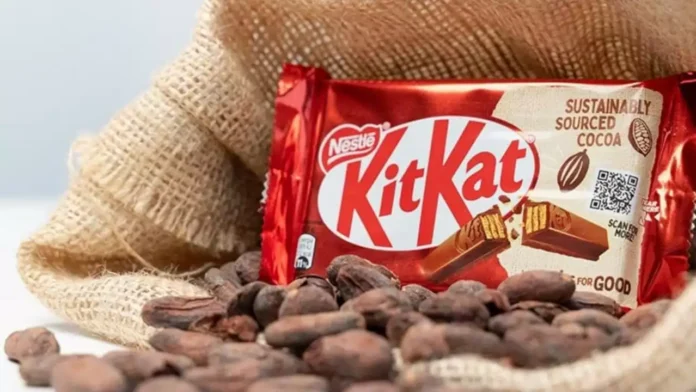
Nestlé has introduced the first KitKat crafted using cocoa mass sourced from beans cultivated by farmer families engaged in the company’s income accelerator initiative.
The company aims to connect consumers with the farmers in the program while raising awareness about the sustainability of the cocoa used in its KitKat bars.
Launched in January 2022, the initiative seeks to tackle income disparity among cocoa-farming families and reduce the risk of child labor. Furthermore, it endeavors to champion and implement improved agricultural practices while fostering gender equality.
Families engaged in the program receive assistance in embracing sustainable agricultural practices, participating in agroforestry initiatives, diversifying their sources of income, and facilitating their children’s education.
Nestlé’s income accelerator initiative has already positively affected more than 10,000 families in Côte d’Ivoire, West Africa, and plans to extend its reach to Ghana this year, benefiting a total of 30,000 families. Nestlé foresees that by 2030, the program will yield significant and widespread improvements, reaching approximately 160,000 cocoa-farming families within Nestlé’s global cocoa supply chain.
To achieve this objective, Nestlé has collaborated with diverse partners and suppliers, including the Rainforest Alliance, aiming to revolutionize its global cocoa sourcing methods. The goal is to attain complete traceability and physical segregation of cocoa obtained through its income accelerator program, ensuring the ability to monitor the entire journey of cocoa beans—from their origin to the factory—keeping them physically separate from other cocoa sources.
The cocoa mass from the income accelerator program conforms to stringent traceability standards, guaranteeing ‘mixed identity preserved’ traceability. This ensures that cocoa can be traced and stored separately, meeting high-quality standards.
Furthermore, Nestlé aims to incorporate segregated cocoa butter for all its KitKat chocolate in Europe by mid-2024, with intentions to extend this practice to other regions in the coming years.
Corinne Gabler, head of confectionery and ice cream for Nestlé, said, “KitKat has consistently embraced innovation, centred around its iconic ‘Have a break, Have a KitKat.’ Today, this innovation is brought to life through the Breaks for Good initiative that puts cocoa farmers at the centre of our product through our income accelerator programme. We couldn’t think of a better brand than KitKat to represent our efforts to create a meaningful impact in cocoa communities.”
Thierry Touchais, manager of strategic accounts for the Rainforest Alliance, commented, “We’re delighted to collaborate with Nestlé on their journey towards more sustainable cocoa sourcing. It’s encouraging to find a company of this scale using a ‘mixed identity preserved’ model in which cocoa can be traced back to Rainforest Alliance-certified farmers engaged in Nestlé’s income accelerator. The approach showcases the potential for positive change in the industry.”
The KitKat Breaks for Good are now accessible at retailers in 27 European countries, and they are set to debut in the UK in May. Moreover, a limited-edition KitKat featuring 70% dark chocolate, sourced from the income accelerator, has been introduced in the UK market as a pilot.
Archies, a renowned gifting brand, has collaborated with Mondelez India to enhance the gifting experience for customers ahead of the Valentine’s season, as announced in a press release on Tuesday.
The collaboration aims to enhance “meetha” (sweet) occasions by presenting tailored gift hampers from Mondelez India, according to the provided release.
“We are excited about the possibilities this collaboration brings,” said Varun Moolchandani, executive director, Archies.
“Mondelez India’s reputation for crafting delightful and high-quality chocolates perfectly complements our mission to provide customers with an array of choices that symbolize affection and thoughtfulness. This Valentine’s season is just the beginning, and we look forward to creating countless sweet moments for our customers together,” he added.
The collaboration officially kicks off with a lineup of Mondelez India’s gift hampers now offered at Archies stores.
Desmond D’Souza, vice president – sales, Mondelez India said, “We are excited to offer our differentiated gift hampers across Archies India’s stores and website. We look forward to jointly building a compelling gifting proposition for Indian shoppers, and to entrench our products as a gift item across multiple occasions, both large and small.”
Archies offers greeting cards, home decor, and various gifting products, boasting a network of over 200 stores nationwide. In December last year, it introduced same-day delivery services in Delhi-NCR.
Mondelez India, a division of the Mondelēz International group, launched Cadbury Dairy Milk and Bournvita in India in 1948. The company is based in Mumbai and maintains sales offices in New Delhi, Mumbai, Kolkata, and Chennai. Additionally, it operates manufacturing facilities in Maharashtra, Madhya Pradesh, Himachal Pradesh, and Andhra Pradesh.
Contrary to speculation suggesting that Swiggy might increase its platform fee for food orders from INR 5 to INR 10 in the upcoming months to counterbalance losses before its scheduled initial public offering (IPO), the Bengaluru-headquartered food delivery aggregator has refuted these claims, asserting that there are no such plans in its future strategies.
“We are always running small experiments to better understand the consumer’s choices. This was one such experiment, and we may or may not scale it up in the future if it doesn’t meet our goal of serving our users in the best way possible. We have been always looking for ways to make our platform more affordable, and our latest offering, Pockethero, is another example of that. Pockethero is designed for budget-conscious consumers, and we’re expanding it across the country right now,” stated a spokesperson from Swiggy.
According to a Moneycontrol report, the company is likely to double its platform fee on food orders from INR 5 to INR 10 in the coming months. This move is seen as a strategic effort to reduce losses as it gears up for its upcoming IPO later this year.
Swiggy has begun hinting at the introduction of a new fee for select customers on its app, as mentioned in the report.
Last year, Swiggy started experimenting with platform fees. During the initial trial period, the company cautiously introduced a nominal platform fee of INR 2 on specific food orders, regardless of the cart size.
Having noted that the extra fee had minimal impact on the volume of food orders, Swiggy broadened its approach. Several weeks later, the platform started implementing a uniform platform fee for all customers.
The foodtech giant has gradually increased its platform fee to INR 5, although a percentage of customers continues to pay a discounted fee of INR 3.
The platform fee, applied alongside the delivery fee, is applicable to all customers, including those enrolled in Swiggy’s loyalty program, Swiggy One.
Swiggy’s rival, Zomato, has recently increased the platform fee to INR 4 per order across key markets from INR 3, as indicated on its app.
Both platforms impose a platform fee in addition to the delivery charge, but this fee is waived for customers enrolled in their respective loyalty programs.
This is consistent with Swiggy’s pursuit of profitability, particularly as the company prepares for its stock market debut in 2024. The anticipated timeline for Swiggy’s IPO is mid-2024.
Established in 2014 by Sriharsha Majety, Nandan Reddy, Phani Kishan Addepalli, and Rahul Jaimini, Swiggy has secured a total funding of $3.6 billion so far.
Last year, Swiggy’s co-founder and CEO Sriharsha Majety announced that the company’s food delivery business had achieved profitability as of March 2023. “As of March 2023, Swiggy’s food delivery business has turned profitable (After factoring in all corporate costs; excluding employee stock option costs).”
In FY22, the company reported a consolidated loss of INR 3,629 crore and generated revenue of INR 5,704.9 crore. Notably, INR 3,444.4 crore of the total revenue originated from the food delivery business.
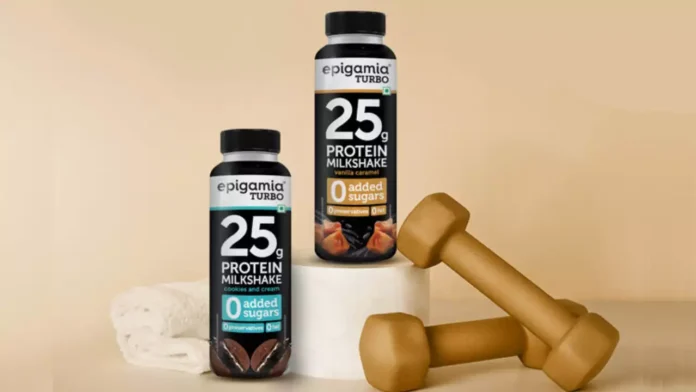
Epigamia, the flagship brand of Drums Food International, has recently introduced India’s first ready-to-drink 25g protein milkshakes. These innovative beverages come with the promise of zero added sugar, zero fat, and zero preservatives, catering to health-conscious consumers.
Available in two delectable flavors—Vanilla Caramel and Cookies & Cream—these protein-packed milkshakes serve as an excellent choice for a pre or post-workout boost or a convenient protein-rich snack. Their easy portability and consumption eliminate the hassle of preparing protein shakes, making them a tasty and nutritious on-the-go option.
The Turbo series of protein milkshakes is conveniently available in a 250 ml bottle, making it an ideal choice for those on the move. These milkshakes derive their protein from Milk Protein Concentrate (MPC), boasting a PDCAAS score (protein digestibility scoring system adopted by US FDA) of 1. This score signifies that MPC is the most easily digestible and absorbable protein.
Epigamia’s Turbo range stands out in terms of its protein-to-calorie ratio when compared to other ready-to-drink protein milkshakes, offering 25% more protein for the same caloric content. In comparison to whey powder, one bottle matches the calorie and protein content found in one scoop of whey powder, providing a convenient and flavorful option for those mindful of their protein intake. Notably, these milkshakes are crafted with zero added sugar, zero fat, and no preservatives, enhancing their appeal for health-conscious individuals.
Rahul Jain, Co-Founder and CEO, of Epigamia, said, “At Epigamia, we firmly believe that enjoying a healthier lifestyle should be a flavourful and convenient experience for everyone. Today, most Indians are protein deficient. Fortunately, awareness around protein is rising and people are increasingly adding protein in their diet. Our aim is to deliver a product with an outstanding macronutrient profile, easy absorption, great taste, and convenience through our Epigamia Turbo protein milkshakes.”
These Turbo Protein Milkshakes are now conveniently accessible at select stores nationwide and can be easily ordered online through Swiggy Instamart, Blinkit, BigBasket, and Epigamia.
Ever since the Fightertrailer dropped on January 15, fans have been on cloud nine. Why? As the film features the dynamic duo of Hrithik Roshan and Deepika Padukone in the lead, and let’s be honest, who wouldn’t be thrilled about that?
Hold on to that, fans aren’t just raving about the sizzling chemistry between Roshan and Padukone in Fighter, they’re also going bonkers over the actor’s chiseled physique. As he is seriously pulling off such feats at the age of 50.
Hrithik Roshan in Fighter
Roshan has got those killer hazel eyes, a cute little nose, and a height that makes him stand out. But what’s even more awesome? The way he keeps himself in shape. He has a body and skin to swear by, which is all because of what he put on his plate and gym.
Hrithik Roshan’s 5 Week Body Transformation For the Upcoming Action-Thriller Fighter
Roshan, who was born and brought up in Mumbai, introduced the whole Bollywood to the wonders of aesthetic fitness. But the Bollywood heartthrob took it to the next level when a few months back he dropped his fabulous body transformation on Instagram, sharing before-and-after photos. He even shared how he achieved this in just 5 weeks.
“I do this because my movie characters sometimes challenge me to look a certain way. And I love challenges. That being said, I don’t depend on one shape or the other for my own self-worth,” he wrote in the caption.
Hrithik Roshan’s 5 week transformation
Are you curious about his magical transformation? The actor himself revealed that it wasn’t all rainbows and sunshine. In an Instagram post, he shared that he had to bid farewell to crucial commitments, miss out on quality time with loved ones, skip social events, and even pass on parent-teacher meetings. The sacrifices didn’t stop there – he had to hit the bed by 9 pm, which was “the second hardest part,” as he penned.
Hrithik Roshan Stuck with Dull Diet For His Role in Fighter
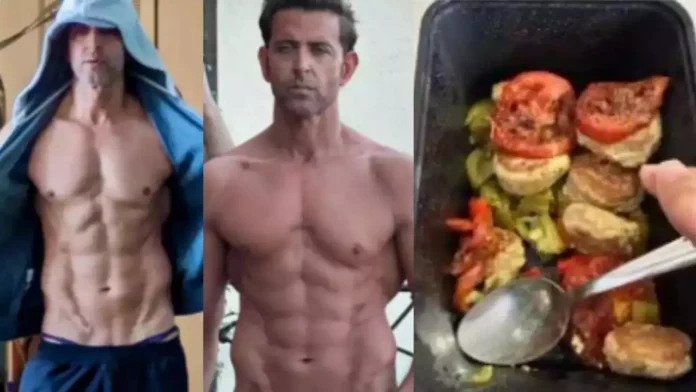
Hrithik Roshan’s trainer, Kris Gethin, spilled the actor’s dietary regimen during the preparation for his role in the film. For the role of Patty in Siddharth Anand’s 2024 flick, the Bollywood star embraced a bodybuilder’s diet, munching on around six to seven meals every single day.
Hrithik Roshan’s diet
His big platter mostly includes single-form ingredients such as chicken, egg whites, whey protein, and fish, along with sources of complex carbohydrates like oats, quinoa, rice, and sweet potato.
When chomping on solid foods got too tricky for the actor, he went for shakes, but he stuck to the good stuff. Even though his diet might seem tad boring, his chef Shubham Vishwakarma spiced things up with some kitchen magic.
He used culinary work of art, giving a Desi twist to the usual plain eats to make dishes like an egg white burger with chicken breast. Forget the regular bun – the chef went all out and used fluffy egg whites instead. Who knew dieting could be this fancy?
What Does Hrithik Roshan’s Workout Routine Looks Like?
In an interview with GQ, Kris Gethin shared what Bang Bang! star’s workout routine looks like. He explained that Roshan’s “weight training sessions last for 45-60 minutes.” They “focus on two body parts in each session, like the back and biceps, chest and triceps, or shoulders and abs.”
“He also focuses on completing a minimum of 10,000 steps every day on top of his cardio. He does some form of cardio every single day for about 40 minutes, be it hitting the beach for a jog or a swim,” the co-founder of Kris Gethin Gyms continued.
But the celebrity trainer also added that they change it up all the time because they don’t want the body to adapt and the workout to become boring and monotonous.
Here’s How You Can Craft a Bollywood Style Fitness Routine with Flavour
We know that the Greek god of Hindi cinema was prepping for a movie, so he went all bodybuilder mode, chowing down on like six or seven meals a day. We can also definitely snag inspiration from his meal. So, let’s whip up a plan with a balanced diet that’s packed with all the good stuff.
First things first, you can choose scrambled eggs, egg whites, greek yogurt, or cottage cheese for the protein punch. Then, grabbing a handful of nuts for those healthy fats can be another good option.
You can also get your lean protein fix with grilled chicken or fish, add in some quinoa, oatmeal with fruits or brown rice for those complex carbs, and toss in steamed veggies for a vitamin boost. Keep it crisp with a mixed salad, loading up on fiber and essential nutrients.
Now, let’s talk about how you can set a good workout routine for yourself, taking inspiration from the Bollywood hunk. Just like Roshan, you can set aside 45-60 minutes for some weightlifting action. Now, pick two body parts to work on in each session. Maybe it’s back and biceps today, chest and triceps tomorrow, or hit those shoulders and abs on another day.
You can even include about 40 minutes of cardio each day. Mix it up, don’t be boring. Jog one day, maybe splash around in the pool the next, or throw in any cardio fun you like.
That being said, consistency is the key. Therefore, stick to a regular workout plan and pick stuff you actually like doing. Because if it’s fun, you’re more likely to stick with it. Everyone’s fitness journey is unique – even yours is one of a kind. So, don’t rush it, take it slow and level up when you feel ready.
Good Glamm Group, a direct-to-consumer company, has entered into an exclusive three-year partnership with Dharma Productions. As part of this agreement, all theatrical and OTT releases by Dharma over the next three years will exclusively collaborate with the beauty brands of Good Glamm.
The beauty and personal care brands of Good Glamm, such as St Botanica, Organic Harvest, and MyGlamm, are set to be showcased through strategic in-movie and OTT placements. This collaboration will include the development of co-branded product lines, limited edition launches, and marketing campaigns, all released under the Dharma Productions banner, as stated by Darpan Sanghvi, the founder and chief executive officer of Good Glamm.
The content-to-commerce unicorn sees these as “symbiotic partnerships”.
Sanghvi said, “Such associations are long-term brand building platforms for us; as for the movies and releases, these will be promoted through our brand assets.”
Sanghvi mentioned that the group is currently engaged in discussions with three additional production houses and major studios for similar agreements lasting three to five years. He emphasized that these partnerships will be mutually exclusive, ensuring no overlap between them.
The D2C group, set to finalize its Series E funding this quarter, aims to maintain a competitive edge in the face of increased competition by focusing on portfolio innovation and disruptive marketing, as highlighted by Sanghvi.
Over the past two years, Good Glamm has focused on consolidating its portfolio, opting to scale up its existing lineup rather than acquiring new brands.
“Our focus is to get to profitability now. In the next two quarters, we have to become profitable so that we can look at a successful IPO next year,” Sanghvi said.
“If our profitability plans are on track, we get three-four quarters of profitability and growth. Then we can look at the IPO by Diwali 2025.” he added.
The group has acquired several brands, such as The Moms Co, Organic Harvest, Sirona, St Botanica, and BabyChakra. In addition to these, it holds ownership of the digital media and content platform ScoopWhoop and has a stake in Twinkle Khanna’s media company, Tweak India.
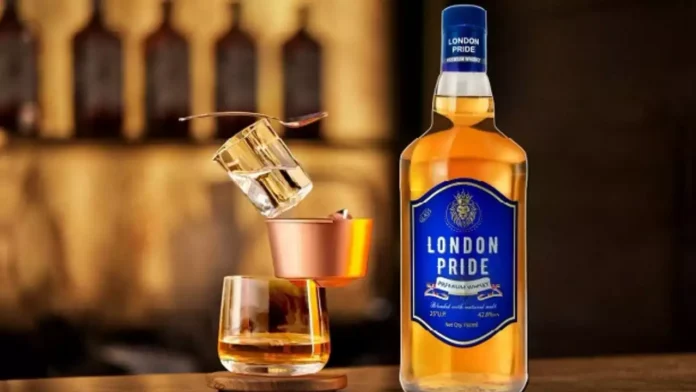
The Supreme Court on Monday issued a directive to a company based in Madhya Pradesh, renowned for its production and sale of whisky under the trademark ‘London Pride.’ The court sought clarification on whether the company is amenable to altering the trade dress and color of its product, pointing out similarities with the well-known whiskies ‘Blenders Pride’ and ‘Imperial Blue’ from liquor major Pernod Ricard India Pvt Ltd. Presiding over the bench, Chief Justice D Y Chandrachud tasked senior advocate S Muralidhar, representing the ‘London Pride’ brand, with obtaining instructions and conveying the company’s response during the next hearing.
“Why have you (‘London Pride’) adopted the same trade dress and colour and all? Get instructions on whether you will change the trade dress and colour (visual appearance of a product),” the bench, also comprising Justices JB Pardiwala and Manoj Misra, said.
The apex court said it will hear arguments on the issue of trademark dispute on names at the next hearing.
The legal battle over the alleged infringement of trademark of the whisky brands witnessed an unusual sight in the Supreme Court on January 5 as liquor bottles were placed before the country’s highest court.
The top court was hearing a plea by liquor major Pernod Ricard India Pvt Ltd, which manufactures and sells ‘Blenders Pride’ and ‘Imperial Blue’ whisky, against last November’s verdict of the Madhya Pradesh High Court.
Pernod Ricard had approached the high court against an order passed by the commercial court, Indore, which rejected its application for issuance of temporary injunction. The firm had alleged infringement of their trade mark.
It told the high court it had registered the trade mark in respect of ‘Blenders Pride’ and ‘Imperial Blue’ and also has registered trade mark in respect of Seagram’s, which is their house mark and appears on their products sold under various brands.
It alleged that JK Enterprises has imitated their trade mark and is manufacturing and selling its whisky under the trade mark ‘London Pride’.
The high court had dismissed Pernod Ricard’s plea, saying the trial court had not committed any error in holding that no similarity was found in the mark of JK Enterprises which can be said to be such imitation of Pernod Ricard’s trade mark.
Pernod Ricard had argued before the high court that ‘Pride’ was the most essential and distinctive component of the mark ‘Blenders Pride’ which they have been using since 1995.
The firm had said they were also using another mark ‘Imperial Blue’ since 1997 and are selling whisky under the same in distinctive label, packaging and trade dress.
“The plaintiffs (Pernod Ricard) acquired knowledge that defendant is selling London Pride whisky which is deceptively similar to its Blenders Pride trade mark. The whisky of defendant is being sold by putting label, using packaging, getup and trade dress deceptively similar to Imperial Blue,” the high court had noted in its verdict.
The other side had said they were manufacturing and selling liquor in the brand name of ‘London Pride’ in Madhya Pradesh and the trademark ‘London Pride’ was entirely different in name, style and composition from any of the earlier registered trademarks.
The counsel appearing for the other side had argued before the high court that the overall comparison of the trademarks unmistakably showed that there was no similarity in them which may cause any confusion in the mind of a consumer while purchasing the whisky.
The rate at which coffee prices are rising has accelerated due to unseasonal rainfall, a scarcity of labor, and increased demand, particularly from urban youth, in the aftermath of the Covid-19 pandemic, according to experts.
“Torrential rains during off-season caused a lot of damage to coffee. To add to it, shortage of labour has also slowed down the harvest process,” said ND Jayaram, a large grower from Karnataka.
Due to unseasonal rainfall in the coffee-producing states, the Coffee Board of India anticipates that production will be 10-15% lower than the previous estimate of 367,000 tonnes.
In December 2023, coffee prices experienced a 16% inflation rate, marking the fourteenth consecutive month of double-digit inflation. In October, the inflation rate reached its peak at 16.9%, the highest level since 2015.
Industry executives attribute the rise in coffee prices to an expanding network of coffee chains, which has subsequently boosted demand.
“The demand for coffee has gone up significantly post-Covid compared to the pre-Covid era,” said KG Jagdeesha, CEO, Coffee Board of India.
Jagdeesha stated that even with elevated prices, the consumption of coffee remains unaffected. This is attributed to the rising disposable income among urban youths, coupled with an increased willingness to spend on coffee.
The surge in coffee prices has impacted traditional coffee-drinking communities, particularly in the southern region. Nevertheless, some individuals within these communities opt for a solution by blending chicory, a coffee substitute with a comparable flavor but lacking caffeine.
India stands as the eighth-largest producer of coffee globally, predominantly cultivating robusta beans utilized in the production of instant coffee. Additionally, the country produces some of the pricier arabica varieties.
In 2023, coffee exports experienced a 4.5% increase in value, reaching a record $1.16 billion. However, there was a decline in volume attributed to higher global prices. The Coffee Board of India reported that India exported around 396,346 tonnes of coffee, down from 413,942 tonnes the previous year.
Prosus, the largest shareholder in Swiggy, is likely to be designated as a promoter for the upcoming initial public share sale of the online food and grocery delivery company, according to a report from ET. Sources familiar with the matter have indicated that the major sellers in this IPO will be the existing investors of Swiggy.
The Dutch-listed investment arm of the South African conglomerate Naspers has been actively seeking to decrease its stake in Swiggy, aiming to bring it below the current 33%. Despite ongoing talks with potential investors, these efforts have yet to achieve success. According to Indian regulations, holding a stake of 26% or more qualifies a shareholder as a promoter, leading to restrictions on post-IPO share sales.
As Swiggy gears up to file its draft IPO papers in the forthcoming months, sources indicate that the $1 billion IPO is anticipated to include a minimum of $600 million in an offer for sale by existing investors.
Swiggy’s spokesperson opted not to comment, and an email directed to Prosus remained unanswered until the press time.
While Swiggy is in the process of preparing its IPO papers, insiders reveal that Boat, the New Delhi-based wearables and audio accessory brand, is contemplating a reconsideration of its plan to go public in 2024. This comes after Boat withdrew its draft red herring prospectus (DRHP) filed with the Securities and Exchange Board of India in 2022, citing challenging market conditions.
However, one of the sources mentioned that it still intends to proceed with a public share sale.
Several new-age companies are seeking to make their debut on the stock market, following a turbulent 12-18 months for technology-led startups on local exchanges. In recent weeks, FirstCry, Ola Electric, Mobikwik, and Unicommerce have submitted their draft IPO papers and are anticipated to go public later this year.
Swiggy aims to file draft IPO papers by the end of the current fiscal year, but the timeline could change, according to individuals familiar with the matter.
“Prosus has been in talks with several investors to dilute the stake in Swiggy as part of a broader strategy to do secondaries (sale of shares) across portfolio firms, but it hasn’t worked out due to a valuation mismatch in Swiggy,” a person aware of the matter said.
Prosus, having invested around $1 billion in Swiggy, aims to shed the promoter tag to attain greater autonomy in managing the investment post the IPO.
SoftBank, with a 46% stake in the hospitality chain Oyo, also faces a similar situation. However, in the case of FirstCry, SoftBank reduced its holding to around 25.5% before the company filed the DRHP in December, from more than 30% at one point in time.
Boat, the audio-product maker, is scheduled to meet with investment bankers later this month to review its IPO plans.
“There is definite interest to relaunch the IPO as there is momentum in the market. They (Boat) will take a call on it soon,” a person aware of the matter said.
Aman Gupta, co-founder and Chief Marketing Officer of Boat, declined to comment on the matter.
In October 2022, it pulled back the DRHP after securing $60 million in funding.
Besides Gupta, Sameer Mehta, the other co-founder of Boat, also serves as its chief executive. He assumed this position after Vivek Gambhir was appointed chairman last year.
In 2022, Imagine Marketing, the parent company of Boat, submitted the DRHP to Sebi with the intention of raising INR 2,000 crore. This comprised a fresh issue of shares amounting to INR 900 crore and an offer for sale of shares valued at up to INR 1,100 crore.
Mobikwik is another firm that had initially postponed its IPO after filing its DRHP in July 2021. However, in a recent move, the company has refiled its draft papers with Sebi this month, aiming to raise INR 700 crore through a primary share sale.
We use cookies to ensure that we give you the best experience on our website. If you continue to use this site we will assume that you are happy with it.