Friday, December 19, 2025
Home Blog Page 57

Lay’s and Ranbir Kapoor’s ARKS Label Turn Snack Pack Colours Into Vibrant ‘Colour-Lays’ Sneakers

0
Lays.png
Lay’s and Ranbir Kapoor’s ARKS Label Transform Snack Pack Colours Into ‘Colour-Lays’ Sneakers

What happens when India’s favourite chips brand collides with Ranbir Kapoor’s streetwear label? You get Colour-Lays, a limited-edition sneaker drop that turns Lay’s iconic pack colours into bold footwear.

In the launch film, Ranbir Kapoor is brainstorming with his ARKS team when a basket of Lay’s chips catches his eye. The vibrant colours spark the idea of sneakers inspired by nostalgia, flavour, and pop culture. From snack packs to streetwear, it’s a cultural remix.

According to Deloitte’s 2024 Gen Z & Millennial Survey, two-thirds of young consumers prefer brands that reflect their values and culture. Lay’s has long owned that space with flavours tied to memory and celebration. Now, ARKS reimagines that legacy in sneakers that are both familiar and disruptive.

“Lay’s colours are cultural shorthand,” says Abhinav Verma, Co-Founder & CEO, ARKS. “We asked what if we reframed them in sneaker language? The result is not just fashion, but a conversation between nostalgia and identity.”

For Lay’s, the move continues its streak of cultural disruption. “We have always shown up where culture is created,” says Saumya Rathor, Marketing Director, Lay’s. “This collaboration with ARKS isn’t just footwear, it’s a true cultural drop that is playful, expressive, and rooted in the energy of now.”

Colour-Lays proves that when brands mix authenticity with creativity, they don’t just launch products, they launch culture.

Advertisement

India’s Wearables Lose Shine: Smartwatch Shipments Crash 28% to 6.6 Mn Units as Boat Holds 28% Share, Boult Surges 21%

0
Image of watch
India’s Wearables Lose Shine: Smartwatch Shipments Crash 28% to 6.6 Mn Units as Boat Holds 28% Share, Boult Surges 21%

India’s booming wearables story is hitting a pause. According to International Data Corporation’s (IDC) India Monthly Wearable Device Tracker, shipments fell for the fifth straight quarter in April–June 2025, slipping 9.4% year-on-year to 26.7 million units. The slowdown was led by smartwatches and wireless earbuds, categories that had driven the explosive surge in 2022 and 2023 but are now showing signs of fatigue.

Boat, through its parent Imagine Marketing, held on to the top spot with a 28% market share, even as its volumes dipped 4.8%. Noise remained the second-largest player with 13.1%, though its shipments fell 8.6%. Boult, which recently rebranded to GoBoult, was the outlier, posting a sharp 21.8% rise and capturing 10.9% share. Oppo and OnePlus jointly held 8%, while Realme accounted for 6.5%.

The real pain was visible in smartwatches, which dropped 28.4% YoY to 6.6 million units. Their share of the overall wearables market shrank to 24.9%, down from 31.5% a year earlier. IDC attributes this to saturation in the entry-level segment and waning demand. Earwear shipments too slipped marginally by 1.2% to 19.9 million units, though within the category, truly wireless stereo (TWS) devices continued to dominate with a 71.2% share. Neckbands declined 16.1%, while over-the-ear headphones nearly doubled to 1.5 million units.

Average selling prices edged higher, with wearables averaging $19.2 (₹1,700) in Q2, up 2.2% YoY.

Amid the slump, new form factors are quietly gaining ground. Smart rings crossed 75,000 units, growing 2.8% YoY, with Ultrahuman, Gabit and Aabo together holding 65%. Smart glasses leapt to 50,000 units, up from just 4,000 a year earlier, driven by launches from Meta and Lenskart. Smart wristbands surged 118.5% to 83,000 units, largely on the back of Samsung’s Galaxy Fit3, which commanded over 80% share.

Advertisement

“Gordon Ramsay Lands in India: Street Burger Opens at Delhi Airport T1, Eyes Rs 14,000-Cr Burger Market with Mumbai Next”

Image of Gordon Ramsay.
“Gordon Ramsay Lands in India: Street Burger Opens at Delhi Airport T1, Eyes Rs 14,000-Cr Burger Market with Mumbai Next”

Celebrity chef Gordon Ramsay has made his India debut with his casual dining chain, Street Burger, opening its first outlet at Delhi’s Indira Gandhi International Airport, Terminal 1. The launch marks Ramsay’s first step into the Indian quick-service dining space, with a second outlet planned for Mumbai in the coming months.

Born in London in 2020, Street Burger was created as an accessible brand offering what the group calls “honest priced burgers with bags of flavour.” The Delhi outlet adapts that formula for Indian palates, with a menu that balances international favourites and local twists. Alongside Ramsay’s Fried Chicken Burger and classic cheeseburgers, diners will find a Tandoori Paneer Burger and a Butternut Bhaji Burger, both developed specifically for India.

The brand is entering one of the world’s fastest-growing food and beverage markets, where organised QSR chains have been expanding aggressively. India’s burger market alone is estimated to be worth over Rs 14,000 crore, dominated by McDonald’s, Burger King and a growing cluster of homegrown players. Street Burger is expected to target the urban traveller and millennial consumer base, with its first outlet inside one of India’s busiest airports, which serves more than 50 million passengers annually.

“India’s passion for its rich culinary heritage makes it a natural home for Street Burger,” said Andy Wenlock, CEO of Gordon Ramsay Restaurants Global. “Our aim is to create something familiar yet unique, combining Ramsay’s signature style with flavours that resonate deeply with Indian customers.”

The expansion adds India to the global footprint of Gordon Ramsay Restaurants, which now operates across the UK, Europe, Asia and the Middle East. With Mumbai next on the map, industry watchers say Ramsay’s entry could intensify competition in India’s already crowded burger wars.

Advertisement

Piyush Goyal Inaugurates “Mauli” in Kandivali: FSSAI and Danone India Roll Out Nation’s First All-Women Clean Street Food Hub, 6,000 Vendors Trained, 10,000 More in Pipeline

0
Image of FSSAI
Piyush Goyal Inaugurates “Mauli” in Kandivali: FSSAI and Danone India Roll Out Nation’s First All-Women Clean Street Food Hub, 6,000 Vendors Trained, 10,000 More in Pipeline

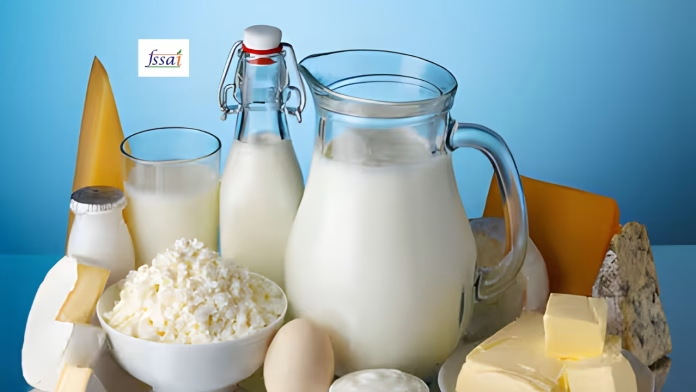
Mumbai’s Kandivali has become home to a national first. The Food Safety and Standards Authority of India (FSSAI), in partnership with Danone India, has opened “Mauli,” the country’s first clean street food hub operated entirely by women. Union Minister Piyush Goyal inaugurated the project, calling it a milestone under the Eat Right India movement.

Mauli is staffed by women from Self-Help Groups (SHGs) who have undergone FoSTaC training, a food safety and hygiene certification programme designed by FSSAI. The hub aims to show that street food, often celebrated for taste but questioned for safety, can meet high standards of cleanliness and trust while creating sustainable livelihoods for women.

Danone India’s Managing Director, Shashi Ranjan, said the project reflects the company’s mission to “bring health through food” and its long-term partnership with FSSAI. “By giving women access to training and resources, we are creating safe food spaces and enabling entrepreneurship,” he said.

For FSSAI, Mauli is more than a single initiative. The regulator has trained over 6,000 street food vendors in western India so far, with 200 more certified during the launch event. The next phase will cover over 10,000 vendors across the region, ensuring that safe food practices scale beyond Mumbai.

Piyush Goyal praised the initiative as “a shining example of women’s empowerment, food safety and community development coming together.” FSSAI has confirmed that more such hubs are planned for other Indian cities as the Eat Right India movement expands into schools, workplaces and community spaces.

With Mauli, Mumbai’s street food scene gains not only a new address but also a benchmark that could redefine how India eats on the go.

Advertisement

Flipkart Minutes Hits 50 Million Shoppers in First Year, Plans 800 Dark Stores to Ride Festive Quick-Commerce Wave

0
Image of flipkart.
Flipkart Minutes Hits 50 Million Shoppers in First Year, Plans 800 Dark Stores to Ride Festive Quick-Commerce Wave

Flipkart’s one-hour delivery service, Flipkart Minutes, is betting big on India’s festival shopping spree. The Walmart-owned platform, which turned one this August, reported 50 million unique visitors in its first year and says customer appetite for instant delivery is only accelerating.

The service, currently live across 19 cities and 2,900 pincodes, has been doubling order volumes every 45 days. Backed by a plan to roll out 800 dark stores, it is positioning itself as a serious contender in the country’s fast-growing quick-commerce market.

Festivals have already given the platform a sales boost. Raksha Bandhan alone saw a 30-fold surge in gifting orders, with 8 pm emerging as the single busiest shopping hour. High-ticket categories are also driving momentum: in its first year, Flipkart Minutes sold nearly five lakh smartphones and over 20 lakh consumer electronics units, alongside daily staples, food, beverages, and personal care.

Senior leadership remains bullish on demand. “There is a lot of positive sentiment. Be it Rakhi, Independence Day or Janmashtami, we are seeing customers lean on us for convenience during key moments,” said Hemant Badri, Senior Vice President at Flipkart. Vice President Kabeer Biswas added that the rise of gig workforce availability, digital payments, and evolving shopping behavior are accelerating adoption.

For the festive quarter, Flipkart Minutes is deepening inventory across essentials, mobiles, electronics, and festival-led assortments. AI-powered demand forecasting will be used to predict buying patterns region by region, while Ekart’s last-mile network is being ramped up to handle peak volumes.

With more than 900 categories already live, the company believes the season ahead could be a turning point, as quick-commerce shifts from occasional convenience to a mainstream shopping habit.

Advertisement

Emami Agrotech Bets Big on Branded Staples: Targets Rs 2,000-Crore Foods Business in 5 Years, Launches Atta, Maida and Sooji

0
Image of emami agrotech
Emami Agrotech Bets Big on Branded Staples: Targets Rs 2,000-Crore Foods Business in 5 Years, Launches Atta, Maida and Sooji

Emami Agrotech Ltd, the Rs 20,000-crore edible oil, foods and bio-diesel arm of the Emami Group, has announced its entry into India’s fast-growing branded staples market. With this foray, the company has set its sights on scaling its foods vertical to Rs 2,000 crore in the next three to five years.

The move positions Emami Agrotech inside India’s branded staples space, a category pegged at over Rs 80,000 crore, where consumer preference is steadily shifting away from loose grains and flours toward packaged, hygienic, and trusted labels.

The company launched its Emami Healthy & Tasty branded atta, maida and sooji on Tuesday, marking the start of its staples portfolio. Its foods business, currently valued at nearly Rs 100 crore, will now expand beyond edible oils, spices and soya chunks into daily-use pantry essentials. Officials said the immediate priority is to consolidate presence in eastern India before rolling out nationally.

“More than just another product launch, this is our step into the core of Indian kitchens. With staples, we want to be part of everyday meals and family connections around food,” said Vibhash V Agarwal, Director, Emami Group.

The company is also exploring an initial public offering (IPO) within two to three years as part of its long-term strategy.

Industry data indicates packaged staples are gaining share across both urban and semi-urban markets, driven by changing consumer habits and rising incomes. Emami Agrotech plans to leverage its wide distribution reach and digital supply chain to capture this shift.

Since the launch of Healthy & Tasty in 2010, the brand has steadily diversified. With the addition of staples, Emami aims to reposition itself as a full-spectrum kitchen solutions brand, extending well beyond edible oils.

Advertisement

Captain Fresh Joins IPO Wave with ₹1,700-Crore Issue as Losses Narrow to ₹229 Crore

0
Image of captain fresh
Captain Fresh Joins IPO Wave with ₹1,700-Crore Issue as Losses Narrow to ₹229 Crore

Captain Fresh, the Bengaluru-based B2B seafood exporter, has formally set the stage for its stock market debut with a plan to raise ₹1,700 crore through a fresh issue of shares. The decision, cleared by its board last week, follows the company’s recent shift from a private to a public entity and its rebranding to Infifresh Foods Limited, according to regulatory filings.

Founded in 2020 by Utham Gowda, Captain Fresh has rapidly grown into one of India’s leading tech-led supply chain platforms for packaged seafood. Its operations stretch across India and international markets such as the Middle East, Europe, and the United States. The company positions itself as a bulk supplier to retailers and distributors, connecting fishing communities and aquaculture hubs directly with demand centers.

Financially, the momentum has been strong. In FY24, the company posted an operating revenue of ₹1,395 crore, marking a 71 percent surge from ₹817 crore in FY23. Net losses also narrowed to ₹229 crore compared with ₹294 crore a year earlier, highlighting improving operational efficiency.

The IPO plans come on the heels of a ₹250-crore pre-IPO funding round in January, which saw participation from marquee investors such as Prosus Ventures, Accel, and Tiger Global. Prominent backers also include Swiggy cofounder Sriharsha Majety’s family office, Sid Khanna of India Equity Partners, and the late Sunjay Kapur of Sona Comstar.

With this move, Captain Fresh joins the growing list of B2B tech-first firms like Zetwerk and Infra.Market preparing to tap public markets. If successful, the ₹1,700-crore fundraising will give Captain Fresh capital to strengthen its sourcing base, expand global reach, and double down on technology that ensures fresher seafood for buyers worldwide.

Advertisement

Saugata Gupta Bets on Foods: Marico’s Saffola Oats, Honey & Snacks May Outgrow Edible Oils’ 19% Share by 2028 

0
Image of saffola.
Saugata Gupta Bets on Foods: Marico’s Saffola Oats, Honey & Snacks May Outgrow Edible Oils’ 19% Share by 2028

Homegrown FMCG giant Marico expects its packaged food business under Saffola to outgrow its edible oil vertical within the next three to four years, Managing Director and CEO Saugata Gupta said.

In FY25, the foods division crossed the Rs 900-crore milestone, contributing 11 per cent to Marico’s domestic sales, compared with 19 per cent from edible oils. While oils grew at low single digits, foods surged 33 per cent, driven by oats, honey, snacks and newer health-focused launches.

“Foods is more profitable than oils and carries a larger headroom for expansion. Saffola’s portfolio will continue to grow with higher distribution, improved penetration and consumer trials,” Gupta told PTI. The company is stepping up its presence in muesli, honey and healthy snacking through Saffola Crunchiez, while also betting on its digital-first brands True Elements and Plix in plant-based nutrition.

Marico closed FY25 with consolidated revenue above Rs 10,000 crore, including Rs 7,581 crore from its standalone India business. Chairman Harsh Mariwala had earlier set a target of Rs 20,000 crore topline by 2030, hinging on innovation, brand-led growth and operational efficiency.

Gupta said the company aims to double in five years, implying a 13 per cent compound annual growth rate. That requires high single-digit expansion in core businesses, 20 per cent-plus growth from foods and double-digit gains internationally.

The maker of Parachute and Livon is also scaling manufacturing capacity while investing in automation, AI and analytics to sharpen decision-making. “We are not capex heavy, but we are making judicious calls on technology and capability building,” Gupta noted.

Advertising and promotion will remain a priority, with spends tilted towards above-the-line campaigns and digital outreach. Gupta stressed that Marico has not cut back on brand investments despite cost pressures, calling A&P spend “critical” for the company’s diversification journey.

Advertisement

“Land in 10 Minutes?” Zepto Joins Hands with India’s Largest Branded Land Developer HoABL Ahead of Its India Listing Plans

0
Image of zepto
“Land in 10 Minutes?” Zepto Joins Hands with India’s Largest Branded Land Developer HoABL Ahead of Its India Listing Plans

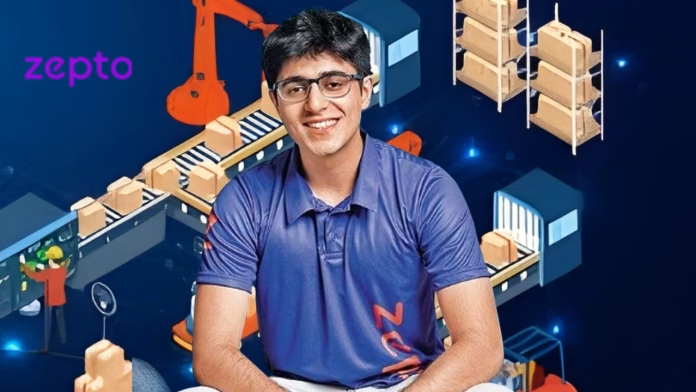
Quick commerce player Zepto has rolled out one of its most unusual brand tie-ups yet, joining hands with The House of Abhinandan Lodha (HoABL), India’s largest branded land developer. The campaign, released during Janmashtami, plays on Zepto’s “10-minute delivery” pitch and shows land plots being brought straight to consumers, with a delivery partner carrying a symbolic miniature of those plots. The film signs off with the line: “This Janmashtami, reimagine land investments, with India’s largest branded land developer, The House of Abhinandan Lodha and Zepto.”

It remains unclear whether the arrangement is limited to advertising visibility or if Zepto will list HoABL land parcels directly, similar to property platforms like MagicBricks or 99acres. ET has sought confirmation from the company.

This is not Zepto’s first experiment with offbeat partnerships. Earlier this year, the startup worked with Czech automaker Skoda to facilitate test drives for its Kylaq SUV, an association that briefly went viral after being mistaken for a “10-minute car delivery” service.

The campaign comes at a crucial time for Zepto, which is laying the groundwork for its India IPO. The company recently secured Rs 400 crore from Motilal Oswal Financial Services as part of a larger Rs 1,000 crore transaction, valuing the firm at around $5.4 billion, or Rs 47,298 crore. In parallel, it is closing a primary round led by General Catalyst and Avenir Growth, which also includes Rs 1,500 crore infused by Zepto’s founders through debt arranged from Edelweiss and several domestic family offices.

Additional minority stakes have been picked up by Elcid Investments and MapmyIndia through Motilal Oswal’s wealth arm. With its domicile shift to India and corporate rebranding complete, Zepto is clearly working to ensure its IPO lands as smoothly as its 10-minute pitch.

Advertisement

ITC Food Tech Scales 60 Kitchens Across 5 Cities, Adds Pan-Asian Brand Sansho and Pilots Aashirvaad Thalis in Bengaluru Corporates

0
Image of itc
ITC Food Tech Scales 60 Kitchens Across 5 Cities, Adds Pan-Asian Brand Sansho and Pilots Aashirvaad Thalis in Bengaluru Corporates

ITC, best known for everything from cigarettes to cookies, is quietly building its next big bet in food. Under the banner of ITC Food Tech, the conglomerate is carving a space in India’s fresh foods and food delivery market, led by cloud kitchens and new-age dining experiments.

Launched in 2020 with a single cloud kitchen in Bengaluru, the business now operates over 60 kitchens across Bengaluru, Mumbai, Pune, Chennai and Hyderabad. Three flagship brands sit at its core: Aashirvaad Soul Creations, serving affordable, homestyle vegetarian thalis; ITC Master Chef Creations, a premium North Indian gourmet line with butter chicken, kebabs and dal makhani; and Sunfeast Baked Creations, an extension of ITC’s popular FMCG cookie brand into breads and desserts.

Recently, ITC introduced Sansho, a Pan-Asian delivery brand, and acquired frozen foods player Prasuma to strengthen its reach in ready-to-cook and gourmet segments. The group says expansion will remain “measured”, with Delhi joining its network this year and the target of crossing 80 kitchens by December.

Rohit Bhalla, who heads ITC Food Tech, calls it a “startup within ITC” but one built on the strengths of the conglomerate. These include procurement at scale, packaging innovations, and most importantly, culinary expertise from ITC Hotels. “Indian cuisines are hard to standardise and scale. That is the gap we want to solve,” he says.

The strategy is not limited to delivery apps. ITC has started piloting Aashirvaad thalis in five Bengaluru corporate food courts and is experimenting with a café format for Sunfeast Baked Creations. Bhalla insists scale will not come at the cost of consistency. “Cloud kitchens are operationally complex. We spent our first three years cracking Bengaluru before adding more cities,” he adds.

With food delivery growing fast but still fragmented, ITC is betting that its brand trust and backend muscle can help it win a long game.

Advertisement