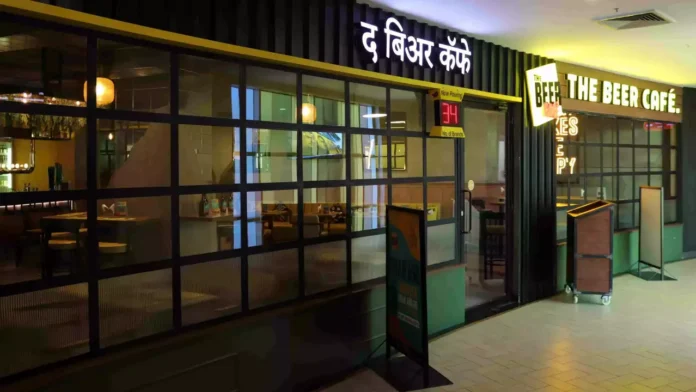
The Beer Café has launched two new outlets in Mumbai: one at Phoenix Market City, Kurla, and the other at Growel’s 101 Mall, Kandivali. Embracing a distinctive concept, these cafes seamlessly merge the enduring charm of beer with the inviting ambiance of a café, offering a delightful fusion of craft beers, scenic surroundings, and an eclectic global cuisine. With these additions, the brand’s presence in Mumbai now extends to a total of seven outlets.
Rahul Singh, Founder and CEO, said, “Guest satisfaction stands as the cornerstone of our brand’s ethos. We are committed to ensuring that every guest departs with an unforgettable experience filled with delight. This dedication has been integral to our operations for over a decade, where we have consistently delivered on our promise to offer refreshing, chilled beer suitable for every budget and occasion.”
Rugged elements like concrete, metallic accents, & industrial materials are used in the decor, which has an overall rustic tone. The area exudes an industrial charm, enhanced by the industrial fixtures and distressed wood that provide a cosy yet homely feel. Pops of vivid colours give a little personality while the neutral tones create a calming atmosphere.
Sleek leather sofas provide a comfortable lounging space, while exposed ceilings and a wooden ceiling add to the industrial style. The living room becomes alive with the addition of hanging vines and plants that provide a breath of fresh air against the stark backdrop.
The brand is planning further expansion with the goal of bringing its signature style to new locations.
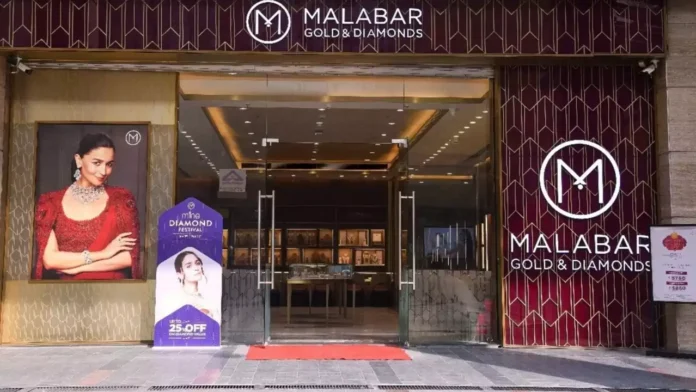
Malabar Gold & Diamonds, a prominent jewellery conglomerate, has surpassed an annual retail global turnover of INR 51,218 crore in the last financial year, as announced in a recent media release.
Additionally, the company plans to launch 100 new stores in the coming year and intends to expand its current workforce of 21,000 by adding 7,000 new employees, underscoring its dedication to inclusive growth.
With a strategic expansion plan targeting both domestic and international markets, the brand seeks to strengthen its position as a global leader. In addition to its existing operations in India, Malabar Gold & Diamonds plans to venture into new states including Jharkhand, Goa, Assam, Tripura, and Jammu & Kashmir.
At present, the company runs 345 stores spanning 13 countries. Moreover, it intends to broaden its presence by inaugurating new stores in New Zealand, Egypt, Bangladesh, and several locations across Europe.
MP Ahammed, Chairman of Malabar Group, underscored the company’s commitment to responsible practices, saying, “Maintaining our status as a Responsible Jeweler is our top priority. We are committed to responsibly sourcing our materials and making a positive impact on the communities we operate in.”
The company runs 14 supply chain management units in 8 countries and operates 15 jewellery manufacturing units in 5 countries. These are complemented by design studios that feature over 25 exclusive brand collections. Additionally, the company is in the process of setting up new jewellery manufacturing facilities in several locations throughout India.
With over 15 million customers spread across 100 countries, Malabar Gold & Diamonds stands as a beacon of excellence in the global jewellery industry, driven by the philosophy of ‘Make in India, Market to the World’.
Approximately 15,000 local stores in Bengal have partnered with Amazon India to supply fresh flowers, rangoli, and puja essentials for various new year celebrations such as Poila Baisakh, Ugadi, Gudi Padwa, Bohag Bihu, and more.
Stores offering home furnishings, kitchenware, personal care items, computers, and peripherals have also collaborated with Amazon for this special occasion.
The e-commerce company’s local partner stores are situated in Kolkata, Howrah, Durgapur, Nadia, Hooghly, and Kharagpur. Abhishek Jain, the head of local shops at Amazon India, mentioned that the orders will be delivered from these locations.
The festivals of Poila Baisakh, Ugadi, Gudi Padwa, Bohag Bihu, Maha Vishubha, and Sankranti are celebrated in various regions. Many of these new year celebrations are also observed in Bengal by the respective communities residing there.
Jain commented, “This year, nearly 4,700 sellers are providing approximately 60,000 festival-themed products across India on our platform. We anticipate an increase in the number of sellers on our platform.”
Supermarket giants such as Tesco, Australia’s Woolworths Group, and Africa’s largest grocery retailer, Shoprite, have joined forces to establish a $125 million venture capital fund aimed at speeding up retail innovation.
The retailers announced that their new fund, W23 Global, will invest in start-ups and scale-ups over the next five years. These investments aim to enhance consumer experiences by enabling faster, more personalized, and interconnected shopping both in-store and online.
This will encompass investments in start-ups using technology to transform the grocery value chain and tackle sustainability issues in the industry.
Each retailer, that include Ahold Delhaize as well as Empire Company, is an equal contributor & partner in W23 Global, and their CEOs will also serve on the investment committee, according to the release.
“We aim to give our investors unrivalled access to ground-breaking innovations in grocery and sustainability globally in a time when innovation is revolutionising retail and value chains across the economy,” said Ingrid Maes, CEO & Chief Investment Officer of W23 Global.
In calendar year 2023, there was a noticeable uptick in advertising volumes for fast-moving consumer goods (FMCG) companies on TV and radio, as reported by TAM Media’s ad expenditure data. Conversely, there was a decline in advertising activity on print and digital platforms compared to the previous year, 2022. Experts highlight that FMCG brands dominated advertising spending in the Indian market, estimated to be between INR 1,00,000 crore to INR 1,50,000 crore.
Advertising volumes for fast-moving consumer goods (FMCG) on television increased by more than 3% during the past calendar year, driven by robust expansion particularly in the second and third quarters.
Among the top 10 advertisers, their collective contribution amounted to 69% of TV ad volumes, with Hindustan Unilever emerging as the dominant entity on the list.
FMCG firms showed a strong preference for general entertainment and movie channels, which collectively accumulated 62% of TV ad volumes.
In 2023, advertising space for the FMCG sector in print experienced a decline of 10%. Despite this, the sector maintained its dominance in print advertising, securing the highest share of ad space at 10% in October 2023. The lowest share of ad space for FMCG was recorded in February 2023, at 6%.
The over-the-counter (OTC) product range claimed the top position among categories, commanding a 7% share of ad space.
The top five publication languages—Hindi, English, Marathi, Kannada, and Telugu—collectively accounted for 86% of the print ad space. Hindi emerged as the dominant language, commanding a 52% share of the ad space.
Digital impressions for FMCG ads saw a 23% decline overall in 2023. In Q2 and Q4, impressions rose by 29% and 10% respectively compared to Q1, but experienced a 6% decrease in Q3.
November 2023 witnessed the FMCG sector reaching its peak ad impressions on digital media, commanding an 11% share, whereas the lowest share was recorded in February 2023, accounting for 6.5%.
Pharma & healthcare emerged as the leading advertising category within the FMCG sector on digital platforms.
PepsiCo India’s brand, Sting, is ready to thrill consumers throughout India with the introduction of its limited-edition flavor, Sting Blue Current. This captivating new addition enhances the Sting Energy range. Alongside the launch of Sting Blue Current, the brand is unveiling a playful new marketing campaign that emphasizes Sting’s commitment to delivering electrifying energy. With the tagline ‘Sting Blue Current, Kamaal ka Current,’ the campaign invites consumers to personally experience the excitement of Sting Blue Current.
The film starts with a young couple sitting beneath a starry sky. The girl eagerly awaits a shooting star to make a secret wish. In a playful twist, the boy energizes himself by drinking Sting Blue Current, transforming into a shooting star as the girl closes her eyes to make her wish. The film concludes on an exhilarating note, echoing the brand’s tagline ‘Sting Blue Current, Kamaal ka Current,’ igniting a sense of potential with Sting Blue Current’s empowering ‘Can-Do’ energy.
Ankit Agarwal, Associate Director of Energy & Hydration at PepsiCo India, commented on the launch of Sting Blue Current and its associated campaign, stating, “In recent years, Sting has won a special place in the hearts of consumers across India.” Expanding on our success in the Indian market, we’re releasing Sting Blue Current, a new variation that offers consumers a revitalising flavour alongside Sting’s signature energy. Sting Blue Current captures our brand’s spirit of revitalising consumers and demonstrates our commitment to giving our audience an exhilarating boost while being true to the brand they’ve come to love.”
The new Sting Blue Current TV commercial will be promoted through a comprehensive 360-degree campaign, encompassing television, digital platforms, outdoor advertising, and social media.
Sting Blue Current is priced at INR 20/- for a 200 ml single-serve pack and is available nationwide in India. The classic red flavor of Sting remains accessible in small single-serve packs of 200ml and 250ml, as well as in multi-serve packs of 500ml, at all modern and traditional retail stores across India and on major e-commerce platforms.
Indians are cooking at home less frequently than they did a decade ago, as indicated by government data and research reports. This decline is accompanied by a rise in spending on out-of-home dining and processed foods. The trend is expected to intensify due to the growing popularity of quick commerce and food delivery apps, increasing income levels, and evolving food preferences.
According to the latest data from the Ministry of Statistics and Program Implementation (MoSPI) and ICICI Securities, urban elite households at the top of the pyramid allocated nearly half of their food budget to packaged food, restaurant meals, and food delivery in FY23. This is an increase from 41.2% a decade ago.
“Due to the growing prevalence of food delivery and quick commerce apps, the proportion of processed food in consumption is likely to have risen. As households ascend the income ladder, their consumption patterns evolve,” commented Paras Jasrai, Senior Analyst at India Ratings and Research.
During the period in review, spending on processed food by elite urban consumers increased by 2.2 times, while it rose by 3.3 times for middle-income consumers. This shift has occurred as the proportion of food items in overall expenditure has decreased.
In the same period, middle-income households increased their spending on processed food and beverages from 16% to nearly 25% of their food budget.
“Given the increasing spending power of the middle class, demand is expected to rise. Additionally, the growing number of working couples further contributes to this demand,” commented Madan Sabnavis, Chief Economist at Bank of Baroda, highlighting the high potential for growth.
Sabnavis also highlighted that innovation in products like low-sugar and organic food and beverages is expected to resonate with higher income groups, further contributing to growth.
According to the ICICI Securities report, the top 5% of the urban population are reducing their absolute spending on staples, suggesting that the kitchen is becoming less central for elite urban households.
The report reveals that the urban elite spend an average of INR 971 per month per person on food delivery in FY23, compared to INR 60 per person in mid-to-high income families. This expenditure is projected to have increased by 18% in FY24.
“There is a shift in urban households from consuming staples to more value-added and experiential foods, which inherently are processed,” stated social commentator and brand specialist Santosh Desai.
“Undoubtedly, food delivery has been a dominant trend of the past decade, alongside the premiumization of food experiences. As a result, many households are shifting away from the need to cook every meal at home and are purchasing more processed foods even for consumption at home,” explained the source.
The trend is not exclusive to urban households, as the proportion of processed food and beverages has also increased among rural households during this period.
According to Mospi data, there is a significant rise in expenditure on processed food and beverages as the income level of urban households rises. In contrast, spending on cereals, eggs, fish, meat, and edible oil remains steady. Nonetheless, there is a slight uptick in spending on milk and milk products.
Although urban households cook less frequently, when they do, they tend to use branded packaged goods as ingredients rather than fundamental basics. This tendency has resulted in an increase in demand for processed foods, according to B Krishna Rao, Senior Category Head of Parle Products.
“Even the current fad of millet-based products offered by companies would eventually fall into (category of) processed food,” he said
According to experts, spending on dry fruits has increased from 0.8% to 1.3% of total household expenditure in urban areas over the past decade, and from 0.6% to 1.2% in rural households, indicating rising incomes and aspirations. Meanwhile, Mospi data revealed that spending on sugar and salt has decreased by half in urban households over the same period, dropping from 1.2% to 0.6% of the budget.
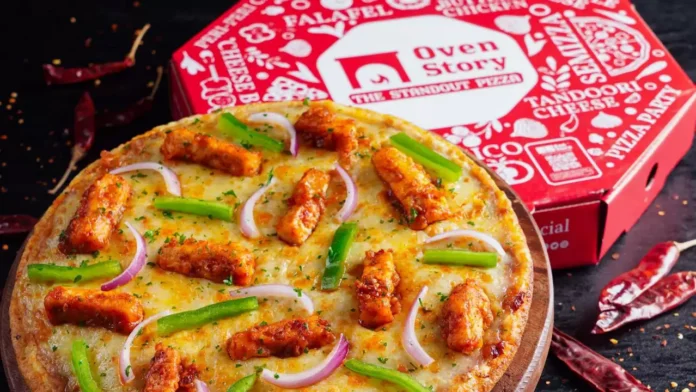
Rebel Foods, known for its network of cloud kitchens and digital brands, is making a significant investment in the offline channel. Having achieved unicorn status in 2021, the company is growing its leading brand, Oven Story Pizza, through franchising in the offline market. This strategic decision aims to capture a larger market share in the rapidly expanding pizza sector and challenge global pizza chains in the region.
Ankit Jindal, the Business Head at Rebel Foods, stated, “Franchising is a key initiative we are prioritizing this year. Our goal is to establish Oven Story Pizza as a leading brand in its category, and we are accelerating its offline expansion to achieve this. We plan to launch 250-300 outlets over the next 2-3 years, which we believe is a significant milestone to compete effectively with global chains.” The company is also recognized for its brands such as Faasos, Behrouz Biryani, Mandarin Oak, and Firangi Bake, among others.
He further mentioned that the franchising model aligns perfectly with the brand’s current stage and will also facilitate the company’s access to a network of similarly minded individual entrepreneurs.
“Our emphasis will be on launching these stores in tier-2 and tier-3 cities. We see immense untapped potential in these areas. As disposable incomes rise and consumer awareness increases, people in these markets are increasingly spending on dining out and ordering food. There’s also a growing preference for national food brands, and consumers are open to trying new offerings. From a real estate cost standpoint, we believe our franchise partners will find profitable opportunities in these markets,” added Jindal.
In 2024, the company plans to launch 40-50 offline outlets for the brand.
The company is optimistic about the pizza category. Jindal highlighted that in recent years, the category has gained momentum in tier 2, 3, and 4 markets, with numerous local brands emerging and attracting more consumers to the category.
Discussing the growth trends for FY24, Jindal stated, “We have seen robust year-over-year growth across our 75 locations, spanning Tier-1 and Tier-2 markets in India and the UAE. The EatSure Food-Court App has played a key role in driving this growth by catering to consumers’ needs for multiple restaurant options in one order.”
Rebel Foods is also the exclusive franchise holder for the American fast-food brand Wendy’s in India.
We are also growing Wendy’s offline presence. In Delhi-NCR, we now operate three to four restaurants, and we’re working on opening a few more,” Jindal continued.
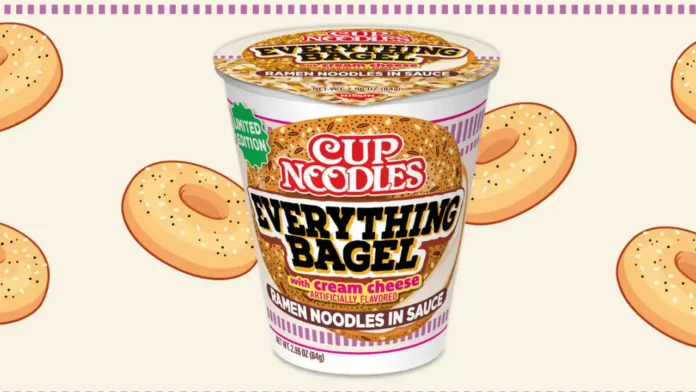
Nissin Foods has diversified its Cup Noodles portfolio with the introduction of bagel-inspired noodles.
The Everything Bagel variety merges noodles with sesame, poppy, and caraway seeds, garlic, and dried onion in a cream cheese-flavored sauce, creating a ramen dish with a saucy texture rather than a soup-based one.
Priscila Stanton, Nissin Foods’ senior vice president of marketing, expressed, “We’re aware that noodle enthusiasts and food aficionados are always seeking innovative ways to enhance their instant ramen with diverse sauces, seasonings, and unexpected elements. In particular, consumers have been incorporating Everything Seasoning into their ramen since its popularity surged, and we drew inspiration from our consumer base to infuse everyone’s beloved noodles with a creamy twist.”
The Everything Bagel with Cream Cheese flavor is currently on offer for a limited period at Walmart outlets, priced at $1.18.
Shreen Nobbel, the brand manager at Froneri UK, said, “After witnessing remarkable growth in the Oreo ice cream line, with the range expanding by 76% in recent years, we were inspired to introduce the new Oreo snacking mini bites. We recognize the large number of Oreo ice cream enthusiasts out there, and these Oreo mini bites are designed as a convenient on-the-go snacking option, sure to delight Oreo fans.”
This marks the newest addition to Froneri’s lineup of innovations. In February, the company introduced new Nuii ice cream flavors, followed by the launch of new Häagen-Dazs ice cream bars in January, and last year saw the debut of Häagen-Dazs Butter Cookie Cones.
Oreo Mini Bites are now available for purchase at UK retailers, priced at £2.50 per cup.
We use cookies to ensure that we give you the best experience on our website. If you continue to use this site we will assume that you are happy with it.