Gurugram-based social commerce startup CityMall is preparing to secure ₹334 crore ($38 million) in a fresh Series D round, according to regulatory filings. The raise will be led by Accel, with participation from long-term backers Waterbridge Ventures, Elevation Capital, Norwest Capital, Citius, General Catalyst and angel investor Rohit Agarwal.
The company’s board has cleared the issue of 7,278 Series D preference shares and one equity share at ₹4,58,716 apiece. Accel will contribute the largest cheque of ₹173.2 crore ($19.7 million), followed by Waterbridge Ventures at ₹52 crore ($5.9 million) and Citius at ₹48.38 crore ($5.5 million). Norwest Capital is slated to invest ₹25.96 crore, Elevation Capital ₹21.65 crore, General Catalyst ₹8.67 crore, while Agarwal is expected to add ₹4 crore.
This is CityMall’s first significant fundraising in over three years, after it raised $75 million in its Series C round in March 2022. The company’s valuation remains unchanged at ₹2,780 crore ($316 million), making this a flat round unless additional capital comes in.
Founded in 2020, CityMall operates through a network of community resellers in smaller towns and cities, selling groceries, FMCG, and household items. The platform has indicated plans to move into higher-margin categories such as beauty and accessories to boost growth.
Financially, the firm has shown mixed progress. Its gross merchandise value (GMV) rose 23 percent in FY24 to ₹427 crore, up from ₹346.4 crore the previous year. Revenue climbed as well, but net losses widened by 10 percent to ₹159 crore.
The proceeds from the new round will go into capital expenditure, marketing, and broader corporate needs as the company looks to consolidate its presence in India’s competitive social commerce space.
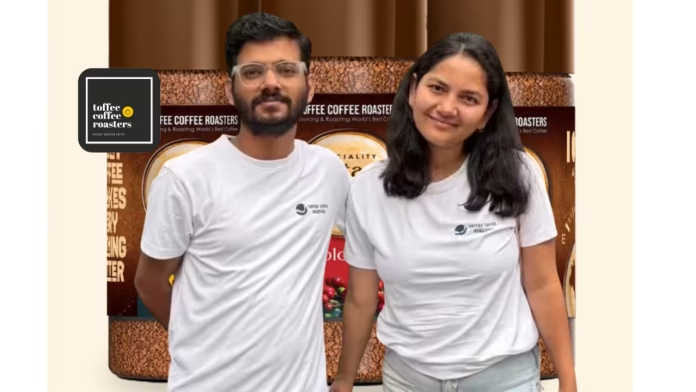
Blue Tokai, the homegrown coffee chain that has become a symbol of India’s specialty coffee movement, has raised $25 million in fresh capital to fuel its next phase of growth. The round, backed by existing investors A91 Partners, Anicut, Verlinvest and 12 Flags, comes as the company sharpens its expansion plans both within India and overseas.
The funding will be directed toward opening new cafés across key Indian cities while also building out the company’s backend infrastructure. Two large-scale projects are already in motion: a roastery and bakery facility in Bengaluru and another in Gurugram. These hubs will allow the brand to increase production capacity and improve supply efficiencies as it prepares for a larger footprint.
The company is also preparing for an international push, with Japan and the UAE identified as first markets. The idea is to showcase Indian coffee on a global stage, positioning the brand as an ambassador for the country’s coffee-growing regions.
Blue Tokai, which has already turned profitable, is now setting far more ambitious targets. Co-founder and COO Shivam Ramaswamy said the brand is looking to scale to more than 800 stores and reach ₹2,000 crore in revenue over the next four years, double its earlier projections of ₹1,000 crore revenue and ₹100 crore EBITDA by 2027.
“We are not only building a retail network but also a cultural identity for Indian coffee,” said co-founder and CEO Matt Chitharanjan, noting that the company’s long-term vision is tied to sustainability and fostering entrepreneurship in the ecosystem.
With over a decade of operations behind it and a loyal consumer base, Blue Tokai is now preparing to move from being India’s specialty coffee pioneer to a global nameplate, betting that its mix of quality sourcing and café culture can resonate far beyond its home market.
Thinking about starting an ice cream shop? 🍦 The first step toward success is understanding your ice cream business model—a blueprint that explains how your shop will operate, attract customers, and generate profit.
Whether you want to open a small neighborhood parlor, a trendy gelato shop, or a mobile ice cream truck, a clear business model helps you stand out in a competitive market.
In this guide, we’ll break down the ice cream business model, revenue opportunities, costs, and strategies to build a successful shop.
What Is an Ice Cream Business Model?
An ice cream business model defines how your shop:
Creates value – offering delicious, unique ice cream.
Delivers value – through your shop, truck, or online delivery.
Captures value – generating profits through direct sales, events, and upsells.
It’s essentially the roadmap of your ice cream business, helping you understand your customers, costs, and growth opportunities.
Key Components of an Ice Cream Business Model
1. Value Proposition (Why Customers Choose You)
Your value proposition is what makes your shop unique. Examples include:
Premium, locally sourced ingredients.
Trendy options like rolled ice cream or nitrogen ice cream.
Vegan, dairy-free, or low-sugar alternatives.
Family-friendly atmosphere with Instagram-worthy design.
💡 Tip: Focus on one or two differentiators to make your shop memorable.
2. Customer Segments (Who You Serve)
Successful shops know their audience. Common ice cream customer groups include:
Families with kids looking for a weekend treat.
Teens & young adults drawn to social media trends.
Tourists in high-traffic areas.
Health-conscious customers seeking vegan or keto-friendly options.
Event clients for catering birthdays, weddings, or corporate gatherings.
3. Revenue Streams (How You Make Money)
Ice cream shops can generate income in multiple ways:
💡 On average, an ice cream shop requires $55,000 – $135,000+ to launch, depending on size and location.
Why the Ice Cream Business Model Works
The ice cream industry thrives because:
Demand is steady year-round, with summer peaks.
Ice cream has high markup and low production costs.
New trends (vegan, artisan, rolled) keep customers engaged.
It’s a product that appeals to all generations.
FAQs About the Ice Cream Business Model
1. Is an ice cream shop profitable?
Yes! Most shops see 20–40% net profit margins, especially in busy locations.
2. What’s the cheapest ice cream business model?
A food cart or truck has the lowest startup cost (around $10,000–$30,000) compared to a full shop.
3. Can I make money in the winter?
Yes—by offering hot desserts (waffles, brownies), coffee, or delivery, you can keep sales strong during colder months.
4. Should I open a franchise or independent shop?
Franchises (like Cold Stone) cost more upfront but come with brand recognition. Independent shops allow more creativity and flexibility.
Final Thoughts
A clear ice cream business model is the foundation of your shop’s success. By identifying your target customers, perfecting your menu, and building strong branding, you can scoop up profits while creating a fun, community-driven business.
Whether you’re opening a neighborhood ice cream parlor, a trendy rolled ice cream shop, or a mobile truck, your business model will guide every decision.
Start small, refine your model, and grow into a brand that customers crave. 🍨
Are you thinking about opening an ice cream shop? 🍦 Starting an ice cream business is one of the sweetest ways to turn your love for desserts into a profitable venture. With global demand for frozen treats steadily growing, an ice cream shop can be a fun, rewarding, and highly profitable business—if planned correctly.
In this step-by-step guide, we’ll cover everything you need to know about how to start an ice cream shop, from market research and business planning to startup costs and marketing strategies.
Why Start an Ice Cream Shop?
Ice cream is timeless. Unlike food trends that come and go, ice cream has been a beloved treat for decades. Opening your own ice cream parlor gives you the opportunity to:
Tap into a billion-dollar industry – The global ice cream market is expected to exceed $100 billion by 2030.
Appeal to all ages – Kids, teens, adults, and seniors all love ice cream.
Experiment with unique products – Rolled ice cream, boozy milkshakes, and vegan options attract new customers.
Create a community hub – Ice cream shops are often family-friendly gathering spots.
In short, ice cream isn’t just a product—it’s an experience.
How to Start an Ice Cream Shop in 10 Steps
1. Research the Market
The first step in starting any business is market research. Ask yourself:
Who are your customers? (Families, college students, tourists, office workers?)
Who are your competitors? (National chains like Baskin-Robbins, or local mom-and-pop shops?)
What are the current ice cream trends? (Vegan, organic, rolled, or low-sugar?)
💡 Pro Tip: Visit competitors in your area. Note their pricing, customer flow, and menu. See what you could do differently to stand out.
2. Decide on Your Business Model
Not all ice cream businesses look the same. You’ll need to choose a model that fits your budget and goals:
Traditional Ice Cream Parlor – Sit-down shop with cones, cups, sundaes, and milkshakes.
Ice Cream Truck or Cart – Mobile, lower startup cost, perfect for events and parks.
Franchise – Join a well-known brand like Cold Stone or Dairy Queen, but expect higher costs.
Your model determines your startup costs, menu, and target audience.
3. Write Your Ice Cream Shop Business Plan
A solid business plan is essential for attracting investors, applying for loans, and staying organized. Your ice cream shop business plan should include:
Executive Summary – What your shop is about, your goals, and financial outlook.
Company Description – Who you are, your shop concept, and your unique value.
Market Analysis – Who your customers are and how you’ll compete.
Menu & Product Line – Core items plus specialty creations.
Marketing Strategy – How you’ll attract and retain customers.
Operations Plan – Staff roles, supplier relationships, and daily processes.
Financial Plan – Startup costs, revenue forecasts, and break-even analysis.
💡 Pro Tip: Even if you don’t need outside funding, writing a plan helps you stay focused.
4. Find the Perfect Location
The right location can make or break your ice cream shop. Consider:
High Foot Traffic Areas – Near schools, parks, shopping centers, or tourist spots.
Visibility & Accessibility – Easy parking and signage help attract walk-ins.
Seasonality – Shops in tourist-heavy towns may see huge summer spikes but slow winters.
If you choose a food truck model, location flexibility becomes a major advantage.
5. Register Your Business & Get Licenses
Running a food business requires permits and legal paperwork. Common requirements include:
Registering your business (LLC, sole proprietorship, or corporation).
Food service permits and regular health inspections.
Sales tax permits to collect tax on sales.
Business insurance (liability, equipment, and property coverage).
Check with your local health department to ensure compliance.
6. Build an Irresistible Menu
Your menu is the heart of your ice cream shop. Start with customer favorites, then add unique twists.
💡 Pro Tip: Rotate limited-time flavors to keep customers excited.
7. Purchase Equipment & Choose Suppliers
Running an ice cream shop requires specific equipment:
Freezers & dipping cabinets
Soft-serve or rolled ice cream machines
Blenders & topping stations
Refrigerated display cases
Point-of-sale (POS) system
When choosing suppliers, focus on quality ingredients (local dairy, organic produce, specialty toppings). Some shops even market their ice cream as “farm-to-cone” for added appeal.
8. Create Your Shop Design & Branding
Your shop should feel fun, inviting, and Instagram-worthy. Consider:
Bright colors and eye-catching décor.
Comfortable seating for families.
A unique theme (retro 1950s parlor, tropical tiki hut, modern minimalist).
Consistent branding on packaging, cups, napkins, and signage.
A well-branded shop encourages social media shares, which is free advertising.
9. Hire & Train Your Team
Great customer service is key to repeat business. Hire friendly, enthusiastic staff and train them on:
Food safety & hygiene.
Customer service & upselling (suggesting toppings, sundaes).
Efficient portion control to reduce waste.
During summer, expect higher demand and plan for seasonal staff.
10. Market Your Shop & Launch
Now comes the fun part: spreading the word.
📢 Marketing Ideas for Ice Cream Shops:
Host a grand opening event with free samples.
Offer loyalty programs (buy 10 cones, get 1 free).
Create seasonal promotions (free toppings in July, holiday flavors in December).
Leverage social media & TikTok trends for viral exposure.
Partner with schools, events, and local businesses.
💡 Pro Tip: Claim your Google Business Profile to show up on Maps when people search “ice cream near me.”
Ice Cream Shop Startup Costs (U.S. Averages)
Opening an ice cream shop requires investment, but costs vary by model.
Rent & Renovation: $20,000 – $50,000
Equipment: $15,000 – $40,000
Licenses & Permits: $2,000 – $5,000
Ingredients & Supplies: $5,000 – $10,000
Marketing & Branding: $3,000 – $8,000
Working Capital: $10,000 – $25,000
👉 Total: $55,000 – $135,000+ depending on location and size.
Mobile ice cream carts and trucks can cost significantly less (as low as $10,000 – $30,000).
FAQs About Starting an Ice Cream Shop
1. Is an ice cream shop profitable?
Yes! Profit margins are often 20–40%, especially in high-traffic areas. Shops with creative menus and strong marketing tend to perform best.
2. What is the best business model for beginners?
A food cart or truck has the lowest startup cost and is ideal for testing the market before opening a full storefront.
3. Do ice cream shops make money year-round?
Yes, but sales peak in summer. Many shops offset slower winter months with hot desserts (waffles, brownies), coffee, or catering events.
4. How much does it cost to open an ice cream franchise?
Franchises like Cold Stone or Dairy Queen can cost $200,000 – $500,000+, including fees and equipment.
Final Thoughts
Starting an ice cream shop is both exciting and rewarding. With the right business plan, location, and menu strategy, you can create a shop that delights customers and turns a healthy profit.
Remember:
Do thorough market research before investing.
Write a detailed business plan to guide decisions.
Create an irresistible menu and brand to stand out.
Market consistently using social media and community engagement.
If you’re ready to take the leap, grab your scoop and start planning today—your dream ice cream shop is closer than you think!
Reliance Industries Ltd (RIL) has announced plans to invest ₹40,000 crore ($4.7 billion) over the next three years in building Asia’s largest integrated food parks, a project that will anchor its ambitions in the fast-moving consumer goods space. The announcement was made by Isha Ambani, Director of Reliance Retail, during the company’s 48th annual general meeting.
The new food parks will be equipped with AI-led automation, robotics, and sustainability-focused technologies designed to cut costs and drive efficiency at scale. The initiative will fall under Reliance Consumer Products Ltd (RCPL), a direct subsidiary that reported revenues of ₹11,500 crore in FY25, making it one of the fastest-growing FMCG players in the country within just three years of launch.
Reliance has already invested ₹3,000 crore in 12 state-of-the-art factories powered by Industry 4.0 systems. These facilities, according to Ambani, are recording some of the highest efficiency levels seen in the domestic FMCG sector. To bolster innovation, Reliance has also established a 1.5 lakh square foot research hub, staffed by more than 100 scientists, which has filed 15 patents in the last year. Its focus ranges from “better-than-market” quality standards to first-to-India and first-to-world products.
RCPL’s portfolio already includes Campa Cola, which has achieved double-digit market share in several states, and Independence, its daily essentials brand, which crossed ₹1,000 crore in sales last year.
Ambani outlined an ambitious five-year target for the business: to reach ₹1 lakh crore in revenue faster than any other Indian consumer brands company. With food and beverages projected to remain the largest growth driver in India’s ₹6 lakh crore FMCG market, Reliance is betting that its mix of technology-driven manufacturing and aggressive brand building will help it scale rapidly.
Campus Activewear, one of India’s largest sports and athleisure footwear companies, has appointed Bollywood actor Kriti Sanon as the brand ambassador for its women’s category. The move comes at a time when women’s sportswear and athleisure are emerging as a significant growth engine for the homegrown sneaker maker, which closed FY25 with revenues of over ₹1,700 crore.
Sanon, who transitioned from engineering to cinema before becoming an entrepreneur with her own beauty line, has built a reputation for versatility and independence. Campus is looking to tap into that persona to deepen its connect with urban, style-conscious women who see sneakers as a statement of identity as much as comfort.
“Our women’s portfolio has been one of the fastest growing verticals in the past year. Kriti’s personality reflects the ambition, versatility and authenticity that resonate strongly with this segment,” said Nikhil Aggarwal, CEO and Whole Time Director, Campus Activewear. He added that women’s footwear is now positioned as a core pillar of the company’s expansion plans, with investments in design, innovation, and marketing aimed at capturing a larger slice of India’s ₹14,000-crore footwear market.
For Sanon, who recently won the National Award for Best Actress and has over 55 million followers across social media, the association is about endorsing a brand that mirrors her own philosophy. “Style should reflect who you are. Campus represents that freedom of choice while delivering on comfort and fashion,” she said.
Campus, which already sells over 20 million pairs annually, has been sharpening its focus on the women’s sneaker segment to compete more directly with global players like Adidas and Puma. With Sanon’s mass appeal, the company hopes to accelerate that push and strengthen its leadership in the affordable athleisure space.
India is moving to secure a bigger slice of the Philippine food basket, with rice at the heart of the push. Despite being the world’s largest exporter of the grain, India’s rice shipments to the Philippines remain surprisingly small, just 48.91 million dollars in 2024-25. That is barely a drop compared to Manila’s massive 2.52 billion dollar rice import bill in the same year.
The gap is not lost on New Delhi. A high-level delegation of exporters will travel to the Philippines in early September to pitch not only rice but also onions, potatoes, groundnuts, and meat. The plan, officials say, is to deepen ties with food importers in one of Southeast Asia’s fastest-growing markets.
The Philippines imported agricultural goods worth about 20 billion dollars in 2024, with wheat, oilcake, palm oil and rice among the top categories. India’s share in that pie was just over 2 percent, amounting to 413 million dollars. Its key exports were bovine meat, groundnut, rice and tobacco, leaving plenty of headroom for growth.
The government is also banking on trade events to fast-track deals. Filipino buyers will attend World Food India, scheduled for September 25 to 28, and the first International Rice Conference in New Delhi on October 30-31. Both platforms are expected to be used to showcase India’s strengths in agri trade and build long-term supply contracts.
Officials note that India’s agricultural export strategy is not limited to Southeast Asia. The CIS region, led by Russia, has emerged as another strong destination. Exports to CIS rose from 480 million dollars in 2023-24 to 628 million dollars in 2024-25, supported by participation in major fairs like World Food Moscow.
For India, the Philippines presents both a challenge and an opening: a vast rice market yet to be cracked despite its global dominance in exports.
Aditya Birla Group is sharpening its play in India’s fast-evolving fashion business, splitting its retail operations into two listed entities to capture a wider slice of the market. Addressing shareholders of Aditya Birla Fashion and Retail Ltd (ABFRL), Chairman Kumar Mangalam Birla said the group now operates with “dual growth engines” after completing the demerger of Aditya Birla Lifestyle Brands Ltd (ABLBL), which was listed in June.
India’s per capita GDP is projected to climb from 2,500 dollars to more than 4,000 dollars in the next five years, Birla noted, adding that this surge in aspirational consumption would accelerate the shift from unorganised to organised retail. That, he said, will create new demand across fashion categories and push the creation of brands at scale.
ABLBL, which houses labels such as Louis Philippe, Van Heusen, Allen Solly, Peter England, Reebok and American Eagle, has outlined a target of consistent double-digit revenue and EBITDA growth over the next five years. Over 250 new stores are planned for FY26, with a mix of franchise-led and company-owned outlets.
ABFRL will focus on Pantaloons, its mass retail brand, alongside ethnic labels like Sabyasachi, Shantnu & Nikhil, Masaba, Tarun Tahiliani, Jaypore, Tasva and TCNS. In the short term, Pantaloons will prioritise profitability, with an EBITDA margin improvement of 300 basis points targeted over the next five years. The chain plans to add 20–25 stores annually, each expected to turn profitable within a year.
To strengthen its balance sheet, ABFRL has raised 490 million dollars through a mix of QIP and preferential issue. Birla said the focus will now be on organic growth, profitability and building presence across all major consumption themes shaping India’s fashion future.
La Chérie Expands Beyond Pune, Bets on Mumbai with Japanese Cheesecake Priced at ₹299–₹899 as Artisanal Dessert Sales Surge 20%
Mumbai has a new addition to its dessert culture with the arrival of La Chérie, the brand best known for its “Dancing Cloud” Japanese cheesecake. The Pune-based patisserie has chosen Mumbai as its next market after building a steady following for its light-as-air cheesecake, which has become a conversation starter among dessert enthusiasts.
Japanese cheesecakes, made with eggs and baked in a souffle style, have seen rising demand in India over the past two years, reflecting the broader influence of Japanese dining trends such as matcha cafés and omakase restaurants. La Chérie is betting on that wave, positioning its cheesecake as a premium yet everyday indulgence. Unlike traditional dense cheesecakes, the “Dancing Cloud” is delicate, low on sugar, and free from gelatin, artificial stabilizers, and compound chocolate. The focus, according to the founders, is on technique, freshness, and purity of ingredients.
The brand has rolled out different formats for the Mumbai market: the Mini Dancing Cloud at Rs 299, a chocolate version at Rs 359, and the larger whole cheesecake priced at Rs 899. Orders are being fulfilled both through cloud kitchens and delivery platforms such as Swiggy and Zomato, with initial demand reportedly outpacing forecasts.
India’s dessert industry, valued at over Rs 12,000 crore, is rapidly shifting towards artisanal and small-batch products as younger consumers look for quality over quantity. With more than 20 percent of the premium dessert segment now driven by international formats, La Chérie’s expansion comes at a time when the market is ripe for differentiation.
For Mumbai’s food lovers, the arrival of La Chérie is less about novelty and more about redefining indulgence with a dessert that is subtle, refined, and designed for repeat cravings.
Montreal’s Ssense Seeks Bankruptcy Protection as U.S. Sales Drop 28% and Tariffs Bite Into $800 Loophole
Montreal-based luxury e-commerce platform Ssense has filed for protection under Canada’s Companies’ Creditors Arrangement Act after its largest lender moved to force a sale, escalating the financial strain on one of the most prominent players in online fashion retail.
Founded in 2003 by brothers Rami, Bassel and Firas Atallah, Ssense grew into a global name by curating high-fashion labels such as Maison Margiela, Acne Studios and Jacquemus, often at discounted prices. But mounting pressures have left the company vulnerable. A spokesperson confirmed the retailer is now seeking court protection to retain control of its assets and operations, calling the lender’s decision to trigger a sale process “deeply disappointing.”
The collapse of the “de minimis” import loophole has added to the turmoil. Until this month, shipments under $800 into the U.S. were exempt from tariffs. With the exemption gone, Canadian retailers face duties as high as 35 percent, a cost increase that threatens Ssense’s ability to stay competitive in its most important market.
The filing comes at a moment of broader instability across luxury e-commerce. MatchesFashion shut operations in 2024, LuisaViaRoma declared bankruptcy earlier this month, and Farfetch only survived after being acquired by Coupang. In the United States, Saks is still working to repair damaged supplier relationships after missed payments.
Ssense’s troubles were visible before tariffs tightened. U.S. sales plunged 28 percent in 2024, reversing a four-year boom between 2019 and 2023 when the company had tripled revenue, according to data from Business of Fashion.
The company has outlined plans to restore vendor trust, rebuild U.S. demand and stabilize cash flow. “Our mission to discover and champion emerging creative talent is unchanged,” its spokesperson said, adding that the restructuring process would provide “time and stability to emerge stronger.”
We use cookies to ensure that we give you the best experience on our website. If you continue to use this site we will assume that you are happy with it.