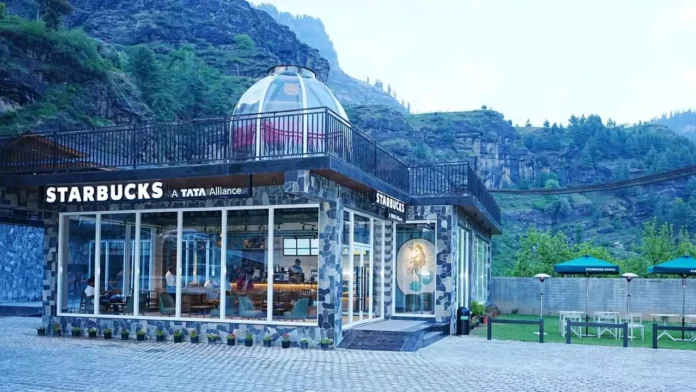
Rahul Chaudhary, Starbucks India’s Store Expansion & Business Development representative, wrote on his LinkedIn profile, “This store stands as our highest-altitude location in India, nestled at 7,697 feet. Offering breathtaking vistas of the majestic Trans-Himalayan ranges, it’s a true haven for nature enthusiasts. Immerse yourself in the beauty of snow-capped mountains while savoring your favorite coffee.”
Chaudhary added, “Whether you’re a biker en route to Leh Ladakh or exploring destinations like Manali, Atal Tunnel, Sissu, and Rohtang, make sure to drop by this stunning store for your beloved cup of coffee.”
The outlet lies 8 km away from Manali city, in the direction of Solang Valley, Atal Tunnel, and Rohtang Pass.
Earlier this month, it opened its first outlet in Jammu and Kashmir.
Starbucks entered the Indian market in 2012 through a 50:50 joint venture between Seattle-based Starbucks Coffee Co. and Tata Consumer Private Limited. Currently, the retailer operates around 400 outlets in India and aims to open 1,000 more nationwide by 2028.
In a bold and unconventional move, Lahori Zeera, the popular Indian beverage brand, chose to associate with a family comedy show on Sony Television instead of the Indian Premier League (IPL) for its marketing campaign. Nikhil Doda, COO and Co-Founder of Lahori Zeera, shared the strategic reasoning behind this decision in a recent interview.
“We always wanted to position ourselves as a fun and joyous brand, positioning ourselves as a fun, “Masaledaar” drink,” Nikhil explained. “IPL, while immensely popular, is more aligned with sports and energy drinks. Our product, on the other hand, fits perfectly with the lively and humorous vibe of a comedy show.” By sponsoring a comedy show, Lahori Zeera aimed to reach a broader, more diverse audience that resonates with the brand’s identity as a fun and masaledaar drink.
This strategy has proven to be more effective for the brand, helping people relate to the product in a more meaningful way.
Reflecting on the past few months, Nikhil highlighted a period of significant growth and new product launches for Lahori Zeera. “We have been continuously expanding our base, distributor network, and team,” he noted. The company, which initially focused on North India, has now extended its reach to over 15 states, with a robust increase in its distributor base from 1,000 to over 1,600, which implies 60-70% increase in DB count.
The company’s financial performance has also been impressive. Last year, the brand closed at INR 315 crores in net revenue and almost INR 500 crores in gross revenue. This year in April, the brand clocked INR 60 crores in net revenue. “With the new plants fully operational, Lahori Zeera is targeting a 100% growth, aiming for INR 600 crores in net revenue and INR 800 crores in gross revenue this year. The peak summer months alone are expected to contribute INR 200 crores in net revenue,” Nikhil stated.
Recognizing the importance of logistics in the beverage industry, Lahori Zeera strategically expanded its manufacturing capabilities. ” You can’t produce beverages in a single location and distribute them nationwide without incurring significant logistics costs. So, last year, we set up a plant in Vapi to serve the western part of the country,” Nikhil explained.
This plant also seeds the eastern markets, including Bihar, Jharkhand, West Bengal, and Odisha. Plans are underway for a third unit in Lucknow, which is expected to operationalize next year, further strengthening their supply chain.
“The strategy is to use the Vapi plant to establish our presence in the East, so by the time the Lucknow plant becomes operational next year, the market will already be mature and ready for expansion. This phased approach ensures that we can efficiently scale up and meet the demand across different regions,” he said.
With this, the brand is also working on new products, as innovation remains at the core of Lahori Zeera’s strategy. Recently, the company introduced two new flavors: Masala Cola and Minty Lemon. “These distinct flavours are aimed at catering to the Indian taste and are expected to contribute substantially to our revenues,” Nikhil said. These products, along with traditional favorites like Aampanna and Shikanji, resonate well across different regions of India.
The brand SKUs has expanded from offering a single product last year to around seven flavors. The newly launched products are also been well received nationwide. These flavors are made from ethnic Indian condiments commonly found in Indian kitchens and households, making them familiar and beloved.
Despite the growing popularity of energy drinks, Lahori Zeera remains committed to its core identity. “Lahori as a brand will only do ethnic Indian drinks,” Nikhil emphasized. However, he didn’t rule out the possibility of entering the energy drink market in the future, though it would be under a different brand name.
Parag Milk Foods has reported a 56.1% decline in consolidated net profit to INR 9.81 crore for the fourth quarter ended March 2024, as stated in a regulatory filing. This contrasts with the consolidated net profit of INR 22.35 crore recorded in the same period of the previous fiscal year.
According to the BSE filing, Parag Milk Foods’ total revenue from operations in Q4 FY24 dropped to INR 790.11 crore from INR 800.95 crore in Q4 FY23.
However, its total expenses in Q4 FY24 decreased to INR 784.23 crore compared to INR 793.57 crore in the corresponding period of the previous year.
The company’s chairman, Devendra Shah, remarked, “In FY24, our consolidated revenues have surpassed the INR 3,000 crore mark, accompanied by enhanced margins and profitability. The Profit after tax for the year reached INR 91 crore, buoyed by robust operating cash flows of INR 99 crore.”
“Prices for milk procurement have been good in the last few quarters, but a rise is anticipated. We are ready to improve our margin profile even in the face of obstacles,” Shah continued.
Parag Milk Foods intends to broaden its presence in the global market by establishing a foreign wholly owned subsidiary (WOS) in Dubai, UAE. This strategic expansion aims to enhance the company’s global outreach and establish streamlined supply chain operations worldwide to cater to the international market, according to the company statement.
“We are improving efficiency across the value chain and moving closer to revolutionising our business operations. We want to create a foreign wholly owned subsidiary (WOS) in Dubai to service the global market as we grow and expedite our distribution network. We are convinced that, with a solid basis in place, we will experience growth and profitability in the future that will lead the industry, said Shah.
The Food Safety and Standards Authority of India (FSSAI) has issued a warning to traders, fruit handlers, and Food Business Operators (FBOs) using ripening chambers to rigorously adhere to the ban on calcium carbide for artificial fruit ripening, especially during the mango season. FSSAI further urges the Food Safety Departments of States/UTs to maintain vigilance and take decisive action against individuals involved in such illegal practices in accordance with the provisions of the FSS Act, 2006, and related regulations.
Calcium carbide, frequently employed in ripening fruits such as mangoes, emits acetylene gas containing harmful traces of arsenic and phosphorus. These substances, referred to as ‘Masala’, pose significant health risks including dizziness, persistent thirst, irritation, weakness, difficulty swallowing, vomiting, and skin ulcers. Moreover, handling acetylene gas is equally perilous. There’s a risk of direct contact between calcium carbide and fruits during its application, potentially leaving residues of arsenic and phosphorus on the fruits.
Because of these hazards, the utilization of calcium carbide for fruit ripening is prohibited under Regulation 2.3.5 of the Food Safety and Standards (Prohibition and Restrictions on Sales) Regulations, 2011. This regulation expressly declares, “No individual shall trade, offer, display for sale, or possess for sale in any manner, fruits artificially ripened using acetylene gas, commonly referred to as carbide gas.”
Given the widespread misuse of banned calcium carbide, FSSAI has approved the use of ethylene gas as a safer substitute for fruit ripening in India. Ethylene gas can be applied at concentrations up to 100 ppm (100 l/L), varying based on the crop, variety, and maturity stage. Ethylene, a naturally occurring hormone in fruits, orchestrates the ripening process by initiating and regulating a cascade of chemical and biochemical reactions. Treating unripe fruits with ethylene gas jumpstarts the natural ripening process until the fruit begins generating ethylene independently in significant amounts.
Moreover, the Central Insecticides Board and Registration Committee (CIB & RC) has granted approval for Ethephon 39% SL to facilitate the consistent ripening of mangoes and various other fruits.
FSSAI has released a detailed guidance document advising Food Business Operators on the protocol for artificially ripening fruits. This document presents a Standard Operating Procedure (SOP) encompassing all facets of fruit ripening using ethylene gas, including constraints, specifications for Ethylene Ripening System/Chamber, handling procedures, Ethylene Gas sources, protocols for application from different sources, post-treatment procedures, and safety protocols.
If consumers observe any use of Calcium Carbide or any improper use of ripening agents for artificial fruit ripening, they are encouraged to report the matter to the respective State Commissioners of Food Safety for appropriate action against the offenders.
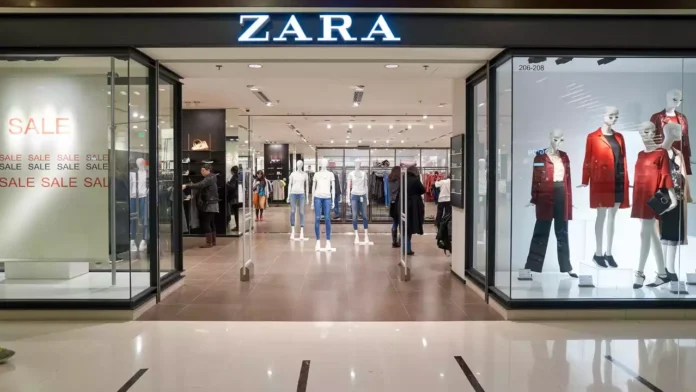
Inditex, the Spanish conglomerate behind the renowned fashion label Zara, experienced its most sluggish sales expansion in India during FY24, excluding the pandemic-affected year. The world’s leading fashion entity encountered mounting competition from international adversaries within the clothing industry, which is becoming progressively crowded.
Inditex Trent, the collaborative venture with Tata overseeing 23 Zara outlets in India, witnessed an 8% revenue increase to INR 2,775 crore in the previous fiscal year. This surge was notably lower compared to the 40% growth recorded the year before, as outlined in Trent’s annual report. However, net profit also experienced a decline, reaching INR 244 crore, marking an 8% decrease.
Zara’s arrival in the country over a decade ago marked a phenomenal success story, initially doubling sales every two years. However, in recent years, the pace of expansion has slowed down. P. Venkatesalu, CEO at Trent, acknowledges the intense competition and real challenges within the market. Yet, he remains optimistic, highlighting the vast opportunity and market size, suggesting that multiple successful players can thrive. Trent is positioned well to navigate this next phase of growth by capitalizing on its platform and growth strategies, as mentioned in the report.
Trent, the operator of Westside, has redirected its attention towards its lower-priced fast fashion label, Zudio. In the previous fiscal year, Zudio expanded its footprint by opening approximately four new stores per week on average, bringing the total store count to 545. Additionally, Trent has a distinct partnership with the Inditex group to manage Massimo Dutti outlets in India. This collaboration resulted in a 14% revenue increase, amounting to INR 102 crore.
In recent years, consumer demand has faced challenges, requiring brands to exert additional efforts to achieve same-store growth. Much of the top-line growth for brands has been driven by the addition of new stores, according to experts.
Devangshu Dutta, the founder of retail consulting firm Third Eyesight, noted that many international and premium Indian brands are vying for a relatively small portion of the population concentrated in major urban centers. While the Indian market stands out amidst the economic challenges faced by major global economies, the influence of global pressures might affect brands’ confidence in expanding. Dutta emphasized that this doesn’t necessarily indicate “fatigue” for the brand.
“However, if the battle for customer attention becomes fiercer and their options become more dispersed among a plethora of firms, it will undoubtedly influence the performance of each brand,” he continued.
As the world’s second most populous nation, India presents an appealing market for apparel brands, particularly as younger demographics increasingly adopt Western-style fashion. Inditex primarily manages Zara’s backend operations and merchandise sourcing, while Tata’s expertise lies predominantly in real estate identification and location scouting.
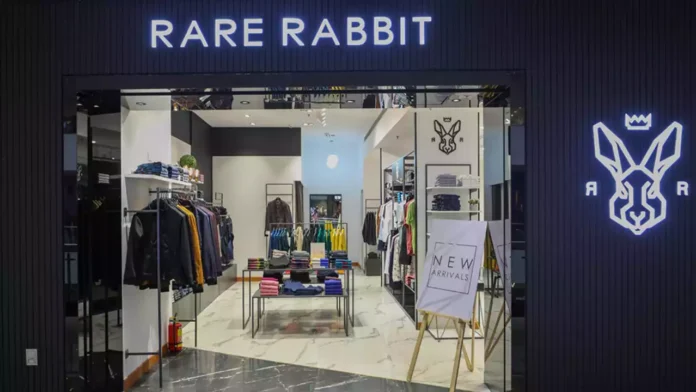
Rare Rabbit, a new-age men’s apparel and fashion label, is finalizing its inaugural institutional funding cycle of INR 500 crore, spearheaded by investment powerhouse A91 Partners, according to sources familiar with the matter.
The fundraising effort is anticipated to involve contributions from the family office of Ravi Modi, the visionary behind Vedant Fashions, which operates the ethnic fashion label Manyavar, as well as Nikhil Kamath, the co-founder of Zerodha. Together, they are expected to invest approximately INR 150 crore.
A91 is anticipated to inject the remaining INR 350 crore into the funding round.
According to insiders, the deal will involve approximately INR 250 crore of primary capital infusion into the company, while the remainder will constitute a secondary share sale by Akshika and Manish Poddar, the husband-wife duo.
These individuals stated that Rare Rabbit is valued at INR 2,200 crore. Having been bootstrapped until now, the brand stands out as one of the most prominent direct-to-consumer (D2C) brands to emerge in the fashion sector.
Attempts to reach out to Poddar, Kamath, and A91 Partners yielded no response. Siddhartha Saraf, the chief investment officer of Manyavar’s family office, declined to provide any comments.
As per information from one of the aforementioned sources, Rare Rabbit recorded revenues exceeding INR 600 crore in fiscal year 2024, accompanied by an operating profit surpassing INR 100 crore. This top-line figure signifies a growth of over 60% year-on-year for the company, which had reported operating revenues of INR 376 crore in FY23.
According to documents obtained from the Registrar of Companies, the company declared a net profit of INR 32 crore for the fiscal year 2023. However, its financials for FY24 have not been filed yet.
According to industry executives, the trend towards premiumization has significantly fueled growth in the men’s fashion sector over the past 18-24 months. Beyond formal attire, casual shirts, denim, and trousers within the premium segment have experienced noteworthy growth, as reported by insiders.
“Numerous premium brands have surpassed the INR 1,000-2,000 crore revenue threshold as apparel premiumization continues to accelerate… In a year such as FY24, characterized by slower growth for many brands, the premium segment has exhibited rapid expansion,” remarked an investor in the segment.
Established in 2015, Rare Rabbit operates under the umbrella of Radhamani Textiles, headquartered in Bengaluru. The House of Rare encompasses the premium women’s fashion label Rareism, the everyday wear brand Articale, and the flagship Rare Rabbit.
Previously, Radhamani Textiles primarily operated as an apparel manufacturer, with a strong emphasis on catering to export markets. The company supplied fashion products to prominent brands, including global giants like Inditex, the European fast fashion conglomerate behind Zara.
“A majority of companies typically prioritize either manufacturing or building a successful brand… This stands out as a ‘rare’ instance of a company excelling at both,” commented a senior fashion industry executive based in Gurugram.
Manish serves as the creative director for Rare Rabbit, while Akshika oversees the management of the Rareism label.
The omnichannel men’s fashion brand presently runs approximately 135 physical stores and has ambitious expansion plans following its initial funding round.
“Approximately two-thirds of the company’s business originates from the offline channel… Following the funding, there are expectations for a rapid expansion of the store network within a short timeframe,” stated a knowledgeable source.
Several of these stores are located in tier-II and tier-III cities such as Ahmedabad, Bhopal, Dehradun, Ranchi, Guwahati, and Vijayawada, alongside major metro cities like Delhi, Bengaluru, Mumbai, Hyderabad, and Chennai.
Annually, the Louis Philippe brand under Aditya Birla Fashion & Retail Ltd generates approximately INR 2,500 crore in revenue, while the American fashion label Tommy Hilfiger, managed in India by Arvind Ltd, is a brand valued at INR 1,000-1,200 crore.
In fiscal year 2023, Marks and Spencer, the British fashion label operated by Reliance Retail in India, reported operating revenue exceeding INR 1,600 crore, with earnings before interest, taxes, depreciation, and amortization (EBITDA) surpassing INR 300 crore.
“In FY24, growth has decelerated for numerous brands… Rare’s growth in such a period underscores some significant trends in the industry,” remarked one of the individuals.
During the initial nine months of FY24, Aditya Birla Fashion’s lifestyle business segment, comprising premium fashion brands such as Louis Philippe, Allen Solly, Van Heusen, and Simon Carter, disclosed revenue of INR 4,995 crore, marking a 2% decline compared to the corresponding period in FY23.
On April 26, it was reported that former Zomato top executive Mohit Gupta and Myntra cofounder Mukesh Bansal secured $26 million in seed funding for their premium women’s fashion startup Lyskraft. This funding round stood out as one of the largest early-stage investments for an Indian startup amidst the prevailing funding constraints.
In February, Bombay Shirt Company, a men’s clothing brand with a 12-year history, concluded a funding round worth INR 54 crore, spearheaded by Singularity Growth with involvement from CaratLane founder Mithun Sacheti. This funding round encompassed both primary and secondary transactions. The company had announced plans to utilize the fresh capital for expanding its store network.
The southern region of India seems to be leading the way in the overall economic recovery post-Covid, with five states showing stronger sales in both discretionary and fast-moving consumer goods (FMCG) compared to other parts of the country.
According to the latest report from Kantar, a global consumer research firm, individuals in the southern region topped the charts in FMCG expenditure, with an average increase of INR 2,261 per person in 2023 compared to 2022. The report also noted a significant surge in total shopping trips in 2023 compared to the previous year, witnessing a remarkable 185% rise in FMCG pack purchases.
The data pertains to Andhra Pradesh, Karnataka, Kerala, Tamil Nadu, and Telangana.
The report noted that this rise in purchases indicates a boost in purchasing ability and consumer trust in the area, stimulating demand across a range of FMCG categories.
Companies have indicated that demand has seen an upswing across the entire nation since January-March. The Retailers’ Association of India (RAI) highlighted that growth rates in the western and northern regions matched those of the peninsula only in April, with the south emerging as India’s top-performing region over the past 12-15 months.
RAI monitors retail-level sales growth across various categories on a monthly basis. In April, retailers in the southern region experienced a 5% year-on-year expansion in sales, surpassing the 4% growth rate seen pan-India. According to RAI data, in December, there was a 7% growth in the south compared to the 4% growth rate observed nationwide.
Kumar Rajagopalan, the CEO of RAI, highlighted that the peninsular region is witnessing superior growth even in discretionary categories, attributed to a significantly larger younger demographic and elevated disposable incomes. He added that FMCG growth is anticipated to excel due to double the rate of supermarket penetration compared to other regions, guaranteeing greater shelf space for all categories of new products.
The acceleration of the southern recovery, according to chief executives, can be attributed to the notable concentration of new-age sectors like startups and tech companies. These sectors employ a young workforce capable of comfortably affording increased discretionary spending, thus contributing to the region’s swifter economic rebound.
Manufacturing investment has remained strong, and states like Kerala have witnessed a resurgence in remittances from overseas following the pandemic.
Saugata Gupta, the chief executive of Marico, suggested that the southern region might be experiencing faster expansion due to its higher concentration of urban centers. He noted that the growth rate in the FMCG industry has been driven by urban markets for five consecutive quarters until the last calendar year, with rural growth surpassing urban growth only in the January to March period.
He mentioned that this year, the other regions will catch up in line with the rural recovery.
During earnings calls earlier this month, companies like Dabur and Adani Wilmar informed analysts that the southern market is a key focus for them. ITC is currently testing the majority of its new packaged food product launches in that region, while Hindustan Unilever mentioned in a recent earnings call that it is conducting a pilot for Boost Ready to Drink there.
Earlier, Mohit Malhotra, the chief executive of Dabur India, highlighted that per capita income is increasing at a faster pace in the southern region. He noted that there is a preference for more functional products among consumers in the south, contributing to enhanced growth.
Shrikant Kanhere, the chief financial officer of Adani Wilmar, the country’s largest edible oil company, also emphasized that the southern market is highly lucrative. He mentioned that the company is rolling out market-specific campaigns tailored to the region.
In FY24, Karnataka recorded the highest annual average withdrawal of INR 1.83 crore per cash-dispensing machine, as per CMS Info Systems.
CMS, which serves every second ATM and every third organized retail outlet in India for cash management, released its latest consumption report last month.
The report noted that Karnataka and Tamil Nadu were among the top five consumption hotspots in India last fiscal year, alongside Delhi, Uttar Pradesh, and West Bengal.
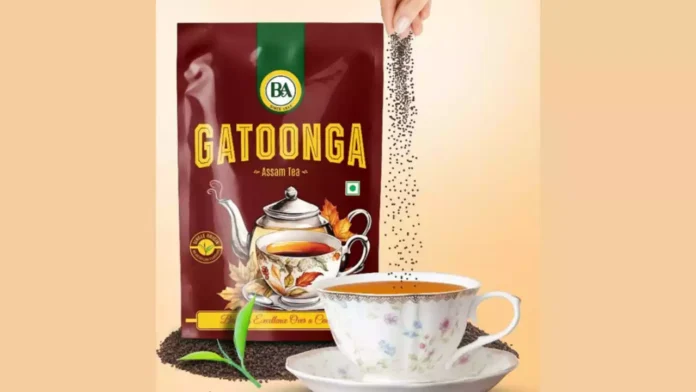
For the first time in its century-long history, B&A Ltd has ventured into the retail sector with its ‘Gatoonga’ brand of black tea, a top company official announced. The brand debuted in Assam, as the company aims to establish a strong presence in its home state before expanding to other regions of the country, according to B&A Ltd Managing Director Somnath Chatterjee.
“The company’s entry into the retail sector began with the ‘Gatoonga’ brand, targeting the Assam market first. It plans to gradually expand across India, following a demand-driven growth strategy,” he said.
B&A Ltd Deputy Managing Director Dhruba Jyoti Dowerah stated that the company’s parent group previously had four verticals, with retail branding now becoming the fifth.
The current verticals include tea manufacturing and processing, packaging, tea tourism, and broking.
Originally established in 1915 as Barasali Tea firm Ltd., B&A Ltd. is the publicly traded flagship firm of the INR 300-crore Barooahs & Associates Group.
The company currently operates 11 tea estates in upper Assam and produced 5.5 million kilograms of black tea last year.
Chatterjee announced that the Group has initiated a INR 50-crore capital expenditure plan for a pan-India growth strategy. As part of this plan, it recently acquired the Moheema tea estate in Golaghat district.
He mentioned that this marks the company’s first acquisition in over six decades.
“In a landmark move after six decades, the B&A Group has crafted a roadmap for a pan-India growth strategy, encompassing new acquisitions and expansion into the branded retail tea market. Over the next seven years, the company plans to invest approximately INR 50 crore as a pivotal component of its growth strategy,” he elaborated.
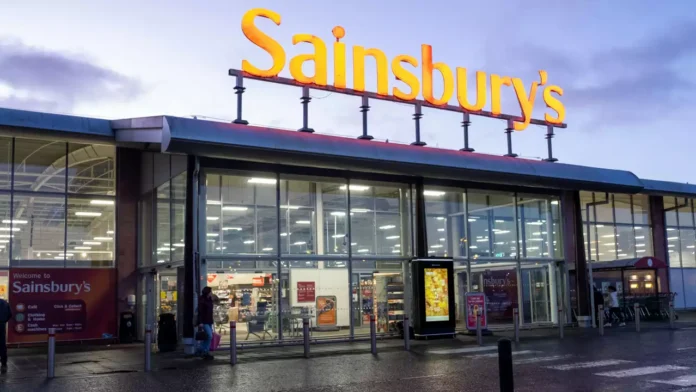
Sainsbury’s, the renowned supermarket chain, has entered into a five-year strategic partnership with Microsoft to harness AI in enhancing both customer and colleague experiences.
This partnership will bolster and accelerate Sainsbury’s Next Level strategy, geared towards achieving more robust shareholder returns.
Combining the retailer’s datasets with Microsoft’s AI and machine learning (ML) capabilities is anticipated to streamline store operations, enhance efficiency for colleagues, and provide customers with more effective service.
Store associates will also gain from real-time data and insights, enabling smarter shelf replenishment processes.
Utilizing AI to integrate diverse data inputs like shelf-edge cameras, store associates will be guided to areas requiring restocking.
This not only saves time but also allows colleagues to dedicate more time to customer service.
Microsoft Azure will underpin all these advancements within Sainsbury’s cloud ecosystem.
Clodagh Moriarty, Sainsbury’s Chief Retail and Technology Officer, stated, “Partnering with Microsoft will expedite our goal of becoming the UK’s premier AI-enabled grocer.”
“This collaboration stands as one of the crucial avenues through which we’re investing in transforming our capabilities over the course of the next 3 years, allowing us to make major advances in productivity and efficiency, maintain our commitment to exemplary customer service, and generate returns for our shareholders.”
In March, Sainsbury’s unveiled plans to streamline its operations, leading to an estimated reduction of 1,500 jobs.
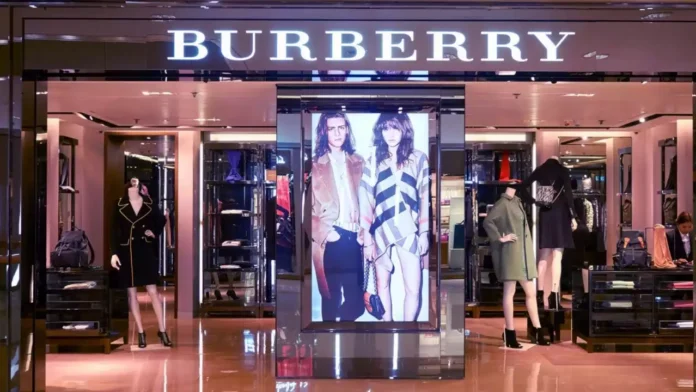
Burberry, the renowned luxury fashion brand, saw its profits dwindle by 44% to £271 million ($342 million) in the fiscal year 2024 (FY24), down from £492 million in FY23.
In FY24, the retailer experienced a significant 40% drop in its profit before taxation (PBT), falling to £383 million from £634 million in FY23.
The retailer saw a 36% decrease in its reported operating profit, dropping to £418 million in FY24 from £657 million the previous year. Additionally, its adjusted reported operating profit fell by 34% to £418 million at the reported rate in FY24, down from £634 million in FY23.
For the period ending on March 30, 2024, Burberry disclosed revenue of £2.96 billion, marking a 4% decline at the reported rate compared to £3.09 billion in FY23.
Comparable store sales for the fiscal year experienced a 1% decrease, characterized by a robust 10% rise in the first half, which was mitigated by an 8% decline in the latter half.
In FY24, the retailer’s basic earnings per share (EPS) stood at 74.1 pence, while the diluted EPS was 73.9 pence. This contrasts with FY23 figures of 126.9 pence for basic EPS and 126.3 pence for diluted EPS.
During the latest fiscal year, more than half of Burberry’s stores were either newly opened or refurbished, strengthening its distribution network.
As of March 30, 2024, Burberry operated 422 directly managed stores alongside 33 franchise stores.
Jonathan Akeroyd, Burberry’s CEO, remarked, “Navigating our strategy amid a slowdown in luxury demand has posed challenges. Despite our FY24 financial results falling short of initial projections, we’ve advanced in reshaping our brand identity, refining our product offerings, and enhancing distribution, all while implementing operational enhancements.”
“We’re leveraging insights gained over the past year to refine our strategy, while remaining adaptable to external circumstances. We maintain confidence in our approach to unlock Burberry’s potential as a contemporary British luxury brand and in our capability to navigate this phase successfully.”
Based on foreign exchange rates as of April 25, 2024, Burberry forecasts a currency headwind of £30 million to revenue and £20 million to adjusted operating profit in FY25.
We use cookies to ensure that we give you the best experience on our website. If you continue to use this site we will assume that you are happy with it.