Friday, December 19, 2025
Home Blog Page 49

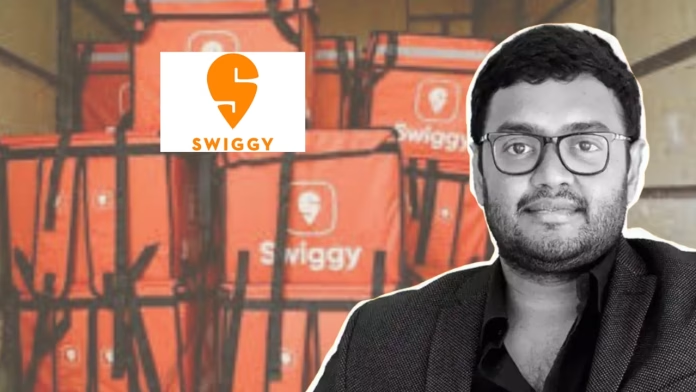
Swiggy Raises Platform Fee to ₹15 in Select Cities, Zomato Follows with ₹12 Levy as Festive Orders Surge

0

Online food delivery major Swiggy has increased its platform fee to ₹15 in high-demand regions, marking its second revision in less than a month. The charge, which includes GST, was raised from ₹14 introduced in mid-August, and earlier stood at ₹12.

The platform fee is a flat levy collected on every order placed through Swiggy and rival Zomato. While modest compared to the average order size of ₹500–600, the charge is an important lever to improve profitability for food delivery companies. Swiggy first rolled out the fee at ₹2 in April 2023 and has gradually raised it in line with rising operating costs.

Zomato, meanwhile, has also revised its fee. On Tuesday, it increased the levy to ₹12 from ₹10. Unlike Swiggy, Zomato’s fee excludes GST. The timing of the hikes comes ahead of the festive season, when order volumes typically see a sharp uptick.

Swiggy’s push to strengthen unit economics follows widening losses. For the April–June quarter of FY26, its net loss doubled year-on-year to ₹1,197 crore, dragged down by heavy investments in its quick-commerce business Instamart. Operating revenue during the quarter rose 54 percent to ₹4,961 crore, while cash outflow stood at ₹1,053 crore, including operating, financing and investing activities.

Industry analysts say the platform fee increases are part of a broader attempt by food delivery firms to balance growth with profitability. Competitive pressures, however, remain strong. Bengaluru-based Rapido has begun testing “Ownly,” a food delivery service with lower commission charges for restaurants, positioning itself as a challenger to the Swiggy-Zomato duopoly.

Both Swiggy and Zomato have refrained from public comment on the latest hikes, but sector experts expect further adjustments to platform fees as delivery volumes rise during the festive quarter.

Advertisement

“How Profitable Is Owning a Grocery Store? From Kirana Shops to D-Mart, Breaking Down Margins and Money”

0

Grocery stores may not always grab headlines like tech startups or luxury brands, but they remain one of the most resilient businesses across the globe. No matter the economic cycle, people will always need food, household supplies, and daily essentials. That stability makes the grocery business attractive for entrepreneurs. But the big question is—how profitable is owning and operating a grocery store?

Understanding the Business Model

Grocery retail is a high-volume, low-margin business. Unlike fashion or electronics, where profit margins can soar past 30%, grocery stores usually work within 2–5% net profit margins. However, what keeps them viable is fast inventory turnover and repeat customers. When hundreds of small-margin products are sold daily, the cumulative profits can add up to a sustainable business.

Profit Margins: Where the Money Really Is

Margins in grocery vary by category:

  • Fresh produce & staples (rice, wheat, pulses): 5–8%
  • Packaged foods & beverages: 10–15%
  • Snacks, confectionery & personal care items: 15–25%
  • Premium or organic products: Up to 30%

The takeaway: a grocery store isn’t just about stocking basics—it’s about strategically mixing low-margin essentials with higher-margin goods to boost profitability.

Operating Costs That Impact Profit

A store’s profitability hinges not just on sales but on how well costs are controlled. Key expenses include:

  • Rent: Urban high-footfall locations are expensive; suburban or neighborhood stores save costs.
  • Inventory: Overstocking leads to spoilage, especially with perishables. Smart inventory management is crucial.
  • Staffing: Small stores often start family-run to cut manpower costs, while larger ones require a trained team.
  • Utilities & technology: Electricity, refrigeration, billing systems, and digital payment setups add to monthly outflow.

On average, a small grocery store can break even in 12–18 months with consistent footfall and disciplined expense control.

Scale Matters: Small Shops vs. Supermarkets

  • Neighborhood Kirana Stores: Often launched with ₹3–5 lakh investment, these family-run shops thrive on loyal, repeat customers and low overheads.
  • Mini-Supermarkets & Franchise Stores: Require upwards of ₹15–20 lakh investment but offer larger margins due to bulk buying and brand tie-ups.
  • Modern Retail Chains (like Reliance Fresh, D-Mart): Operate at wafer-thin margins but win with scale and massive turnover.

For a new entrepreneur, starting lean and scaling gradually is often the safer route.

Strategies to Improve Profitability

  1. Diversify inventory – Add high-margin categories like snacks, dairy, and personal care alongside staples.
  2. Leverage technology – Use POS systems, UPI-based billing, and inventory apps to cut leakages.
  3. Home delivery & WhatsApp orders – Low-cost ways to expand your customer base.
  4. Tie-ups with FMCG brands – Many provide credit cycles, promotional support, and supply-chain benefits.
  5. Customer loyalty programs – Simple discounts or “buy 10, get 1 free” schemes can lock in repeat customers.

Final Word: A Business Built on Consistency

Owning and operating a grocery store is not a get-rich-quick venture. It’s a steady, volume-driven business that rewards patience, discipline, and customer relationships. While margins are modest, the demand is universal and recession-proof. For entrepreneurs willing to manage costs smartly, build customer trust, and adapt to digital retail trends, grocery stores can deliver reliable long-term profitability.

In the end, the business isn’t just about selling essentials—it’s about becoming an essential part of your community.

Advertisement

Jimmy Choo Brings Back Sydney Sweeney for Autumn 2025 Campaign, Betting on ‘Main Character Energy’ to Drive Global Luxury Sales

0

Jimmy Choo has launched its Autumn 2025 campaign with Emmy-nominated actor Sydney Sweeney returning as the face of the British luxury brand. The new campaign continues the label’s focus on positioning accessories as transformative, both in style and in mood, with Sweeney at the center of its storytelling.

Presented through a series of short films and stills, the campaign casts Sweeney in a variety of environments, each shifting to reflect the energy of the shoes and bags she wears. From bold stilettos to sculptural handbags, the visuals are designed to underline the campaign’s theme of “main character energy,” a phrase Jimmy Choo has adopted to highlight glamour as a personal state of being rather than just an aesthetic choice.

Sandra Choi, creative director of Jimmy Choo, described the project as a study in the versatility of modern femininity. “This campaign reinforces the power of shoes and accessories to transform, acting out the possible characters. Glamour, after all, is a feeling,” Choi said.

For Sweeney, who has become one of the most sought-after names in Hollywood and global fashion alike, the campaign adds to a growing list of collaborations. In the past year, she has fronted campaigns for luxury labels, attended international fashion weeks, and built a presence that resonates with younger audiences seeking style that feels both aspirational and accessible.

The Autumn 2025 collection emphasizes dynamic, wearable glamour, a direction that luxury brands are leaning into as they court younger consumers who increasingly define global luxury spending. With this campaign, Jimmy Choo aims not only to highlight its latest products but also to reinforce its role in shaping cultural conversations around identity, self-expression, and the enduring allure of statement accessories.

Advertisement

WaterScience Secures ₹1.4 Crore from Peter Thiel-Backed Velocity; Targets 3 Million Homes, 100% YoY Growth in Non-Drinking Water Filtration

0

Bengaluru-based WaterScience, a direct-to-consumer brand specialising in water filtration solutions, has raised ₹1.4 crore from Velocity, the growth capital platform backed by Peter Thiel’s Valar Ventures. With this, the company has now mobilised a total of ₹7 crore from Velocity since 2020.

The new infusion is earmarked for scaling up marketing campaigns, accelerating growth, and foraying into newer product categories beyond its current portfolio. Co-founder Pavithra Rao said the brand, which claims a presence in 2 million households, is eyeing an additional 1 million homes by the end of FY26. “We are committed to innovating across water solutions while expanding aggressively. Velocity’s backing helps us push harder on both reach and product innovation,” Rao added.

Founded in 2016, WaterScience operates in the non-drinking water filtration space, offering products for showers, taps, and whole-home systems. The company has been recording over 100 percent year-on-year growth, with distribution spanning Amazon, Flipkart, Shopify, and more than 1,000 offline retail partners nationwide.

The market for household water treatment in India, pegged at over $3 billion, is still dominated by drinking water purifiers. By focusing on non-drinking categories, WaterScience has carved a niche in areas often overlooked but with high repeat demand. The brand’s scale-up is also reflective of broader D2C momentum in home solutions, as rising awareness around water quality pushes more consumers to invest in household filtration systems.

With fresh funding in hand, WaterScience is expected to intensify its brand visibility in metros and tier-2 cities alike, while also diversifying its catalogue to capture more share of the growing urban water treatment market.

Advertisement

“How to Start a Grocery Store in India at Low Cost: From Kirana Shops to Smart Retail in 2025”

0

Grocery stores are the backbone of Indian retail. Despite the rise of e-commerce and quick-commerce apps, over 90% of daily essentials in India are still bought from neighborhood kirana stores. For aspiring entrepreneurs, this presents a timeless opportunity. But while the demand is constant, the challenge is starting small without draining your savings. So, how do you set up a grocery store in India at low cost and still make it profitable?

Choosing the Right Format

The first decision is scale. A mini-kirana shop or a localized general store can be launched with as little as ₹3–5 lakh, whereas larger supermarkets require ₹20 lakh and upwards. For a low-cost entry, most entrepreneurs start with:

  • Small rented shop spaces in residential clusters
  • Shared spaces or counters inside larger establishments
  • Mobile grocery vans or carts targeting underserved neighborhoods

Starting lean gives you flexibility to test customer preferences before investing more.

Location Is Everything

In groceries, location can make or break profitability. A shop near housing societies, hostels, or busy street corners ensures steady footfall. Unlike restaurants, grocery demand is recurring—families return weekly or even daily. Choose a spot that balances affordable rent with high accessibility.

Tip: A 150–200 sq. ft. shop is often enough to start. Focus on stocking fast-moving essentials rather than filling every shelf.

Smart Inventory Planning

The trap most first-time owners fall into is overstocking. Instead, begin with core categories—grains, pulses, oils, packaged foods, dairy, snacks, and household items. Gradually expand into niche products (organic foods, frozen goods) once you know your customers’ buying patterns.

Tie-ups with local wholesalers or distributors help cut sourcing costs. Many FMCG brands like HUL, ITC, and Britannia also offer credit cycles and supply support for new retailers.

Keeping Costs Low

  • Leasing vs. buying: Opt for rental shops to avoid heavy upfront investment.
  • Basic interiors: Functional racks, freezers, and a billing counter are enough to begin with.
  • Manpower: Start with family-run operations or 1–2 helpers before scaling up staff.
  • Digital tools: Use POS software or UPI-based billing apps for smooth transactions without investing in heavy tech infrastructure.

A frugal setup keeps monthly expenses predictable and profits easier to sustain.

Marketing on a Budget

Even kirana stores need branding. Simple steps can build trust:

  • Distribute leaflets in nearby societies
  • Offer discounts on bulk purchases
  • Provide home delivery via WhatsApp or tie-ups with Dunzo/Swiggy Genie
  • Run loyalty programs like “buy 10, get 1 free” on staples

A local presence, combined with digital payments and delivery, helps you compete with modern retail chains.

Profitability and Break-Even

Margins vary: staples like rice and flour yield 5–8%, while packaged snacks and personal care products go up to 15–25%. With steady footfall, a small grocery store can generate ₹8–15 lakh annual revenue, reaching break-even in 12–18 months. The secret lies in high inventory turnover and building repeat customers.

Final Scoop: Start Small, Grow Steady

The scope for grocery retail in India is massive—urbanization, rising incomes, and the shift to branded packaged goods all play in your favor. By starting lean, choosing the right location, and running operations smartly, you can launch a low-cost grocery store that grows steadily over time.

In a country where “the kirana shop” is part of daily life, the opportunity isn’t going away anytime soon. The question is: are you ready to stock your first shelf and serve your neighborhood?

Advertisement

Warburg Pincus Re-enters India’s Jewellery Market, to Buy 10% in Kalyan’s Candere Amid Surge in Lifestyle Jewellery Demand

0

Global private equity giant Warburg Pincus is preparing a return to the Kalyan Jewellers fold, this time through a stake in its lifestyle jewellery brand Candere. According to people tracking the talks, Warburg is negotiating to buy about 10 percent in Candere for around Rs 800–850 crore. The deal will be structured as a mix of secondary shares purchased from Kalyan Jewellers and fresh equity issued by Candere, with the new capital earmarked for expansion.

Candere, founded in 2013 as an online-first retailer, has been sharply scaling its offline presence under Kalyan’s ownership. The brand, which Kalyan bought into in 2017 for just Rs 35–40 crore, is now valued in thousands of crores. Over the last 18 months, Candere has added more than 70 showrooms and is preparing to open 80–90 more through a franchise-led model. This pivot has helped position it as a mass-market, lifestyle-focused format distinct from Kalyan’s flagship stores.

For Warburg, the deal represents a familiar bet. The New York fund invested Rs 1,200 crore in Kalyan Jewellers back in 2014, followed by Rs 500 crore in 2017, before exiting fully in 2024 after the jeweller’s public listing. A re-entry via Candere suggests confidence in India’s organised jewellery retail, particularly lightweight and branded offerings aimed at younger consumers.

Financials highlight Candere’s fast but uneven growth. In the quarter ended June 30, the brand reported revenue of Rs 66 crore, up 67 percent year-on-year, while net losses widened to Rs 10 crore. Management has indicated that profitability is targeted by March 2026. Parent Kalyan Jewellers, meanwhile, reported consolidated revenue of Rs 7,268 crore in the same quarter, up 31 percent, with net profit rising 48 percent to Rs 264 crore.

The deal, once sealed, would deepen the wave of investor interest in India’s jewellery sector, which has recently seen large fundraises by Giva, Aukera and BlueStone.

Advertisement

Ishaan Khatter Breaks Global Fashion Barrier: First Indian Face of Hugo Boss’ Fall-Winter 2025, Joins League of Beckham & Hemsworth

0

Actor Ishaan Khatter has marked a milestone for Indian representation in global fashion by becoming the first Indian to front Hugo Boss’ Fall-Winter 2025 international campaign. The German luxury label, which has previously cast global icons such as David Beckham and Chris Hemsworth, is repositioning its brand voice around younger and emerging talent under the theme “Be Your Own Boss.”

Speaking about the collaboration, Khatter said the association goes beyond personal achievement. “This isn’t just a milestone for me, it’s a reflection of Indian presence in the European fashion space. The ethos of owning your story and shaping your destiny resonated deeply with me,” he told ETRetail.

Khatter’s visibility in the fashion and lifestyle sector has been building steadily. He was the only Indian actor invited to Louis Vuitton’s Spring/Summer 2026 Paris showcase, recently fronted a campaign for Messika Jewellery, and continues to collaborate with Indian consumer brands including Nykaa and Bisleri Pop. His approach to endorsements, he explained, is guided by quality and authenticity. “I won’t endorse something I don’t use or believe in. I’ve turned down categories like skin-whitening creams because I don’t want to back harmful messaging.”

Looking ahead, the 28-year-old actor is considering entrepreneurship in segments that align with his personal interests such as music, fashion, lifestyle and travel. “Those are natural extensions of who I am,” he said.

While his Hollywood debut with The Perfect Couple and the upcoming film Homebound have broadened his international footprint, Khatter maintains he is cautious with labels like “global icon.” For him, the significance lies in how India is being viewed across industries. “The world is looking at India in cinema, in fashion, in business. I’d like to see not just global brands here, but Indian brands growing outward too,” he said.

Advertisement

Zomato Lifts Platform Fee to ₹12, Eyes Extra ₹45 Crore a Quarter as Blinkit Drags Profits Down 90%

0

Food delivery platform Zomato has quietly increased its platform fee to ₹12 per order, up from ₹10 earlier, as the company looks to squeeze more profitability from the surge in festive-season demand. Rival Swiggy has matched the move with its own ₹2 hike, now charging ₹14 per order.

The platform fee, first rolled out at just ₹2 in April 2023, has steadily climbed in line with Zomato’s rising scale. At current order volumes of 2.3–2.5 million a day, the ₹12 fee is expected to generate close to ₹3 crore in daily revenue. That translates to nearly ₹90 crore in a single month, or up to ₹45 crore more per quarter than what the company would have earned at the old ₹10 fee.

While the increase may feel negligible for individual customers, the cumulative impact is material for Zomato, especially as it battles margin pressures from its quick commerce arm Blinkit. The company recently reported a sharp 90% year-on-year fall in profit after tax to ₹25 crore in Q1 FY26, compared with ₹253 crore in the same period last year. Revenues, however, jumped 70% to ₹7,167 crore.

Alongside the fee hike, Zomato has been experimenting with other monetisation levers. It has piloted weather-linked surcharges and is currently testing a ₹50 “VIP Mode” in select cities, promising faster deliveries, priority riders and a concierge-style service. A “long-distance fee” payable by restaurants for orders over four kilometres has also been introduced, drawing pushback from smaller eateries.

Industry watchers say such incremental charges, once tested, tend to stick if volumes remain unaffected. For Zomato and Swiggy, the festival quarter will be a litmus test on how far India’s food delivery consumers are willing to pay for speed and convenience.

Advertisement

Tuco Kids Raises $4 Million to Scale Sustainable Skincare for Children; RTP Global Leads Round, Fireside Doubles Down

0

Tuco Kids, the Bengaluru-based kids’ personal care startup catering to children between 3 and 13 years, has secured $4 million in a Series A funding round led by RTP Global. Existing backers Fireside Ventures, Whiteboard Capital and MG Investments also participated.

Launched in 2023 by former Unilever and Ola executive Aishvarya Murali, the brand has quickly carved out space in the under-served children’s personal care segment. Tuco Kids’ portfolio spans soaps, lotions, creams, face care, sunscreens, deodorants, mosquito repellents, kids’ makeup, kajals and curated gift packs. The company says all packaging is made from reclaimed landfill and ocean plastic, reinforcing its sustainability pitch.

The new capital will be used to widen product innovation, strengthen online and offline presence, and increase consumer reach. Tuco currently sells through its own direct-to-consumer platform as well as marketplaces including Amazon, Flipkart, Nykaa, Myntra, FirstCry, Blinkit, Zepto and Instamart.

According to the founders, Tuco has grown 10-fold since inception and claims to have served more than two lakh parents across India. Earlier this year, the company brought on board Chanakya Gupta, former senior executive at Curefit and Flipkart, as co-founder to accelerate scale-up efforts.

“Kids deserve complete transparency about what touches their skin. Our products are built around that promise,” said Murali and Gupta in a joint statement, adding that the funding will help extend this mission to more families nationwide.

Investors remain bullish on the category. “Tuco is unlocking a high-potential market through sharp innovation and consumer insight,” said Pavitra Gupta, Director at RTP Global. Fireside Ventures’ Partner Adarsh Menon called Tuco one of the earliest wins from its Early Venture program and praised the team’s ability to build clarity in a category long overlooked by large FMCG players.

Advertisement

Sebi Clears boAt Parent Imagine Marketing’s ₹13,000-Crore IPO; Aman Gupta and Sameer Mehta Gear Up for Second Listing Attempt

0

Markets regulator Sebi has cleared the public listing of Imagine Marketing Ltd, the parent company behind the boAt brand, paving the way for one of India’s most awaited consumer electronics IPOs this year.

The approval follows Imagine Marketing’s confidential filing in April and sets the stage for a market debut that could value the Warburg Pincus-backed company at around ₹13,000 crore, according to people aware of the matter. This marks the firm’s second attempt at going public after it shelved a ₹2,000-crore IPO plan in 2022. That earlier draft had proposed a ₹900-crore fresh issue and a ₹1,100-crore offer for sale.

Founded in 2013 by Aman Gupta and Sameer Mehta, Imagine Marketing has built a diversified product suite spanning headphones, speakers, smartwatches, grooming devices and mobile accessories under the boAt label. The company has carved a strong position in the affordable wearables and audio accessories market, competing with global majors such as Apple, Samsung and local challenger Noise.

Sebi’s green light comes at a time when IPO activity in India remains buoyant. Alongside Imagine Marketing, 12 other companies have received approval for share sales. The list includes Urban Company, renewable energy player Juniper Green Energy, Allchem Lifescience, Pace Digitek, Omnitech Engineering, KSH International, Ravi Infrabuild Projects, Mouri Tech, Priority Jewels, Corona Remedies, Om Freight Forwarders and Jain Resource Recycling.

For investors, boAt’s proposed listing is being closely tracked as a proxy to India’s expanding consumer electronics story. With demand for affordable wearables surging, the company is expected to use public market funds to strengthen distribution, scale product innovation and sharpen its competitive edge in a crowded sector.

With regulatory clearance secured, Imagine Marketing now joins the growing pipeline of consumer-facing businesses ready to test investor appetite in India’s primary markets.

Advertisement