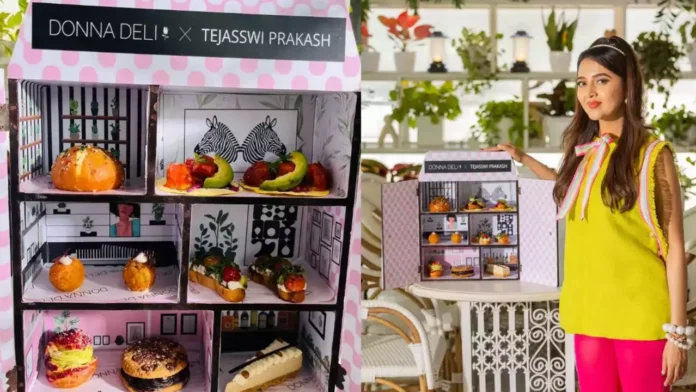
Donna Deli, a prominent name in the culinary scene, has collaborated with actress Tejasswi Prakash to introduce the new DollHouse Menu. This collaboration aims to provide a one-of-a-kind blend of flavours and creativity, curated to create an unforgettable dining experience.
Tejasswi Prakash, a passionate food aficionado, has handpicked the DollHouse Menu, personally selecting her favorite dishes for this exclusive offering. The menu showcases four main courses and two desserts, each meticulously crafted to cater to diverse tastes and preferences.
Exploring the DollHouse Menu: A Culinary Adventure
For vegetarians, tantalizing choices include the Mini Korean Bun and the Ricotta and Arugula Confit Cherry Tomato Toastie, while non-vegetarians can relish in the Chipotle Chicken Vol Au Vents and the Spicy Chicken Sausage Toastie. To sweeten the experience, guests can indulge in the Lotus Biscoff Cheesecake and the Pistachio Praline Choux for dessert.
Tejasswi Prakash expressed, “Embrace your inner royalty and pamper yourself like a queen with our DollHouse Menu.”
Ayush Kapur, the owner of Donna Deli, remarked, “We are excited to partner with Tejasswi Prakash in delivering our patrons a distinct and delightful dining journey. The DollHouse Menu mirrors Tejasswi’s discerning palate and our dedication to providing inventive and delectable choices.”
The DollHouse Menu will be accessible throughout the day, beckoning guests to embark on a culinary journey brimming with warmth and flavor. Whether it’s a laid-back brunch or a cozy dinner, Donna Deli guarantees a memorable gastronomic escapade.
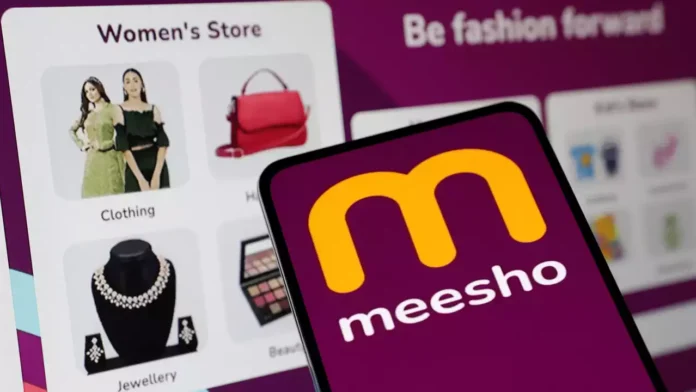
In February of this year, Meesho, a Bengaluru-based ecommerce platform, introduced Valmo, its own logistics marketplace. The goal was to democratize third-party logistics and alleviate delivery costs, particularly for smaller players.
Four months down the line, analysts observe that significant repercussions are being felt by major third-party logistics providers.
“In India, the sector is largely unorganised, with local and regional entities operating within specific regions. With Valmo, Meesho aims to eliminate entry barriers for these players and establish a nationwide logistics solution,” stated a knowledgeable source regarding the new initiative.
Rapid Expansion and Operational Statistics of Valmo
Indeed, Valmo has rapidly expanded its operations to handle an average of 900,000 orders per day, representing approximately one-fifth of all third-party ecommerce shipments in India.
Its reach now extends to over 6,000 postal codes spanning across more than 20 cities.
The marketplace hosts at least 3,000 micro-entrepreneurs.
With Valmo, Meesho reduces delivery expenses, already achieving a 5% decrease. The company anticipates a further reduction of around 10%.
According to a report by Kotak Institutional Equities, Meesho has the potential to generate revenue from logistics, as it has significantly increased the proportion of insourced operations beyond 20%, affecting the growth of third-party players. The report states that Meesho represents approximately 20% of Delhivery’s Express Parcel business and captures 45% or more of the revenues of other major ecommerce players such as Flipkart, Amazon, and others.
Elara Capital said in a note, “While the ecommerce sector is projected to grow at 15-20%, Meesho, handling 24% of total shipments in India in FY23, has expanded its captive logistics share, resulting in reduced reliance on third-party logistics providers. This shift could potentially constrain segmental growth in the future.”
However, Delhivery refutes any suggestion of such impact on its operations.
In a conference call with analysts following the company’s fourth-quarter results, Sahil Barua, the co-founder and CEO of Delhivery, stated, “Neither do I expect significant volatility coming any further from here from various players deciding to experiment with various logistics models in terms of volume nor do I anticipate it having a material impact on our EBITDA.”
It’s tougher to establish a logistics company than it is to grow one past a certain point, he noted. And that Delhivery’s primary business was logistics. “Part of what enables us to provide the margins that we do is our ability to operate a fully integrated and a part truckload system, which even lowers our costs in the Express Parcel sector. To be sure, things would be difficult if we were currently a parcel-only business, depending on a single supplier for a significant portion of our volumes, launching self-logistics, and applying price pressure. However, thankfully for us, that isn’t the situation, Barua stated during the analyst call.
In a statement last December, Meesho announced it had attained profitability for the July-September quarter of FY24.
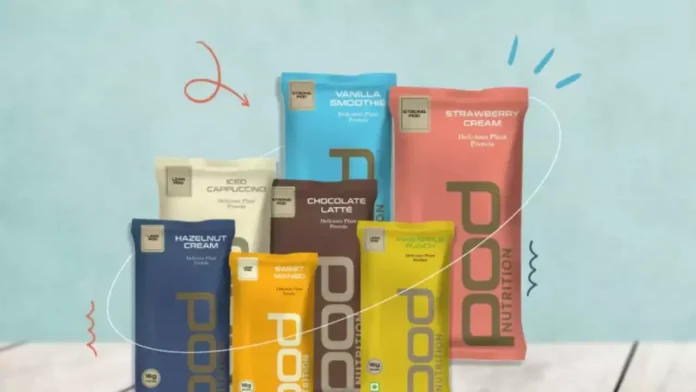
In a transformative move poised to redefine the fitness and nutrition industry in India, Good Fettle Private Limited has launched Pod Nutrition, a groundbreaking vegan protein brand. Distinguished by its superior taste, purity, and nutritional excellence, the brand sets a new standard in plant-based supplements. Meticulously crafted, it offers a guilt-free indulgence without compromising on flavor or quality.
Pod Nutrition represents a significant milestone in Good Fettle’s mission to provide premium, sustainable, and ethically sourced nutritional products. Following the success of India’s first low-calorie, low-carb, guilt-free ice cream, Good Fettle has now ventured into the vegan protein market, aiming to make a substantial impact on health-conscious consumers.
Akhil Gupta, Co-Founder of Good Fettle Private Limited, expressed, “Through Pod Nutrition, our goal is to transform perceptions around vegan protein supplementation. Our products not only offer outstanding taste but also supply essential nutrients for optimal health and vitality. We aspire to have a significant impact on consumers’ lives by addressing their nutritional requirements through Pod Nutrition, thereby making a meaningful difference every day.”
Addressing India’s Protein Deficiency
Research indicates that 73 percent of Indians lack sufficient protein intake and are unaware of their daily needs. To address this gap, Pod Nutrition emerges as a timely solution for health-conscious individuals seeking high-quality plant-based nutrition. This innovative protein blend stands out for being free from artificial colors, sweeteners, soy, and dairy. It effortlessly mixes into water, smoothies, or macro-friendly recipes, catering to diverse dietary preferences and restrictions.
Ayush Gupta, emphasized, “Pod Nutrition transcends being merely a protein brand; it embodies a lifestyle choice that enables individuals to embrace wellness without compromise. We’re setting new standards, and the evidence lies in the protein. Our innovative plant-based protein blend is meticulously crafted and designed to support your body’s recovery, empowering you to pursue your most ambitious fitness objectives. These products signify a new chapter in the realm of protein supplements, reminiscent of our iconic Ice Cream. We are committed to catering to the needs of Indians through health-oriented product offerings that resonate with both current and future food trends.”
The brand presents a selection of seven delightful flavors: Strawberry Cream, Hazelnut Cream, Vanilla Smoothie, Iced Cappuccino, Sweet Mango, Pineapple Punch, and Chocolate Latte. It is offered in two variations: Lean POD containing 16g of protein and Strong POD with 26g of protein, catering to diverse consumer preferences, from those focused on maintaining a lean physique to others supporting an active lifestyle. Pod Nutrition can be conveniently purchased through the company’s official website.
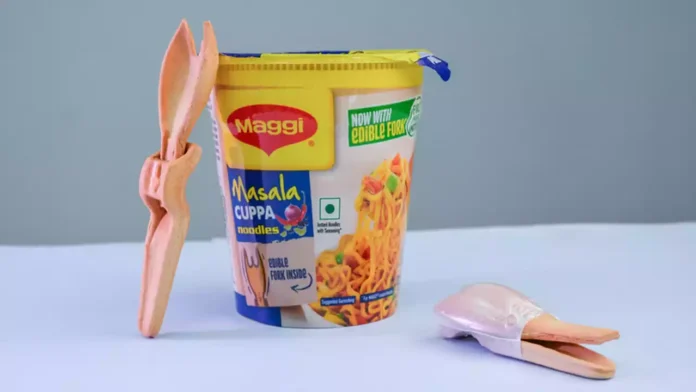
Nestlé has launched a limited-edition plant-based fork for Maggi cup noodles in India. Experts in food science and packaging at company’s R&D center in India worked with a local startup to create a two-piece edible fork made from wheat flour and salt. This unique combination, along with a proprietary design and manufacturing process, ensures the fork’s functionality while preserving the noodles’ nutritional value and taste.
Redesigning accessories such as straws, cups, and cutlery is a key aspect of Nestlé’s commitment to reducing or eliminating plastic use in packaging. This initiative complements efforts to simplify packaging materials, expand reusable and refillable systems, and explore alternative packaging materials across various product categories.
Gerhard Niederreiter, head of Nestlé’s Institute of Packaging Sciences, states, “At Nestlé, we are constantly investigating alternative sustainable packaging solutions that guarantee food safety, enhance consumer experience, and preserve product taste and quality. In this instance, our packaging experts created a unique alternative fork, leveraging our scientific expertise in various food-grade packaging materials and designs.”
Antonia Wanner, group head of ESG Strategy & Deployment, explains, “Minimising packaging & designing for recyclability are central to Nestle’s sustainability commitments. Our teams continually explore innovative materials and advanced technologies to create packaging solutions that are convenient, protect the food, and benefit the planet.”
Testing Innovative Packaging Solutions: Paper Scoop for Adult Milk Powders
Furthermore, Nestlé’s packaging experts in R&D Nutrition and China are testing a patented paper scoop for adult milk powders in China. This innovative packaging design, featuring a flat, foldable scoop and a metal cap, eliminates the need for plastic entirely.
By 2021, Nestlé had replaced 4.5 billion plastic straws worldwide with paper straws. Nestlé’s R&D teams have continued to innovate with recyclable straws, looking for new solutions and improving the functionality of existing paper straws. The Nestlé Institute of Packaging Sciences has also made significant efforts to create new paper cups, including researching non-plastic coatings that can withstand hot beverages.
These recent examples highlight Nestlé’s commitment to innovative solutions aimed at reducing the use of virgin plastics by incorporating less plastic, recycled plastic, and alternative packaging materials.
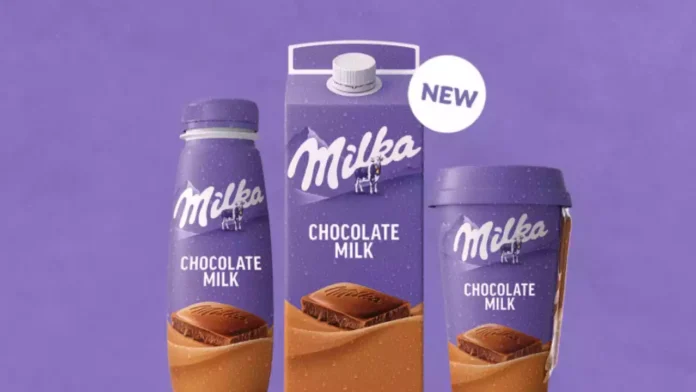
Arla Foods, the Danish dairy group, has entered into a licensing agreement with Mondelez International, the US confectionery giant, to manufacture and distribute chocolate milk bearing the Milka brand in three countries.
Arla disclosed that the chocolate milk products will be introduced in Germany, Austria, and Poland.
Milka, a chocolate brand under the ownership of Mondelez, which also owns Cadbury and Oreo brands, currently offers products in various categories such as ice cream, cakes, and pastries. The upcoming chocolate milk, set to be launched next month, will be manufactured at Arla’s dairy facility in Esbjerg, Denmark.
“I’m thrilled to embark on a long-term strategic partnership with Mondelez International, bringing delicious and sought-after products to our consumers,” stated Patrik Hansson, Arla Foods’ Executive Vice President and Chief Marketing Officer.
“Milka is a cherished brand, and I’m confident in our manufacturing, commercial, and marketing prowess to elevate it further. Our ambition is crystal clear: We aim to secure the top position in our launch markets,” emphasized Patrik Hansson.
Product Varieties and Flavors
Arla disclosed that the beverage will come in three distinct formats and offer three different flavors.
Clive Jones, President of Central Europe and EU Central Sales at Mondelez International, remarked, “This partnership enables us to extend the cherished Milka brand across Europe, offering consumers an exciting new avenue to savor their favorite chocolate.”
“As we persist in innovating and expanding our portfolio, this venture into a new category represents a pivotal milestone in Milka’s journey of success,” remarked the spokesperson.
On May 28th, Mondelez inaugurated a biscuit and baked snacks NPD facility in Singapore to serve its Asia Pacific, Middle East, and Africa markets.
The company emphasized that this move reaffirms its dedication to innovation and product development throughout Southeast Asia, as well as in Australia, New Zealand, and Japan.
Insight Cosmetics, a Mumbai-based cosmetics company, has ventured into skincare with the introduction of 11 new serums.
The company asserts that the serums are entirely vegan, free from toxins, undergo dermatological testing, and are formulated to demonstrate noticeable results within 14 days. This line of products is accessible both online and in physical retail outlets.
Mihir Jain, Sales & Marketing Director at Insight Cosmetics, expressed enthusiasm about the company’s foray into the skincare sector, stating, “We’re thrilled to embark on this new phase of our journey. With our range of premium, toxin-free serums tailored for Indian skin, we aim to offer a perfect blend of affordability and quality.”
Established in 2001, the company boasts a diverse portfolio of over 350 SKUs, encompassing nail polish, lipsticks, mascaras, eyeliners, eyeshadows, foundations, concealers, lip gloss, and makeup brushes, among other products.
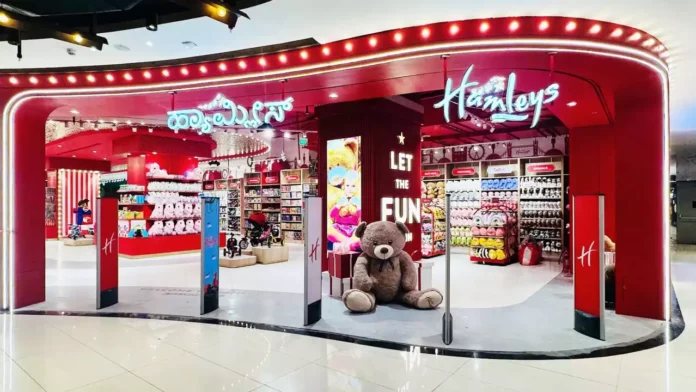
Hamleys, the multinational toy retailer owned by Reliance, has launched its new store in Bengaluru, as announced by a company official’s social media post. The outlet is situated at Phoenix Mall of Asia, alongside other family entertainment centers (FECs) like Fun City and Timezone.
In a LinkedIn post, Chinmoy Das, manager of leasing at The Phoenix Mills Ltd., announced, “Hamleys is now open at Phoenix Mall of Asia. Shop from a wide range of toys and immerse your kids in a realm of joy, fun, and wonderland with unique games and much more.”
Hamleys presently has over eight outlets in Bengaluru.
The store provides toys from over 260 Indian and international brands, such as Lego, Nerf, Disney, Marvel, Uno, Funskool, Ed-a-Mamma, and Barbie, catering to children of all ages, from toddlers to pre-teens and adolescents.
In 2019, Reliance Brands acquired full ownership of British toy retailer Hamleys Global Holdings Ltd. (HGHL) in an all-cash transaction. Currently, Hamleys operates in 36 cities across India, boasting over 100 stores that include both toy outlets and play areas.
Founded by William Hamleys in 1760, Hamleys stands as one of the world’s oldest toy retailers. Its inaugural store, a modest toy shop in Holborn, London, was opened by its founder. Today, the UK-based brand boasts over 170 Hamleys shops spanning across 18 countries, including the UK, India, UAE, China, and Russia.
Reliance Brands, a division of Reliance Retail Ventures Ltd. (RRVL), acts as the holding company for all retail ventures under Reliance Industries Ltd. Established in 2007, its mission was to introduce and grow global brands in the luxury and premium segments. Over the years, it has introduced over 85 international brands into India.
Myntra, the fashion and lifestyle e-commerce platform, stated on Wednesday that it anticipates 20 million users to visit the platform during its sale which starts on 31 May.
The platform anticipates 1.35 million additional users to shop during the 20th edition of EORS (End of Reason Sale), according to Neha Wali, Head of Growth and Revenue.
Myntra stated that by empowering kiranas and enhancing the last-mile delivery ecosystem, kirana partners gain an extra source of income due to the heightened volume of orders during EORS.
“We will optimize the use of all its Forward Distribution Centres (FDCs) to ensure a smoother, hassle-free delivery process during and after EORS,” it said in a statement.
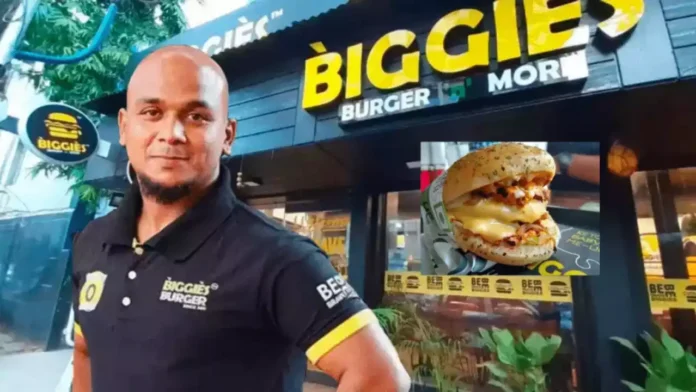
Biggies Burger, a homegrown burger chain, is set to capitalize on the potential of the Eastern market in India. With plans to aggressively expand, the brand aims to open 75 stores in the East region by 2028, targeting 2.5-3 times annual growth by expanding its store network, as revealed by the company.
The company expects the market to contribute around 20% to its overall revenue and aims to capture approximately 15% market share in the East market.
Having set its sights on achieving a total of 250 operational stores by the end of the fiscal year 2025-2026 and with ongoing plans for expansion into the East, Biggies Burger aims to establish itself as the leading burger brand across all regions of India.
Regarding this expansion, Biraja Rout, the Founder of Biggies Burger, remarked, “Having built a loyal customer base in the South and West, we believe our distinctive offerings will also strike a chord with consumers in Eastern India.”
Current Operations and Market Presence
Established in 2011, the burger chain currently operates 141 stores, mainly situated in South and West India. The ongoing strategic expansion into the Eastern market is poised to significantly bolster its presence and capture a larger portion of the burgeoning Indian QSR market.
Earlier this year, the company secured an undisclosed sum in pre-Series A funding, valuing it at INR 210 crore, aiming to extend its reach throughout the nation.
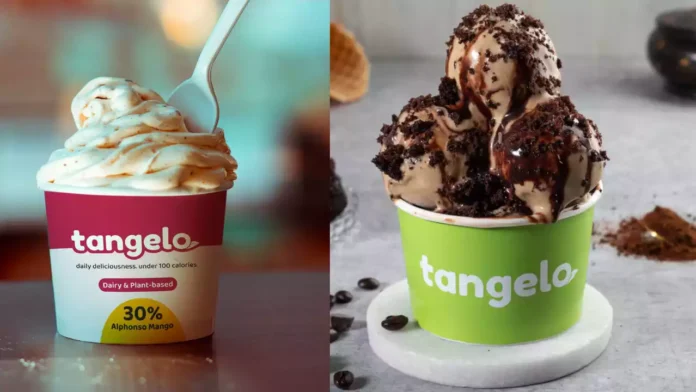
In a competitive market where consumers are increasingly health-conscious yet unwilling to compromise on taste, Tangelo Ice Cream has emerged as a standout player. Since its launch in August 2022, Tangelo has rapidly become a favorite among ice cream lovers, thanks to its commitment to wholesome ingredients and delicious flavors.
“Tangelo has a legacy that I’m proud to continue. It all started as a hobby for my father after he retired, and we officially launched the brand in August 2022. And we make wholesome, healthy ice creams that are also outstandingly delicious,” said Ayesha Malhotra, Co-Founder of Tangelo Ice Cream. Tangelo prides itself on using real ingredients without artificial flavors or colors, ensuring that every scoop is made from at least 30% real fruit. This commitment to quality has been a cornerstone of their success.
Rapid Growth and Market Success
With the summer season on, the brand has been seeing a significant footfall. Tangelo has seen a staggering 4X increase in sales over the past year. “Our sales this year have gone up 4X from last year. So, we’re very excited,” said Malhotra.
This growth has been driven by an expanding product range, including vegan, sugar-free, and classic dairy ice creams. Their retail footprint has also grown, with three outlets in the NCR region, the latest being in Gurgaon on Golf Course Road, a strategic location close to their largest customer base.
However, operating in the ice cream industry is no easy feat. “The cold chain & distribution pose unique challenges for ice cream,” Malhotra explained. Maintaining the required temperature for frozen products is crucial, and Tangelo has navigated these challenges with a focus on quality and customer satisfaction. “Ice cream is a fragile product where people, once they become loyal to a brand, can stick to it,” she added, highlighting the emotional and nostalgic connection many have with ice cream.
Originally an offline-first brand, Tangelo has shifted its focus to online sales. “Since then, we’ve made a conscious effort to change it to an online-first brand,” Malhotra stated. This shift has paid off, with their online sales experiencing a significant boost. Tangelo has also expanded its presence through 10 dark stores across NCR, further enhancing their delivery capabilities.
While the main growth driver is online sales, Malhotra recognizes the importance of offline presence for building brand awareness. “Offline does help, but the growth comes from the online presence,” she noted. The new Golf Course Road outlet serves not just as a retail space but as a strategic point for enhancing customer experience and brand visibility.
Future Expansion Plans
Looking ahead, Tangelo plans to continue its expansion. “We want to expand our dark stores again to areas just on the outskirts of NCR,” Malhotra revealed. This cautious yet ambitious approach aims to maintain quality while reaching new customers. Additionally, Tangelo is set to launch two new products within the next quarter, keeping the brand fresh and exciting for consumers.
With this, the ice cream brand is also witnessing good repeat numbers.
Tangelo’s success isn’t just about numbers; it’s about the strong connection with customers, she said. “We have a high number of returning customers. I’m very pleased with that,” Malhotra said, with a 30% repeat customer rate indicating strong brand loyalty. This loyalty is built on delivering a product that people genuinely enjoy. “People see value in Tangelo,” she emphasized.
Among their offerings, chocolate flavors have been particularly popular. “We do vegan sugar and dairy sugar, and people can’t tell that it’s not a regular kulfi,” Malhotra shared, showcasing their ability to create healthy yet indulgent treats.
As Tangelo continues to innovate and grow, Malhotra remains optimistic about the future. “Every month since January we’ve been expanding,” she said. The brand is also exploring quick commerce options to enhance their delivery speed, aiming to offer an even better customer experience.
We use cookies to ensure that we give you the best experience on our website. If you continue to use this site we will assume that you are happy with it.