Saturday, December 20, 2025
Home Blog Page 47

Profit Push for SMEs: Amazon Cuts Seller Fees by 4–7%, Adds Basket-Building Tools, and Targets 25–40% Margin Gains This Festive Season

0

Amazon India is gearing up for its flagship Great Indian Festival, beginning September 23, with an expanded seller base, sharper logistics, and aggressive fee cuts designed to boost small and medium businesses during the country’s peak shopping season.

Amit Nanda, Director, Selling Partner Services at Amazon, said the platform now has 17 lakh registered sellers, a 25 per cent rise in new product launches compared to last year. “We are already seeing momentum across categories with more than 15,000–20,000 new product types added ahead of the event,” he said.

Last year’s festival saw 40 crore customer visits and a 70 per cent increase in crorepati sellers compared to 2023. More than 70 per cent of participating sellers came from tier II and III cities, while 85 per cent of customers were from non-metro markets. Over 3 crore products were delivered within one or two days, and small enterprises sold over 1,000 units every minute.

For 2025, Amazon has reinforced its logistics backbone, inducting 1.5 lakh seasonal workers, adding 12 fulfilment centres and six new sortation hubs, and expanding transportation lanes. The company has also cut seller fees sharply. From April, referral fees were removed entirely on 1.2 crore products priced below Rs 300 across 135 categories, while charges in fashion, beauty, home appliances, and healthcare were reduced further in September. Handling fees for items under 25kg were lowered by up to Rs 100.

“These measures translate into significant profitability for sellers. A 4–7 per cent cut in fees can mean a 25 to 40 per cent jump in profits,” Nanda noted. Amazon has also introduced tools like Sell More Save More, offering smart catalog recommendations to help sellers improve average order sizes while trimming shipping costs.

Advertisement

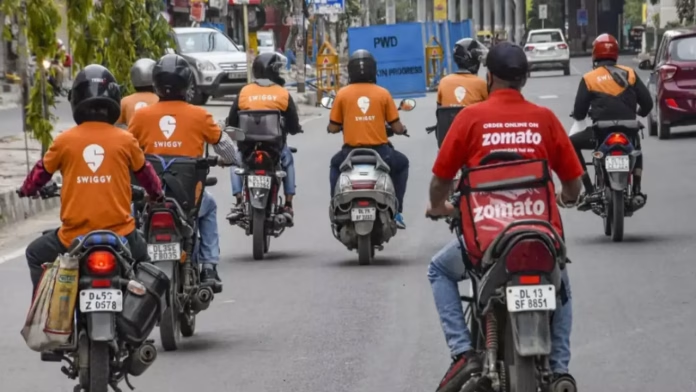
India’s Food Delivery Market to Bounce Back in FY26: Zomato, Swiggy Growth Slowed to 18% in FY25, But GST Reforms and Rising Consumption May Push GOV Past 20%

0

India’s food delivery and quick commerce sectors are set for a fresh phase of growth, with analysts pointing to the recent goods and services tax (GST) reforms, stronger discretionary spending, and a revival in consumer confidence as the key drivers.

Industry trackers note that growth in online food delivery had cooled in recent quarters, with gross order value (GOV) for market leaders Swiggy and Zomato slowing to 18% in FY25, from 19-20% in FY24. Quick commerce players too had faced pressure, as aggressive competition, rapid expansion of dark stores, and higher customer acquisition costs weighed on margins.

That slowdown may now be short-lived. Brokerage Motilal Oswal said GST rationalisation and the upcoming festive season should help lift order volumes and frequency, with food services and QC among the biggest beneficiaries. Naveen Malpani, partner and consumer industry leader at Grant Thornton Bharat, said, “The GST rationalisation is expected to unlock momentum in discretionary spending, particularly in food services and quick commerce.”

Swiggy’s Food Marketplace CEO Rohit Kapoor echoed that view in a recent LinkedIn post, noting that the reforms will provide a “strong tailwind” for the sector. Zomato’s District CEO Rahul Ganjoo added that lower tax slabs will make quality experiences more accessible for both metro and emerging city consumers, boosting consumption at large.

However, some players argue the impact could be uneven. Since delivery services now fall under Section 9(5) of the CGST Act, platforms must collect and remit GST on delivery charges. Several companies have already raised fees, which could nudge up consumer costs.

Kazem Samandari, co-founder and executive chairman of French patisserie chain L’Opera, said the sector still needs critical reforms such as input credit eligibility. “The benefits are minimal and indirect. What we require most is input credit access,” he noted.

Advertisement

AI Meets Americano: Perplexity’s ‘Curious’ Café Debuts in Seoul with Lee Jung-jae Backing, Targeting Korea’s $20-Billion AI Market

0

U.S.-based artificial intelligence company Perplexity has stepped into the offline world with the launch of its first cafe in Seoul’s Gangnam district. The venue, called Curious, opened on September 3 inside the Artist Company building on Dosan-daero, owned primarily by actor Lee Jung-jae. The move marks the first time a global AI startup has directly operated a cafe, signaling Perplexity’s intent to deepen its brand presence in South Korea, one of the fastest-growing AI markets in Asia.

Perplexity, founded in 2022 by former OpenAI and DeepMind engineers, is valued at $18 billion and counts Jeff Bezos and Nvidia among its investors. The company, which operates an AI-powered search and answering engine with around 15 million monthly users, is increasingly popular in Korea. According to IGAworks, its local monthly active users surged from 330,000 in January to about 820,000 in August.

The Curious cafe is designed as both a coffeehouse and brand showcase. An Americano is priced at 7,000 won, while cakes are sourced from popular Seongsu-based bakery Thousand. Customers subscribing to Perplexity Pro at the cafe can claim a 50% discount and a free trial month. AI-generated music plays throughout the space, which features a retro-futuristic interior mixing spaceship themes with 1970s American design. Merchandise, from mugs and beans to T-shirts and notebooks, is also on sale.

The choice of Gangnam is tied to Perplexity’s partnership with Artist Company. CEO Aravind Srinivasan, a fan of Squid Game, met Lee Jung-jae earlier this year to explore AI-entertainment collaborations. In March, Lee fronted Perplexity’s ad campaign in Korea.

South Korea’s AI market is forecast to expand from $2.07 billion in 2022 to nearly $20 billion by 2032, according to KOSA. With rivals like OpenAI, Anthropic, and Cohere preparing Korean operations, Perplexity’s offline experiment could become a blueprint for AI firms seeking stronger consumer connections.

Advertisement

From Jeans to Lipsticks: Gap Inc. Makes $500-Billion Beauty Market Play, Shares Jump 2.4%

0

Gap Inc., the US apparel retailer best known for its denim and khakis, is now betting on lipsticks and lotions. The San Francisco-based company said it will enter the fast-growing beauty and personal care segment this fall, starting with a pilot launch at 150 Old Navy stores across the United States.

The assortment will span skincare, makeup, nail polish, and hair products, with most items priced under $25, positioning the brand squarely in the mass-premium category. According to the Wall Street Journal, Gap will expand the rollout gradually, with Gap-branded outlets expected to start offering beauty lines from 2026.

The move marks a significant shift in Gap’s strategy as it seeks to reduce dependence on its core apparel business, which has been squeezed by weakening consumer demand and higher tariff costs. In its most recent quarter, the company reported lower-than-expected comparable sales, underscoring the need for diversification.

Beauty offers a high-margin opportunity. Globally, the personal care industry is estimated at over $500 billion, with steady growth outpacing apparel. Analysts say Old Navy’s wide store footprint and family-oriented positioning could give Gap an edge in building a beauty portfolio that resonates with younger and more diverse shoppers.

Shares of Gap Inc. rose 2.4% in early trading after the announcement, signalling investor confidence in the diversification plan. Alongside beauty, the company said it also plans to expand its accessories portfolio, another category with higher repeat purchase potential compared to fashion apparel.

Gap joins rivals such as H&M and Zara, which have also experimented with beauty and fragrance lines to capture discretionary spend beyond clothing. For the 55-year-old retailer, this could be the start of a new chapter—where a shopping trip for jeans also means picking up a serum or lipstick at checkout.

Advertisement

1.4 Billion Consumers, 7.8% GDP Growth, 2 Slabs—FM Bets Big on New GST Regime to Power India’s Next Phase

0

Finance Minister Nirmala Sitharaman on Friday said the government’s new dual-slab goods and services tax (GST) structure would provide a significant boost to India’s growth momentum, even as policymakers prepare targeted support for exporters grappling with higher US tariffs.

The revamped GST regime, effective September 22, will consolidate the existing multi-rate system into two slabs of 5% and 18%. In addition, a 40% rate will apply to select luxury and sin goods. “GST impacts every one of the 1.4 billion Indians. From household purchases to automobiles, everything is touched by GST, so this reform will have a very positive impact,” Sitharaman said in an interview, adding that industry leaders had assured her the benefits of lower rates would be passed on to consumers.

India’s economy expanded 7.8% in the June quarter, the fastest in five quarters, but rising US tariffs on Indian exports have raised concerns over sustaining this pace. Sitharaman clarified that the GST reform was not specifically designed to offset tariff shocks, but acknowledged it would “collaterally help” the sectors most affected.

She said a relief package tailored for tariff-hit sectors is under discussion. “Respective ministries are in talks with affected industries and a package is being worked out,” the minister noted, without setting a timeline.

The minister also confirmed discussions on easing Press Note 3 restrictions, which mandate prior approval for investments from countries sharing land borders with India, and flagged ongoing visa relaxations for renewable energy and domain-specific exports.

On the macro front, Sitharaman reiterated India’s position on Russian oil imports, stating decisions will be guided by national interest. She stressed that “relentless work on next-generation reforms” is underway following the Prime Minister’s Independence Day roadmap.

Advertisement

From WhatsApp Orders to Bulk Supplies: Proven Ways to Improve Grocery Stores in Towns and Semi-Urban India

0

Running a grocery store in a bustling metro is one story; operating one in a town area is another. In smaller towns, grocery stores are more than just shops—they’re community hubs where families return for their daily essentials. The good news is demand is steady, but the challenge lies in standing out, building loyalty, and growing profits in a market where competition is often local and margins are tight. If you’ve ever asked yourself, “How do I improve my grocery business in a town area?”—here’s a roadmap.

Understand Local Needs First

Every town has its unique consumption patterns. A student-dominated town may demand instant noodles, snacks, and affordable meal packs, while a family-oriented area will prioritize staples, fresh produce, and household goods. Spend time observing buying habits and talk to your customers—this ensures you stock exactly what the community wants, reducing waste and increasing sales.

Smart Inventory, Not Just Bigger Inventory

In smaller towns, overstocking is a common pitfall. Essentials like rice, flour, and oil must always be available, but premium or slow-moving goods should be added gradually. Build strong ties with local wholesalers or FMCG distributors (Nestlé, ITC, HUL) who often extend credit cycles, helping you manage cash flow.

Improve Customer Experience

Convenience is key. Customers in town areas may not have quick-commerce apps, but they value:

  • Home delivery on call or WhatsApp.
  • Digital payments (UPI, wallets, cards) for hassle-free checkout.
  • Organized shelves and fast billing that save their time.

Small gestures—like remembering regular customers’ preferences or offering delivery in the evening—create loyalty that bigger chains can’t match.

Market on a Micro-Level

You don’t need flashy ads; you need visibility. Try:

  • Flyers or discount coupons in residential colonies.
  • “Family packs” of staples at better rates.
  • Festival offers on essentials (sugar during Diwali, oil during Holi).
  • Loyalty cards or simple schemes like “Buy groceries worth ₹1,000 and get ₹50 off.”

Word-of-mouth spreads fast in towns, and a small incentive can convert casual buyers into repeat customers.

Explore Bulk and Institutional Sales

If your store is in a town with schools, hostels, or small businesses, explore supplying them in bulk. For example, a steady order from a local café for bread, milk, or packaged snacks can secure predictable monthly revenue.

Keep Costs Under Control

Profitability in town grocery stores comes from managing expenses. Rent and labor costs are usually lower than cities, but wastage can eat into margins. Monitor perishables closely and invest in a basic freezer or cold storage to extend shelf life for dairy and frozen goods.

Final Word: Small Changes, Big Results

Improving your grocery business in a town area isn’t about copying large-format supermarkets—it’s about serving your community better than anyone else. By aligning with local demand, improving customer convenience, using low-cost marketing, and building bulk partnerships, you can steadily grow both revenue and reputation.

In grocery retail, consistency is everything. Each delivery on time, each stocked shelf, and each loyal customer adds up to long-term success. The next big leap in your town’s grocery trade may just start with small improvements you make today.

Advertisement

How to Expand a Grocery Store Business? Insights from India’s Kiranas, Reliance Fresh, and D-Mart Playbook

0

The grocery sector is one of the most dependable businesses in India. From kirana shops tucked in bylanes to sprawling supermarkets like Reliance Smart and D-Mart, grocery retail thrives because demand never stops. But while the market is large, competition is fierce. Every street has a kirana, and e-commerce players like Amazon Fresh and Blinkit are pulling customers online. The real question is: how can grocery store owners grow their business and increase profits in this crowded space?

Focus on Customer Experience

At its heart, the grocery business is about trust and convenience. Shoppers often choose one store for years because it feels reliable. To win loyalty:

  • Ensure clean, organized shelves that make shopping easier.
  • Provide fast billing and digital payments (UPI, cards, wallets).
  • Train staff to be polite and efficient—service matters as much as price.

A good customer experience keeps people coming back even when competitors offer discounts.

Expand Product Range Smartly

Growth doesn’t mean stocking everything. Instead, study what your customers want. In middle-class neighborhoods, staples and packaged foods move fastest, while in affluent areas, demand for organic products, imported foods, and frozen items is higher.

Adding high-margin categories like personal care, snacks, and ready-to-eat products can significantly improve profitability without increasing footfall.

Embrace Technology and Digital Tools

Modern grocery success isn’t just about shelves—it’s about screens too. Small stores can increase reach by:

  • Using POS systems to track sales and manage inventory.
  • Accepting online orders via WhatsApp or simple apps.
  • Listing their store on platforms like Dunzo, Swiggy Genie, or Blinkit Partner for hyperlocal delivery.

Even kirana stores that digitize see an uptick in sales and reduced inventory losses.

Marketing That Works on a Budget

Grocery stores rarely invest in marketing, but simple steps can boost visibility:

  • Flyers and pamphlets in nearby societies.
  • Festive discounts on essentials like oil, rice, or atta.
  • Loyalty schemes such as “Buy 10, Get 1 Free” or cashback on prepaid store accounts.
  • Small social media presence—posting daily deals on WhatsApp or Instagram Stories can attract younger buyers.

Build Partnerships and Bulk Sales

Tie-ups with local offices, hostels, or caterers can generate bulk orders for staples and packaged items. This not only increases sales volume but also ensures predictable monthly revenue. Some grocery store owners also partner with milk brands, bakeries, or vegetable vendors to create a one-stop solution for customers.

Control Costs While Scaling

Profitability is as much about reducing costs as increasing sales. Start by monitoring wastage—especially in perishables like vegetables and dairy. Negotiate better deals with distributors or source directly from wholesalers. If footfall increases, expand strategically—perhaps an extra freezer for frozen items before investing in a second store.

The Bottom Line: Growth Is About Adaptation

Increasing a grocery store business isn’t about copying Reliance or D-Mart—it’s about adapting smartly. A small kirana that offers home delivery, keeps shelves stocked with what its customers truly want, and manages costs efficiently can grow steadily and profitably.

The grocery market in India is vast, but customers are becoming more demanding. Stores that blend personal trust with modern convenience are the ones that will thrive.

So, whether you run a neighborhood kirana or dream of building the next mini-supermarket, the path to growth begins with one simple step: listening to your customers and adapting to their needs.

Advertisement

The Ultimate Grocery Store Business Plan: Low-Cost Investments, Profit Margins, and Lessons from D-Mart & Big Bazaar

0

If there’s one business that rarely goes out of demand, it’s groceries. From neighborhood kirana shops to sprawling chains like D-Mart and Reliance Fresh, the grocery sector is the backbone of India’s retail economy. But while the demand is guaranteed, success isn’t automatic—it depends on how well you plan. A grocery store business plan is the difference between a shop that survives and one that thrives.

Why a Business Plan Matters

Unlike high-margin businesses, grocery retail runs on thin profit margins—often between 2–8%. That means efficiency, smart stocking, and location strategy are everything. A well-structured business plan helps you map out investment, control costs, plan inventory, and estimate break-even timelines, reducing trial-and-error risks.

Step 1: Decide Your Store Format

Your business plan should first define what kind of grocery store you want to open:

  • Kirana/Neighborhood Store (₹3–5 lakh investment): Small, family-run, with loyal repeat customers.
  • Mini-Supermarket (₹15–20 lakh): Offers variety, better margins, and attracts higher footfall.
  • Franchise Model (₹10 lakh+): Partnering with brands like Reliance Smart Point or Spencer’s gives scale and supply-chain advantages.

Starting small and scaling gradually is often the most cost-effective route.

Step 2: Location and Market Research

Location can make or break a grocery store. A corner shop in a residential colony guarantees recurring footfall, while a high-rent commercial area can eat into profits. Conduct basic research:

  • How many competing stores operate nearby?
  • Is the area dominated by students, working professionals, or families?
  • Do people prefer branded packaged goods or staples bought in bulk?

Answering these helps refine your store’s positioning and product mix.

Step 3: Smart Inventory Planning

Overstocking perishables is the quickest way to lose money. Start lean by focusing on fast-moving essentials—grains, pulses, cooking oils, snacks, dairy, and cleaning supplies. Gradually add niche items like organic foods, frozen goods, or imported products once you understand customer demand. Tie-ups with FMCG distributors like HUL, ITC, Nestlé, and Britannia can provide better pricing and even promotional support.

Step 4: Cost Control and Technology

Operating costs—rent, electricity, refrigeration, and staff—determine profitability. To keep expenses low:

  • Begin with basic racks and freezers instead of lavish interiors.
  • Use POS billing systems or UPI-based apps for efficiency.
  • Start family-run to save on manpower until footfall increases.

Step 5: Marketing and Customer Loyalty

Even kiranas need branding. Flyers in residential societies, WhatsApp ordering, and tie-ups with delivery apps like Dunzo or Swiggy Genie can drive business. Offering bulk discounts, cashback, or loyalty programs ensures customers keep returning. Remember, in groceries, repeat customers are the real goldmine.

Step 6: Financial Projections and Profitability

Margins differ by category—staples (5–8%), packaged goods (10–15%), and snacks or personal care (20–25%). A small store with consistent footfall can clock ₹8–15 lakh annual turnover, breaking even within 12–18 months. Your business plan should clearly map investment vs. expected revenue, giving you a realistic profit picture.

Final Takeaway: Plan Before You Stock

A grocery store business isn’t glamorous, but it’s stable, essential, and profitable if done right. A clear business plan helps you anticipate challenges, minimize risks, and maximize margins. Whether you’re dreaming of a corner kirana or aiming to build the next mini-supermarket, success lies in planning before stocking.

The shelves may be filled with essentials, but the foundation of a profitable grocery store is strategy. Are you ready to draft yours?

Advertisement

Alia Bhatt Becomes Levi’s Global Brand Ambassador After Gucci and L’Oréal Deals, Joins Beyoncé in Denim Giant’s $6.2 Billion Push

0

Alia Bhatt has added another international label to her growing list of global partnerships. After fronting campaigns for Gucci and L’Oréal Paris, the actor has now been appointed as the Global Brand Ambassador for Levi’s, one of the world’s most recognisable denim brands.

The announcement marks Levi’s latest push to strengthen its women’s portfolio, aligning with shifting consumer preferences that favour relaxed fits, wider legs and comfort-led silhouettes. Industry insiders say the move is part of the company’s broader strategy to stay relevant with younger audiences and expand its reach among women shoppers in key markets.

“For me, a pair of jeans is never just a pair of jeans – it is something you live in and make your own,” Bhatt said in a statement. “Denim has always been about self-expression, and Levi’s has been central to that journey across generations. I am excited to represent a brand that connects so many people globally.”

Levi’s, which has a strong presence across India and is focusing on South Asia, Middle East and Africa as high-growth regions, said Bhatt’s influence extends beyond films and red carpets. “Alia shapes conversations,” said Hiren Gor, Managing Director for South Asia-Middle East and Africa at Levi Strauss & Co. “As we expand our women’s range and lead the shift towards style-led, comfort-first fits, she brings both cultural credibility and fashion authority.”

The partnership puts Bhatt alongside global names like Beyoncé, who also represents Levi’s, and follows the brand’s recent collaborations with Diljit Dosanjh and Deepika Padukone. With this appointment, Bhatt continues her rise as one of India’s most prominent global fashion voices, bridging Bollywood’s star power with the world’s biggest luxury and lifestyle brands.

Advertisement

Delhi’s Sneaker Scene Levels Up: Gully Labs Unveils Store Designed by Dhruv & Pranvi Jain with a Built-In Shoe Factory and Coffee Lounge

0

Delhi just got a new creative hub. Gully Labs has officially launched its flagship store in Panchsheel Park, South Delhi, bringing together sneakers, design, and coffee under one roof.

The space isn’t just another retail outlet, it’s been designed to function as both a mini shoe factory and a sneaker customisation studio. Visitors can watch the process of creation up close and then add their own personal touch, turning each pair of sneakers into a one-of-a-kind piece.

The store’s striking look was crafted by designers Dhruv and Pranvi Jain, built by Parminder Singh Nagi, and captured through the lens of photographer Avesh Gaur. The façade itself makes a bold statement, with oversized sneaker art that’s hard to miss.

But Gully Labs is about more than shoes. The brand has teamed up with Subko Specialty Coffee Roasters, Bakehouse and Fine Cacao to set up an in-house café. The idea is to create a “third space” for Delhiites—a baithak-style hangout where people can meet, share ideas, and immerse themselves in the culture that surrounds sneakers.

To mark the launch, the store is offering special prices and free customisations for customers on September 6 and 7. It’s a way to invite the community in, not just as shoppers, but as collaborators in shaping the identity of the brand.

With its mix of art, craftsmanship, and community spirit, Gully Labs’ first store looks set to become a landmark for sneaker enthusiasts and coffee lovers alike.

Advertisement