Alia Bhatt has added another international label to her growing list of global partnerships. After fronting campaigns for Gucci and L’Oréal Paris, the actor has now been appointed as the Global Brand Ambassador for Levi’s, one of the world’s most recognisable denim brands.
The announcement marks Levi’s latest push to strengthen its women’s portfolio, aligning with shifting consumer preferences that favour relaxed fits, wider legs and comfort-led silhouettes. Industry insiders say the move is part of the company’s broader strategy to stay relevant with younger audiences and expand its reach among women shoppers in key markets.
“For me, a pair of jeans is never just a pair of jeans – it is something you live in and make your own,” Bhatt said in a statement. “Denim has always been about self-expression, and Levi’s has been central to that journey across generations. I am excited to represent a brand that connects so many people globally.”
Levi’s, which has a strong presence across India and is focusing on South Asia, Middle East and Africa as high-growth regions, said Bhatt’s influence extends beyond films and red carpets. “Alia shapes conversations,” said Hiren Gor, Managing Director for South Asia-Middle East and Africa at Levi Strauss & Co. “As we expand our women’s range and lead the shift towards style-led, comfort-first fits, she brings both cultural credibility and fashion authority.”
The partnership puts Bhatt alongside global names like Beyoncé, who also represents Levi’s, and follows the brand’s recent collaborations with Diljit Dosanjh and Deepika Padukone. With this appointment, Bhatt continues her rise as one of India’s most prominent global fashion voices, bridging Bollywood’s star power with the world’s biggest luxury and lifestyle brands.
Delhi just got a new creative hub. Gully Labs has officially launched its flagship store in Panchsheel Park, South Delhi, bringing together sneakers, design, and coffee under one roof.
The space isn’t just another retail outlet, it’s been designed to function as both a mini shoe factory and a sneaker customisation studio. Visitors can watch the process of creation up close and then add their own personal touch, turning each pair of sneakers into a one-of-a-kind piece.
The store’s striking look was crafted by designers Dhruv and Pranvi Jain, built by Parminder Singh Nagi, and captured through the lens of photographer Avesh Gaur. The façade itself makes a bold statement, with oversized sneaker art that’s hard to miss.
But Gully Labs is about more than shoes. The brand has teamed up with Subko Specialty Coffee Roasters, Bakehouse and Fine Cacao to set up an in-house café. The idea is to create a “third space” for Delhiites—a baithak-style hangout where people can meet, share ideas, and immerse themselves in the culture that surrounds sneakers.
To mark the launch, the store is offering special prices and free customisations for customers on September 6 and 7. It’s a way to invite the community in, not just as shoppers, but as collaborators in shaping the identity of the brand.
With its mix of art, craftsmanship, and community spirit, Gully Labs’ first store looks set to become a landmark for sneaker enthusiasts and coffee lovers alike.
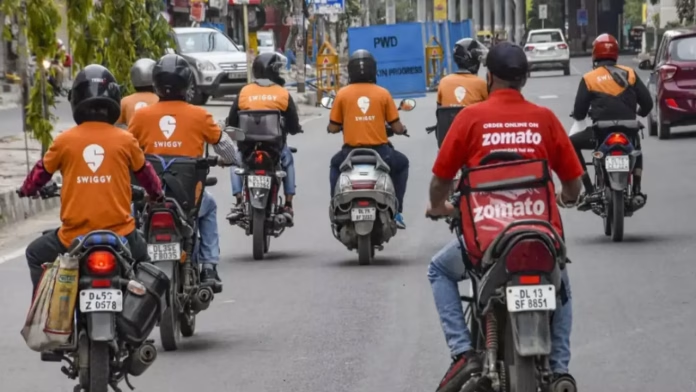
Food delivery giants Zomato and Swiggy are bracing for an annual goods and services tax outgo of Rs 180–200 crore each after the GST Council clarified that platforms must pay 18% tax on delivery fees. The decision ends a long-running dispute over whether aggregators or gig workers were liable, but it also raises costs for an industry already struggling with slowing growth.
Executives at both firms told ET that the additional tax will not be absorbed by the companies. Instead, the burden is likely to be shared between delivery workers, whose payouts could be trimmed, and customers, who may face a new delivery levy. “This will immediately reduce partner earnings and in parallel, a charge to consumers is being considered,” said a senior Zomato executive, requesting anonymity.
The ruling follows earlier run-ins between tax authorities and the platforms. In December 2024, Zomato received a notice for Rs 803 crore in unpaid GST, interest, and penalties for 2019–22. Swiggy too was issued a pre-demand notice. How the latest clarification will impact these past claims remains unclear.
Brokerages see the change as a negative in the near term. Morgan Stanley noted that the 18% GST on local delivery services will now apply whether firms account for it as revenue or as pass-through, but added that companies are well-positioned to shift the cost to users.
The development comes amid muted growth in online food delivery. Gross order value has been expanding below 20% year-on-year for both players in recent quarters, far slower than earlier years. For April–June, Zomato posted an operating profit of Rs 451 crore, while Swiggy’s food business reported Rs 192 crore.
Section 9(5) of the GST Act already obliges platforms to collect tax on behalf of restaurants. The latest interpretation now firmly brings delivery services into the net.
Unilever has signaled a reset in its India playbook, appointing Priya Nair as managing director and chief executive of Hindustan Unilever (HUL), marking the first time a woman will lead India’s largest consumer goods maker. The decision, according to Unilever’s global chief executive Fernando Fernandez, stems from the need to reignite sales momentum in a market that accounts for nearly 14% of the multinational’s global turnover.
Speaking at the Barclays Global Consumer Staples Conference, Fernandez underlined that the leadership overhaul was aimed at making India a co-anchor of growth alongside the United States. “Priya brings global perspective and depth of experience, which is critical for HUL at this juncture. Companies of HUL’s scale risk becoming inward-looking, but the India of tomorrow requires leadership that thinks beyond legacy models,” he said.
Nair, who assumed charge on August 1, succeeded Rohit Jawa, whose two-year term was the shortest in HUL’s history. Alongside her elevation, HUL has also inducted senior executives from Britannia and Hero MotoCorp to head its foods and finance divisions.
India remains Unilever’s second-largest market after the US, with HUL controlling over 50% share in hair care, skincare, dishwashing, and packaged foods, and around 45% in laundry. The company is betting that India’s projected 5-6% real GDP growth will be mirrored in its own volume expansion over time.
HUL’s revenue rose 5% in the June quarter, but growth has hovered between flat and 4% for nearly two years, reflecting sluggish consumer demand. To diversify, HUL has bought high-growth startups such as skincare label Minimalist and nutraceuticals brand Oziva, both expected to cross €100 million in combined revenues this year.
With reach across 9 million retail outlets, including 3 million directly served, and a digital ordering app, Shikhar, HUL is banking on a mix of scale, technology, and new categories to hold its dominance as competition intensifies from agile new-age brands.
Digital physiotherapy platform FlexifyMe has raised ₹20 crore (approximately $2.4 million) in a pre-Series A round led by IvyCap Ventures, with participation from Signal Ventures and its existing backers. The healthtech startup, which gained national attention after featuring on Shark Tank India Season 3, said the new capital will be directed towards expanding its hybrid care model, opening advanced posture and gait analysis labs, and deepening clinical research partnerships.
Founded in 2021 by Manjeet Singh and Amit Bhayani, FlexifyMe combines artificial intelligence with licensed physiotherapy to treat chronic musculoskeletal conditions such as lower back, neck, and shoulder pain. Its proprietary system analyzes posture and motion to detect weaknesses and guide patients toward corrective treatment. Unlike traditional symptom-led care, the platform claims to deliver measurable, data-backed interventions.
The company offers one-on-one live physiotherapy sessions, curated video-based exercise programs, and yoga routines through subscription packages. It also partners with enterprises, insurers, and healthcare providers to integrate its solutions into larger wellness ecosystems.
“Our goal is to make recovery from chronic pain scientific and measurable. By blending AI insights with qualified physiotherapists, we can help patients avoid unnecessary surgeries and return to active living faster. This funding will allow us to build more labs, strengthen clinical validation, and scale our services across India,” said Manjeet Singh, co-founder of FlexifyMe.
The startup had earlier raised $1 million in a seed round led by Flipkart Ventures. Its Shark Tank India pitch attracted Emcure Pharmaceuticals’ executive director Namita Thapar, who invested in the company during Season 3.
India’s physiotherapy and rehabilitation market is expected to grow rapidly as lifestyle-related chronic pain conditions rise. FlexifyMe’s bet is that a tech-first, hybrid approach can capture this demand at scale.
When Kshiti Jikar Mehta began baking cookies in her family kitchen in 2018, she had little more than an idea and a passion for food. Seven years later, her brand The Cookie Co has evolved into a fast-growing startup, with a flagship outlet in Vadodara and plans to expand across India.
The company specializes in New York–style artisanal cookies priced for mass affordability. What started as a home-based venture soon grew into a cloud kitchen operation before establishing its first retail presence. “From having no business plan to running a store today, the journey has been about perseverance and belief,” Mehta said.
Vadodara-based dessert brand The Cookie Co is fast emerging as a serious contender in India’s premium snacking market. Founded in 2019 by Ivy League alumna and former finance professional Kshiti Jikar Mehta, the company has transformed from a home kitchen venture into a structured consumer brand, now eyeing pan-India expansion.
What began as small-batch baking from her mother-in-law’s kitchen has grown into three outlets and a thriving direct-to-consumer channel that ships cookies across the country. The company reports a consistent 50 percent year-on-year growth rate, supported by high customer retention and modest marketing spends. “We want to serve cookies to every corner of the country while ensuring the artisanal standards remain intact,” says Mehta.
She credits part of her growth to India’s evolving startup ecosystem. Pro-startup policies, access to financial aid and the rise of strategic partnerships, she said, have created an environment where new entrepreneurs can scale faster than before. “This is the best time to invest in one’s dreams,” Mehta observed.
The Cookie Co’s flagship store in Vadodara marks a significant step for the brand, but Mehta has her sights set on a national presence. The company is exploring franchise partnerships to replicate its format across key cities. “We want to take our cookies to every corner of the country and eventually build a global footprint,” she said.
Mehta, who spent her early years in the United States, believes India now offers a fertile ground for entrepreneurs. “I don’t miss anything about living abroad. India today has everything, from ease of doing business to a supportive ecosystem. What we need is the courage to take risks,” she added.
As consumer appetite for premium yet accessible desserts grows, The Cookie Co aims to position itself as a leading player in India’s evolving bakery market. From ₹50,000 to a Cookie Empire: How The Cookie Co is Baking India’s Next Dessert Success
The Cookie Co’s offerings stand out for their freshness, affordability, and New York–style recipes. All products are egg-free, preservative-free, and designed with an extended shelf life, making them suitable for both retail shelves and nationwide delivery. The brand’s customer base has also expanded into corporate gifting, where it is seeing strong traction from institutional partners seeking customized dessert boxes.
Mehta, who studied at Purdue and Harvard before working in corporate finance roles in the United States, credits her shift to entrepreneurship to her long-standing passion for baking. What started as a source of comfort during her student years has now become a full-fledged enterprise. The company began with an initial investment of ₹50,000 and has already raised a small friends-and-family funding round to support its next phase.
The Cookie Co is preparing for a 10-outlet expansion across western India while scaling its central kitchen and operations team. With a 95 percent women-led workforce and a clear roadmap for growth, the company aims to establish itself as a national player in the gourmet dessert space.
We are not just selling cookies, we are selling the experience of have fresh cookies out of the oven” says Kshiti.
Bengaluru-based e-commerce startup FirstClub has raised $23 million in a Series A round, taking its valuation to $120 million, just three months after launching its consumer app. The round, which was 90 percent equity and the remainder debt, was co-led by Accel and RTP Global, with participation from Blume Founders Fund, 2am VC, Paramark Ventures, and Aditya Birla Ventures. This follows the company’s $8 million seed round in December 2024 at a $40 million valuation.
Founded by former Flipkart executive Ayyappan R in late 2024, FirstClub is positioning itself against India’s crowded quick-commerce market by focusing on premium and exclusive selections rather than delivery speed. The startup currently operates four “clubhouses,” or dark stores, in Bengaluru, offering 4,000 curated stock-keeping units across groceries, fresh produce, dairy, and packaged foods. Around 60 percent of its products are exclusive, selected after blind testing by consumer panels.
The model is showing traction. Average order values stand at ₹1,050, roughly double that of mainstream quick-commerce rivals such as Blinkit and Instamart. Repeat purchase rates are around 60 percent, with the customer base skewing 70 percent female and concentrated in households earning over ₹15 lakh annually. To maintain its positioning, the platform restricts checkouts below ₹199.
With fresh capital, FirstClub plans to expand to 35 dark stores in Bengaluru before moving into new cities. The company also intends to diversify into children’s nutrition, pet food, home essentials, and nutraceuticals, while piloting cafés that will serve freshly prepared items. Longer term, the startup aims to replicate premium retail experiences similar to Costco and Whole Foods for Indian consumers.
FirstClub currently employs 185 people, including a 75-member operations team, and is building its own supply chain to back its quality-first approach.
House of Zelena (HOZ), a startup focused on maternity and postpartum wear, has raised ₹7 crore in a seed round co-led by Sprout Venture Partners and Singapore-based M Venture Partners. Early-stage accelerator GSF and a group of angel investors also participated in the round.
The latest infusion takes the company’s total funding to $1.2 million. HOZ said the capital will be channelled into strengthening its supply chain, accelerating product innovation and expanding community-led initiatives. Investments will also go towards building technology platforms to support engagement with mothers across the country.
Founded in Bengaluru, HOZ positions itself in the fast-growing maternity apparel and postpartum care segment. The company designs clothing that blends comfort, functionality and style, while also exploring textile-driven solutions that address pain management and recovery for new mothers.
“With this funding, our objective is to scale aggressively and deliver international-quality solutions at price points accessible to Indian moms,” said co-founder Mayank Kamal. “We are committed to innovating with textiles to make recovery and everyday wear easier for mothers, while creating a strong community around the brand.”
The maternal apparel market in India has gained momentum in recent years, driven by rising awareness, higher disposable incomes and growing e-commerce penetration. Analysts estimate the segment will continue to expand as more consumers shift towards specialized and functional wear during pregnancy and postpartum stages.
HOZ plans to leverage the funding to build a stronger distribution network while also focusing on design-led innovation. By tapping into both online and offline channels, the company aims to establish itself as a leading player in the niche but fast-expanding maternity wear space in India.
Mother Dairy, one of India’s largest dairy brands, announced on Thursday that it will pass on the benefits of the recent Goods and Services Tax (GST) reduction on dairy products to its customers. The assurance follows the GST Council’s decision to lower tax rates on a wide basket of value-added dairy categories.
Mother Dairy, which posted revenues of ₹17,500 crore in the last financial year, said the rate cut covers paneer, cheese, butter, ghee, UHT milk, milk-based beverages and ice creams. The company said the move would not only make packaged dairy products more affordable but also expand their reach across households.
“We commend the Union Government’s decision to reduce GST rates on dairy items. This will significantly improve affordability and accessibility for consumers, especially in packaged categories that are witnessing strong growth,” said Manish Bandlish, Managing Director of Mother Dairy.
He added that the reform will strengthen consumer trust in safe, high-quality packaged products and encourage families to opt for value-added dairy choices. “We are fully committed to ensuring that the benefits of this reduction are effectively transferred to consumers,” Bandlish noted.
Industry analysts believe the reduction in GST will stimulate higher demand in organized dairy segments and expand market opportunities for farmers supplying to these value chains. Packaged dairy categories such as cheese, UHT milk and milk-based beverages have seen rapid growth in recent years, driven by urban consumption patterns and rising disposable incomes.
The GST relief comes at a time when consumer spending is under pressure from food inflation, and the move is expected to support household budgets while boosting demand for branded dairy products.
Actor Samantha Ruth Prabhu has added another chapter to her growing entrepreneurial journey, joining menstrual and feminine healthcare brand ZOY as co-founder. With this, the actor’s tally of ventures as investor or co-founder has touched 12, spanning wellness, fashion, sports and personal care.
Prabhu, who earlier co-founded Secret Alchemist and fashion label Saaki, has consistently backed ventures aligned with her personal values. “I look for brands that can create meaningful impact. Whether it is Secret Alchemist, Saaki, Ekam or even the Chennai Pickleball team, I want to support businesses that I genuinely believe in,” she told Moneycontrol.
ZOY, founded by Maheshwari Moorthy, aims to disrupt India’s $1.3 billion menstrual hygiene market, which is projected to grow at 12 percent annually till 2030. The segment continues to be dominated by plastic-based, chemically processed products that studies have linked to fertility issues, PCOS, urinary tract infections and chronic discomfort.
The new venture plans to introduce toxin-free, holistic alternatives, including medicated strip sanitary napkins and the patented Snow Lotus Therapy Pad. The product has been designed to regulate cycles, support PCOS management and aid natural detoxification.
Prabhu, who has spoken openly about her personal health struggles, said her association with ZOY is an extension of her advocacy for mindful living and women’s empowerment. “This is not just about menstrual care. It is about rethinking women’s health as a whole. We want to build a brand that helps women make informed choices and experience their cycles differently,” she said.
Her focus on wellness comes at a time when Indian consumers are increasingly turning to clean and sustainable personal care. For Prabhu, ZOY marks not just another investment, but a commitment to reshape conversations around women’s health in India.
We use cookies to ensure that we give you the best experience on our website. If you continue to use this site we will assume that you are happy with it.