Saturday, December 20, 2025
Home Blog Page 47

From WhatsApp Orders to Bulk Supplies: Smart Ways to Grow a Grocery Business in Indian Towns”

0

Running a grocery business in a bustling city is one thing, but doing so in a town area is a different game altogether. Smaller markets come with unique challenges—limited footfall, tighter purchasing power, and lower product variety—but they also offer something urban outlets often struggle to get: strong customer loyalty and community trust. The question is, how do you turn these advantages into higher sales and better profits?

Know Your Customers Better Than Anyone Else

In a town, people often stick to the same kirana store for years, not because of prices alone but because of relationships. A friendly chat, home delivery on credit, or simply keeping their preferred brand in stock goes a long way. Start by understanding your regular customers’ buying habits—what brands they like, what they buy in bulk, and when their monthly stock-up happens.

Stock Smart, Not Heavy

One of the most common mistakes in small-town grocery stores is overstocking, especially perishables. Instead, focus on fast-moving essentials—rice, flour, edible oils, biscuits, soaps—and then experiment with smaller quantities of premium or new items. For example, if customers are asking for branded snacks or a new detergent, test it in small batches before expanding.

Go Digital, Even in a Small Market

Digital payments are no longer just for metro cities. UPI transactions are booming in towns too, and customers increasingly prefer paying via QR codes. You can also set up a simple WhatsApp ordering system for home delivery—a service that instantly makes your store more convenient than the competitor down the lane.

Add Value Beyond Groceries

Margins in groceries are slim, so think of side categories that sell fast with higher margins—dairy, bakery items, snacks, and even basic personal care. In towns, customers often prefer a one-stop shop rather than making multiple trips, so adding these products increases your average bill size without requiring huge investment.

Build Loyalty with Small Gestures

Town-area customers value personal relationships more than big discounts. A free carry bag for regular buyers, small credit during tough times, or festive offers (like a Diwali hamper discount) can cement loyalty for years. Word-of-mouth is powerful in small communities; happy customers will bring in more business than any paid advertisement.

Keep an Eye on Bulk Sales

In many towns, hostels, schools, small restaurants, and offices rely on nearby grocery stores for bulk supplies. Tapping into this segment can give you steady, large orders each month. Offer customized packs, slight discounts, or free delivery to lock in these clients.

The Bottom Line

Improving a grocery business in a town area isn’t about copying the supermarket model—it’s about leveraging trust, convenience, and community bonds. By stocking smartly, adopting digital tools, and offering small but meaningful value additions, you can steadily increase profits while strengthening your presence in the local market.

In towns, the grocery store isn’t just a business—it’s part of the social fabric. The closer you are to your customers’ lives, the stronger and more profitable your store will become.

Advertisement

Why Online Grocery Is the Next Goldmine: Lessons from Blinkit, Zepto, and India’s Digital Kirana Revolution”

0

Not too long ago, groceries meant a trip to the local kirana or supermarket. But in the last five years, India’s shopping habits have shifted dramatically. With the rise of platforms like BigBasket, Blinkit, Zepto, and even Reliance JioMart, online grocery retail has turned into one of the fastest-growing businesses in the country. For entrepreneurs, the question is simple: why is the online grocery store seen as the perfect business today?

Demand That Never Slows Down

Groceries aren’t a luxury; they’re essentials. Whether the economy is booming or slowing, people need food grains, vegetables, dairy, and daily-use products. This built-in demand makes groceries one of the most recession-proof categories. By moving the business online, owners tap into convenience-hungry consumers who prefer ordering with a click instead of standing in line.

Changing Consumer Habits in India

India’s urban and semi-urban consumers are now conditioned to expect speed and convenience. The success of 10-minute delivery apps like Zepto and Blinkit proves that time is now as valuable as price. Online grocery stores serve this expectation by combining variety, doorstep delivery, and flexible payment methods—all factors that keep customers coming back.

Scalability at Lower Costs

Unlike a physical supermarket that requires high rentals, heavy inventory, and large staff, an online grocery store can start lean. Cloud-based inventory systems, tie-ups with local suppliers, and a small warehouse are often enough to begin. Over time, the model can scale with technology—expanding delivery zones, adding SKUs, or even integrating AI for demand prediction.

The Power of Data and Loyalty

What truly makes online grocery attractive is data-driven decision making. Apps track what customers buy, when they shop, and how much they spend. This data fuels targeted offers, loyalty programs, and personalized recommendations that boost repeat purchases. For instance, BigBasket has built a steady customer base by predicting monthly stock-up cycles and offering subscription models.

Untapped Markets: Beyond the Metros

While metros are crowded with players, tier-2 and tier-3 towns are the next big frontier. With rising smartphone penetration and UPI adoption, smaller towns are ready for digital-first shopping. For a new entrant, focusing on these underserved markets can mean fewer competitors and higher loyalty.

Challenges—But Solvable Ones

Of course, online grocery is not without challenges: thin margins, logistics costs, and customer acquisition expenses can squeeze profits. But companies like Reliance and Tata-owned BigBasket have shown that scale, efficient supply chains, and smart delivery networks can turn the model profitable. Local entrepreneurs can start small with hyperlocal delivery and grow steadily.

The Bottom Line

The online grocery business is not just a trend—it’s the natural evolution of how people want to shop. Essentials will always sell, but convenience and speed are now equally critical. For entrepreneurs, the model combines steady demand, scalability, and long-term profitability, making it one of the most promising ventures today.

If you’ve been waiting to start a business that balances necessity with innovation, the online grocery store might just be the perfect bet. After all, food never goes out of fashion—only the way we buy it does.

Advertisement

Shiseido Taps Bollywood Star Power: Tamannaah Bhatia Fronts Ultimune Serum Launch as India’s $2.5-Billion Premium Skincare Market Heats Up

0

Japanese beauty major Shiseido has rolled out the latest version of its Ultimune Power Infusing Serum in India, backed by a high-profile campaign featuring actress Tamannaah Bhatia. The launch underlines Shiseido’s strategy to deepen its presence in the fast-growing Indian premium skincare market.

The campaign film, unveiled this week, presents Bhatia as the face of resilience and vitality, echoing Shiseido’s global positioning of Ultimune as a product that harnesses the science of skin regeneration to deliver strength and confidence. With this iteration, Ultimune aims to appeal to consumers who view skincare as both functional and emotional, blending dermatological efficacy with a message of empowerment.

For Shiseido, India represents an important growth opportunity. The country’s premium beauty and personal care market is estimated to reach $2.5 billion by 2027, with skincare driving much of the momentum. Ultimune, one of Shiseido’s global bestsellers, has already found strong consumer adoption in markets such as Japan, China and Europe. The Indian launch, supported by local ambassador Bhatia, is designed to strengthen brand recognition and accelerate acceptance among urban millennials and Gen Z buyers.

Kadambari Lakhani, chief executive and director at Baccarose Perfumes and Beauty Products, Shiseido’s distribution partner in India, said the campaign is as much about philosophy as it is about product. “This is about bringing innovation in skin science to India while celebrating confidence and self-acceptance. Tamannaah Bhatia perfectly embodies this ethos,” she said.

Shiseido has signalled that it will invest heavily in India, using both product innovation and storytelling to differentiate itself from global rivals. The Ultimune campaign marks a step forward in positioning the brand not just as a skincare label but as a lifestyle choice, fusing science, artistry and individuality for a new generation of consumers.

Advertisement

Sawariya Group Cracks Into Lifestyle With Luxe Asia; Partners With UK, French, Taiwanese Brands, Focus on Tier-II Retail Growth

0

Diversified player Sawariya Group has taken a decisive step into the lifestyle and luxury goods market with the launch of its new subsidiary, Luxe Asia. The company announced on Monday that it aims to build a USD 20 million business from this vertical by 2026, banking on India’s appetite for premium lifestyle products.

Luxe Asia will spearhead the group’s foray into the premium luggage category through exclusive partnerships with three international names—IT from the United Kingdom, Jump from France, and Departure from Taiwan. The company sees the luggage business as a strong entry point into the broader lifestyle segment, with plans to later expand into additional luxury categories.

To reach its target, Sawariya is drawing up an aggressive retail and distribution blueprint. The group intends to establish a presence in 350 multi-brand outlets, 18 exclusive brand stores, and more than 20 franchise-operated stores over the next two years. Tier-II cities are expected to account for a large part of this expansion, reflecting the rapid growth in consumer spending beyond metropolitan markets.

Raman Agrawal, Founder and Director of Sawariya Group, said the lifestyle push is aligned with the company’s long-term growth strategy. “The expansion into the lifestyle segment is an important milestone. With Luxe Asia, we expect to build a strong presence in the premium category and bring some of the world’s most respected global brands closer to Indian consumers,” Agrawal noted.

Founded as a diversified business house, Sawariya Group has been expanding into new sectors to capture emerging consumer trends. Luxe Asia is positioned as its premium lifestyle arm, and the company is betting on rising discretionary spending and aspirational demand in India to drive its next growth phase.

Advertisement

Profit Push for SMEs: Amazon Cuts Seller Fees by 4–7%, Adds Basket-Building Tools, and Targets 25–40% Margin Gains This Festive Season

0

Amazon India is gearing up for its flagship Great Indian Festival, beginning September 23, with an expanded seller base, sharper logistics, and aggressive fee cuts designed to boost small and medium businesses during the country’s peak shopping season.

Amit Nanda, Director, Selling Partner Services at Amazon, said the platform now has 17 lakh registered sellers, a 25 per cent rise in new product launches compared to last year. “We are already seeing momentum across categories with more than 15,000–20,000 new product types added ahead of the event,” he said.

Last year’s festival saw 40 crore customer visits and a 70 per cent increase in crorepati sellers compared to 2023. More than 70 per cent of participating sellers came from tier II and III cities, while 85 per cent of customers were from non-metro markets. Over 3 crore products were delivered within one or two days, and small enterprises sold over 1,000 units every minute.

For 2025, Amazon has reinforced its logistics backbone, inducting 1.5 lakh seasonal workers, adding 12 fulfilment centres and six new sortation hubs, and expanding transportation lanes. The company has also cut seller fees sharply. From April, referral fees were removed entirely on 1.2 crore products priced below Rs 300 across 135 categories, while charges in fashion, beauty, home appliances, and healthcare were reduced further in September. Handling fees for items under 25kg were lowered by up to Rs 100.

“These measures translate into significant profitability for sellers. A 4–7 per cent cut in fees can mean a 25 to 40 per cent jump in profits,” Nanda noted. Amazon has also introduced tools like Sell More Save More, offering smart catalog recommendations to help sellers improve average order sizes while trimming shipping costs.

Advertisement

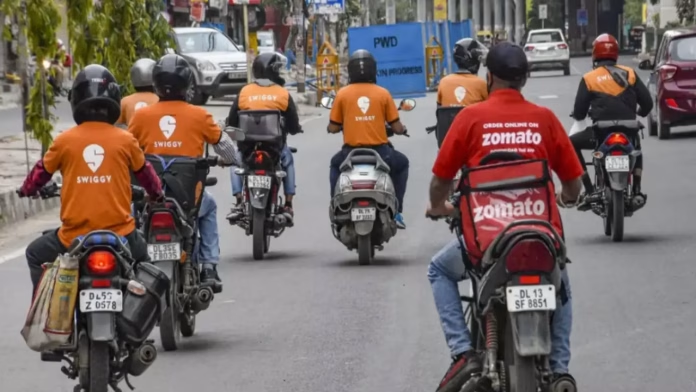
India’s Food Delivery Market to Bounce Back in FY26: Zomato, Swiggy Growth Slowed to 18% in FY25, But GST Reforms and Rising Consumption May Push GOV Past 20%

0

India’s food delivery and quick commerce sectors are set for a fresh phase of growth, with analysts pointing to the recent goods and services tax (GST) reforms, stronger discretionary spending, and a revival in consumer confidence as the key drivers.

Industry trackers note that growth in online food delivery had cooled in recent quarters, with gross order value (GOV) for market leaders Swiggy and Zomato slowing to 18% in FY25, from 19-20% in FY24. Quick commerce players too had faced pressure, as aggressive competition, rapid expansion of dark stores, and higher customer acquisition costs weighed on margins.

That slowdown may now be short-lived. Brokerage Motilal Oswal said GST rationalisation and the upcoming festive season should help lift order volumes and frequency, with food services and QC among the biggest beneficiaries. Naveen Malpani, partner and consumer industry leader at Grant Thornton Bharat, said, “The GST rationalisation is expected to unlock momentum in discretionary spending, particularly in food services and quick commerce.”

Swiggy’s Food Marketplace CEO Rohit Kapoor echoed that view in a recent LinkedIn post, noting that the reforms will provide a “strong tailwind” for the sector. Zomato’s District CEO Rahul Ganjoo added that lower tax slabs will make quality experiences more accessible for both metro and emerging city consumers, boosting consumption at large.

However, some players argue the impact could be uneven. Since delivery services now fall under Section 9(5) of the CGST Act, platforms must collect and remit GST on delivery charges. Several companies have already raised fees, which could nudge up consumer costs.

Kazem Samandari, co-founder and executive chairman of French patisserie chain L’Opera, said the sector still needs critical reforms such as input credit eligibility. “The benefits are minimal and indirect. What we require most is input credit access,” he noted.

Advertisement

AI Meets Americano: Perplexity’s ‘Curious’ Café Debuts in Seoul with Lee Jung-jae Backing, Targeting Korea’s $20-Billion AI Market

0

U.S.-based artificial intelligence company Perplexity has stepped into the offline world with the launch of its first cafe in Seoul’s Gangnam district. The venue, called Curious, opened on September 3 inside the Artist Company building on Dosan-daero, owned primarily by actor Lee Jung-jae. The move marks the first time a global AI startup has directly operated a cafe, signaling Perplexity’s intent to deepen its brand presence in South Korea, one of the fastest-growing AI markets in Asia.

Perplexity, founded in 2022 by former OpenAI and DeepMind engineers, is valued at $18 billion and counts Jeff Bezos and Nvidia among its investors. The company, which operates an AI-powered search and answering engine with around 15 million monthly users, is increasingly popular in Korea. According to IGAworks, its local monthly active users surged from 330,000 in January to about 820,000 in August.

The Curious cafe is designed as both a coffeehouse and brand showcase. An Americano is priced at 7,000 won, while cakes are sourced from popular Seongsu-based bakery Thousand. Customers subscribing to Perplexity Pro at the cafe can claim a 50% discount and a free trial month. AI-generated music plays throughout the space, which features a retro-futuristic interior mixing spaceship themes with 1970s American design. Merchandise, from mugs and beans to T-shirts and notebooks, is also on sale.

The choice of Gangnam is tied to Perplexity’s partnership with Artist Company. CEO Aravind Srinivasan, a fan of Squid Game, met Lee Jung-jae earlier this year to explore AI-entertainment collaborations. In March, Lee fronted Perplexity’s ad campaign in Korea.

South Korea’s AI market is forecast to expand from $2.07 billion in 2022 to nearly $20 billion by 2032, according to KOSA. With rivals like OpenAI, Anthropic, and Cohere preparing Korean operations, Perplexity’s offline experiment could become a blueprint for AI firms seeking stronger consumer connections.

Advertisement

From Jeans to Lipsticks: Gap Inc. Makes $500-Billion Beauty Market Play, Shares Jump 2.4%

0

Gap Inc., the US apparel retailer best known for its denim and khakis, is now betting on lipsticks and lotions. The San Francisco-based company said it will enter the fast-growing beauty and personal care segment this fall, starting with a pilot launch at 150 Old Navy stores across the United States.

The assortment will span skincare, makeup, nail polish, and hair products, with most items priced under $25, positioning the brand squarely in the mass-premium category. According to the Wall Street Journal, Gap will expand the rollout gradually, with Gap-branded outlets expected to start offering beauty lines from 2026.

The move marks a significant shift in Gap’s strategy as it seeks to reduce dependence on its core apparel business, which has been squeezed by weakening consumer demand and higher tariff costs. In its most recent quarter, the company reported lower-than-expected comparable sales, underscoring the need for diversification.

Beauty offers a high-margin opportunity. Globally, the personal care industry is estimated at over $500 billion, with steady growth outpacing apparel. Analysts say Old Navy’s wide store footprint and family-oriented positioning could give Gap an edge in building a beauty portfolio that resonates with younger and more diverse shoppers.

Shares of Gap Inc. rose 2.4% in early trading after the announcement, signalling investor confidence in the diversification plan. Alongside beauty, the company said it also plans to expand its accessories portfolio, another category with higher repeat purchase potential compared to fashion apparel.

Gap joins rivals such as H&M and Zara, which have also experimented with beauty and fragrance lines to capture discretionary spend beyond clothing. For the 55-year-old retailer, this could be the start of a new chapter—where a shopping trip for jeans also means picking up a serum or lipstick at checkout.

Advertisement

1.4 Billion Consumers, 7.8% GDP Growth, 2 Slabs—FM Bets Big on New GST Regime to Power India’s Next Phase

0

Finance Minister Nirmala Sitharaman on Friday said the government’s new dual-slab goods and services tax (GST) structure would provide a significant boost to India’s growth momentum, even as policymakers prepare targeted support for exporters grappling with higher US tariffs.

The revamped GST regime, effective September 22, will consolidate the existing multi-rate system into two slabs of 5% and 18%. In addition, a 40% rate will apply to select luxury and sin goods. “GST impacts every one of the 1.4 billion Indians. From household purchases to automobiles, everything is touched by GST, so this reform will have a very positive impact,” Sitharaman said in an interview, adding that industry leaders had assured her the benefits of lower rates would be passed on to consumers.

India’s economy expanded 7.8% in the June quarter, the fastest in five quarters, but rising US tariffs on Indian exports have raised concerns over sustaining this pace. Sitharaman clarified that the GST reform was not specifically designed to offset tariff shocks, but acknowledged it would “collaterally help” the sectors most affected.

She said a relief package tailored for tariff-hit sectors is under discussion. “Respective ministries are in talks with affected industries and a package is being worked out,” the minister noted, without setting a timeline.

The minister also confirmed discussions on easing Press Note 3 restrictions, which mandate prior approval for investments from countries sharing land borders with India, and flagged ongoing visa relaxations for renewable energy and domain-specific exports.

On the macro front, Sitharaman reiterated India’s position on Russian oil imports, stating decisions will be guided by national interest. She stressed that “relentless work on next-generation reforms” is underway following the Prime Minister’s Independence Day roadmap.

Advertisement

From WhatsApp Orders to Bulk Supplies: Proven Ways to Improve Grocery Stores in Towns and Semi-Urban India

0

Running a grocery store in a bustling metro is one story; operating one in a town area is another. In smaller towns, grocery stores are more than just shops—they’re community hubs where families return for their daily essentials. The good news is demand is steady, but the challenge lies in standing out, building loyalty, and growing profits in a market where competition is often local and margins are tight. If you’ve ever asked yourself, “How do I improve my grocery business in a town area?”—here’s a roadmap.

Understand Local Needs First

Every town has its unique consumption patterns. A student-dominated town may demand instant noodles, snacks, and affordable meal packs, while a family-oriented area will prioritize staples, fresh produce, and household goods. Spend time observing buying habits and talk to your customers—this ensures you stock exactly what the community wants, reducing waste and increasing sales.

Smart Inventory, Not Just Bigger Inventory

In smaller towns, overstocking is a common pitfall. Essentials like rice, flour, and oil must always be available, but premium or slow-moving goods should be added gradually. Build strong ties with local wholesalers or FMCG distributors (Nestlé, ITC, HUL) who often extend credit cycles, helping you manage cash flow.

Improve Customer Experience

Convenience is key. Customers in town areas may not have quick-commerce apps, but they value:

  • Home delivery on call or WhatsApp.
  • Digital payments (UPI, wallets, cards) for hassle-free checkout.
  • Organized shelves and fast billing that save their time.

Small gestures—like remembering regular customers’ preferences or offering delivery in the evening—create loyalty that bigger chains can’t match.

Market on a Micro-Level

You don’t need flashy ads; you need visibility. Try:

  • Flyers or discount coupons in residential colonies.
  • “Family packs” of staples at better rates.
  • Festival offers on essentials (sugar during Diwali, oil during Holi).
  • Loyalty cards or simple schemes like “Buy groceries worth ₹1,000 and get ₹50 off.”

Word-of-mouth spreads fast in towns, and a small incentive can convert casual buyers into repeat customers.

Explore Bulk and Institutional Sales

If your store is in a town with schools, hostels, or small businesses, explore supplying them in bulk. For example, a steady order from a local café for bread, milk, or packaged snacks can secure predictable monthly revenue.

Keep Costs Under Control

Profitability in town grocery stores comes from managing expenses. Rent and labor costs are usually lower than cities, but wastage can eat into margins. Monitor perishables closely and invest in a basic freezer or cold storage to extend shelf life for dairy and frozen goods.

Final Word: Small Changes, Big Results

Improving your grocery business in a town area isn’t about copying large-format supermarkets—it’s about serving your community better than anyone else. By aligning with local demand, improving customer convenience, using low-cost marketing, and building bulk partnerships, you can steadily grow both revenue and reputation.

In grocery retail, consistency is everything. Each delivery on time, each stocked shelf, and each loyal customer adds up to long-term success. The next big leap in your town’s grocery trade may just start with small improvements you make today.

Advertisement