Saturday, December 20, 2025
Home Blog Page 46

Trufrost & Butler Raises $7 Million to Boost Supply Chain, Ramp Domestic Production and Eye Overseas Growth with Carpediem Capital’s Backing

0

Trufrost & Butler, a fast-growing player in commercial refrigeration and foodservice equipment, has raised $7 million in growth funding from private equity firm Carpediem Capital. The company said the infusion will be used to strengthen domestic manufacturing, accelerate order fulfilment, expand its service infrastructure, and selectively enter international markets.

Founded in 2018 by industry veterans Neeraj Seth and Satish Dudeja, the company caters to a wide spectrum of clients including cafés, quick service restaurants, cloud kitchens, hotels, bakeries, bars and fine-dining establishments. Its portfolio spans refrigeration systems, cooking ranges, beverage dispensers, and other commercial kitchen essentials. Unlike traditional vendors, Trufrost & Butler positions itself as a solutions partner with a service-led model and low capital expenditure options aimed at faster returns for food and beverage operators.

Over the past five years, the company has built a footprint across major Indian cities, supported by beverage specialists and culinary consultants who work with clients on efficiency and product innovation. “This investment reflects our vision of reshaping the foodservice equipment sector with reliable products and robust support,” said Neeraj Seth, Co-founder and Managing Director. “It will allow us to scale our manufacturing base, improve service delivery, and prepare for overseas expansion while deepening our commitment to the Indian market.”

Carpediem Capital, which focuses on consumer and services businesses, sees the company as a strong contender in an otherwise fragmented industry. “Trufrost & Butler has demonstrated sharp execution and built trust in a sector where reliability is critical,” said Hithendra Ramachandran, Managing Director at Carpediem Capital. “We believe it has the potential to emerge as a category leader by bringing structure, scale and innovation to the market.”

Advertisement

Mars Cosmetics Ropes in Marketing Veteran Anmol Sahai Mathur to Power Next Phase of Growth with Bold, Inclusive Campaigns Across India

0

Mars Cosmetics, among the fastest-growing players in India’s beauty and personal care segment, has appointed Anmol Sahai Mathur as its vice president of marketing. The move comes as the company prepares for its next phase of growth in a highly competitive market expected to touch $30 billion by 2030, according to industry estimates.

Mathur brings over a decade of experience in digital marketing, brand building, and creator partnerships. He returns to Mars with prior familiarity of the company’s values, which focus on accessible pricing, product innovation, and inclusivity. His mandate will be to sharpen brand identity, strengthen digital engagement, and roll out campaigns that resonate with diverse consumer segments across India.

Before this appointment, Mathur led digital marketing efforts at the Open Network for Digital Commerce (ONDC), where he managed initiatives in influencer outreach, content strategy, and digital branding. His earlier roles included leadership stints at social platforms Triller and Eloelo, where he worked on scaling user acquisition and engagement.

Commenting on the appointment, Mathur said he aimed to build marketing campaigns that reflect the “bold and open beauty philosophy” of Mars while deepening consumer trust. “This is about creating impactful stories and conversations that connect emotionally with people across markets,” he said.

Rishabh Sethia, business administrator at Mars Cosmetics, noted that bringing Mathur back was a deliberate move. “He understands our DNA and has the expertise to guide us through the next stage of expansion. His leadership will help us reach new customers while reinforcing our promise of affordable and high-quality products,” Sethia said.

With this appointment, Mars Cosmetics is signaling its intent to scale aggressively in India’s beauty market while continuing its push for inclusive campaigns under its “Makeup for Everyone” vision.

Advertisement

Flipspaces Raises $50 Million in Fresh Series C, Total Funding Tops $85 Million as CE-Invests, Panthera Growth Partners and SMBC Back Global Interiors Play

0

Commercial interior design and build startup Flipspaces has raised $50 million in a fresh Series C funding round, taking its total capital raised in this round to more than $85 million. The latest financing, announced on Monday, will be used to scale operations in India, the United States and the United Arab Emirates, while also bolstering its proprietary technology platform.

The round saw participation from CE-Invests, based in the UAE, Panthera Growth Partners from Singapore, and Japan’s SMBC Asia Rising Fund. Earlier this year, Flipspaces closed a $35 million investment led by Iron Pillar, with backing from Synergy Capital Partners and Prashasta Seth. The latest tranche also enabled an exit for early investor Carpediem Capital.

Kunal Sharma, founder and chief executive officer, said the company plans to channel the proceeds into three areas: artificial intelligence-led technology development, international market expansion, and targeted acquisitions across its key geographies. “We are creating a technology-first ecosystem that redefines how interior design and execution are delivered globally,” Sharma said.

Founded in 2015 by Sharma along with Ankur Muchhal, Vikash Anand and Mrinal Sharma, Flipspaces has built a platform-driven model that integrates business development, design, procurement and project management. The company also offers virtual reality walkthroughs that allow clients to visualize and tweak layouts before execution. Its next phase of technology innovation includes AI tools aimed at enhancing efficiency, transparency and delivery timelines in what remains a fragmented global interiors industry.

Flipspaces has delivered more than 1,000 projects covering eight million square feet across its three core markets. In India, it has largely focused on commercial office spaces, while in the US its portfolio includes restaurants and cafés. Its client roster features large enterprises such as Adani, Genpact and Larsen & Toubro.

Advertisement

India’s Organic Food Regulations Under Review: FSSAI to Align With Global Norms as Exports to Europe and UK Cross Key Benchmarks

0

The Food Safety and Standards Authority of India (FSSAI) has begun the process of revising the country’s organic food regulations in a move aimed at bringing them in line with evolving global benchmarks. A senior official confirmed that a dedicated committee has been set up to draft the new framework, which will govern certification, accreditation, and labelling for organic products.

The revision comes at a time when India’s organic sector has gained prominence internationally, both as a supplier and as a consumer-driven market. Current regulations, framed under the Food Safety and Standards (Organic Foods) Regulations, 2017, draw heavily from the National Programme for Organic Production (NPOP), last updated in 2014. That programme governs certification processes, accreditation norms, and use of the “India Organic” label.

“India is in the process of updating its overall guidelines for organic farming. Naturally, this requires organic food standards to be revisited as well,” the official said. While no timeline has been fixed for the release of new regulations, the overhaul will extend to all organic agricultural products.

The NPOP framework, operated under the Ministry of Commerce, has long served as the backbone of India’s organic certification ecosystem. It works in parallel with the participatory guarantee system managed by the Ministry of Agriculture and Farmers’ Welfare. Importantly, NPOP’s crop standards already enjoy recognition as “equivalent” by the European Commission, Switzerland, and Great Britain, enabling smoother trade in organic produce.

The revised regulations are expected to factor in recent changes in international rules, particularly in the EU and North America, where stricter definitions of organic farming and traceability requirements are emerging. With India’s organic exports growing steadily over the past two decades, industry players view the regulatory upgrade as crucial to maintaining credibility and expanding market access.

Advertisement

Swiggy Faces Heat After Customer Allegedly Found Same Meal ₹663 Cheaper at Outlet Just 2 km Away

0

A man from Coimbatore has triggered a wave of debate online after pointing out that ordering food through Swiggy turned out to be far more expensive than picking it up himself from the same restaurant just a short distance away. The customer, Sunder (@SunderjiJB), posted screenshots on X comparing the bills. He said his Swiggy order came to ₹1,473, but when he went to the outlet—barely two kilometres from his home—the exact same meal cost only ₹810. That’s a difference of ₹663, or nearly 81 percent more.

Sharing the bills, he asked Swiggy directly: “Why is the app charging so much more for the same food? Is this what convenience really costs?” His post has already been seen more than 2.1 million times.

Swiggy hasn’t yet responded to this particular complaint, though the company has previously said that the prices shown on its app are set by restaurants themselves. A representative from Swiggy Cares had earlier explained that menu rates can vary between dine-in and delivery, and the decision lies with the restaurants, not the platform.

The frustration comes at a time when both Swiggy and Zomato have quietly increased their “platform fee” again, hoping to cash in on the festive season surge. Swiggy, headquartered in Bengaluru, has raised its platform fee three times in just three weeks, now charging ₹15 per order (including GST). Meanwhile, Gurugram-based Zomato recently hiked its fee by 20 percent, taking it to ₹12 per order (excluding GST).

Given Swiggy handles around 20 lakh orders daily, it is pulling in close to ₹3 crore a day solely from platform fees. Zomato, which sees 23 to 25 lakh daily orders, earns a similar amount.

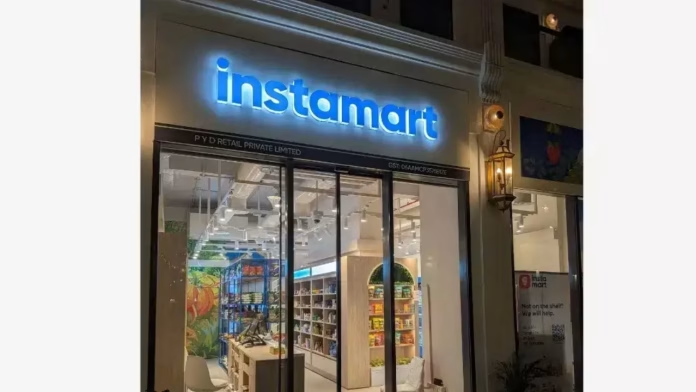
Even with these extra earnings, both companies remain under financial pressure. Their quick-commerce arms—Swiggy Instamart and Zomato-owned Blinkit—continue to be capital-heavy and eat into profits.

What exactly is a platform fee?

It’s an additional charge tacked onto your bill, separate from delivery fees, packaging, restaurant charges, surges, and taxes. Companies say it helps cover logistics and operating costs, cushions the burden of running resource-heavy services like quick commerce, and adds to margins. But for many customers, especially now during the festive rush, it’s become a symbol of how expensive “convenience” really is.

Advertisement

How Profitable Is a Grocery Store? Lessons from Reliance Fresh, D-Mart, and Your Neighborhood Kirana”

0

From the kirana shop around the corner to nationwide chains like D-Mart and Reliance Fresh, grocery retail is the beating heart of India’s economy. Unlike trend-driven businesses, groceries thrive on essentials—items people buy every single day, recession or not. But while the demand is undeniable, entrepreneurs often ask: how profitable is it to own and operate a grocery store?

The answer lies in understanding margins, managing costs smartly, and adapting to customer needs—whether you run a neighborhood shop in a town area or dream of building a supermarket.

Profit Margins: Thin but Consistent

Grocery retail is a high-volume, low-margin business. Most stores operate with net margins between 2% and 8%, but steady demand makes it sustainable. Profitability depends heavily on product mix:

  • Staples like rice, flour, and pulses: 5–8% margin
  • Packaged foods, beverages, FMCG goods: 10–15%
  • Snacks, confectionery, and personal care: 15–25%
  • Organic, premium, or imported products: up to 30%

The smartest stores balance low-margin essentials with higher-margin products to boost overall profitability.

Costs That Can Make or Break You

Running a grocery store isn’t just about sales—it’s about managing expenses.

  • Rent: Urban high-street rents eat into profits, while town-area locations offer lower overheads.
  • Inventory: Overstocking perishables leads to waste; lean stocking ensures cash isn’t locked up.
  • Staffing: Family-run shops in towns save manpower costs, while larger stores need trained staff.
  • Utilities & Technology: Refrigeration, electricity, and POS systems are essential investments that add to monthly bills.

A small kirana store in a town can break even in 12–18 months, thanks to lower rent and strong local loyalty.

Town Advantage: Why Small-Scale Stores Thrive

In smaller towns, grocery stores often enjoy closer customer relationships. Shoppers stick to familiar shops, trusting the owner for fair pricing and timely availability. To improve profitability in these areas:

  • Offer home delivery via WhatsApp for convenience.
  • Stock fast-moving essentials while experimenting with a few premium items.
  • Provide digital payment options to modernize transactions.
  • Introduce bulk packs for families or hostels to increase ticket size.

Town-area stores thrive not by scale, but by becoming indispensable to their communities.

Strategies to Increase Profits

  1. Diversify smartly – Don’t just sell staples; add snacks, dairy, and personal care.
  2. Use digital tools – POS systems and simple inventory apps cut leakages.
  3. Local marketing – Flyers, society tie-ups, and festive offers build visibility.
  4. Bulk sales – Partner with hostels, cafés, or offices for predictable revenue.
  5. Customer loyalty programs – Discounts or prepaid store wallets lock in regular buyers.

The Bottom Line: Steady, Not Flashy

Owning and operating a grocery store won’t make you rich overnight. It’s a business built on consistency, repeat demand, and efficient operations. While margins are slim, the sheer volume of daily essentials makes it one of the most recession-proof ventures.

For entrepreneurs, especially in town areas where overheads are lower and customer loyalty runs deeper, grocery stores can deliver reliable income and long-term sustainability. The real key? Knowing your customers and serving them better than anyone else.

So, if you’re thinking of entering the trade, start small, stock smart, and scale steadily. In groceries, profits come not from a single big sale—but from becoming the shop customers never stop returning to.

Advertisement

From WhatsApp Orders to Bulk Supplies: Smart Ways to Grow a Grocery Business in Indian Towns”

0

Running a grocery business in a bustling city is one thing, but doing so in a town area is a different game altogether. Smaller markets come with unique challenges—limited footfall, tighter purchasing power, and lower product variety—but they also offer something urban outlets often struggle to get: strong customer loyalty and community trust. The question is, how do you turn these advantages into higher sales and better profits?

Know Your Customers Better Than Anyone Else

In a town, people often stick to the same kirana store for years, not because of prices alone but because of relationships. A friendly chat, home delivery on credit, or simply keeping their preferred brand in stock goes a long way. Start by understanding your regular customers’ buying habits—what brands they like, what they buy in bulk, and when their monthly stock-up happens.

Stock Smart, Not Heavy

One of the most common mistakes in small-town grocery stores is overstocking, especially perishables. Instead, focus on fast-moving essentials—rice, flour, edible oils, biscuits, soaps—and then experiment with smaller quantities of premium or new items. For example, if customers are asking for branded snacks or a new detergent, test it in small batches before expanding.

Go Digital, Even in a Small Market

Digital payments are no longer just for metro cities. UPI transactions are booming in towns too, and customers increasingly prefer paying via QR codes. You can also set up a simple WhatsApp ordering system for home delivery—a service that instantly makes your store more convenient than the competitor down the lane.

Add Value Beyond Groceries

Margins in groceries are slim, so think of side categories that sell fast with higher margins—dairy, bakery items, snacks, and even basic personal care. In towns, customers often prefer a one-stop shop rather than making multiple trips, so adding these products increases your average bill size without requiring huge investment.

Build Loyalty with Small Gestures

Town-area customers value personal relationships more than big discounts. A free carry bag for regular buyers, small credit during tough times, or festive offers (like a Diwali hamper discount) can cement loyalty for years. Word-of-mouth is powerful in small communities; happy customers will bring in more business than any paid advertisement.

Keep an Eye on Bulk Sales

In many towns, hostels, schools, small restaurants, and offices rely on nearby grocery stores for bulk supplies. Tapping into this segment can give you steady, large orders each month. Offer customized packs, slight discounts, or free delivery to lock in these clients.

The Bottom Line

Improving a grocery business in a town area isn’t about copying the supermarket model—it’s about leveraging trust, convenience, and community bonds. By stocking smartly, adopting digital tools, and offering small but meaningful value additions, you can steadily increase profits while strengthening your presence in the local market.

In towns, the grocery store isn’t just a business—it’s part of the social fabric. The closer you are to your customers’ lives, the stronger and more profitable your store will become.

Advertisement

Why Online Grocery Is the Next Goldmine: Lessons from Blinkit, Zepto, and India’s Digital Kirana Revolution”

0

Not too long ago, groceries meant a trip to the local kirana or supermarket. But in the last five years, India’s shopping habits have shifted dramatically. With the rise of platforms like BigBasket, Blinkit, Zepto, and even Reliance JioMart, online grocery retail has turned into one of the fastest-growing businesses in the country. For entrepreneurs, the question is simple: why is the online grocery store seen as the perfect business today?

Demand That Never Slows Down

Groceries aren’t a luxury; they’re essentials. Whether the economy is booming or slowing, people need food grains, vegetables, dairy, and daily-use products. This built-in demand makes groceries one of the most recession-proof categories. By moving the business online, owners tap into convenience-hungry consumers who prefer ordering with a click instead of standing in line.

Changing Consumer Habits in India

India’s urban and semi-urban consumers are now conditioned to expect speed and convenience. The success of 10-minute delivery apps like Zepto and Blinkit proves that time is now as valuable as price. Online grocery stores serve this expectation by combining variety, doorstep delivery, and flexible payment methods—all factors that keep customers coming back.

Scalability at Lower Costs

Unlike a physical supermarket that requires high rentals, heavy inventory, and large staff, an online grocery store can start lean. Cloud-based inventory systems, tie-ups with local suppliers, and a small warehouse are often enough to begin. Over time, the model can scale with technology—expanding delivery zones, adding SKUs, or even integrating AI for demand prediction.

The Power of Data and Loyalty

What truly makes online grocery attractive is data-driven decision making. Apps track what customers buy, when they shop, and how much they spend. This data fuels targeted offers, loyalty programs, and personalized recommendations that boost repeat purchases. For instance, BigBasket has built a steady customer base by predicting monthly stock-up cycles and offering subscription models.

Untapped Markets: Beyond the Metros

While metros are crowded with players, tier-2 and tier-3 towns are the next big frontier. With rising smartphone penetration and UPI adoption, smaller towns are ready for digital-first shopping. For a new entrant, focusing on these underserved markets can mean fewer competitors and higher loyalty.

Challenges—But Solvable Ones

Of course, online grocery is not without challenges: thin margins, logistics costs, and customer acquisition expenses can squeeze profits. But companies like Reliance and Tata-owned BigBasket have shown that scale, efficient supply chains, and smart delivery networks can turn the model profitable. Local entrepreneurs can start small with hyperlocal delivery and grow steadily.

The Bottom Line

The online grocery business is not just a trend—it’s the natural evolution of how people want to shop. Essentials will always sell, but convenience and speed are now equally critical. For entrepreneurs, the model combines steady demand, scalability, and long-term profitability, making it one of the most promising ventures today.

If you’ve been waiting to start a business that balances necessity with innovation, the online grocery store might just be the perfect bet. After all, food never goes out of fashion—only the way we buy it does.

Advertisement

Shiseido Taps Bollywood Star Power: Tamannaah Bhatia Fronts Ultimune Serum Launch as India’s $2.5-Billion Premium Skincare Market Heats Up

0

Japanese beauty major Shiseido has rolled out the latest version of its Ultimune Power Infusing Serum in India, backed by a high-profile campaign featuring actress Tamannaah Bhatia. The launch underlines Shiseido’s strategy to deepen its presence in the fast-growing Indian premium skincare market.

The campaign film, unveiled this week, presents Bhatia as the face of resilience and vitality, echoing Shiseido’s global positioning of Ultimune as a product that harnesses the science of skin regeneration to deliver strength and confidence. With this iteration, Ultimune aims to appeal to consumers who view skincare as both functional and emotional, blending dermatological efficacy with a message of empowerment.

For Shiseido, India represents an important growth opportunity. The country’s premium beauty and personal care market is estimated to reach $2.5 billion by 2027, with skincare driving much of the momentum. Ultimune, one of Shiseido’s global bestsellers, has already found strong consumer adoption in markets such as Japan, China and Europe. The Indian launch, supported by local ambassador Bhatia, is designed to strengthen brand recognition and accelerate acceptance among urban millennials and Gen Z buyers.

Kadambari Lakhani, chief executive and director at Baccarose Perfumes and Beauty Products, Shiseido’s distribution partner in India, said the campaign is as much about philosophy as it is about product. “This is about bringing innovation in skin science to India while celebrating confidence and self-acceptance. Tamannaah Bhatia perfectly embodies this ethos,” she said.

Shiseido has signalled that it will invest heavily in India, using both product innovation and storytelling to differentiate itself from global rivals. The Ultimune campaign marks a step forward in positioning the brand not just as a skincare label but as a lifestyle choice, fusing science, artistry and individuality for a new generation of consumers.

Advertisement

Sawariya Group Cracks Into Lifestyle With Luxe Asia; Partners With UK, French, Taiwanese Brands, Focus on Tier-II Retail Growth

0

Diversified player Sawariya Group has taken a decisive step into the lifestyle and luxury goods market with the launch of its new subsidiary, Luxe Asia. The company announced on Monday that it aims to build a USD 20 million business from this vertical by 2026, banking on India’s appetite for premium lifestyle products.

Luxe Asia will spearhead the group’s foray into the premium luggage category through exclusive partnerships with three international names—IT from the United Kingdom, Jump from France, and Departure from Taiwan. The company sees the luggage business as a strong entry point into the broader lifestyle segment, with plans to later expand into additional luxury categories.

To reach its target, Sawariya is drawing up an aggressive retail and distribution blueprint. The group intends to establish a presence in 350 multi-brand outlets, 18 exclusive brand stores, and more than 20 franchise-operated stores over the next two years. Tier-II cities are expected to account for a large part of this expansion, reflecting the rapid growth in consumer spending beyond metropolitan markets.

Raman Agrawal, Founder and Director of Sawariya Group, said the lifestyle push is aligned with the company’s long-term growth strategy. “The expansion into the lifestyle segment is an important milestone. With Luxe Asia, we expect to build a strong presence in the premium category and bring some of the world’s most respected global brands closer to Indian consumers,” Agrawal noted.

Founded as a diversified business house, Sawariya Group has been expanding into new sectors to capture emerging consumer trends. Luxe Asia is positioned as its premium lifestyle arm, and the company is betting on rising discretionary spending and aspirational demand in India to drive its next growth phase.

Advertisement