Friday, December 19, 2025
Home Blog Page 42

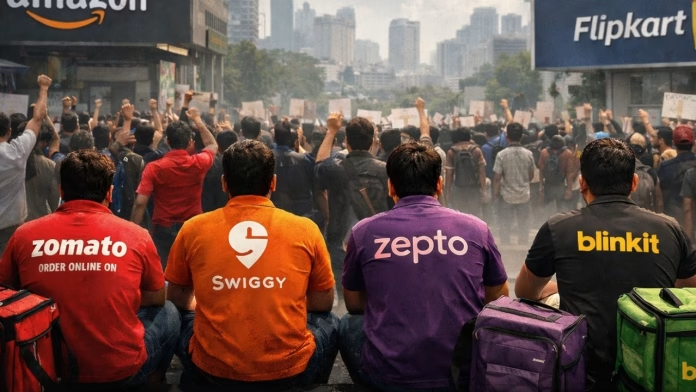
Behind the Festive Rush: Delivery Platforms Face Rising Fraud as 5 Lakh Zomato and 2.4 Lakh Blinkit Riders Hit the Streets

0

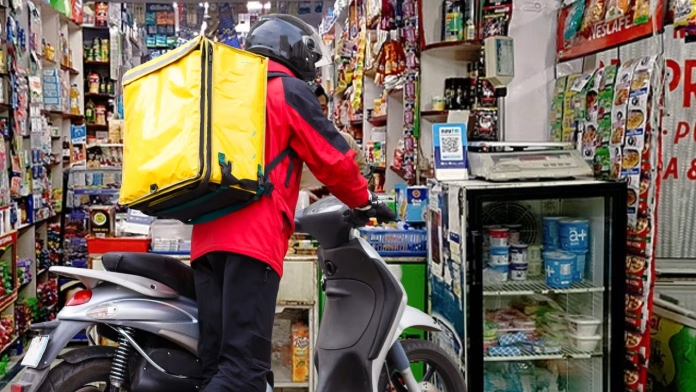
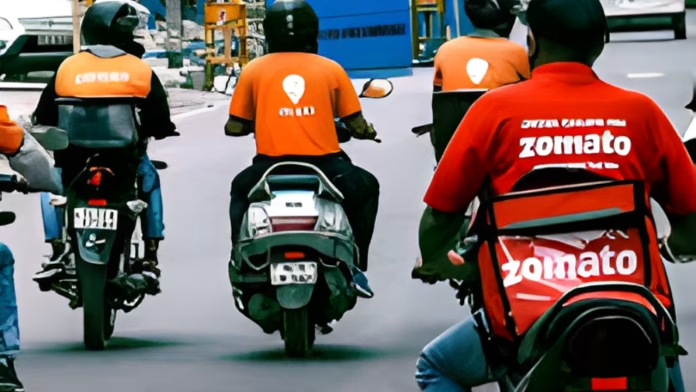
India’s festive season hiring blitz is revealing a troubling undercurrent. While quick-commerce and e-commerce platforms are ramping up gig workforce recruitment by 20-25% compared to last year, incidents of fudged documents, fake addresses, and flawed background verification are on the rise, industry executives said.

Identity verification firm IDfy estimates that nearly 10,000 rider profiles have been blocked so far this season for discrepancies ranging from forged IDs to mismatched addresses. This compares with about 30,000 blocked profiles during last year’s festive surge. “Most of the lapses are related to identity and address proofs,” said Pratik Agarwal, head of IDfy.

With quick-commerce giants Blinkit and Zomato each managing vast fleets—5.09 lakh and 2.4 lakh delivery partners, respectively, as of Q1 FY26—platforms are now doubling down on checks. “Impersonation is treated as identity theft and leads to permanent termination, along with strict action under our code of conduct,” a spokesperson for Eternal, which oversees verification for both firms, said.

Yet, lapses often surface only after incidents. “Weaknesses in ID checks frequently come to light after a fraud, compliance violation, or customer safety issue,” said Aditya Mishra, chief executive of staffing services firm CIEL HR. “Such gaps, if unchecked, carry reputational and regulatory risks.”

Logistics startups are also tightening their processes. Angad Singh of Zippee said his company has instituted criminal record checks, address verification, and blacklist mechanisms. “Rare misrepresentations lead to immediate termination, and offenders are permanently barred,” he added.

Platforms are responding with continuous monitoring, including regular selfie checks to ensure rider identity matches, executives said. Analysts warn that with quick-commerce hiring expected to peak further during Diwali, safeguarding customer trust will require deeper investment in technology-driven verification and real-time oversight.

Advertisement

ITC Foods Bets on Fresh Packaged Play: Sunfeast Cookies, Aashirvaad Chapatis to Ride ₹3,000-Crore Quick Commerce Wave in FY26

0

ITC Foods is gearing up to expand into fresh packaged foods such as cookies, cakes, and chapatis, in a move designed to tap India’s rapidly growing quick commerce market. The initiative reflects the company’s bid to align with shifting consumer preferences for convenience-led foods with short shelf lives, delivered quickly through hyper-local supply chains.

Hemant Malik, chief executive of ITC’s food division, said the company has extended its flagship Sunfeast and Aashirvaad brands into these categories. “Consumers today are looking for products that combine freshness, quality, and accessibility. The rise of quick commerce has made it possible to reach them faster with foods designed to be consumed within days rather than months,” he told ET.

To deliver on this promise, ITC has built a small-batch production and hyper-local distribution model that enables next-day delivery from oven to doorstep. The system bypasses long-haul logistics and warehouse storage, common hurdles in a country where 75 percent of FMCG sales still flow through local kirana stores.

Industry analysts, however, warn that scaling such a model will require more than quick commerce. Devangshu Dutta, founder of retail advisory Third Eyesight, said products with limited shelf lives “must move fast,” making inventory management on quick commerce platforms a challenge. He added that ITC will eventually need to extend these products into modern and general trade to achieve scale.

For ITC, the push into fresh packaged foods comes on the back of steady growth in its food business, which reported gross sales of ₹18,270 crore in FY25, up 6 percent year-on-year. The company joins peers like Hindustan Unilever, Marico, Adani Wilmar, and Parle, all of whom are creating dedicated portfolios for the fast-moving quick commerce channel, now dominated by Blinkit, Swiggy Instamart, and Zepto.

Advertisement

Boat Signs Hip-Hop Sensation KR$NA as Brand Ambassador, Tapping His 116M+ Streams to Power Youth Campaigns

0

Boat, one of India’s largest audio wearables companies, has announced hip-hop artist KR$NA as its newest brand ambassador, strengthening its push to align with the country’s youth-driven music and cultural movements.

The homegrown consumer electronics brand, which leads India’s hearables market with products such as earbuds, headphones, and smartwatches, said the collaboration is designed to blend music, culture and technology while reinforcing its image as a youth-first label.

KR$NA, who has emerged as one of India’s most influential rap voices, has consistently delivered hits that resonate with urban audiences. His songs “YKWIM” (116 million streams), “I Guess” (61 million), and “Joota Japani” (38 million) have made him a mainstay on music charts. Tracks such as “No Cap” and “Never Enough” have further cemented his reputation for storytelling rooted in everyday realities.

Speaking on the partnership, KR$NA said he identifies with Boat’s approach of letting quality speak for itself. “I’ve always kept things limited and let my music do the talking. Boat has the same authenticity. Both of us draw from culture, and this association will connect across every street and corner of the country,” he said.

Boat confirmed that the campaign will not be restricted to product endorsements. It will feature digital-first content, interactive campaigns, and on-ground activations that aim to build communities around music and self-expression. A company spokesperson added that KR$NA’s story of resilience and creativity mirrors the values Boat wants to champion.

Founded in 2016, Boat has built a stronghold in affordable lifestyle electronics and has frequently used music icons and sporting personalities to expand its brand equity. The addition of KR$NA continues this strategy of embedding itself deeper into India’s evolving pop culture fabric.

Advertisement

Gen Z at the Core: Myntra and Vellvette Lifestyle Roll Out Molten Beauty, Eye 40% Share of India’s Online Beauty Spending by 2030

0

Fashion and lifestyle e-tailer Myntra has joined hands with Vellvette Lifestyle Pvt Ltd, the company behind SUGAR Cosmetics, to roll out Molten Beauty, a new brand that blends skincare with makeup and is sharply targeted at Gen Z buyers.

The collaboration, announced on Friday, positions Molten Beauty at the heart of India’s booming beauty and personal care segment, currently valued at over ₹1.2 lakh crore and growing at a double-digit rate. The brand aims to roll out more than 50 products in its first year, spanning categories such as hybrid foundations, serums with tint, skin-friendly lip oils and lightweight blush balms.

Myntra, which counts 25 million Gen Z users on its platform, said the tie-up reflects a growing appetite among younger shoppers for multi-purpose products that prioritize skin health without compromising on style. “Today’s consumers, particularly Gen Z, are looking for beauty that works as hard as they do. Molten Beauty’s skin-first philosophy is designed to meet that demand,” said Nandita Sinha, CEO of Myntra.

The new label will be retailed exclusively on Myntra’s marketplace, its own brand website, and Myntra’s M-Now quick delivery service, ensuring faster access in top urban markets. Analysts note that quick commerce has become a critical lever in beauty sales, especially for impulse-driven categories such as lip and eye products.

For Vellvette Lifestyle, which has built SUGAR into a ₹500-crore-plus brand, Molten Beauty marks a diversification into the next wave of beauty consumption. Industry watchers say the launch could help the company tap a consumer base younger than SUGAR’s millennial-heavy audience.

With Gen Z expected to account for nearly 40% of India’s online beauty spending by 2030, the partnership signals an aggressive play to capture share early in a fast-evolving market.

Advertisement

Balaji Wafers in ₹40,000-Crore Snack Race: ITC, PepsiCo, TPG, Temasek Compete for 10% Stake as Profits Jump 41% in FY24

0

Regional FMCG companies are shaking up India’s consumer goods market, forcing legacy giants to rethink strategy. One of the biggest names at the center of this shift is Rajkot-based Balaji Wafers, which has attracted fresh takeover interest from ITC, PepsiCo and global private equity firms including TPG and Temasek. According to people familiar with the matter, discussions are underway for a 10 percent stake that could value Balaji at nearly Rs 40,000 crore.

Founded in 1982 by Chandubhai Virani and his brothers Bhikubhai and Kanubhai, Balaji has grown from a small theatre snack supplier to a regional powerhouse. The company operates four factories, keeps advertising spends negligible and competes by pricing products 20–30 percent lower than national rivals. Its strategy has paid off. Annual revenue crossed Rs 5,453.7 crore in FY24, up 11 percent from the previous year, while profit after tax jumped 41 percent to Rs 578.8 crore.

This is not PepsiCo’s first attempt to enter Balaji. In 2013, then-CEO Indra Nooyi explored a larger stake, but the Virani family resisted ceding control. Today, global majors see even a minority partnership as a way to tap into Balaji’s stronghold across western and central India and to strengthen supply chain capabilities.

Balaji’s success mirrors a broader trend. From noodles and tea to spices and soft drinks, smaller regional brands are winning consumers by tailoring products to local preferences and undercutting national labels on price. Quick commerce platforms like Blinkit and e-commerce players such as Amazon and BigBasket have accelerated their reach, while investors are pouring money into upcoming brands like Iscon Balaji, Zoff Spices, and Lahori Zeera.

As demand growth slows in metros, regional challengers are becoming the new battleground for India’s FMCG industry.

Advertisement

Restaurant GST Registration in India: Documents, Process, and Compliance Made Simple

0

Running a restaurant in India today isn’t just about food and service — it’s about compliance too. With GST (Goods and Services Tax) streamlining indirect taxation, restaurant owners must understand when and how to register, what tax rates apply, and how non-compliance can dent profits. Whether you own a small café, a family-run dhaba, or a growing cloud kitchen tied to Swiggy and Zomato, GST registration is more than a formality — it’s a business essential.


Who Needs GST Registration for Restaurants?

Not every food outlet is required to register for GST. The rule is simple:

  • Mandatory GST registration if your restaurant’s annual turnover exceeds ₹20 lakh (₹10 lakh in special category states like the North East).
  • Even if turnover is below the threshold, registration is compulsory for restaurants supplying through online aggregators like Zomato, Swiggy, or Uber Eats.
  • Franchise outlets (like Domino’s, KFC, or Subway) typically come under compulsory GST due to their national-scale operations.

👉 Example: A local biryani shop in Hyderabad earning ₹15 lakh a year might avoid GST registration if serving only dine-in customers. But the same shop delivering via Swiggy must register regardless of turnover.


GST Rates for Restaurants

One of the most searched queries is — What GST rate applies to restaurants? Here’s the breakdown:

  • 5% GST (without ITC) → Standalone restaurants (non-AC, AC, or takeaway). Input Tax Credit (ITC) cannot be claimed.
  • 18% GST (with ITC) → Restaurants inside hotels charging room tariff above ₹7,500.
  • 5% GST → Cloud kitchens and online food delivery services.

This means a thali at your neighbourhood mess or a pizza from Domino’s attracts 5% GST, while luxury hotel dining could see higher taxes.


Documents Required for GST Registration

Restaurant owners need to keep these documents ready for GST registration:

  • PAN card of the business owner
  • Aadhaar card
  • Proof of business registration (Partnership deed, ROC certificate, etc.)
  • Address proof of restaurant premises (electricity bill, rent agreement)
  • Bank account details (cancelled cheque or bank statement)
  • Photographs of owners/partners

How to Register for GST Online

The GST registration process is now fully online via the GST portal (www.gst.gov.in). Steps include:

  1. Visit the GST portal and click “New Registration.”
  2. Fill in details (PAN, mobile number, email).
  3. Upload documents and verify via OTP.
  4. Submit application and receive Application Reference Number (ARN).
  5. On approval, GSTIN (GST Identification Number) is issued.

👉 Pro Tip: Many restaurants opt for professional help (CAs, GST practitioners) since errors in initial filing can delay business listings on delivery platforms.


Benefits of GST Registration for Restaurants

While some see GST as red tape, it offers clear benefits:

  • Legitimacy: Customers and delivery apps trust registered businesses.
  • Wider reach: Mandatory for Swiggy/Zomato onboarding.
  • Smooth compliance: Avoid penalties or legal hassles.
  • Business growth: Easier to scale or seek franchise opportunities.

Penalties for Non-Compliance

Avoiding GST when eligible can be costly. Restaurants caught without registration face:

  • 10% penalty of the tax due (minimum ₹10,000).
  • Higher penalties for repeated or intentional evasion.
  • Removal from Swiggy/Zomato platforms, cutting off digital customers.

Conclusion: GST Is the New Normal for Restaurants

In India’s fast-growing F&B industry, GST compliance is no longer optional — it’s the backbone of smooth operations. From Amul parlours in small towns to five-star hotel restaurants in Mumbai, GST rules apply across the board. For small eateries and cloud kitchens, registration not only keeps authorities happy but also opens doors to online food delivery, brand partnerships, and faster growth.

If you’re planning to run a restaurant — big or small — make GST registration your first recipe for success.

Advertisement

GST on Food and Restaurants in India: Why Your Swiggy, Zomato, and Restaurant Bills Look Different

0

When India rolled out the Goods and Services Tax (GST) in 2017, the most immediate question for households and food businesses alike was: How will this affect our daily meals and dining out bills? From grocery staples to weekend dinners at restaurants, GST has reshaped pricing, compliance, and consumer behavior.

GST on Food Items: Essentials vs Processed Foods

One of the biggest distinctions in GST lies between essential food items and processed or packaged foods.

  • 0% GST: Unpackaged essentials like fresh milk, curd, rice, wheat, flour, pulses, fruits, and vegetables. These remain tax-free to protect household budgets.
  • 5% GST: Branded cereals, edible oils, packaged food grains, and frozen vegetables.
  • 12% GST: Butter, cheese, ghee, packaged dry fruits, and frozen meat.
  • 18% GST: Processed foods like chocolates, biscuits, soft drinks, ice cream, and ready-to-eat meals.

This structure ensures daily essentials remain affordable while luxury and processed foods contribute higher tax revenue.

GST on Restaurants: Dining Out Costs Explained

Eating out has also seen a shift under GST. Initially, different tax slabs for AC and non-AC restaurants caused confusion, but reforms have simplified the system.

  • 5% GST (No Input Tax Credit): All standalone restaurants, whether AC or non-AC, levy a flat 5%. However, they cannot claim input tax credit (ITC) on supplies.
  • 18% GST (With Input Tax Credit): Restaurants inside hotels charging ₹7,500 or more per night fall under this category. These can claim ITC.
  • Takeaway & Delivery: Apps like Swiggy and Zomato are also taxed at 5%, keeping parity with dine-in orders.

Impact on Businesses and Consumers

For consumers, GST has simplified billing—no more service tax, VAT, or confusing cess add-ons. A restaurant bill is now easier to understand, though the lack of ITC has pushed some eateries to increase base prices.

For businesses, especially small restaurants and food brands, classification is key. Misapplying GST—say, charging 5% on items that should be taxed at 18%—can invite penalties. Many food entrepreneurs now rely on consultants or billing software to stay compliant.

The Bigger Picture

The GST system for food and restaurants reflects India’s policy balance: shield essentials from price inflation while taxing processed and luxury consumption more heavily. For diners, it explains why milk remains tax-free but an ice cream sundae attracts an 18% levy. For businesses, mastering GST isn’t optional—it’s essential for survival in a competitive, compliance-driven food market.

Bottom Line

GST on food and restaurants has streamlined India’s tax structure, but it has also redefined margins, pricing strategies, and even dining habits. For consumers, awareness helps in making smarter choices. For businesses, compliance is non-negotiable—and getting it right could be the difference between thriving or shutting shop.

Advertisement

GST on Food in India: Why Milk and Rice Are Tax-Free but Chocolates Cost 18% More

0

Since the rollout of the Goods and Services Tax (GST) in India in 2017, few areas have drawn as much discussion as its impact on food. From everyday essentials like rice and milk to dining out at restaurants, GST has reshaped how food businesses operate and how much consumers pay. But the rules aren’t uniform—different categories of food items and restaurant services fall under different slabs.

GST on Food Items: Essentials vs Processed Goods

Not all food items attract GST. In fact, many staples continue to remain tax-free.

  • Exempt (0% GST): Fresh fruits, vegetables, milk, curd, eggs, rice, wheat, flour, and pulses are outside the GST net. This keeps everyday consumption affordable.
  • 5% GST: Branded cereals, packaged food grains, edible oils, and some frozen vegetables fall into this category.
  • 12% GST: Items like butter, cheese, ghee, packaged dry fruits, and frozen meat products.
  • 18% GST: Processed foods, ready-to-eat packaged meals, biscuits, chocolates, soft drinks, and ice cream.

This tiered approach means a packet of branded rice attracts 5% GST, while loose rice from the local kirana is exempt—something many consumers don’t realize.

GST on Restaurants: Dining Out Costs Explained

Restaurants were among the most debated sectors under GST. Initially, a higher rate applied, but it was later rationalized to encourage dining out and boost the industry.

  • 5% GST (No Input Tax Credit): All standalone restaurants, whether air-conditioned or not, charge a flat 5% GST. However, they cannot claim input tax credit (ITC) on raw materials or supplies.
  • 18% GST (With Input Tax Credit): Restaurants located inside hotels with room tariffs above ₹7,500 per night fall under this slab. These outlets can claim ITC.
  • Takeaway and Delivery: Treated at par with dine-in, with 5% GST charged on food orders through delivery apps like Swiggy and Zomato.

This structure has simplified billing for consumers but has also forced restaurants to rethink pricing strategies, especially since ITC benefits are restricted.

Why GST Matters for Food Businesses

For small grocery stores, packaged food sellers, or restaurant owners, understanding GST rates is crucial to price products correctly and stay compliant. Misclassification—say, billing frozen parathas at 5% instead of 18%—can lead to penalties.

The Consumer Perspective

While GST has made dining out more transparent, it has also highlighted the difference between essentials and “luxury” consumption. A thali at a local restaurant attracts 5% GST, while a chocolate bar or a fizzy drink might cost significantly more in tax terms.

The Bottom Line

GST on food items and restaurants reflects India’s balancing act: protecting essentials from inflation while taxing processed and luxury consumption at higher rates. For businesses, clarity in classification and compliance is key. For consumers, it pays to know which items are taxed—and which remain tax-free.

Advertisement

Mars Cosmetics Bets Big on Skincare & Haircare; Rishabh Sethia Targets ₹1,000 Crore in 3 Years with ₹15 Crore Investment, 70 Kiosks and 700+ SKUs

0

Mars Cosmetics, best known for its fast-growing presence in colour cosmetics, is preparing to widen its portfolio into skincare, haircare and wellness, with a revenue target of Rs 1,000 crore within three years.

Rishabh Sethia, director of Mars Cosmetics, confirmed that the company will launch a new skincare-focused brand in the next six months. The brand will debut online, via e-commerce and quick commerce platforms, before expanding into offline retail once it establishes traction. “Our colour cosmetics portfolio has grown strongly, but the opportunity in skincare and haircare is far larger. That is the direction we are heading,” Sethia said.

The company has earmarked Rs 10–15 crore for this expansion, which includes the launch of its new brand and the establishment of an in-house R&D laboratory, expected to go live around the same time. The lab will enable Mars to develop proprietary formulations and strengthen product innovation across categories.

Mars currently offers 650–700 SKUs across eyes, lips, face, nails and accessories. In offline kiosks, its range has grown from 10 SKUs last year to over 40 today, with a target of 70 by year-end. The company plans to increase its kiosk network from 40 to 70 during this fiscal, with an additional investment of Rs 2–2.5 crore.

On the distribution front, Mars reaches 10,000–13,000 general trade outlets every month, with Kerala alone contributing Rs 60–65 lakh in sales monthly. Online and offline channels contribute almost equally, with online accounting for 55 per cent of sales and quick commerce driving 25–30 per cent of that share.

Mars closed FY25 with revenue of Rs 280–300 crore and is projecting Rs 425–440 crore in FY26. The bootstrapped company, which operates at an EBITDA margin of 8–10 per cent, has no plans to raise external capital.

Advertisement

63% Indians Fear Rising Food Bills: PwC Survey Reveals Households Bulk-Buying, Chasing Discounts While 84% Demand Safer, Healthier Options

0

India’s grocery baskets are being reshaped by a mix of rising food costs, health consciousness, and sustainability concerns, according to PwC India’s Voice of the Consumer 2025 survey.

Nearly 63 percent of respondents admitted they are anxious about climbing food bills and are adjusting their shopping behaviour to cope. Bulk buying, hopping between neighbourhood stores, and aggressively seeking discounts have become common strategies for stretching household budgets.

Yet affordability is only part of the story. Food safety remains a dominant priority for 84 percent of consumers, with clean labels, credible certifications and transparent sourcing emerging as key triggers for brand trust. Health is another major influence: almost 30 percent of respondents said they would switch brands if offered a healthier option, even in the face of price pressures.

Technology is also shaping consumption. The survey found that 8 in 10 Indians are now using healthcare apps or wearable devices to track diet and fitness. Many expressed openness to AI-driven personalised nutrition plans, signalling a gradual but significant shift towards tech-enabled wellness.

At the same time, tradition continues to anchor food choices. Nearly 74 percent of consumers said their eating habits are tied to cultural practices and long-standing culinary heritage, reflecting a balance between modern wellness tools and ancestral diets.

Sustainability is steadily gaining ground in decision-making. Close to half of consumers prefer eco-friendly packaging, while 73 percent are willing to pay more if it directly supports healthier land use and farming practices.

PwC India partner Ravi Kapoor said the findings highlight a “dual challenge” for the industry. “Consumers are under pressure from inflation, but they are equally demanding when it comes to nutrition, safety and sustainability. Brands that align with these priorities will be the ones to capture future growth.”

Advertisement